Paper I — Q1
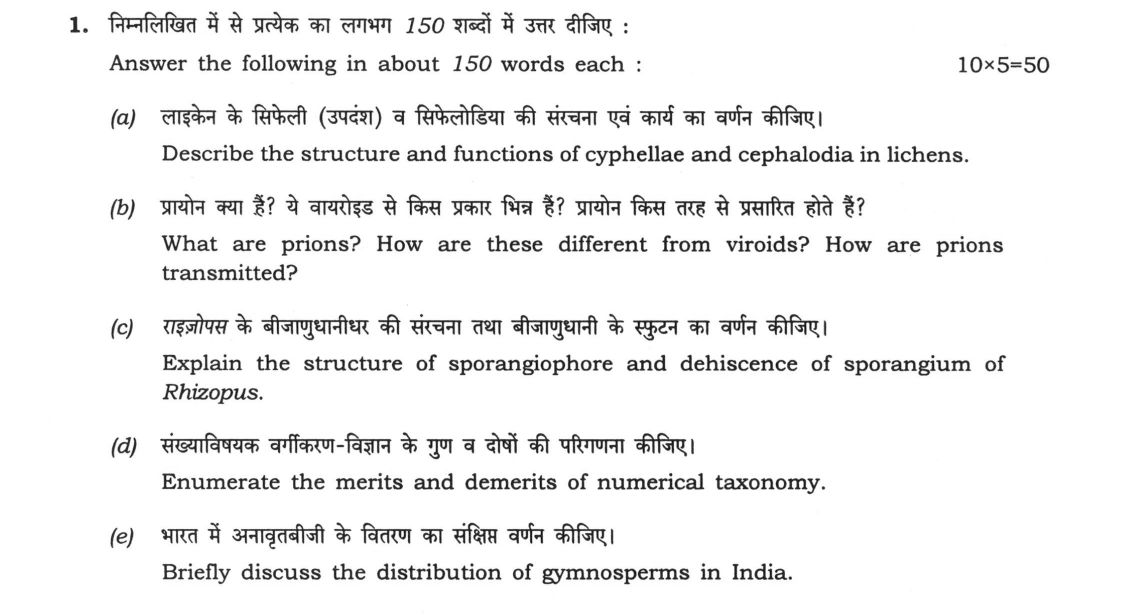
Answer the following in about 150 words each: (a) Describe the structure and functions of cyphellae and cephalodia in…
Answer the following in about 150 words each: Describe the structure and functions of cyphellae and cephalodia in lichens.
What are prions? How are these different from viroids? How are prions transmitted?
Explain the structure of sporangiophore and dehiscence of sporangium of Rhizopus.
Enumerate the merits and demerits of numerical taxonomy.
Briefly discuss the distribution of gymnosperms in India.
हिंदी में प्रश्न पढ़ें
निम्नलिखित में से प्रत्येक का लगभग 150 शब्दों में उत्तर दीजिए : लाइकेन के सिफेली (उपदर्श) व सिफेलोडिया की संरचना एवं कार्य का वर्णन कीजिए।
प्रायोन क्या हैं? ये वायरोइड से किस प्रकार भिन्न हैं? प्रायोन किस तरह से प्रसारित होते हैं?
राइजोपस के बीजाणुधानीधर की संरचना तथा बीजाणुधानी के स्फुटन का वर्णन कीजिए।
संख्याविषयक वर्गीकरण-विज्ञान के गुण व दोषों की परिगणना कीजिए।
भारत में अनावृतबीजी के वितरण का संक्षिप्त वर्णन कीजिए।
Model answer
Written by UPSC Answer Check against this question's marking rubric, to the 150-word length. UPSC does not publish answers for Mains — this is one way to score well, not an official key.
(a) Structure and Functions of Cyphellae and Cephalodia in Lichens
Cyphellae are specialized, well-defined cup-shaped or round depressions present on the lower cortical surface of certain foliose lichens, characteristically in the genus Sticta. Structurally, a cyphella consists of a distinct rim composed of cortical cells, with a central floor where the cortex is interrupted, exposing the loosely arranged, rounded medullary hyphae. Functionally, cyphellae act as aerating organs analogous to the stomata or lenticels of higher plants, facilitating direct gaseous exchange between the atmosphere and the internal fungal-algal medullary layers.
Cephalodia are distinct, gall-like or tuberculate anatomical outgrowths occurring either internally within the medulla or externally on the upper or lower thallus surface of tripartite lichens, such as Peltigera aphthosa and Stereocaulon. They develop when a free-living cyanobacterium (predominantly Nostoc) is entrapped by the mycobiont of a lichen that already possesses a primary green algal photobiont (such as Coccomyxa). Functionally, cephalodia serve as localized nitrogen-fixing compartments. The contained cyanobacteria possess heterocysts that perform biological nitrogen fixation, providing fixed nitrogenous compounds to the entire lichen thallus while the primary chlorophycean photobiont carries out carbon assimilation.
(b) Prions, Their Distinction from Viroids, and Transmission
Prions are anomalous, proteinaceous infectious agents devoid of any detectable nucleic acid genome. They are composed of an aberrantly folded conformational isoform (PrP^Sc) of a normal, host-encoded cellular sialoglycoprotein (PrP^C). The misfolded protein acts as a template, inducing normal PrP^C molecules to undergo structural refolding into the rich β-sheet PrP^Sc state, accumulating as insoluble amyloid plaques that cause neurodegenerative Transmissible Spongiform Encephalopathies (TSEs).
Prions differ fundamentally from viroids across structural and biological domains. Viroids are infectious, low-molecular-weight, naked, circular single-stranded RNA molecules that completely lack a protein coat, and they function primarily as plant pathogens (e.g., Potato spindle tuber viroid). In contrast, prions are strictly protein-only entities encoded by the host genome and pathogenic exclusively to mammals. Furthermore, viroids replicate autonomously via the host's RNA polymerase, whereas prions propagate by post-translational conformational conversion without de novo protein synthesis.
Prions are transmitted through three major routes:
- Ingestion of contaminated animal tissues, as seen in Kuru (ritualistic cannibalism) and variant Creutzfeldt-Jakob Disease (ingestion of Bovine Spongiform Encephalopathy-infected beef).
- Iatrogenic transmission via contaminated neurosurgical instruments, dura mater or corneal grafts, and cadaver-derived human growth hormones.
- Genetic inheritance via germline mutations in the PRNP gene, alongside spontaneous sporadic somatic conversions.
**(c) Sporangiophore Structure and Sporangium Dehiscence in *Rhizopus***
The sporangiophore of Rhizopus is an aerial, erect, unbranched, and aseptate hypha that arises in fascicles or clusters directly from the nodes of the prostrate stolon, directly opposite the subterranean, branched rhizoidal system. At its distal apex, each sporangiophore swells to support a single, terminal, globose sporangium. Internally, the mature sporangium is differentiated into two distinct regions: a sterile, central, dome-shaped central axis termed the columella, which is continuous with the sporangiophore lumen, and a peripheral, fertile peri-columellar zone surrounding the columella, filled with dense cytoplasm containing hundreds of multinucleate, globose to oval, non-motile sporangiospores (aplanospores).
Dehiscence of the sporangium is mediated by atmospheric conditions and the physical properties of the sporangial wall (peridium). At maturity, the thin, fragile peridium becomes encrusted with needle-like crystals of calcium oxalate and turns deliquescent. Under dry conditions, the loss of turgor causes the central columella to shrink, collapse, and invert like an umbrella. The resultant mechanical tension ruptures the brittle, deliquescing outer peridial wall. The peridium breaks away irregularly, leaving only a small basal rim or collar at the junction with the sporangiophore. This exposes the powdery mass of dry sporangiospores directly to the surrounding air, enabling effective wind dissemination.
(d) Merits and Demerits of Numerical Taxonomy
Numerical taxonomy (Taximetrics or Phenetics) classifies biological taxa through the mathematical and statistical evaluation of observable character states, based on Adansonian principles.
Merits:
- Objectivity and repeatability: It minimizes investigator bias and subjective weighting by treating every character with equal initial importance.
- Large data integration: Through computer-assisted algorithms and cluster analysis, it effortlessly integrates massive datasets spanning morphology, anatomy, palynology, embryology, and phytochemistry.
- Phenetic precision: It provides a clear, quantitative index of overall phenetic similarity and character correlation among Operational Taxonomic Units (OTUs), clearly represented in phenograms.
- Predictive value: Reclassification based on high character counts enhances the predictive value of taxonomic groupings.
Demerits:
- Equal weighting fallacy: Assigning equal weight to all characters is biologically unnatural, as it ignores the differing evolutionary and adaptive values of conservative versus homoplastic traits.
- Neglect of phylogeny: It reflects overall phenetic similarity rather than true evolutionary lineages, often misclassifying taxa due to convergent evolution or parallelisms.
- Subjective OTU selection: The initial selection, delimitation, and qualitative coding of characters and OTUs remain prone to subjective decisions by the systematist.
(e) Distribution of Gymnosperms in India
Gymnosperms in India exhibit a distinct phytogeographical distribution, predominantly concentrated in the temperate, sub-alpine, and alpine regions of the Himalayas, with limited representation in the Peninsular hills and North-Eastern tracts.
The Western Himalayas represent the principal reservoir of coniferous flora. In the sub-montane and lower temperate zones, Pinus roxburghii (Chir pine) forms extensive pure forests. The moist temperate belt is dominated by Cedrus deodara (Deodar), Pinus wallichiana (Blue pine), and Picea smithiana (Spruce). Higher temperate to sub-alpine zones support Abies pindrow (Silver fir) and Taxus wallichiana, while alpine tracts harbor scrub formations of Juniperus communis and Ephedra gerardiana.
The Eastern Himalayas, marked by higher precipitation and humidity, support taxa such as Abies spectabilis, Larix griffithii (the only deciduous Indian conifer), Tsuga dumosa, and Picea spinulosa. The subtropical wet forests of the North-Eastern Hills (Khasi, Jaintia, and Naga Hills) are the primary natural habitat of the order Gnetales, represented by Gnetum montanum and Gnetum gnemon, along with Cephalotaxus griffithii.
Peninsular India possesses relict gymnospermic elements. Podocarpus wallichianus, the only native conifer of southern India, occurs in the Western Ghats (Nilgiri and Anamalai Hills). The cycads show endemic distribution: Cycas circinalis in the Western Ghats and the endangered Cycas beddomei, endemic to the Seshachalam/Tirupati Hills of the Eastern Ghats. Relict taxa such as Ginkgo biloba are maintained ex-situ under cultivation in Himalayan hill stations like Darjeeling and Shimla.
What "Describe" is asking you to do
Give a full, ordered account of the thing named — its parts, stages or mechanism — in the sequence in which it actually exists or occurs. Most describe questions come from the science optionals, where the marks sit in correct technical detail and, where the stem says so, a labelled diagram.
Structure that answers it
One-line identification of the subject → the parts or stages in their real order, each with its defining detail → labelled diagram where the subject is structural → closing line on function or significance
Where marks are lost
Loose general prose where the examiner is ticking named parts, correct terminology and their sequence; and in the General Studies papers, turning to evaluation before the description is finished.
How this answer will be evaluated
Approach
Framework: UPSC Botany Paper 1. (a) describe: define > structure or process in order > labelled diagram > significance | (b) define: precise definition > the distinguishing feature > one example | (c) explain: definition/context > points in order > small example > short close | (d) enumerate: list the items in order > one line each > no commentary | (e) discuss: intro > 3-4 dimensions > example > balanced close Full marks: Precise definitions, accurate diagrams, specific examples, and clear differentiation.
Key points expected
- Cyphellae: pores in upper cortex for gas exchange
- Cephalodia: specialized photobiont colonies (e.g., Nostoc)
- Cephalodia function: nitrogen fixation
- Labelled diagram of lichen thallus showing both
- Prions: misfolded proteins (PrP^Sc), no nucleic acid
- Viroids: naked ssRNA, no protein coat
- Transmission: ingestion, iatrogenic, or genetic
- Disease example (e.g., BSE, CJD)
Evaluation rubric
Each sub-part is marked on its own, against the marks and word limit printed on the paper.
- (a) Define and detail the structure and function of cyphellae and cephalodia. · 150 words
describe— define → structure or process in order → labelled diagram → significance
Must cover
- Cyphellae: pores in upper cortex for gas exchange
- Cephalodia: specialized photobiont colonies (e.g., Nostoc)
- Cephalodia function: nitrogen fixation
- Labelled diagram of lichen thallus showing both
Loses marks
- Unlabelled or missing diagram
- Confusing cephalodia with apothecia
Earns more
- Mention of specific lichen species (e.g., *Lecanora*)
- Distinction between photobiont types in cephalodia
Extra mark
- Reference to specific nitrogen-fixing cyanobacteria
- (b) Define prions, contrast with viroids, and explain transmission. · 150 words
define— precise definition → the distinguishing feature → one example
Must cover
- Prions: misfolded proteins (PrP^Sc), no nucleic acid
- Viroids: naked ssRNA, no protein coat
- Transmission: ingestion, iatrogenic, or genetic
- Disease example (e.g., BSE, CJD)
Loses marks
- Describing prions as having a protein coat
- Confusing prions with viruses
Earns more
- Mention of PrP^C to PrP^Sc conversion mechanism
- Comparison of host range (animals vs plants)
Extra mark
- Reference to specific prion disease outbreak
- (c) Detail the structure of the sporangiophore and sporangium dehiscence in *Rhizopus*. · 150 words
explain— definition/context → points in order → small example → short close
Must cover
- Sporangiophore: unbranched, multinucleate, with columella
- Sporangium: spherical, containing sporangiospores
- Dehiscence: rupture of sporangial wall
- Labelled diagram of *Rhizopus* sporangiophore
Loses marks
- Unlabelled or missing diagram
- Confusing sporangiophore with conidiophore
Earns more
- Mention of apical swelling (vesicle)
- Description of columella structure
Extra mark
- Reference to specific *Rhizopus* species (e.g., *R. stolonifer*)
- (d) List the merits and demerits of numerical taxonomy. · 150 words
enumerate— list the items in order → one line each → no commentary
Must cover
- Merit: objective, quantitative approach
- Merit: use of multivariate statistics (e.g., cluster analysis)
- Demerit: ignores evolutionary relationships
- Demerit: data-dependent, subjective character weighting
Loses marks
- Providing commentary instead of a list
- Confusing numerical taxonomy with molecular phylogenetics
Earns more
- Mention of phenetic vs phylogenetic approach
- Reference to specific software or method (e.g., UPGMA)
Extra mark
- Reference to a specific numerical taxonomy study
- (e) Briefly discuss the distribution of gymnosperms in India. · 150 words
discuss— intro → 3-4 dimensions → example → balanced close
Must cover
- Major families: Pinaceae, Cupressaceae, Taxaceae
- Geographic distribution: Himalayas, Western Ghats
- Specific genera: *Pinus*, *Cedrus*, *Taxus*
- Conservation status or habitat (e.g., high altitude)
Loses marks
- Generalizing without specific genera or regions
- Confusing gymnosperms with angiosperms
Earns more
- Mention of specific species (e.g., *Pinus roxburghii*)
- Reference to specific regions (e.g., Khasi Hills)
Extra mark
- Reference to a specific conservation program or IUCN status
Practice this exact question
Write your answer and it is marked point by point against the model answer above — what you covered, what you missed, what you got wrong.
Evaluate my answer →More from Botany 2021 Paper I
- Q1 Answer the following in about 150 words each: (a) Describe the structure and functions of…
- Q2 (a) Explain conjugation and transformation in bacteria. Write a brief note on their signi…
- Q3 (a) Discuss about the names of causal organisms, symptoms, disease cycle and management o…
- Q4 (a) Explain with the help of schematic diagrams haplontic, diplontic, isomorphic, heterom…