Paper I — Q6
(a) Describe the development of female gametophyte in angiosperms with the help of suitable illustrations. (20 marks) (b) Give…
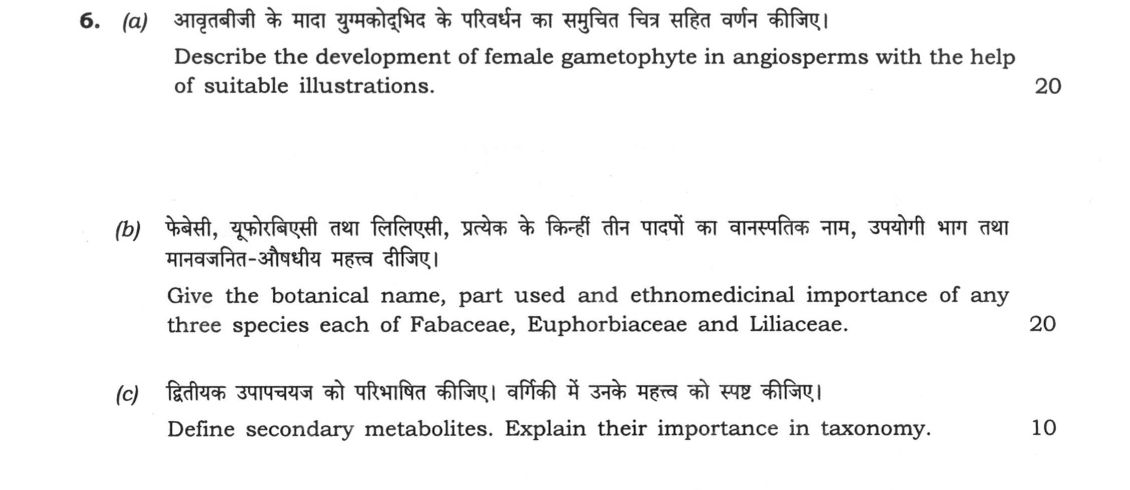
Describe the development of female gametophyte in angiosperms with the help of suitable illustrations. 20 marks
Give the botanical name, part used and ethnomedicinal importance of any three species each of Fabaceae, Euphorbiaceae and Liliaceae. 20 marks
Define secondary metabolites. Explain their importance in taxonomy. 10 marks
हिंदी में प्रश्न पढ़ें
आवृत्तबीजी के मादा युग्मकोद्भिद के परिवर्धन का संयुक्त चित्र सहित वर्णन कीजिए। (20 अंक)
फेबेसी, युफोर्बिएसी तथा लिलिएसी, प्रत्येक के किन्हीं तीन पादपों का वानस्पतिक नाम, उपयोगी भाग तथा मानवजनित-औषधीय महत्व दीजिए। (20 अंक)
द्वितीयक उपापचयज को परिभाषित कीजिए। वर्गीकी में उनके महत्व को स्पष्ट कीजिए। (10 अंक)
Model answer
Written by UPSC Answer Check against this question's marking rubric, to the expected length. UPSC does not publish answers for Mains — this is one way to score well, not an official key.
Development of Female Gametophyte
In angiosperms, the monosporic *Polygonum*-type development represents the most common pathway of female gametophyte (embryo sac) formation. The process comprises two distinct phases: megasporogenesis and megagametogenesis.
During megasporogenesis, a hypodermal archesporial cell in the ovule's nucellus differentiates into a diploid megaspore mother cell (MMC). The MMC undergoes meiosis, producing a linear tetrad of four unilocular haploid megaspores. Typically, the three micropylar megaspores degenerate, while the chalazal megaspore remains functional and enlarges.
During megagametogenesis, the functional megaspore undergoes three successive mitotic nuclear divisions without immediate cytokinesis. The first division forms a 2-nucleate stage, where nuclei migrate to opposite poles. The second and third divisions produce four nuclei at the micropylar end and four at the chalazal end (8-nucleate stage).
Cytokinesis then reorganizes the nuclei into a 7-celled, 8-nucleate structure:
- Micropylar end: An egg apparatus consisting of two synergids characterized by filiform apparatus (guiding pollen tube entry) and one central egg cell (female gamete).
- Chalazal end: Three antipodal cells involved in nutritional transfer.
- Center: A large central cell containing two polar nuclei, which typically fuse prior to fertilization to form a diploid secondary nucleus.
Schematic of Development: MMC (2n) → Meiosis → Linear Tetrad of Megaspores (n) → Functional Chalazal Megaspore → 3 Mitotic divisions → 8-Nucleate Coenocyte → Cellularization → Mature Embryo Sac [Egg Apparatus (3 cells) + Central Cell (2 polar nuclei) + Antipodals (3 cells)].
Ethnomedicinal Species of Fabaceae, Euphorbiaceae, and Liliaceae
Fabaceae:
- Glycyrrhiza glabra: Dried roots and stolons are used ethnomedicinally as a demulcent and expectorant for respiratory tract infections, cough, and peptic ulcers.
- Cassia fistula: The pulp of mature pods and bark are utilized as a safe laxative and for treating inflammatory skin diseases.
- Butea monosperma: Dried seeds and gum are employed as potent anthelmintics against intestinal parasites and as an astringent in chronic diarrhea.
Euphorbiaceae:
- Euphorbia hirta: The whole aerial plant is used in decoctions to treat bronchial asthma, cough, and amoebic dysentery.
- Ricinus communis: Fixed oil extracted from seeds serves as a cathartic and purgative, while poultices of leaves relieve rheumatic joint pain and inflammation.
- Phyllanthus niruri: The whole plant is administered widely for jaundice, hepatitis, and urolithiasis due to its hepatoprotective and diuretic actions.
Liliaceae:
- Aloe vera: The mucilaginous parenchyma of leaves is used topically for burns, wound healing, and dermatitis, and orally for gastrointestinal soothing.
- Asparagus racemosus: The tuberous roots are prized as a galactagogue, adaptogen, and restorative tonic in female reproductive disorders.
- Gloriosa superba: Tuberous rhizomes (containing colchicine) are traditionally applied externally in paste form to alleviate acute gout, joint inflammation, and parasitic skin infections.
Secondary Metabolites and Chemotaxonomy
Secondary metabolites are organic compounds synthesized by plants via specialized pathways (e.g., shikimic acid, acetate-mevalonate, and malonate pathways) that are not directly involved in basic growth, development, or reproduction. Unlike ubiquitous primary metabolites, secondary metabolites (such as alkaloids, flavonoids, terpenoids, and glucosinolates) show restricted and specific distribution across plant taxa.
In taxonomy, secondary metabolites serve as valuable chemical characters (chemotaxonomy) to classify taxa, resolve phylogenetic ambiguities, and establish evolutionary lineages:
- Diagnostic markers: Specific classes characterize particular families, such as benzylisoquinoline alkaloids in Papaveraceae and Magnoliaceae, and betalains in Caryophyllales (which replace anthocyanins).
- Resolving affinities: The presence of mustard oil glucosides (glucosinolates) links Brassicaceae, Capparaceae, and Cleomaceae, demonstrating their close phylogenetic affinity.
- Species identification: Cardenolides (cardiac glycosides) in Apocynaceae and sesquiterpene lactones in Asteraceae provide micromorphological clarity at lower taxonomic ranks, confirming that secondary metabolic distribution reflects underlying genomic and enzymatic divergence.
What "Describe" is asking you to do
Give a full, ordered account of the thing named — its parts, stages or mechanism — in the sequence in which it actually exists or occurs. Most describe questions come from the science optionals, where the marks sit in correct technical detail and, where the stem says so, a labelled diagram.
Structure that answers it
One-line identification of the subject → the parts or stages in their real order, each with its defining detail → labelled diagram where the subject is structural → closing line on function or significance
Where marks are lost
Loose general prose where the examiner is ticking named parts, correct terminology and their sequence; and in the General Studies papers, turning to evaluation before the description is finished.
How this answer will be evaluated
Approach
Framework: UPSC Botany Paper 1. (a) describe: define > structure or process in order > labelled diagram > significance | (b) highlight: name the salient points > one line of substance each > close | (c) explain: definition/context > points in order > small example > short close Full marks: Comprehensive, accurate, well-structured with labelled diagrams and specific examples.
Key points expected
- Megaspore mother cell meiosis to tetrad
- Functional megaspore selection and mitosis
- Nuclei migration and cell wall formation
- Mature embryo sac structure (7 cells, 8 nuclei)
- Three distinct species from Fabaceae
- Three distinct species from Euphorbiaceae
- Three distinct species from Liliaceae
- Correct botanical names (italicised binomials)
Evaluation rubric
Each sub-part is marked on its own, against the marks and word limit printed on the paper.
- (a) Stepwise development of female gametophyte in angiosperms with illustrations. 20 marks
describe— define → structure or process in order → labelled diagram → significance
Must cover
- Megaspore mother cell meiosis to tetrad
- Functional megaspore selection and mitosis
- Nuclei migration and cell wall formation
- Mature embryo sac structure (7 cells, 8 nuclei)
Loses marks
- Unlabelled or missing diagrams
- Confusing male and female gametophyte development
- Lack of stepwise sequence in description
Earns more
- Labelled diagram of embryo sac stages
- Distinction between monosporic and polysporic
- Identification of antipodal cells and synergids
- Mention of specific species (e.g., *Lilium*, *Zea mays*)
Extra mark
- Reference to specific biotech application (e.g., parthenocarpy)
- Mention of specific cultivar or recent study
- (b) Botanical name, part used, and ethnomedicinal importance for 3 species each of Fabaceae, Euphorbiaceae, Liliaceae. 20 marks
highlight— name the salient points → one line of substance each → close
Must cover
- Three distinct species from Fabaceae
- Three distinct species from Euphorbiaceae
- Three distinct species from Liliaceae
- Correct botanical names (italicised binomials)
Loses marks
- Using common names instead of botanical names
- Incorrect family classification of species
- Vague or generic ethnomedicinal claims
Earns more
- Specific parts used (root, leaf, bark, etc.)
- Specific ethnomedicinal uses (e.g., anti-inflammatory, antidiabetic)
- Clear tabular or structured format
- Mention of specific traditional practices
Extra mark
- Reference to specific recent pharmacological study
- Mention of specific conservation status of species
- (c) Definition of secondary metabolites and their importance in taxonomy. 10 marks
explain— definition/context → points in order → small example → short close
Must cover
- Precise definition of secondary metabolites
- Distinction from primary metabolites
- Examples of secondary metabolites (alkaloids, terpenoids, etc.)
- Explanation of taxonomic utility (chemotaxonomy)
Loses marks
- Confusing primary and secondary metabolites
- Lack of specific examples
- Vague explanation of taxonomic importance
Earns more
- Specific examples of chemotaxonomic markers
- Mention of specific families or genera
- Reference to specific analytical techniques (HPLC, GC-MS)
- Link to evolutionary relationships
Extra mark
- Reference to specific recent chemotaxonomic study
- Mention of specific database or repository
Practice this exact question
Write your answer and it is marked point by point against the model answer above — what you covered, what you missed, what you got wrong.
Evaluate my answer →More from Botany 2021 Paper I
- Q3 (a) Discuss about the names of causal organisms, symptoms, disease cycle and management o…
- Q4 (a) Explain with the help of schematic diagrams haplontic, diplontic, isomorphic, heterom…
- Q5 Answer the following in about 150 words each: (a) Enumerate different kinds of trichomes…
- Q6 (a) Describe the development of female gametophyte in angiosperms with the help of suitab…
- Q7 (a) Describe the economic botany of fibre and gum yielding plants (five species each). (2…
- Q8 (a) Compare and contrast 'preservation' and 'conservation' of plants. Explain the importa…