Paper I — Q8
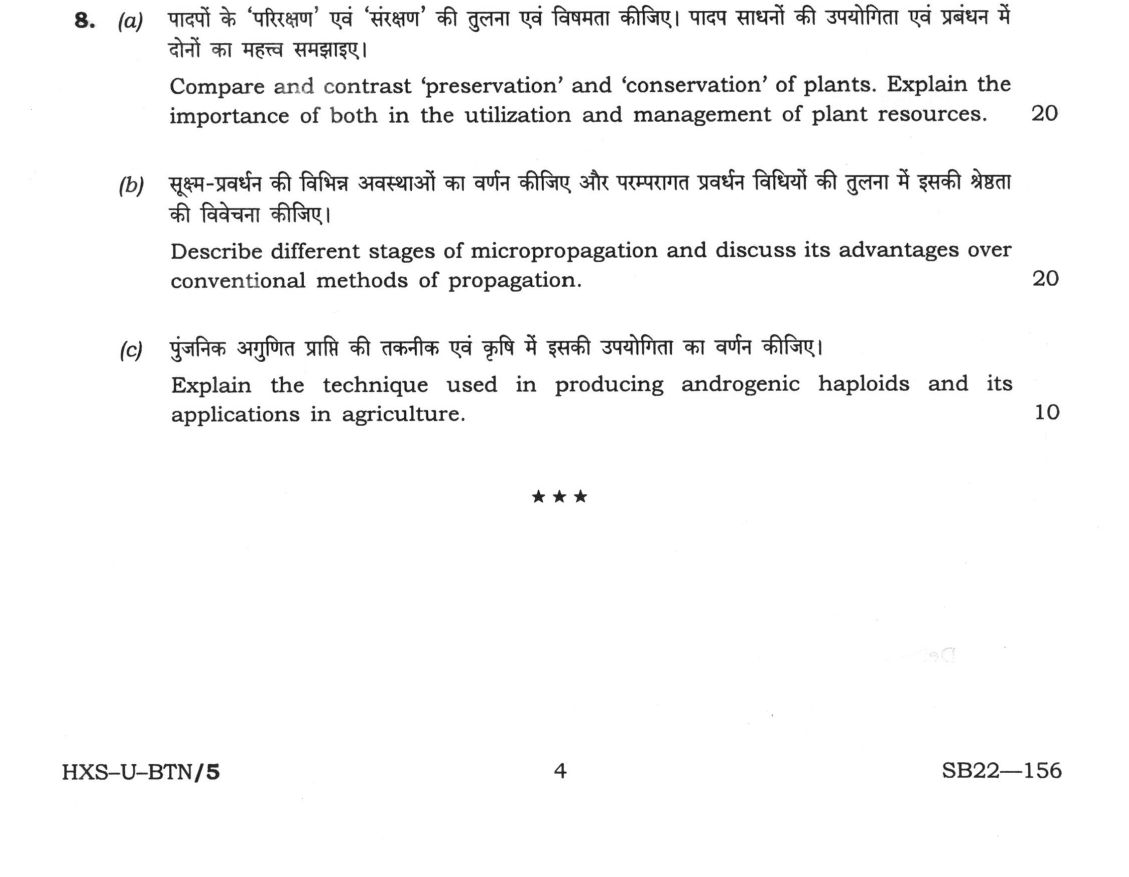
(a) Compare and contrast 'preservation' and 'conservation' of plants. Explain the importance of both in the utilization and…
Compare and contrast 'preservation' and 'conservation' of plants. Explain the importance of both in the utilization and management of plant resources. 20 marks
Describe different stages of micropropagation and discuss its advantages over conventional methods of propagation. 20 marks
Explain the technique used in producing androgenic haploids and its applications in agriculture. 10 marks
हिंदी में प्रश्न पढ़ें
पादपों के 'परिरक्षण' एवं 'संरक्षण' की तुलना एवं विषमता कीजिए। पादप साधनों की उपयोगिता एवं प्रबंधन में दोनों का महत्व समझाइए। (20 अंक)
सूक्ष्म-प्रवर्धन की विभिन्न अवस्थाओं का वर्णन कीजिए और परम्परागत प्रवर्धन विधियों की तुलना में इसकी श्रेष्ठता की विवेचना कीजिए। (20 अंक)
पुंजनिक अगुणित प्राप्ति की तकनीक एवं कृषि में इसकी उपयोगिता का वर्णन कीजिए। (10 अंक)
Model answer
Written by UPSC Answer Check against this question's marking rubric, to the expected length. UPSC does not publish answers for Mains — this is one way to score well, not an official key.
Plant resource management forms the bedrock of global food security and biodiversity maintenance.
Preservation versus Conservation of Plant Resources
Preservation refers to the static maintenance of plant genetic material in an unchanged, non-evolving state. It is primarily executed through ex-situ interventions such as seed gene banks, in vitro repositories, and cryopreservation in liquid nitrogen at -196°C. In contrast, conservation entails the dynamic protection and sustainable management of plant populations within their ecological niches. Conservation is largely in-situ—manifested in National Parks, Biosphere Reserves, and community-managed Sacred Groves—where natural selection and evolutionary processes continue uninterrupted.
In the utilization and management of plant resources, both approaches are complementary. Preservation is vital for halting genetic erosion and safeguarding vulnerable landraces, wild crop relatives, and elite cultivars against catastrophic loss. Institutions like the National Bureau of Plant Genetic Resources (NBPGR) and botanical gardens maintain these static reserves for direct use in hybridization and biotechnology. Conservation sustains ecosystem services, preserves habitat integrity, and allows populations to evolve adaptive traits against emerging climatic stresses and pests. While conservation acts as an evolving reservoir of future genetic variability, preservation secures readily accessible genetic stocks for immediate crop improvement and systematic breeding programs.
Stages and Advantages of Micropropagation
Micropropagation proceeds through five sequential stages:
- Explant Selection and Surface Sterilization: Selection of disease-free, physiologically active mother plants and chemical disinfection of explants (such as apical buds or nodal segments) using sterilants like sodium hypochlorite and mercuric chloride.
- Initiation of Culture: Inoculation of explants onto a sterile basal medium (e.g., Murashige and Skoog medium) to establish aseptic, viable, and growing cultures.
- Shoot Multiplication: Subculturing propagules on media enriched with cytokinins (such as BAP or kinetin) to induce massive axillary branching or adventitious shoot regeneration.
- Rooting of Shoots: Induction of adventitious roots on elongated shoots using auxin-supplemented media (such as IBA or NAA) or half-strength basal formulations.
- Hardening and Acclimatization: Stepwise transfer of rooted plantlets from high humidity in vitro vessels to sterile soil-sand-peat mixtures in shade houses before field transplantation.
Compared to conventional seed or vegetative propagation, micropropagation provides immense multiplication rates within minimal space, year-round production independent of seasonal constraints, and true-to-type clonal fidelity. Meristem-tip culture within micropropagation uniquely enables the production of virus-free stocks from infected mother plants, while also serving as a rapid propagation tool for rare and endangered taxa.
Androgenic Haploids and Agricultural Applications
Androgenic haploidy exploits the totipotency of immature pollen grains, redirecting their developmental pathway from gametophytic maturation to sporophytic embryogenesis. The technique begins with anther culture (plating whole, surface-sterilized anthers containing uninucleate microspores on nutrient media) or isolated microspore culture (mechanically releasing microspores to eliminate maternal somatic tissue interference). Cultured microspores are subjected to abiotic stress pretreatments—such as cold shock, heat treatment, or nutrient starvation—which triggers androgenesis, leading to the formation of haploid embryos either directly or via an intermediate callus phase.
The primary agricultural application of androgenic haploidy is the rapid generation of doubled haploids (DHs) through spontaneous or colchicine-induced chromosome doubling. This achieves 100% homozygosity in a single generation, bypassing 6 to 8 generations of selfing in conventional pure-line development. Androgenic haploidy is widely employed at institutes like ICAR-IARI and IRRI for accelerating breeding cycles in rice, wheat, and Brassica. Additionally, haploids instantly expose recessive mutations that would otherwise remain masked in heterozygotes, streamline quantitative trait loci (QTL) mapping, and facilitate the rapid fixation of stable recombinant lines for hybrid parental development.
Integrating in-situ conservation frameworks with ex-situ biotechnological interventions like micropropagation and haploid breeding ensures both the long-term ecological resilience and the targeted genetic enhancement of global plant resources.
What "Compare and contrast" is asking you to do
Both halves, visibly separated, usually because the two are routinely conflated: similarities across the stated dimensions, then differences across those same dimensions. The longer form is an instruction that the differences must not be folded into the similarities.
Structure that answers it
Dimensions fixed → similarities across them → differences across them → why the pair gets confused and what in fact separates it
Where marks are lost
One half done in a page and the other in three lines. Marks are allotted to each half separately, so the weaker half is lost however strong the other is.
How this answer will be evaluated
Approach
(a) compare: paired headings or table > key differences > significance > conclusion | (b) describe: define > structure or process in order > labelled diagram > significance | (c) explain: definition/context > points in order > small example > short close Full marks: Precise definitions, clear distinction between terms, detailed stepwise processes, and specific examples of species or applications.
Key points expected
- Define preservation (in-situ/ex-situ) vs conservation (sustainable use)
- Contrast objectives: static protection vs dynamic management
- Explain importance in utilization of plant resources
- Explain importance in management of plant resources
- Define micropropagation (tissue culture)
- Describe stages: Selection, Initiation, Multiplication, Rooting, Hardening
- List advantages: rapid multiplication, disease-free plants
- Compare specifically with conventional methods (seeds/cuttings)
Evaluation rubric
Each sub-part is marked on its own, against the marks and word limit printed on the paper.
- (a) Distinguish preservation from conservation and explain their roles in plant resource management. 20 marks
compare— paired headings or table → key differences → significance → conclusion
Must cover
- Define preservation (in-situ/ex-situ) vs conservation (sustainable use)
- Contrast objectives: static protection vs dynamic management
- Explain importance in utilization of plant resources
- Explain importance in management of plant resources
Loses marks
- Treating terms as synonyms without distinction
- Ignoring the 'utilization' aspect of the question
Earns more
- Mention specific examples (e.g., gene banks vs agroforestry)
- Reference to IUCN or CBD definitions
- Link to biodiversity hotspots
Extra mark
- Mention specific legislation (e.g., Biological Diversity Act)
- (b) Outline the stages of micropropagation and list its advantages over conventional methods. 20 marks
describe— define → structure or process in order → labelled diagram → significance
Must cover
- Define micropropagation (tissue culture)
- Describe stages: Selection, Initiation, Multiplication, Rooting, Hardening
- List advantages: rapid multiplication, disease-free plants
- Compare specifically with conventional methods (seeds/cuttings)
Loses marks
- Omitting the hardening stage
- Failing to contrast with conventional methods
Earns more
- Mention specific plant growth regulators (auxins/cytokinins)
- Reference to somaclonal variation
- Mention specific crop examples (e.g., banana, potato)
Extra mark
- Mention cryopreservation as a related technique
- (c) Detail the technique for producing androgenic haploids and their agricultural uses. 10 marks
explain— definition/context → points in order → small example → short close
Must cover
- Define androgenic haploids (pollen-derived)
- Explain technique: Anther/pollen culture (in vitro)
- Mention chromosome doubling (colchicine) for homozygous diploids
- Explain application: rapid development of pure lines
Loses marks
- Confusing androgenic with gynogenic haploids
- Failing to mention chromosome doubling
Earns more
- Mention specific species (e.g., *Oryza sativa*, *Triticum aestivum*)
- Reference to 'double haploids' (DH)
Extra mark
- Mention specific cultivars or recent biotech applications
Practice this exact question
Write your answer and it is marked point by point against the model answer above — what you covered, what you missed, what you got wrong.
Evaluate my answer →More from Botany 2021 Paper I
- Q5 Answer the following in about 150 words each: (a) Enumerate different kinds of trichomes…
- Q6 (a) Describe the development of female gametophyte in angiosperms with the help of suitab…
- Q7 (a) Describe the economic botany of fibre and gum yielding plants (five species each). (2…
- Q8 (a) Compare and contrast 'preservation' and 'conservation' of plants. Explain the importa…