Paper I — Q2
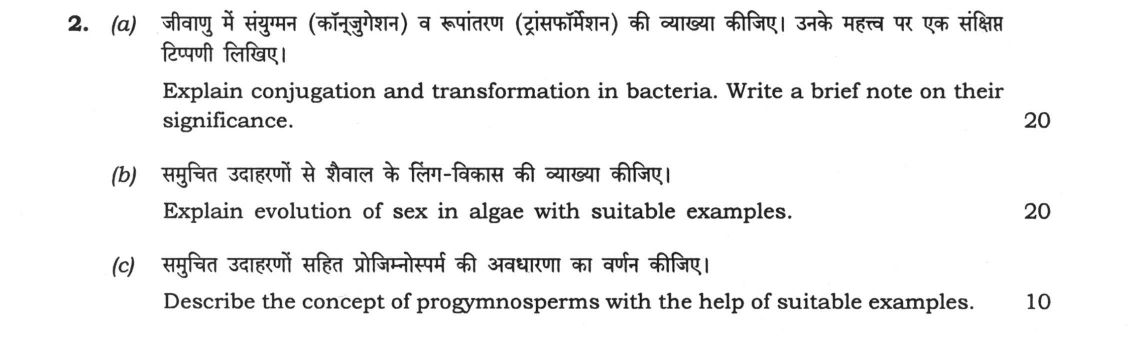
(a) Explain conjugation and transformation in bacteria. Write a brief note on their significance. (20 marks) (b) Explain…
Explain conjugation and transformation in bacteria. Write a brief note on their significance. 20 marks
Explain evolution of sex in algae with suitable examples. 20 marks
Describe the concept of progymnosperms with the help of suitable examples. 10 marks
हिंदी में प्रश्न पढ़ें
जीवाणु में संयुग्मन (कांजुगेशन) व रूपांतरण (ट्रांसफॉर्मेशन) की व्याख्या कीजिए। उनके महत्व पर एक संक्षिप्त टिप्पणी लिखिए। (20 अंक)
समुचित उदाहरणों से शैवाल के लिंग-विकास की व्याख्या कीजिए। (20 अंक)
समुचित उदाहरणों सहित प्रोजिम्नोस्पर्म की अवधारणा का वर्णन कीजिए। (10 अंक)
Model answer
Written by UPSC Answer Check against this question's marking rubric, to the expected length. UPSC does not publish answers for Mains — this is one way to score well, not an official key.
Genetic Diversity and Evolutionary Transitions
(a) Bacterial Genetic Exchange Bacteria, being prokaryotes, lack true sexual reproduction but achieve genetic recombination through horizontal gene transfer. Conjugation is the direct transfer of DNA between two bacterial cells via a cytoplasmic bridge. In the classic F+ × F− mating, the F+ donor cell possesses an F-plasmid encoding the formation of a sex pilus. This pilus retracts, pulling the F− recipient close to form a mating pair. The F-plasmid undergoes rolling circle replication; one strand is nicked and transferred 5' to 3' into the recipient, where it is complementary. The donor retains the plasmid, and the recipient synthesizes the complementary strand, becoming F+. In Hfr (High Frequency of Recombination) strains, the F-plasmid is integrated into the bacterial chromosome. During conjugation, the entire chromosome is transferred in a specific order. The interrupted mating experiment by Jacob and Wollman demonstrated this by shaking cultures to break mating pairs, mapping genes based on the time of entry.
Transformation involves the uptake of naked DNA from the environment by a competent cell. Griffith’s experiment with Streptococcus pneumoniae showed that heat-killed smooth (virulent) strains could transform rough (non-virulent) strains into virulent ones, implying a "transforming principle." Avery, MacLeod, and McCarty later proved this principle was DNA. Significance includes genetic mapping (via Hfr), the spread of antibiotic resistance genes, and the foundation of recombinant DNA technology.
(b) Evolution of Sex in Algae The evolution of sexual reproduction in algae reflects a progression from isogamy to oogamy, driven by selective pressures for efficiency and environmental adaptation.
Isogamy is the simplest form, where gametes are morphologically identical. In Chlamydomonas, two motile, flagellated gametes fuse. This is common in unicellular or simple colonial algae. Anisogamy involves gametes of different sizes but similar morphology. Ectocarpus is a classic example of isogamy, though some brown algae exhibit physiological anisogamy where gametes differ in behavior but not size. True morphological anisogamy, where microgametes are small and motile and macrogametes are large and non-motile, is seen in some species of Fucus (though Fucus is predominantly oogamous, it represents the transitional complexity). The shift to Oogamy represents the culmination of this evolution. Here, the male gamete is a tiny, motile sperm, and the female gamete is a large, non-motile egg. Volvox and Oedogonium are classic oogamous examples. In Oedogonium, the egg is retained in the oogonium, ensuring protection and nutrient supply.
This evolution correlates with life cycles and ecology. Isogamy is often associated with haplontic life cycles, while oogamy frequently aligns with diplontic or heteromorphic cycles. Environmental stress, such as nutrient depletion or temperature changes, often triggers sexual reproduction, ensuring genetic diversity for survival. The transition to oogamy facilitates the evolution of multicellularity, as the large egg provides the resources for early embryo development, a precursor to the seed habit in land plants.
(c) Progymnosperms Progymnosperms are a group of extinct plants that represent a morphological and physiological bridge between pteridophytes and gymnosperms. They possessed the vascular system and secondary growth (wood) characteristic of seed plants but reproduced via spores (pteridophytic reproduction) rather than seeds.
Archaeopteris is the most significant example, flourishing in the Late Devonian. It was the first plant to produce true wood (secondary xylem with vessels and tracheids), enabling the formation of the first forests. Despite its woody stems, it reproduced via megasporangia and microsporangia on separate fronds, similar to ferns. Other examples include Aneurophyton and Protopteridium. Aneurophyton showed heterospory, producing large megaspores and small microspores, a key evolutionary step toward the seed habit.
The evolutionary significance of progymnosperms lies in their role in the colonization of land. Their development of secondary growth provided structural support for taller plants, allowing them to compete for light. Heterospory, seen in Aneurophyton, was a critical innovation; the retention of the megaspore within the megasporangium eventually led to the formation of the seed, protecting the embryo and enabling dormancy. Thus, progymnosperms were instrumental in the transition from spore-based to seed-based reproduction, paving the way for the dominance of gymnosperms in the Carboniferous and Permian periods.
Conclusion From bacterial conjugation to algal oogamy and progymnosperm wood, the evolution of sexual reproduction and complex structures demonstrates nature’s drive for genetic diversity and ecological adaptation. These transitions highlight the continuous interplay between genetic mechanisms and morphological innovation in plant evolution.
What "Explain" is asking you to do
Make the working of something clear — what sets it off, what follows from what, and what it produces. Explain is the Commission's mechanism word: it dominates the technical papers and the “explain why” stems, where the marks sit in the causal chain and not in the label.
Structure that answers it
State what it is → the initiating condition → the chain of cause, step by step → an instance where it plays out → what the chain produces
Where marks are lost
Describing what something looks like instead of why it works that way. Naming the stages without linking them reads as description too.
How this answer will be evaluated
Approach
Framework: Botany Paper 1: Define > Structure/Process > Labelled Diagram > Significance. (a) explain: definition/context > points in order > small example > short close | (b) explain: definition/context > points in order > small example > short close | (c) describe: definition/context > points in order > small example > short close Full marks: Clear mechanisms, labelled diagrams, specific examples, strong significance
Key points expected
- Conjugation: F+ x F-, sex pilus, F plasmid
- Transformation: Naked DNA uptake, competence
- Isogamy: Chlamydomonas
- Anisogamy: Oogonium, Antheridium
- Oogamy: Fucus
- Progymnosperms: Archaeopteris, Protopteris, Peltandra
- Transitional group: Ferns to gymnosperms
Evaluation rubric
Each sub-part is marked on its own, against the marks and word limit printed on the paper.
- (a) Mechanisms of bacterial conjugation and transformation plus their significance. 20 marks
explain— definition/context → points in order → small example → short close
Must cover
- Conjugation: F+ x F- mating, sex pilus, F plasmid transfer
- Transformation: Uptake of naked DNA, competence, recombination
- Labelled diagram of conjugation (pilus) or transformation (uptake)
- Significance: Genetic recombination, biotech applications (e.g., gene transfer)
Loses marks
- Unlabelled diagrams
- Confusing conjugation with transformation mechanisms
- Loose common names instead of binomials
Earns more
- Mention of Hfr strain or F' factor in conjugation
- Mention of Griffith's experiment or Avery's work for transformation
- Distinction between plasmid and chromosomal DNA transfer
Extra mark
- Reference to specific biotech application (e.g., Agrobacterium)
- Mention of specific bacterial species (e.g., E. coli, S. pneumoniae)
- (b) Evolutionary progression of sexual reproduction in algae with examples. 20 marks
explain— definition/context → points in order → small example → short close
Must cover
- Isogamy: Morphologically similar gametes (e.g., Chlamydomonas)
- Anisogamy: Morphologically different gametes (e.g., Oogonium, Antheridium)
- Oogamy: Large non-motile egg, small motile sperm (e.g., Fucus)
- Labelled diagram of gamete types or life cycle
Loses marks
- Unlabelled diagrams
- Confusing isogamy with anisogamy
- Loose common names instead of binomials
Earns more
- Mention of specific algal species (e.g., Chlamydomonas, Fucus, Sargassum)
- Link to alternation of generations
- Mention of environmental factors driving sexual evolution
Extra mark
- Reference to specific evolutionary advantage (e.g., genetic diversity)
- Mention of specific algal class (e.g., Chlorophyceae, Phaeophyceae)
- (c) Concept of progymnosperms with suitable examples. 10 marks
describe— definition/context → points in order → small example → short close
Must cover
- Definition: Vascular plants with woody stems but no true seeds
- Reproduction: Spore-bearing (like ferns) but with gymnosperm-like wood
- Examples: Archaeopteris, Protopteris, Peltandra
- Significance: Transitional group between ferns and gymnosperms
Loses marks
- Confusing progymnosperms with true gymnosperms
- Lack of specific examples
- Loose common names instead of binomials
Earns more
- Mention of specific features (e.g., secondary xylem, no ovules)
- Link to evolutionary transition to seed plants
- Mention of specific geological period (e.g., Carboniferous)
Extra mark
- Reference to specific fossil evidence
- Mention of specific anatomical features (e.g., tracheids, vessels)
Practice this exact question
Write your answer and it is marked point by point against the model answer above — what you covered, what you missed, what you got wrong.
Evaluate my answer →More from Botany 2021 Paper I
- Q1 Answer the following in about 150 words each: (a) Describe the structure and functions of…
- Q2 (a) Explain conjugation and transformation in bacteria. Write a brief note on their signi…
- Q3 (a) Discuss about the names of causal organisms, symptoms, disease cycle and management o…
- Q4 (a) Explain with the help of schematic diagrams haplontic, diplontic, isomorphic, heterom…
- Q5 Answer the following in about 150 words each: (a) Enumerate different kinds of trichomes…