Paper I — Q3
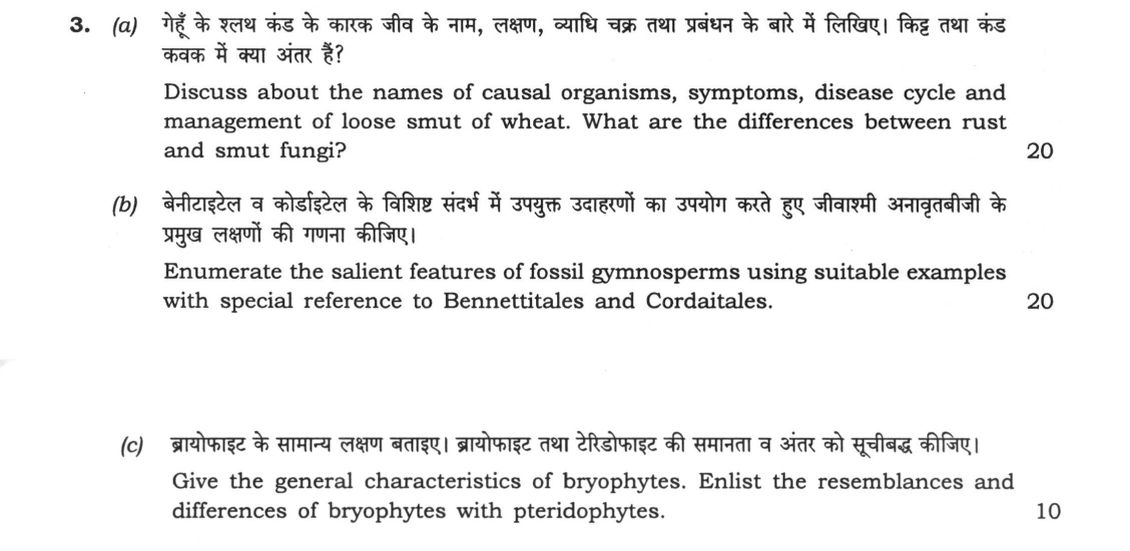
(a) Discuss about the names of causal organisms, symptoms, disease cycle and management of loose smut of wheat. What are the…
Discuss about the names of causal organisms, symptoms, disease cycle and management of loose smut of wheat. What are the differences between rust and smut fungi? 20 marks
Enumerate the salient features of fossil gymnosperms using suitable examples with special reference to Bennettitales and Cordaitales. 20 marks
Give the general characteristics of bryophytes. Enlist the resemblances and differences of bryophytes with pteridophytes. 10 marks
हिंदी में प्रश्न पढ़ें
गेहूं के रलथ कंड के कारक जीव के नाम, लक्षण, व्याधि चक्र तथा प्रबंधन के बारे में लिखिए। किड़ तथा कंड कवक में क्या अंतर हैं? (20 अंक)
बेनरिटाइटेल व कोर्डाइटेल के विशिष्ट संदर्भ में उपयुक्त उदाहरणों का उपयोग करते हुए जीवाश्मी अनावृतबीजी के प्रमुख लक्षणों की गणना कीजिए। (20 अंक)
ब्रायोफाइट के सामान्य लक्षण बताइए। ब्रायोफाइट तथा टेरिडोफाइट की समानता व अंतर को सूचीबद्ध कीजिए। (10 अंक)
Model answer
Written by UPSC Answer Check against this question's marking rubric, to the expected length. UPSC does not publish answers for Mains — this is one way to score well, not an official key.
Plant pathology and paleobotany reveal the intricate interplay between pathogen biology and evolutionary history. This discussion addresses the management of wheat loose smut, the distinction between rust and smut fungi, the fossil record of gymnosperms, and the comparative biology of bryophytes.
Loose Smut of Wheat and Fungal Differentiation Loose smut of wheat is caused by the basidiomycete Ustilago tritici (syn. U. nuda f.sp. tritici). The disease is characterized by the complete replacement of wheat grains with black, powdery teliospores, which are easily detached from the rachis, giving the spike a "loose" appearance. The disease cycle is systemic and seed-borne. Teliospores present in infected seeds germinate upon sowing, producing basidiospores that fuse to form dikaryotic hyphae. These hyphae invade the meristematic tissue of the embryo, growing systemically with the plant without causing external symptoms until flowering. At this stage, the hyphae differentiate into teliospores within the developing spikelets. Management relies on a multi-pronged approach: using certified disease-free seeds, hot water treatment (54°C for 20 minutes) to kill systemic infection, and cultivation of resistant varieties such as HD-2967. In the Indo-Gangetic plains, where wheat is a staple, systemic fungicides are also employed as a supplementary control measure.
Rust and smut fungi, both Basidiomycetes, differ significantly. Rust fungi (Puccinia spp.) are obligate parasites, typically heteroecious (requiring two hosts), and exhibit a complex macrocyclic life cycle with five distinct spore stages (urediniospores, teliospores, basidiospores, aeciospores, and spermogonia). They produce orange-brown pustules. In contrast, smut fungi (Ustilago spp.) are often facultative parasites, autoecious (single host), and possess a simpler life cycle, often lacking aecial and spermogonial stages. They produce dark, sooty masses of teliospores that replace host tissues.
Fossil Gymnosperms: Bennettitales and Cordaitales Fossil gymnosperms dominated the Carboniferous and Permian periods, characterized by heterospory, the origin of the seed habit, and secondary growth. Bennettitales (e.g., Cycadeoidea, Williamsonia) were shrubs or small trees with flower-like strobili. These structures were bisexual, containing synangia (clusters of microsporophylls) and ovules, yet they lacked true flowers and fruits, representing an evolutionary bridge between cycads and angiosperms. Cordaitales (e.g., Cordaites, Mesoxylon) were tall trees with pycnoxylic wood (dense, secondary xylem) and simple, linear leaves. They bore terminal strobili and platyspermic seeds. While Cordaitales were significant in Northern Hemisphere Carboniferous peat formation, it is crucial to note that Indian Gondwana coal seams (Damuda series) are primarily derived from the Glossopteris flora (seed ferns), not Cordaitales.
Bryophytes and Pteridophytes Bryophytes are amphibious, non-vascular plants where the gametophyte is the dominant, independent phase, and the sporophyte is dependent on it. They lack true vascular tissue, roots, and leaves, relying instead on rhizoids for anchorage. They exhibit heteromorphic alternation of generations.
Resemblances with pteridophytes include being chlorophyllous, autotrophic, and possessing heteromorphic alternation of generations with jacketed antheridia and archegonia containing neck canal cells. However, key differences exist: pteridophytes possess true vascular tissue (xylem and phloem), an independent sporophyte, true roots, leaves, and stomata, whereas bryophytes lack these features.
Conclusion The progression from bryophytes to pteridophytes illustrates the critical adaptation to terrestrial life through vascularization. Fossil gymnosperms like Bennettitales and Cordaitales serve as evolutionary bridges, demonstrating the transition from spore-based reproduction to the seed habit, ultimately paving the way for angiosperm dominance. Understanding these historical and pathological dynamics is essential for both agricultural sustainability in India and comprehending plant evolutionary history.
What "Discuss" is asking you to do
Lay the issue out from more than one side — how it arose, what is claimed for it, what is held against it, and where it now stands. UPSC attaches discuss to broad topics with several live dimensions, so coverage of the dimensions earns more than the strength of your opinion.
Structure that answers it
Set the issue up → the case as it is made → the case against → the dimension both sides leave out → where the balance now lies
Where marks are lost
Listing facts with no thread between them, or arguing one side throughout and calling it a discussion.
How this answer will be evaluated
Approach
Framework: UPSC Botany Paper 1. (a) discuss: intro > 3-4 dimensions > example > balanced close | (b) enumerate: list the items in order > one line each > no commentary | (c) describe: define > structure or process in order > labelled diagram > significance Full marks: Comprehensive, accurate, with labelled diagrams and specific examples.
Key points expected
- Causal organism name (Ustilago tritici) and symptoms
- Disease cycle and management of loose smut
- Differences between rust and smut fungi
- Labelled diagram of loose smut or cycle
- Features of Bennettitales (e.g., Bennettia)
- Features of Cordaitales (e.g., Cordaites)
- General features of fossil gymnosperms
- Suitable examples for each order
Evaluation rubric
Each sub-part is marked on its own, against the marks and word limit printed on the paper.
- (a) Detailed account of loose smut of wheat and comparison with rust fungi. 20 marks
discuss— intro → 3-4 dimensions → example → balanced close
Must cover
- Causal organism name (Ustilago tritici) and symptoms
- Disease cycle and management of loose smut
- Differences between rust and smut fungi
- Labelled diagram of loose smut or cycle
Loses marks
- Unlabelled diagrams
- Confusing loose smut with covered smut
- Lack of specific fungal names
Earns more
- Specific management practices (seed treatment)
- Comparison of spore types (teliospores vs uredospores)
- Impact on wheat yield
Extra mark
- Recent biotech application in resistance
- Specific cultivar names
- (b) Salient features of fossil gymnosperms with focus on Bennettitales and Cordaitales. 20 marks
enumerate— list the items in order → one line each → no commentary
Must cover
- Features of Bennettitales (e.g., Bennettia)
- Features of Cordaitales (e.g., Cordaites)
- General features of fossil gymnosperms
- Suitable examples for each order
Loses marks
- Vague generalities without specific examples
- Confusing Bennettitales with angiosperms
- Missing specific reference to the two orders
Earns more
- Reproductive structures (strobili) details
- Leaf morphology of Cordaites
- Fossil significance in evolution
Extra mark
- Specific fossil locality or age
- Comparison with modern gymnosperms
- (c) General characteristics of bryophytes and comparison with pteridophytes. 10 marks
describe— define → structure or process in order → labelled diagram → significance
Must cover
- General characteristics of bryophytes
- Resemblances between bryophytes and pteridophytes
- Differences between bryophytes and pteridophytes
- Labelled diagram of bryophyte structure
Loses marks
- Unlabelled diagrams
- Confusing bryophytes with algae
- Lack of clear comparison points
Earns more
- Specific examples (e.g., Marchantia, Ferns)
- Vascular tissue presence/absence
- Life cycle dominance (gametophyte vs sporophyte)
Extra mark
- Specific ecological role
- Recent research on bryophytes
Practice this exact question
Write your answer and it is marked point by point against the model answer above — what you covered, what you missed, what you got wrong.
Evaluate my answer →More from Botany 2021 Paper I
- Q1 Answer the following in about 150 words each: (a) Describe the structure and functions of…
- Q2 (a) Explain conjugation and transformation in bacteria. Write a brief note on their signi…
- Q3 (a) Discuss about the names of causal organisms, symptoms, disease cycle and management o…
- Q4 (a) Explain with the help of schematic diagrams haplontic, diplontic, isomorphic, heterom…
- Q5 Answer the following in about 150 words each: (a) Enumerate different kinds of trichomes…
- Q6 (a) Describe the development of female gametophyte in angiosperms with the help of suitab…