Paper I — Q7
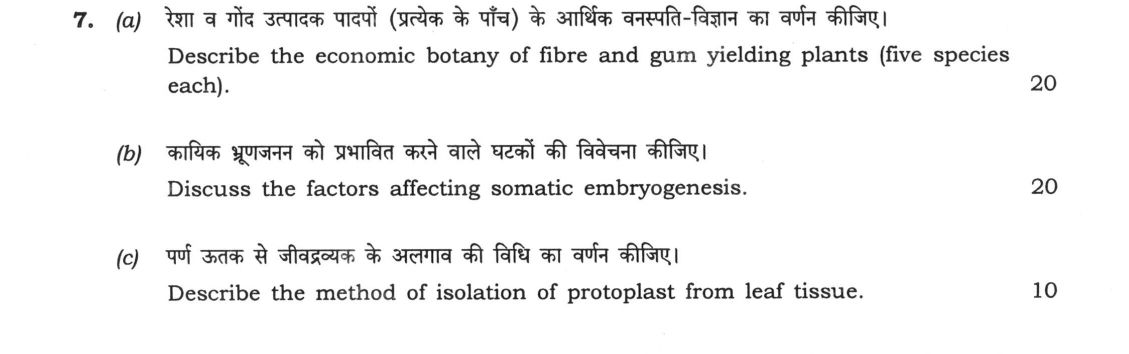
(a) Describe the economic botany of fibre and gum yielding plants (five species each). (20 marks) (b) Discuss the factors…
Describe the economic botany of fibre and gum yielding plants (five species each). 20 marks
Discuss the factors affecting somatic embryogenesis. 20 marks
Describe the method of isolation of protoplast from leaf tissue. 10 marks
हिंदी में प्रश्न पढ़ें
रेशा व गोंद उत्पादक पादपों (प्रत्येक के पाँच) के आर्थिक वनस्पति-विज्ञान का वर्णन कीजिए। (20 अंक)
कायिक भ्रूणजनन को प्रभावित करने वाले घटकों की विवेचना कीजिए। (20 अंक)
पर्ण उत्तक से जीवद्रव्यक के अलगाव की विधि का वर्णन कीजिए। (10 अंक)
Model answer
Written by UPSC Answer Check against this question's marking rubric, to the expected length. UPSC does not publish answers for Mains — this is one way to score well, not an official key.
Economic Botany of Fibre and Gum Plants
Fibre and gum yielding plants constitute vital sectors of economic botany, providing raw materials for textiles, packaging, and industrial applications.
Fibre Yields Five major fibre plants are:
- **Cotton (Gossypium hirsutum):** Source of lint (seed fibre). Extraction involves ginning to separate fibres from seeds. Used in textiles, cottonseed oil, and paper.
- **Jute (Corchorus capsularis):** Bast fibre from the stem. Extraction via retting (water or enzyme) and decortication. Used in sacks, geotextiles, and biodegradable packaging.
- **Flax (Linum usitatissimum):** Bast fibre. Retting and scutching yield linen. Used in high-quality textiles, rope, and paper.
- **Hemp (Cannabis sativa):** Bast fibre. Similar extraction to jute. Used in industrial textiles, rope, and construction materials.
- **Sisal (Agave sisalana):** Leaf fibre. Mechanical decortication of leaves. Used in cordage, mats, and brush bristles.
Gum Yields Five major gum plants are:
- Acacia senegal (Gum Arabic): Exudate from bark. Chemistry: Arabinogalactan. Tapped manually. Used in food emulsifiers, pharmaceuticals, and ink.
- Sterculia urens (Karaya Gum): Exudate from trunk. Chemistry: Galactomannan. Tapped. Used in adhesives, explosives, and food thickener.
- Astragalus gummifer (Tragacanth): Exudate from roots/stems. Chemistry: Rhamnogalacturonan. Harvested from dried exudates. Used in cosmetics, food stabilizer, and oil well drilling.
- Anogeissus latifolia (Ghatti Gum): Exudate from bark. Chemistry: Polysaccharide. Tapped. Used in adhesives, paints, and pharmaceuticals.
- Bauhinia variegata (Gum Karaya source, distinct from Sterculia): Exudate from bark. Chemistry: Polysaccharide. Tapped. Used in adhesives and food industry.
Factors Affecting Somatic Embryogenesis
Somatic embryogenesis (SE) is the in vitro formation of embryos from somatic cells. Key factors include:
Genotypic and Explant Factors Genotype determines embryogenic competence. Explant source (e.g., zygotic embryos, callus, leaf) influences the pathway. Direct SE arises from pre-embryogenic determined cells (PEDCs) without dedifferentiation. Indirect SE involves dedifferentiation into induced embryogenic determined cells (IEDCs) via callus.
Growth Regulators Auxin, particularly 2,4-D, is critical for induction. High 2,4-D promotes IEDC formation in indirect SE. Subsequent reduction or removal of auxin is often sufficient for maturation through globular, heart, torpedo, and cotyledonary stages. Cytokinins (e.g., BAP) can be inhibitory or supportive depending on the system; they are not universally obligatory for stage progression. Abscisic acid (ABA) promotes maturation and desiccation tolerance, distinct from osmotic stress inducers like PEG or high salt/sugar concentrations.
Nutritional and Physical Factors Nitrogen source affects maturation; NH4+ often promotes embryogenic competence, while NO3- supports growth. Physical factors include light (photomorphogenesis), temperature (25°C optimal), and osmotic stress (PEG) which can induce or enhance SE. Biochemical markers like SERK gene expression correlate with competence. Conversion efficiency varies by species, impacting synthetic seed technology.
Isolation of Protoplasts from Leaf Tissue
Protoplast isolation involves enzymatic removal of the cell wall.
Pre-treatment and Enzyme Cocktail Leaf segments are pre-plasmolyzed in high osmoticum (0.4–0.6 M mannitol/sorbitol) to stabilize membranes. The enzyme cocktail typically includes Cellulase Onozuka R-10, Macerozyme R-10, and Driselase (pectinase/hemicellulase).
Incubation and Filtration Tissue is incubated in the enzyme solution at 25°C for 4–16 hours under gentle agitation. The mixture is filtered through nylon mesh (e.g., 100–200 µm) to remove debris.
Purification and Viability Protoplasts are purified by floatation in sucrose gradients or washing. Viability is assessed using FDA staining (fluorescein diacetate), visualized under blue light (~490 nm excitation), or Evans blue exclusion. Yield is calculated based on cell count. Protoplasts are essential for somatic hybridization and genetic transformation.
Conclusion Systematic understanding of fibre/gum extraction, SE factors, and protoplast isolation underpins plant biotechnology applications, from industrial raw material supply to genetic engineering and synthetic seed production.
What "Describe" is asking you to do
Give a full, ordered account of the thing named — its parts, stages or mechanism — in the sequence in which it actually exists or occurs. Most describe questions come from the science optionals, where the marks sit in correct technical detail and, where the stem says so, a labelled diagram.
Structure that answers it
One-line identification of the subject → the parts or stages in their real order, each with its defining detail → labelled diagram where the subject is structural → closing line on function or significance
Where marks are lost
Loose general prose where the examiner is ticking named parts, correct terminology and their sequence; and in the General Studies papers, turning to evaluation before the description is finished.
How this answer will be evaluated
Approach
Framework: UPSC Botany Paper 1. (a) describe: define > structure or process in order > labelled diagram > significance | (b) discuss: intro > 3-4 dimensions > example > balanced close | (c) describe: define > structure or process in order > labelled diagram > significance Full marks: Precise binomials, specific factors, clear method steps, labelled diagrams.
Key points expected
- Five fibre species with italicized binomials
- Five gum species with italicized binomials
- Part yielding fibre or gum for each
- Economic use or industrial application
- Hormonal factors (auxin/cytokinin balance)
- Genetic factors (genotype/embryogenic potential)
- Culture conditions (media, light, temp)
- Physiological factors (age, explant type)
Evaluation rubric
Each sub-part is marked on its own, against the marks and word limit printed on the paper.
- (a) Economic botany of 5 fibre and 5 gum yielding plants. 20 marks
describe— define → structure or process in order → labelled diagram → significance
Must cover
- Five fibre species with italicized binomials
- Five gum species with italicized binomials
- Part yielding fibre or gum for each
- Economic use or industrial application
Loses marks
- Common names without binomials
- Missing species count (less than 5 each)
- No mention of economic use
Earns more
- Specific fibre type (e.g., bast, seed)
- Specific gum type (e.g., exudate, mucilage)
- Mention of specific industrial product
Extra mark
- Recent biotech application of a species
- Specific cultivar name
- (b) Factors affecting somatic embryogenesis. 20 marks
discuss— intro → 3-4 dimensions → example → balanced close
Must cover
- Hormonal factors (auxin/cytokinin balance)
- Genetic factors (genotype/embryogenic potential)
- Culture conditions (media, light, temp)
- Physiological factors (age, explant type)
Loses marks
- Vague generalities without specific factors
- Confusing somatic with zygotic embryogenesis
- No mention of hormonal influence
Earns more
- Mention of specific media (e.g., MS, B5)
- Reference to specific plant model (e.g., *Nicotiana*)
- Mention of osmotic stress or wounding
Extra mark
- Mention of specific gene (e.g., WUS, LEC1)
- Reference to recent biotech application
- (c) Method of isolation of protoplast from leaf tissue. 10 marks
describe— define → structure or process in order → labelled diagram → significance
Must cover
- Enzymatic digestion (cellulase, pectinase)
- Osmotic stabilizer (mannitol/sorbitol)
- Filtration and centrifugation steps
- Viability check (e.g., FDA/SYTOX)
Loses marks
- Missing enzymatic step
- No mention of osmotic stabilizer
- Confusing protoplast with callus
Earns more
- Mention of specific enzyme concentrations
- Mention of incubation time/temperature
- Mention of specific leaf species
Extra mark
- Mention of specific application (e.g., fusion)
- Mention of specific viability stain
Practice this exact question
Write your answer and it is marked point by point against the model answer above — what you covered, what you missed, what you got wrong.
Evaluate my answer →More from Botany 2021 Paper I
- Q4 (a) Explain with the help of schematic diagrams haplontic, diplontic, isomorphic, heterom…
- Q5 Answer the following in about 150 words each: (a) Enumerate different kinds of trichomes…
- Q6 (a) Describe the development of female gametophyte in angiosperms with the help of suitab…
- Q7 (a) Describe the economic botany of fibre and gum yielding plants (five species each). (2…
- Q8 (a) Compare and contrast 'preservation' and 'conservation' of plants. Explain the importa…