Paper I — Q4
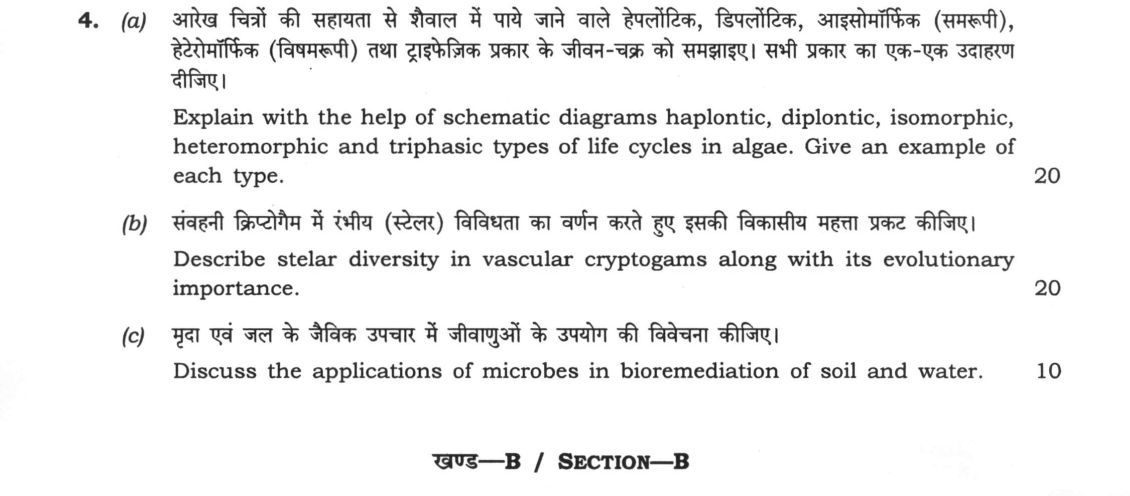
(a) Explain with the help of schematic diagrams haplontic, diplontic, isomorphic, heteromorphic and triphasic types of life…
Explain with the help of schematic diagrams haplontic, diplontic, isomorphic, heteromorphic and triphasic types of life cycles in algae. Give an example of each type. 20 marks
Describe stellar diversity in vascular cryptogams along with its evolutionary importance. 20 marks
Discuss the applications of microbes in bioremediation of soil and water. 10 marks
हिंदी में प्रश्न पढ़ें
आरेख चित्रों की सहायता से शैवाल में पाये जाने वाले हैप्लोटिक, डिप्लोटिक, आइसोमॉर्फिक (समरूपी), हेटेरोमॉर्फिक (विषमरूपी) तथा ट्राइफेजिक प्रकार के जीवन-चक्र को समझाइए। सभी प्रकार का एक-एक उदाहरण दीजिए। (20 अंक)
संवहनी क्रिप्टोगैम में रंभीय (स्टेलर) विविधता का वर्णन करते हुए इसकी विकासीय महत्ता प्रकट कीजिए। (20 अंक)
मृदा एवं जल के जैविक उपचार में जीवाणुओं के उपयोग की विवेचना कीजिए। (10 अंक)
Model answer
Written by UPSC Answer Check against this question's marking rubric, to the expected length. UPSC does not publish answers for Mains — this is one way to score well, not an official key.
Algal Life Cycles
Algal life cycles exhibit diverse strategies for balancing genetic stability and variation, categorized by the dominance of haploid or diploid phases.
Haplontic Cycle: The dominant phase is the haploid gametophyte. The zygote is the only diploid cell, which undergoes meiosis immediately to produce haploid spores. This is seen in Chlamydomonas and Ulothrix. Schematic: Gametophyte (n) → Gametes (n) → Zygote (2n) → Meiosis → Spores (n) → Gametophyte (n).
Diplontic Cycle: The dominant phase is the diploid sporophyte. The gametes are the only haploid cells, formed by meiosis. This pattern is observed in brown algae like Fucus and Sargassum. Schematic: Sporophyte (2n) → Meiosis → Gametes (n) → Zygote (2n) → Sporophyte (2n).
Isomorphic Alternation: Both haploid and diploid phases are morphologically similar but functionally distinct. Ulva and Cladophora exhibit this, where the sporophyte and gametophyte look identical. Schematic: Sporophyte (2n) → Meiosis → Spores (n) → Gametophyte (n) → Gametes (n) → Zygote (2n) → Sporophyte (2n).
Heteromorphic Alternation: The gametophyte and sporophyte are morphologically distinct. In Laminaria, the large sporophyte is dominant, while the gametophyte is a tiny, microscopic structure. Schematic: Large Sporophyte (2n) → Meiosis → Spores (n) → Tiny Gametophyte (n) → Gametes (n) → Zygote (2n) → Large Sporophyte (2n).
Triphasic Cycle: This involves three distinct phases: a haploid gametophyte and two diploid phases (carposporophyte and tetrasporophyte). In Polysiphonia and Batrachospermum, the haploid gametophyte produces gametes. The zygote develops into a diploid carposporophyte, which produces carpospores. These develop into a diploid tetrasporophyte (or Chantransia phase in Batrachospermum), which undergoes meiosis to produce haploid spores that regenerate the gametophyte. Schematic: Gametophyte (n) → Gametes (n) → Zygote (2n) → Carposporophyte (2n) → Carpospores (2n) → Tetrasporophyte (2n) → Meiosis → Spores (n) → Gametophyte (n).
Stellar Diversity in Vascular Cryptogams
The evolution of the stele in pteridophytes reflects increasing complexity in water conduction and mechanical support.
Protostele: The primitive stele, consisting of a solid core of xylem without pith.
- Haplostele: A simple, solid cylinder found in Psilotum.
- Actinostele: Xylem arranged in a star shape, as seen in Selaginella.
- Plectostele: A woven pattern of xylem and phloem strands, characteristic of Equisetum.
Siphonostele: The xylem forms a ring with a central pith. This is a significant evolutionary step allowing for better structural integrity. In Equisetum, the siphonostele is interrupted by leaf gaps, which correlate with the evolution of megaphylls.
Dictyostele: The most advanced type, where the xylem ring is divided into multiple arcs or bundles by leaf gaps. This is found in advanced ferns like Dryopteris.
Polycyclic Steles: In tree ferns, multiple steles may be present, providing enhanced support for large fronds.
Evolutionary Importance: The transition from protostele to siphonostele and dictyostele indicates an adaptation for greater height and efficient long-distance transport. The development of leaf gaps in siphonostele is directly linked to the origin of megaphylls, allowing for increased photosynthetic surface area. This structural evolution enabled vascular cryptogams to dominate terrestrial ecosystems before the rise of gymnosperms.
Microbial Bioremediation
Microbes play a crucial role in cleaning contaminated soil and water through mechanisms like biosorption, bioaccumulation, and biotransformation.
Soil Remediation: Bacteria such as Pseudomonas degrade hydrocarbons in oil spills. Bacillus species can immobilize heavy metals. In India, TERI has successfully used mycoremediation (fungal-based) to treat oil-contaminated soils.
Water Remediation: Algae and bacteria are used to treat eutrophic water bodies. Constructed wetlands utilize microbial mats to filter industrial effluents. The Ganga Action Plan has incorporated microbial consortia to enhance the biological oxygen demand (BOD) reduction in river water.
Conclusion
The diversity in algal life cycles, the structural evolution of pteridophyte steles, and the application of microbes in bioremediation collectively illustrate the adaptive strategies of plants and microorganisms. Understanding these mechanisms is vital for both evolutionary biology and environmental management, particularly in addressing pollution challenges in India.
What "Explain" is asking you to do
Make the working of something clear — what sets it off, what follows from what, and what it produces. Explain is the Commission's mechanism word: it dominates the technical papers and the “explain why” stems, where the marks sit in the causal chain and not in the label.
Structure that answers it
State what it is → the initiating condition → the chain of cause, step by step → an instance where it plays out → what the chain produces
Where marks are lost
Describing what something looks like instead of why it works that way. Naming the stages without linking them reads as description too.
How this answer will be evaluated
Approach
(a) explain: definition/context > points in order > small example > short close | (b) describe: define > structure or process in order > labelled diagram > significance | (c) discuss: intro > 3-4 dimensions > example > balanced close Full marks: Comprehensive, accurate, well-illustrated with clear evolutionary and practical links.
Key points expected
- Haplontic cycle diagram with example (e.g., *Chlamydomonas*)
- Diplontic cycle diagram with example (e.g., *Fucus*)
- Isomorphic alternation of generations diagram (e.g., *Ulva*)
- Heteromorphic alternation of generations diagram (e.g., *Fucus* or *Laminaria*)
- Definition of vascular cryptogams (ferns, lycophytes)
- Description of stelar types (protostele, siphonostele, eustele)
- Evolutionary significance of stelar complexity
- Link to adaptation to terrestrial life
Evaluation rubric
Each sub-part is marked on its own, against the marks and word limit printed on the paper.
- (a) Schematic diagrams of five algal life cycles with examples. 20 marks
explain— definition/context → points in order → small example → short close
Must cover
- Haplontic cycle diagram with example (e.g., *Chlamydomonas*)
- Diplontic cycle diagram with example (e.g., *Fucus*)
- Isomorphic alternation of generations diagram (e.g., *Ulva*)
- Heteromorphic alternation of generations diagram (e.g., *Fucus* or *Laminaria*)
Loses marks
- Unlabelled or missing diagrams
- Confusing isomorphic with heteromorphic
- Missing examples for any cycle type
Earns more
- Triphasic life cycle diagram (e.g., *Polysiphonia*)
- Clear distinction between haploid and diploid phases
- Labelled zygote and spore stages
- Comparison of isomorphic vs heteromorphic phases
Extra mark
- Mention of specific sporophyte/microsporophyte structures
- Reference to specific algal orders
- (b) Stelar diversity in vascular cryptogams and evolutionary importance. 20 marks
describe— define → structure or process in order → labelled diagram → significance
Must cover
- Definition of vascular cryptogams (ferns, lycophytes)
- Description of stelar types (protostele, siphonostele, eustele)
- Evolutionary significance of stelar complexity
- Link to adaptation to terrestrial life
Loses marks
- Confusing vascular cryptogams with seed plants
- Missing evolutionary context
- No diagrams or poor illustrations
Earns more
- Diagram of protostele vs siphonostele
- Mention of specific genera (e.g., *Selaginella*, *Equisetum*)
- Discussion of xylem and phloem arrangement
- Comparison with seed plant steles
Extra mark
- Reference to fossil evidence of stelar evolution
- Mention of specific evolutionary transitions
- (c) Applications of microbes in bioremediation of soil and water. 10 marks
discuss— intro → 3-4 dimensions → example → balanced close
Must cover
- Definition of bioremediation
- Examples of microbes used in soil remediation
- Examples of microbes used in water remediation
- Mechanisms of bioremediation (degradation, uptake)
Loses marks
- Vague or general statements without examples
- Confusing bioremediation with other environmental processes
- No distinction between soil and water applications
Earns more
- Specific microbial species (e.g., *Pseudomonas*, *Bacillus*)
- Types of pollutants (heavy metals, hydrocarbons)
- In-situ vs ex-situ bioremediation
- Advantages and limitations of microbial bioremediation
Extra mark
- Recent biotech applications (e.g., genetically modified microbes)
- Specific case studies of successful bioremediation
Practice this exact question
Write your answer and it is marked point by point against the model answer above — what you covered, what you missed, what you got wrong.
Evaluate my answer →More from Botany 2021 Paper I
- Q1 Answer the following in about 150 words each: (a) Describe the structure and functions of…
- Q2 (a) Explain conjugation and transformation in bacteria. Write a brief note on their signi…
- Q3 (a) Discuss about the names of causal organisms, symptoms, disease cycle and management o…
- Q4 (a) Explain with the help of schematic diagrams haplontic, diplontic, isomorphic, heterom…
- Q5 Answer the following in about 150 words each: (a) Enumerate different kinds of trichomes…
- Q6 (a) Describe the development of female gametophyte in angiosperms with the help of suitab…
- Q7 (a) Describe the economic botany of fibre and gum yielding plants (five species each). (2…