Paper I — Q5
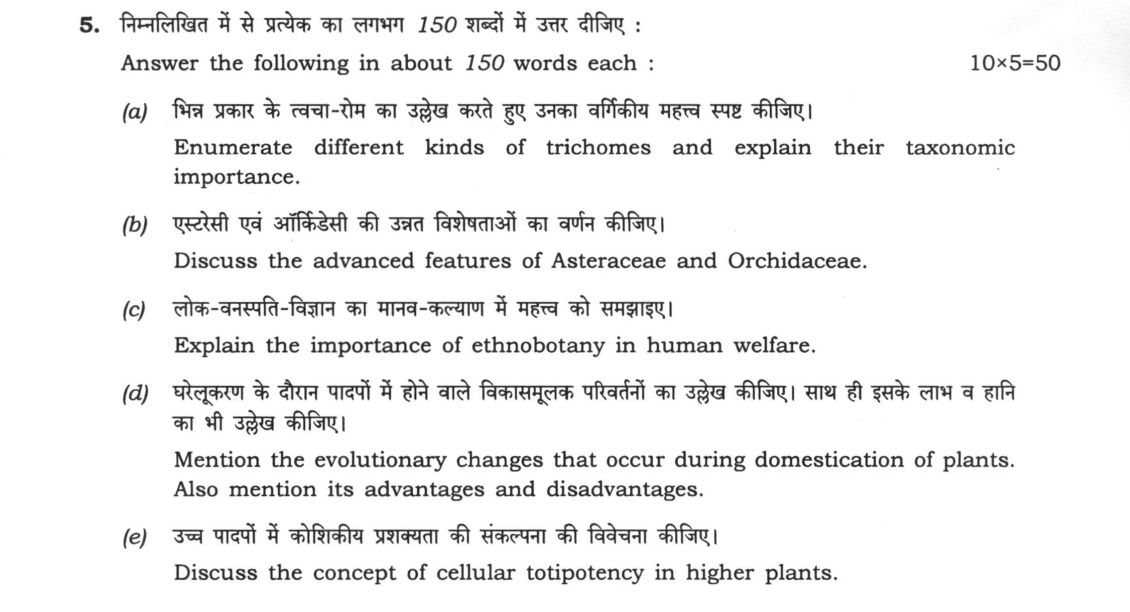
Answer the following in about 150 words each: (a) Enumerate different kinds of trichomes and explain their taxonomic…
Answer the following in about 150 words each: Enumerate different kinds of trichomes and explain their taxonomic importance.
Discuss the advanced features of Asteraceae and Orchidaceae.
Explain the importance of ethnobotany in human welfare.
Mention the evolutionary changes that occur during domestication of plants. Also mention its advantages and disadvantages.
Discuss the concept of cellular totipotency in higher plants.
हिंदी में प्रश्न पढ़ें
निम्नलिखित में से प्रत्येक का लगभग 150 शब्दों में उत्तर दीजिए : भिन्न प्रकार के त्वचा-रोम का उल्लेख करते हुए उनका वर्गीकीय महत्त्व स्पष्ट कीजिए।
एस्टेरेसी एवं ऑर्किडेसी की उन्नत विशेषताओं का वर्णन कीजिए।
लोक-वनस्पति-विज्ञान का मानव-कल्याण में महत्त्व को समझाइए।
घरेलुकरण के दौरान पादपों में होने वाले विकासमूलक परिवर्तनों का उल्लेख कीजिए। साथ ही इसके लाभ व हानि का भी उल्लेख कीजिए।
उच्च पादपों में कोशिकीय प्रशक्यता की संकल्पना की विवेचना कीजिए।
Model answer
Written by UPSC Answer Check against this question's marking rubric, to the 150-word length. UPSC does not publish answers for Mains — this is one way to score well, not an official key.
(a) Kinds of Trichomes and their Taxonomic Importance
Trichomes are epidermal appendages categorized broadly into non-glandular and glandular types. Non-glandular trichomes can be unicellular (simple hairs in Gossypium) or multicellular. Multicellular forms display distinct architectures, such as uniseriate or multiseriate filaments, branched or dendroid forms (Cruciferae), stellate hairs (Malvaceae), T-shaped hairs (Oleaceae, Malpighiaceae), and peltate scales. Glandular trichomes consist of a stalk and a secretory head, exemplified by the capitate and peltate glands of Lamiaceae, stinging hairs of Urticaceae, and digestive glands of insectivorous plants.
Taxonomically, trichome micromorphology provides stable diagnostic criteria across families, genera, and species. The presence of stellate trichomes defines Malvaceae, T-shaped hairs characterize members of Oleaceae, and glandular peltate hairs distinguish Lamiaceae. Trichome density, distribution, and structure help delimit cryptic species, resolve phylogenetic boundaries, and verify herbal drug authentication in pharmacognosy.
(b) Advanced Features of Asteraceae and Orchidaceae
Asteraceae (dicots) and Orchidaceae (monocots) represent the evolutionary zeniths of angiosperms, each showing specialized adaptations for entomophilous pollination and efficient reproduction.
Asteraceae displays a compact capitulum inflorescence that functions as a single pseudanthium, dividing labor between marginal ray florets and central disc florets. Advanced floral features include syngenesious anthers forming a tube around the style for a specialized piston-mechanism of pollen presentation, an inferior unilocular bicarpellary ovary with basal placentation yielding an indehiscent cypsela fruit, and a calyx modified into a persistent pappus optimized for anemochory.
Orchidaceae exhibits extreme floral zygomorphy with resupination (180° floral twisting). The perianth includes a modified median petal termed the labellum, serving as an attractive landing platform. The essential organs are fused into a central gynostemium (column), uniting the stamen, style, and stigma. Pollen grains are aggregated into cohesive masses called pollinia, and a modified sterile stigma (rostellum) prevents self-pollination. Specialized mechanisms, such as pseudocopulation in Ophrys, ensure high-fidelity, species-specific cross-pollination.
(c) Importance of Ethnobotany in Human Welfare
Ethnobotany documents the traditional relationships between indigenous communities and plant diversity, providing vital inputs for modern healthcare, conservation, and sustainable development. It acts as a primary lead for pharmacognosy and modern drug discovery; classic examples include the isolation of reserpine from Rauwolfia serpentina, quinine from Cinchona officinalis, and the revitalization of Trichopus zeylanicus (Jeevani) based on the traditional knowledge of the Kani tribe in India.
Beyond pharmacology, ethnobotany preserves valuable Traditional Ecological Knowledge (TEK) and supports Intellectual Property Rights (IPR) documentation through platforms like India's Traditional Knowledge Digital Library (TKDL) and the Biological Diversity Act, 2002. It aids bioprospecting for climate-resilient crops and nutraceuticals, preserves biodiversity through community-managed sacred groves, and supports sustainable tribal livelihoods through the commercialization of Non-Timber Forest Products (NTFPs).
(d) Evolutionary Changes during Domestication, Advantages, and Disadvantages
Plant domestication is an evolutionary process driven by artificial selection, resulting in a recognizable "domestication syndrome." Key evolutionary transitions include:
- Loss of natural seed dispersal mechanisms (non-shattering rachis in Triticum and indehiscent pods in Fabaceae).
- Loss or significant reduction of seed dormancy, ensuring rapid, uniform germination.
- Organ gigantism, characterized by larger fruits, grains, and vegetative parts.
- Synchronous flowering, maturity, and uniform growth habit.
- Reduction or loss of physical defenses (spines, prickles) and toxic secondary metabolites (tannins, bitter alkaloids).
Advantages: Drastic enhancement of crop yield, harvest index, palatability, processing ease, and nutritional availability, securing the dietary requirements of human populations.
Disadvantages: Severe genetic bottlenecks and genetic erosion, resulting in the loss of ancestral resistance alleles. This narrow genetic base creates monoculture vulnerability to catastrophic pest outbreaks, emergent pathogens, and abiotic stresses, alongside an absolute evolutionary dependence of domesticated plants on human cultivation for survival.
(e) Concept of Cellular Totipotency in Higher Plants
Cellular totipotency is the innate capacity of a differentiated, living plant cell containing a complete genome to revert to an undifferentiated state and regenerate into a whole, fertile plant. Conceptually formulated by Gottlieb Haberlandt in 1902, it was demonstrated experimentally by F.C. Steward in 1958, who reconstituted mature, flowering Daucus carota plants from cultured secondary phloem explants in liquid media containing coconut milk.
The realization of totipotency requires dedifferentiation of specialized somatic cells into an unorganized callus mass, followed by redifferentiation under the influence of regulated auxin-to-cytokinin balances. This developmental reprogramming proceeds through two distinct morphogenetic routes: organogenesis (unipolar initiation of shoot or root meristems) and somatic embryogenesis (bipolar embryo development from vegetative cells).
Totipotency underpins plant tissue culture, enabling high-efficiency clonal micropropagation of endangered and horticulturally superior genotypes, generation of virus-free stocks through meristem tip culture, regeneration of genetically engineered crops, haploid breeding, and long-term ex-situ conservation of germplasm via cryopreservation.
What "Enumerate" is asking you to do
Produce the complete set of items asked for, countable and correctly named. The examiner marks against a checklist, so a missing item costs and an elaborated one gains nothing — where discussion is wanted the stem asks for it as a separate sub-part.
Structure that answers it
One line naming the basis on which the set is drawn → items numbered, each in a phrase or a single line → the discussion sub-part taken up separately, after the list is complete
Where marks are lost
Treating it as an essay. Six items named in six lines score better than three items explained at length.
How this answer will be evaluated
Approach
Framework: UPSC Botany Paper 1. (a) enumerate: list the items in order > one line each > no commentary | (b) discuss: intro > 3-4 dimensions > example > balanced close | (c) explain: definition/context > points in order > small example > short close | (d) enumerate: list the items in order > one line each > no commentary | (e) discuss: intro > 3-4 dimensions > example > balanced close Full marks: Precise, specific, with diagrams and examples.
Key points expected
- Distinguish glandular from non-glandular trichomes
- Classify non-glandular into simple, branched, stellate, T-shaped
- Link specific trichome types to taxonomic families
- Mention function (defense, secretion) as secondary
- Identify Asteraceae advanced features (syngenesy, cypsela)
- Identify Orchidaceae advanced features (resupinate, column)
- Compare floral symmetry (actinomorphic vs zygomorphic)
- Mention fruit types (achene vs capsule)
Evaluation rubric
Each sub-part is marked on its own, against the marks and word limit printed on the paper.
- (a) List trichome types and explain their taxonomic importance. · 150 words
enumerate— list the items in order → one line each → no commentary
Must cover
- Distinguish glandular from non-glandular trichomes
- Classify non-glandular into simple, branched, stellate, T-shaped
- Link specific trichome types to taxonomic families
- Mention function (defense, secretion) as secondary
Loses marks
- Confusing trichomes with stomata
- Listing only functions without types
Earns more
- Labelled diagram of trichome types
- Specific examples (e.g., stellate in *Malvaceae*)
Extra mark
- Mention specific species with unique trichomes
- (b) Discuss advanced features of Asteraceae and Orchidaceae. · 150 words
discuss— intro → 3-4 dimensions → example → balanced close
Must cover
- Identify Asteraceae advanced features (syngenesy, cypsela)
- Identify Orchidaceae advanced features (resupinate, column)
- Compare floral symmetry (actinomorphic vs zygomorphic)
- Mention fruit types (achene vs capsule)
Loses marks
- Confusing Asteraceae with Compositae (synonyms)
- Missing the 'advanced' aspect (e.g., just listing features)
Earns more
- Labelled diagram of composite head or orchid flower
- Mention specific genera (*Helianthus*, *Dendrobium*)
Extra mark
- Mention pollination mechanisms specific to each
- (c) Explain the importance of ethnobotany in human welfare. · 150 words
explain— definition/context → points in order → small example → short close
Must cover
- Define ethnobotany
- List medicinal uses (e.g., *Artemisia*, *Neem*)
- Mention food and fiber uses
- Link to conservation of traditional knowledge
Loses marks
- Vague generalities without specific examples
- Ignoring the 'human welfare' aspect
Earns more
- Specific examples of tribal knowledge
- Mention bioprospecting or biopiracy issues
Extra mark
- Mention specific biotech application from ethnobotany
- (d) Mention evolutionary changes during domestication and its pros/cons. · 150 words
enumerate— list the items in order → one line each → no commentary
Must cover
- List changes (seed size, loss of shattering, growth habit)
- Mention advantages (yield, uniformity)
- Mention disadvantages (genetic erosion, vulnerability)
- Link to specific crops (e.g., *Oryza*, *Triticum*)
Loses marks
- Confusing domestication with evolution
- Missing the 'disadvantages' part
Earns more
- Mention specific domestication centers (e.g., Fertile Crescent)
- Labelled diagram of domestication process
Extra mark
- Mention recent biotech application in domestication
- (e) Discuss the concept of cellular totipotency in higher plants. · 150 words
discuss— intro → 3-4 dimensions → example → balanced close
Must cover
- Define cellular totipotency
- Explain mechanism (dedifferentiation, redifferentiation)
- Mention applications (tissue culture, micropropagation)
- Link to specific examples (e.g., *Tobacco*, *Potato*)
Loses marks
- Confusing totipotency with pluripotency
- Missing the 'higher plants' context
Earns more
- Labelled diagram of tissue culture process
- Mention specific growth regulators (auxin, cytokinin)
Extra mark
- Mention specific biotech application (e.g., somatic hybridization)
Practice this exact question
Write your answer and it is marked point by point against the model answer above — what you covered, what you missed, what you got wrong.
Evaluate my answer →More from Botany 2021 Paper I
- Q2 (a) Explain conjugation and transformation in bacteria. Write a brief note on their signi…
- Q3 (a) Discuss about the names of causal organisms, symptoms, disease cycle and management o…
- Q4 (a) Explain with the help of schematic diagrams haplontic, diplontic, isomorphic, heterom…
- Q5 Answer the following in about 150 words each: (a) Enumerate different kinds of trichomes…
- Q6 (a) Describe the development of female gametophyte in angiosperms with the help of suitab…
- Q7 (a) Describe the economic botany of fibre and gum yielding plants (five species each). (2…
- Q8 (a) Compare and contrast 'preservation' and 'conservation' of plants. Explain the importa…