Paper II — Q1
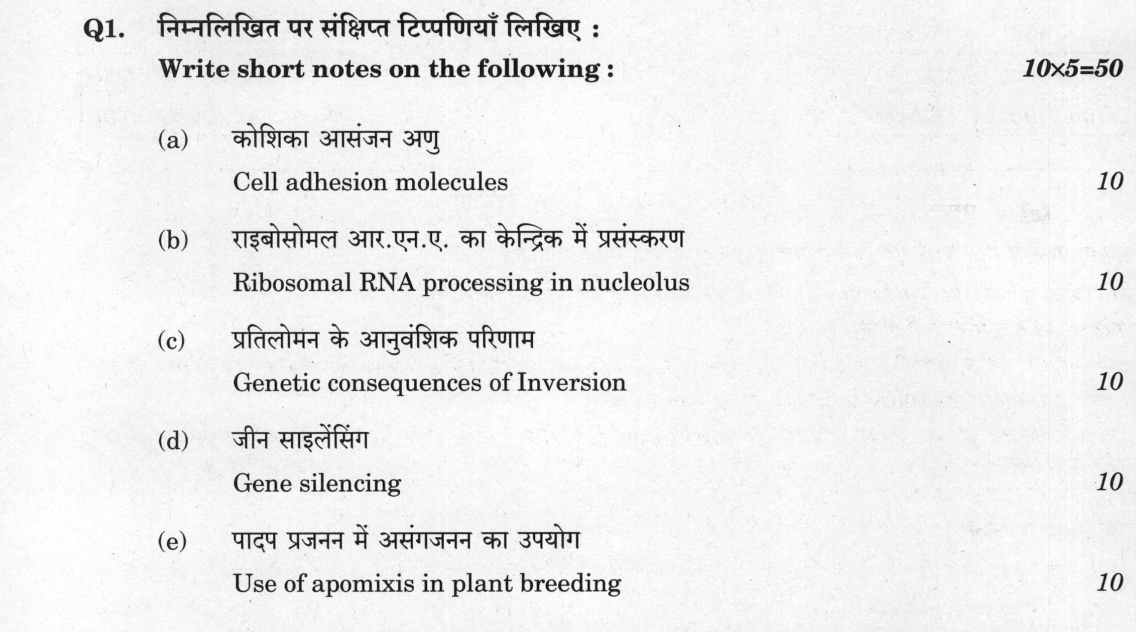
Write short notes on the following : 10×5=50 (a) Cell adhesion molecules 10 (b) Ribosomal RNA processing in nucleolus 10 (c)…
Write short notes on the following : 10×5=50
Cell adhesion molecules 10
Ribosomal RNA processing in nucleolus 10
Genetic consequences of Inversion 10
Gene silencing 10
Use of apomixis in plant breeding 10
हिंदी में प्रश्न पढ़ें
निम्नलिखित पर संक्षिप्त टिप्पणियाँ लिखिए : 10×5=50
कोशिका आसंजन अणु 10
राइबोसोमल आर.एन.ए. का केन्द्रक में प्रसंस्करण 10
प्रतिलोमन के आनुवंशिक परिणाम 10
जीन साइलेंसिंग 10
पादप प्रजनन में असंगजन का उपयोग 10
Model answer
Written by UPSC Answer Check against this question's marking rubric, to the expected length. UPSC does not publish answers for Mains — this is one way to score well, not an official key.
Cell Adhesion Molecules (CAMs)
Cell adhesion molecules are specialized surface proteins that mediate the binding of cells to other cells or to the extracellular matrix (ECM). They are critical for tissue integrity, morphogenesis, and immune surveillance. In animal biology, four major families are recognized: cadherins, which are calcium-dependent mediators of homophilic cell-cell adhesion; integrins, which bridge the cytoskeleton to the ECM via heterophilic interactions; selectins, involved in leukocyte rolling during inflammation; and the immunoglobulin superfamily (IgSF), which includes NCAM and L1. In plants, the concept of CAMs is adapted to the rigid cell wall context. While plants lack mobile membrane-bound CAMs akin to animals, they utilize plasmodesmata-associated proteins and specific wall components to facilitate intercellular communication and adhesion. For instance, plasmodesmata allow cytoplasmic continuity, enabling the transport of signaling molecules and small RNAs, effectively acting as a molecular bridge for tissue coordination. The significance of CAMs lies in their role in developmental patterning; defects in cadherin function, for example, lead to epithelial-mesenchymal transition and metastasis in cancer. In plants, the precise regulation of cell separation and adhesion is vital for organogenesis and vascular development, ensuring that tissues maintain structural coherence while allowing for growth and differentiation.
Ribosomal RNA Processing in Nucleolus
The nucleolus is the site of ribosome biogenesis, organized into three distinct compartments: the Fibrillar Center (FC), the Dense Fibrillar Component (DFC), and the Granular Component (GC). Transcription of the 45S pre-rRNA is initiated by RNA Polymerase I within the FC. This precursor is processed through a series of endonucleolytic and exonucleolytic cleavages to yield the mature rRNAs. In plants and yeast, the 45S pre-rRNA is processed into 18S, 5.8S, and 25S rRNAs, which constitute the small (40S) and large (60S) ribosomal subunits, respectively. It is crucial to note that while animal cells produce 28S rRNA, plant and yeast large subunits utilize 25S rRNA. The processing involves the removal of internal transcribed spacers (ITS1 and ITS2) and external transcribed spacers. Small nucleolar RNAs (snoRNAs), organized into snoRNPs, guide site-specific chemical modifications, including 2'-O-methylation and pseudouridylation, of the rRNA. These modifications are essential for ribosomal stability and function. The assembly of ribosomal proteins with the modified rRNAs occurs progressively in the DFC and GC. The final maturation steps involve the export of the 40S and 60S subunits to the cytoplasm, where they join to form the functional 80S ribosome. This process is tightly coupled with energy availability, as the nucleolus acts as a cellular stress sensor, disassembling during nutrient deprivation to conserve resources.
Genetic Consequences of Inversion
An inversion is a chromosomal rearrangement where a segment of a chromosome is reversed end-to-end. Inversions are classified as paracentric, if they do not include the centromere, or pericentric, if they do. The primary genetic consequence of an inversion heterozygote is the formation of an inversion loop during meiotic prophase I to align homologous sequences. If a crossover occurs within this loop, it leads to the production of unbalanced gametes. In paracentric inversions, crossovers result in dicentric and acentric fragments, leading to gamete inviability due to the breakage-fusion-bridge cycle. In pericentric inversions, crossovers yield duplications and deletions, also resulting in reduced fertility. Consequently, recombination is suppressed within the inverted region in heterozygotes, effectively linking genes within the inversion into a supergene. This suppression can have position effects, where the relocation of a gene to a different chromosomal environment alters its expression level. In evolutionary terms, inversions play a significant role in speciation by reducing gene flow between populations. A classic example is Drosophila pseudoobscura, where chromosomal inversions are associated with local adaptation and reproductive isolation. In plants, inversions can fix favorable gene combinations, facilitating rapid adaptation to environmental stresses.
Gene Silencing
Gene silencing is the process by which gene expression is repressed at the transcriptional or post-transcriptional level. It is a fundamental mechanism for regulating development, maintaining genome stability, and defending against viral infections. Two primary forms are recognized: Transcriptional Gene Silencing (TGS) and Post-Transcriptional Gene Silencing (PTGS). TGS involves the epigenetic modification of chromatin, such as DNA methylation and histone deacetylation, which condenses the chromatin structure and prevents transcription factor binding. This is often mediated by the RNA-directed DNA methylation (RdDM) pathway. PTGS, commonly known as RNA interference (RNAi), targets mRNA for degradation or inhibits its translation. The mechanism begins with the processing of double-stranded RNA (dsRNA) or long non-coding RNA into small interfering RNAs (siRNAs) or microRNAs (miRNAs) by the enzyme Dicer. These small RNAs are loaded into the RNA-induced silencing complex (RISC), which uses the siRNA/miRNA as a guide to recognize and cleave complementary mRNA sequences. Gene silencing is crucial for functional genomics, allowing researchers to knock down specific genes to study their function. In agriculture, RNAi is being explored for crop improvement, such as silencing genes responsible for susceptibility to pathogens or reducing allergenicity in food crops. It also serves as a natural defense mechanism against transposons and viruses, maintaining genomic integrity.
Use of Apomixis in Plant Breeding
Apomixis is a form of asexual reproduction in which seeds are produced without fertilization, resulting in offspring that are genetically identical to the mother plant. It is broadly classified into gametophytic apomixis, where the embryo develops from an unreduced egg cell, and sporophytic apomixis, where the embryo develops directly from somatic cells of the ovule. The primary application of apomixis in plant breeding is the fixation of heterosis (hybrid vigor). In conventional hybrid crop production, such as in maize or rice, farmers must purchase new hybrid seeds every season because the F1 generation does not breed true. Apomixis allows the perpetuation of hybrid varieties, as the seeds produced are clones of the hybrid, retaining the heterotic combination of alleles. This can significantly reduce costs for farmers and ensure consistent yield performance. Natural apomixis is found in several grasses, including Pennisetum (pearl millet) and Panicum (dwarf millet). However, the exploitation of apomixis faces challenges, including poor seed set, linkage with undesirable traits, and the complexity of the genetic pathways involved. Recent research has focused on engineering apomixis in major crops like rice and wheat by manipulating genes involved in meiosis and endosperm development. If successfully implemented, apomixis could revolutionize seed industry by enabling the mass production of hybrid seeds without the need for annual cross-pollination, thereby enhancing food security and agricultural sustainability.
What "Write short notes" is asking you to do
Five or six self-contained answers, marked separately, typically 10 marks and about 150 words each. Each note must carry its own definition, its two or three defining features and a line on why it matters; a common introduction or conclusion across the notes earns nothing.
Structure that answers it
Per note: one-line definition or identification → two or three features, mechanisms or named examples → one line of significance or Indian application
Where marks are lost
Writing the first two notes at essay length and rationing the rest. Each note is marked on its own, so marks surrendered on a compressed or unattempted note cannot be won back by the long ones.
How this answer will be evaluated
Approach
Framework: Botany Paper 2: Define > Structure/Process > Labelled Diagram > Significance. (a) write short notes: define > 3-4 key features > one example > one-line significance | (b) write short notes: define > 3-4 key features > one example > one-line significance | (c) write short notes: define > 3-4 key features > one example > one-line significance | (d) write short notes: define > 3-4 key features > one example > one-line significance | (e) write short notes: define > 3-4 key features > one example > one-line significance Full marks: All parts have definition, 3-4 features, example, significance, and labelled diagram.
Key points expected
- Definition of cell adhesion molecules
- 3-4 key features (e.g., Ca2+ dependence, specificity)
- One example (e.g., Integrins, Cadherins)
- One-line significance (e.g., tissue integrity)
- Definition of rRNA processing in nucleolus
- 3-4 key features (e.g., cleavage, methylation)
- One example (e.g., 45S pre-rRNA to 18S, 5.8S, 28S)
- One-line significance (e.g., ribosome assembly)
Evaluation rubric
Each sub-part is marked on its own, against the marks and word limit printed on the paper.
- (a) Define CAMs, list 3-4 key features, give one example, state one-line significance. 10 marks
write short notes— define → 3-4 key features → one example → one-line significance
Must cover
- Definition of cell adhesion molecules
- 3-4 key features (e.g., Ca2+ dependence, specificity)
- One example (e.g., Integrins, Cadherins)
- One-line significance (e.g., tissue integrity)
Loses marks
- Unlabelled diagrams
- Loose common names without scientific context
Earns more
- Mention of specific CAM families (e.g., Selectins)
- Link to immune response or development
Extra mark
- Labelled diagram of CAM structure
- Recent biotech application (e.g., cancer metastasis)
- (b) Define rRNA processing, list 3-4 key features, give one example, state one-line significance. 10 marks
write short notes— define → 3-4 key features → one example → one-line significance
Must cover
- Definition of rRNA processing in nucleolus
- 3-4 key features (e.g., cleavage, methylation)
- One example (e.g., 45S pre-rRNA to 18S, 5.8S, 28S)
- One-line significance (e.g., ribosome assembly)
Loses marks
- Unlabelled diagrams
- Loose common names without scientific context
Earns more
- Mention of snoRNPs
- Link to protein synthesis
Extra mark
- Labelled diagram of nucleolus
- Recent biotech application (e.g., ribosome engineering)
- (c) Define inversion, list 3-4 key features, give one example, state one-line significance. 10 marks
write short notes— define → 3-4 key features → one example → one-line significance
Must cover
- Definition of chromosomal inversion
- 3-4 key features (e.g., paracentric, pericentric)
- One example (e.g., Drosophila melanogaster)
- One-line significance (e.g., speciation, recombination suppression)
Loses marks
- Unlabelled diagrams
- Loose common names without scientific context
Earns more
- Mention of inversion loops
- Link to evolutionary biology
Extra mark
- Labelled diagram of inversion loop
- Recent biotech application (e.g., genetic mapping)
- (d) Define gene silencing, list 3-4 key features, give one example, state one-line significance. 10 marks
write short notes— define → 3-4 key features → one example → one-line significance
Must cover
- Definition of gene silencing
- 3-4 key features (e.g., transcriptional, post-transcriptional)
- One example (e.g., RNAi, siRNA)
- One-line significance (e.g., gene regulation)
Loses marks
- Unlabelled diagrams
- Loose common names without scientific context
Earns more
- Mention of epigenetic mechanisms
- Link to disease (e.g., cancer)
Extra mark
- Labelled diagram of RNAi pathway
- Recent biotech application (e.g., CRISPR)
- (e) Define apomixis, list 3-4 key features, give one example, state one-line significance. 10 marks
write short notes— define → 3-4 key features → one example → one-line significance
Must cover
- Definition of apomixis
- 3-4 key features (e.g., asexual reproduction, seed formation)
- One example (e.g., Taraxacum officinale)
- One-line significance (e.g., crop improvement)
Loses marks
- Unlabelled diagrams
- Loose common names without scientific context
Earns more
- Mention of apomictic species
- Link to plant breeding
Extra mark
- Labelled diagram of apomixis
- Recent biotech application (e.g., hybrid seed production)
Practice this exact question
Write your answer and it is marked point by point against the model answer above — what you covered, what you missed, what you got wrong.
Evaluate my answer →More from Botany 2021 Paper II
- Q1 Write short notes on the following : 10×5=50 (a) Cell adhesion molecules 10 (b) Ribosomal…
- Q2 (a) Describe types and composition of chromatin. How is DNA packaged in a eukaryotic cell…
- Q3 (a) Describe properties of genetic code and briefly explain Wobble hypothesis. 15+5=20 (b…
- Q4 (a) Describe various methods of gene transfer in plants. 20 (b) Give an account of Operon…