Paper II — Q8
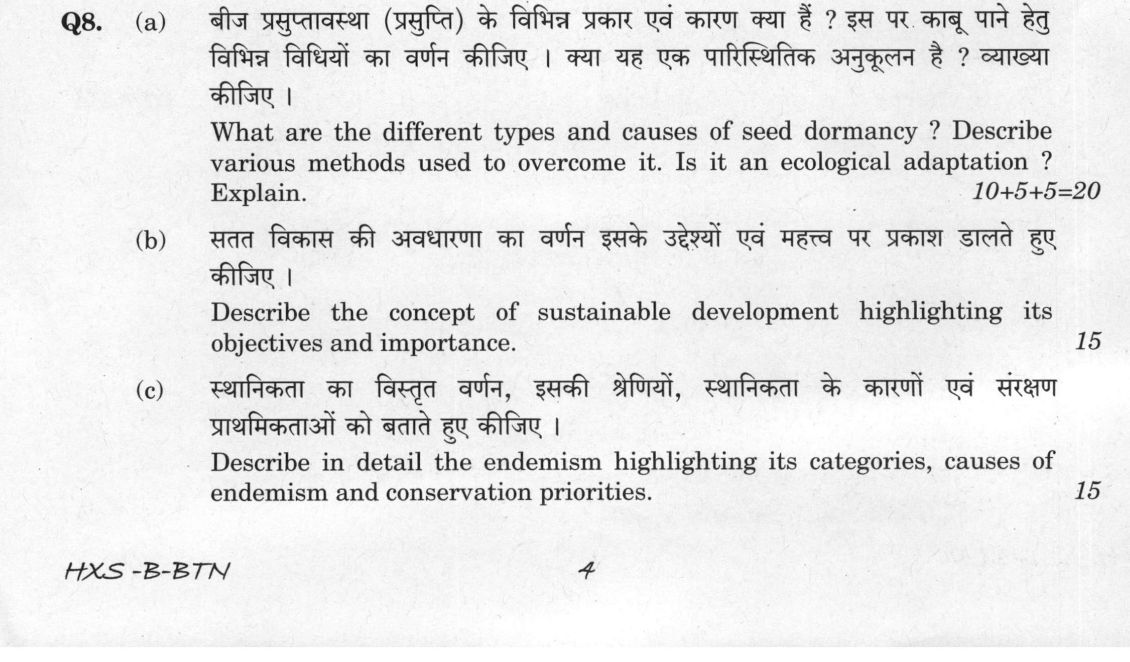
(a) What are the different types and causes of seed dormancy ? Describe various methods used to overcome it. Is it an ecological…
What are the different types and causes of seed dormancy ? Describe various methods used to overcome it. Is it an ecological adaptation ? Explain. 10+5+5=20
Describe the concept of sustainable development highlighting its objectives and importance. 15 marks
Describe in detail the endemism highlighting its categories, causes of endemism and conservation priorities. 15 marks
हिंदी में प्रश्न पढ़ें
बीज प्रसुप्तावस्था (प्रसुप्ति) के विभिन्न प्रकार एवं कारण क्या हैं ? इस पर काबू पाने हेतु विभिन्न विधियों का वर्णन कीजिए । क्या यह एक पारिस्थितिक अनुकूलन है ? व्याख्या कीजिए । 10+5+5=20
सतत विकास की अवधारणा का वर्णन इसके उद्देश्यों एवं महत्व पर प्रकाश डालते हुए कीजिए । 15
स्थानिकता का विस्तृत वर्णन, इसकी श्रेणियों, स्थानिकता के कारणों एवं संरक्षण प्राथमिकताओं को बताते हुए कीजिए । 15
Model answer
Written by UPSC Answer Check against this question's marking rubric, to the expected length. UPSC does not publish answers for Mains — this is one way to score well, not an official key.
Seed dormancy, sustainable development, and endemism form the triad of biological conservation, linking physiological mechanisms to global ecological strategies.
Seed Dormancy: Types, Causes, and Overcoming Methods Seed dormancy is a state of suspended growth despite favorable environmental conditions. It is broadly classified into exogenous and endogenous types. Exogenous dormancy arises from external factors, primarily physical barriers in the seed coat (hard seed coat) or chemical inhibitors like phenolics and tannins. Endogenous dormancy is intrinsic, resulting from physiological immaturity of the embryo, morphological immaturity (underdeveloped embryo), or morphophysiological constraints where both structure and physiology limit germination. Combined dormancy involves both exogenous and endogenous factors.
To overcome dormancy, specific methods are employed based on the cause. Physical scarification (rubbing, cutting, or acid treatment) breaks hard seed coats. Stratification (cold or warm moist storage) satisfies physiological requirements for temperate species. Hormonal treatments, particularly Gibberellic Acid (GA3), break physiological dormancy by mobilizing reserves and degrading abscisic acid (ABA). After-ripening allows physiological maturation in dry seeds.
Ecologically, dormancy is a vital adaptation. It acts as a "bet-hedging" strategy, ensuring not all seeds germinate simultaneously, thus buffering against unfavorable seasons. It aids in gap detection, allowing seeds to wait for canopy openings in forests, and ensures seasonal synchronization, preventing germination during frost or drought. This temporal niche partitioning enhances survival in variable environments.
Sustainable Development: Concept and Importance Sustainable development, defined by the 1987 Brundtland Commission as "development that meets the needs of the present without compromising the ability of future generations to meet their own needs," rests on three pillars: economic growth, social inclusion, and environmental protection. Its objective is to decouple economic progress from resource depletion and environmental degradation.
The importance of this concept lies in ensuring intergenerational equity and long-term planetary health. It aligns with the United Nations Sustainable Development Goals (SDGs), providing a framework for holistic progress. In the Indian context, it is crucial for balancing rapid industrialization with the preservation of biodiversity and natural capital, ensuring that development does not exceed the regenerative capacity of ecosystems.
Endemism: Categories, Causes, and Conservation Endemism refers to species restricted to a specific geographic area. It is categorized into:
- Paleoendemism: Ancient lineages with small ranges, often relict species (e.g., Ginkgo biloba).
- Neoendemism: Recently evolved species with small ranges, often due to recent speciation.
- Schizoendemism: Species split by barriers into multiple endemic populations.
- Patroendemism: Species endemic to a region due to historical colonization.
- Apoendemism: Species that have expanded their range but remain endemic to a larger area.
Causes of endemism include geographical isolation (mountains, islands), edaphic specialization (specific soil types), climatic stability, and long evolutionary history. India hosts significant endemism in the Western Ghats, Eastern Himalayas, and Andaman-Nicobar Islands. For instance, the Western Ghats harbor numerous endemic orchids and sholas, while the Andamans feature unique flora like Rafflesia species.
Conservation priorities for endemic flora are high due to their narrow ranges and high extinction risk. In-situ conservation involves protecting habitats through National Parks, Biosphere Reserves, and Wildlife Sanctuaries. Ex-situ strategies include seed banks (like the National Bureau of Plant Genetic Resources), cryopreservation, and botanical gardens. Prioritizing endemic zones in conservation planning is essential to prevent irreversible loss of genetic diversity.
Conclusion Understanding seed dormancy mechanisms aids in the ex-situ conservation of endemic species, while the framework of sustainable development ensures that such conservation efforts are integrated into broader socio-economic policies. Together, they form the backbone of effective biodiversity management.
What "Describe" is asking you to do
Give a full, ordered account of the thing named — its parts, stages or mechanism — in the sequence in which it actually exists or occurs. Most describe questions come from the science optionals, where the marks sit in correct technical detail and, where the stem says so, a labelled diagram.
Structure that answers it
One-line identification of the subject → the parts or stages in their real order, each with its defining detail → labelled diagram where the subject is structural → closing line on function or significance
Where marks are lost
Loose general prose where the examiner is ticking named parts, correct terminology and their sequence; and in the General Studies papers, turning to evaluation before the description is finished.
How this answer will be evaluated
Approach
Framework: UPSC Botany Paper 2. (a) describe: define > structure or process in order > labelled diagram > significance | (b) describe: define > structure or process in order > labelled diagram > significance | (c) describe: define > structure or process in order > labelled diagram > significance Full marks: Precise definitions, clear distinction between types/causes, specific examples, and logical flow.
Key points expected
- Distinguish exogenous (physical) vs endogenous (physiological) dormancy
- Explain causes: seed coat impermeability, embryo immaturity, inhibitors
- List methods: scarification, stratification, gibberellic acid (GA3) treatment
- Explain ecological adaptation: survival against unfavorable seasons
- Define concept: meeting present needs without compromising future
- List objectives: environmental protection, economic growth, social equity
- Explain importance: resource conservation, biodiversity preservation
- Link to 'Sustainable Agriculture' or 'Integrated Pest Management'
Evaluation rubric
Each sub-part is marked on its own, against the marks and word limit printed on the paper.
- (a) Define dormancy, classify types/causes, list breaking methods, and justify ecological adaptation. 20 marks
describe— define → structure or process in order → labelled diagram → significance
Must cover
- Distinguish exogenous (physical) vs endogenous (physiological) dormancy
- Explain causes: seed coat impermeability, embryo immaturity, inhibitors
- List methods: scarification, stratification, gibberellic acid (GA3) treatment
- Explain ecological adaptation: survival against unfavorable seasons
Loses marks
- Confusing dormancy with desiccation sensitivity
- Failing to distinguish physical from physiological barriers
- Listing methods without explaining the mechanism
Earns more
- Mention specific inhibitors like abscisic acid (ABA)
- Reference specific species (e.g., *Canna*, *Avena*)
- Diagram of seed coat structure or stratification process
Extra mark
- Mention specific GA3 concentration for breaking dormancy
- Reference to specific crop application (e.g., potato tubers)
- (b) Define sustainable development, outline its core objectives, and explain its importance. 15 marks
describe— define → structure or process in order → labelled diagram → significance
Must cover
- Define concept: meeting present needs without compromising future
- List objectives: environmental protection, economic growth, social equity
- Explain importance: resource conservation, biodiversity preservation
- Link to 'Sustainable Agriculture' or 'Integrated Pest Management'
Loses marks
- Treating it purely as an economic concept
- Ignoring the biological/ecological dimension
- Vague generalities without specific objectives
Earns more
- Reference to Brundtland Report (1987)
- Mention of Millennium Development Goals (MDGs) or SDGs
- Diagram showing the three pillars (Economy, Society, Environment)
Extra mark
- Reference to specific Indian policy (e.g., National Action Plan on Climate Change)
- Mention of specific biotech application for sustainability
- (c) Define endemism, categorize types, explain causes, and detail conservation priorities. 15 marks
describe— define → structure or process in order → labelled diagram → significance
Must cover
- Define endemism: species restricted to a specific geographic area
- Categorize: micro-endemic vs macro-endemic (or island vs continental)
- Explain causes: geographic isolation, speciation, habitat specificity
- Detail conservation priorities: in-situ (protected areas) vs ex-situ (seed banks)
Loses marks
- Confusing endemism with rarity
- Failing to distinguish between micro and macro endemism
- Ignoring the role of isolation in speciation
Earns more
- Mention specific endemic species (e.g., *Nepenthes*, *Rafflesia*)
- Reference to 'Hotspots of Biodiversity'
- Diagram of an island biogeography model
Extra mark
- Reference to specific conservation act (e.g., Wildlife Protection Act)
- Mention of specific endemic region (e.g., Western Ghats, Sundarbans)
Practice this exact question
Write your answer and it is marked point by point against the model answer above — what you covered, what you missed, what you got wrong.
Evaluate my answer →More from Botany 2021 Paper II
- Q5 Write short notes on the following : 10×5=50 (a) Alkaloids and their significance 10 (b)…
- Q6 (a) Describe C₄ cycle of photosynthesis and differentiate amongst C₃, C₄ and CAM plants.…
- Q7 (a) What is unique of Indian plant biodiversity ? Discuss briefly the threats and various…
- Q8 (a) What are the different types and causes of seed dormancy ? Describe various methods u…