Paper II — Q5
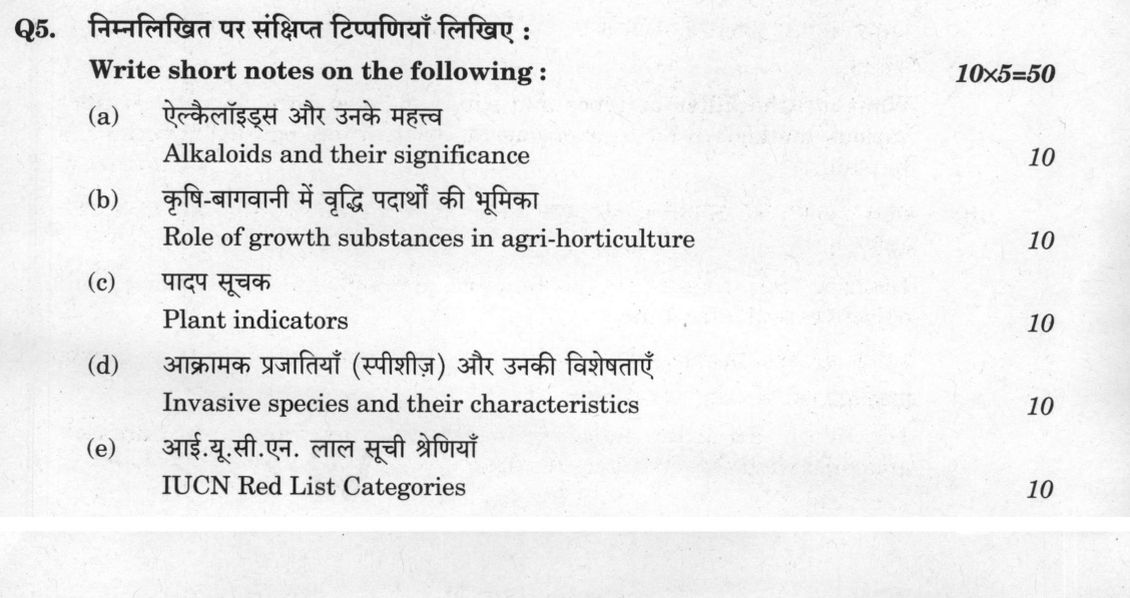
Write short notes on the following : 10×5=50 (a) Alkaloids and their significance 10 (b) Role of growth substances in…
Write short notes on the following : 10×5=50
Alkaloids and their significance 10
Role of growth substances in agri-horticulture 10
Plant indicators 10
Invasive species and their characteristics 10
IUCN Red List Categories 10
हिंदी में प्रश्न पढ़ें
निम्नलिखित पर संक्षिप्त टिप्पणियाँ लिखिए : 10×5=50
एल्केलॉइड्स और उनके महत्व 10
कृषि-बागवानी में वृद्धि पदार्थों की भूमिका 10
पादप सूचक 10
आक्रामक प्रजातियाँ (स्पीशीज़) और उनकी विशेषताएँ 10
आई.यू.सी.एन. लाल सूची श्रेणियाँ 10
Model answer
Written by UPSC Answer Check against this question's marking rubric, to the expected length. UPSC does not publish answers for Mains — this is one way to score well, not an official key.
(a) Alkaloids and Their Significance
Alkaloids are a diverse group of naturally occurring, low-molecular-weight, nitrogen-containing basic secondary metabolites primarily derived from amino acids such as tyrosine, tryptophan, lysine, and ornithine. Synthesized principally in angiosperms, alkaloids are stored in vacuoles and specialized laticifers or idioblasts. In planta, they serve primarily as potent chemical defenses against herbivory, insect predation, and microbial pathogens owing to their bitter taste and profound physiological toxicity, while also functioning as nitrogen-storage reservoirs and endogenous growth regulators.
In pharmacognosy and modern therapeutics, alkaloids represent critical chemical scaffolds. Well-characterized examples include the analgesic and narcotic alkaloids morphine and codeine extracted from Papaver somniferum; the antimalarial quinoline alkaloid quinine derived from the bark of Cinchona officinalis; the antihypertensive indole alkaloid reserpine isolated from the roots of the Indian medicinal plant Rauwolfia serpentina; and the anticancer vinca alkaloids vinblastine and vincristine obtained from Catharanthus roseus. Furthermore, purine and pyridine alkaloids such as caffeine from Coffea arabica and nicotine from Nicotiana tabacum function as central nervous system stimulants and natural bio-insecticides, respectively. In agrochemistry, semi-synthetic alkaloid derivatives provide eco-friendly pest-management alternatives due to their selective neurotoxic and repellent properties.
(b) Role of Growth Substances in Agri-Horticulture
Plant growth substances (phytohormones) are signal molecules synthesized in minute concentrations that regulate cellular division, elongation, and differentiation. Their commercial applications have transformed agri-horticultural practices across five primary classes:
Auxins (Indole-3-acetic acid, NAA, IBA): Synthetic auxins such as IBA and NAA are routinely applied to promote adventitious rooting in vegetative cuttings, facilitating clonal propagation. Synthetic auxins like 2,4-D function as selective herbicides against broad-leaved dicot weeds in cereal monocultures. Auxins also induce parthenocarpy in crops like tomato and prevent premature fruit and flower abscission in citrus and mango orchards.
Gibberellins (primarily GA3): Gibberellins are applied to overcome physiological seed and bud dormancy in deciduous fruit trees and potatoes. In viticulture, GA3 application promotes pedicel elongation and increases berry size in seedless grapes (Vitis vinifera). In sugarcane (Saccharum officinarum) cultivation, foliar sprays of GA3 stimulate internodal elongation, enhancing cane yield by up to twenty tonnes per hectare. They are also widely utilized in the brewing industry to accelerate alpha-amylase synthesis during barley malting.
Cytokinins (Kinetin, 6-Benzylaminopurine): Cytokinins are essential additives in plant tissue culture media, where high cytokinin-to-auxin ratios induce de novo shoot organogenesis. They delay post-harvest foliar senescence (the Richmond-Lang effect) in leafy greens and cut flowers by preserving chlorophyll integrity and mobilizing nutrients, while also breaking apical dominance to promote lateral branching in floriculture.
Ethylene (gaseous hormone, applied as Ethephon): Ethylene coordinates climacteric fruit ripening in banana, mango, and tomato by activating cell-wall-degrading enzymes. It promotes synchronized flowering in Ananas comosus (pineapple), alters sex expression toward pistillate flower production in cucurbits, and accelerates fruit and leaf abscission to facilitate mechanical harvesting in cherries and cotton.
Abscisic Acid (ABA): ABA acts as a stress-response hormone by inducing rapid stomatal closure through guard cell potassium-ion efflux under moisture deficit, making it a valuable antitranspirant spray. ABA is also applied exogenously to prolong tuber and seed dormancy during post-harvest storage, preventing unseasonal sprouting.
(c) Plant Indicators
Plant indicators (bioindicators) are plant species or communities whose presence, physiological aberrations, or biochemical responses reliably denote specific environmental conditions, soil properties, mineral deposits, or anthropogenic pollution regimes. Because plants are sessile, they continuously integrate ecological stresses over time, offering sensitive diagnostics for ecological monitoring.
Epiphytic lichens, particularly fruticose genera such as Usnea and foliose taxa like Parmelia, are classical indicators of atmospheric sulfur dioxide (SO₂) and heavy metal pollution, as their lack of a cuticle makes them vulnerable to cellular acidification and chlorophyll degradation. In aquatic ecosystems, free-floating macrophytes such as Eichhornia crassipes and Lemna minor indicate cultural eutrophication driven by high nitrate and phosphate influx, as well as dissolved heavy metal accumulation.
Edaphic indicators and metallophytes reflect localized subterranean chemical compositions. Hyperaccumulating ferns such as Pteris vittata serve as reliable bioindicators and phytoremediators for arsenic-contaminated soils, while Noccaea caerulescens pinpoints zinc and cadmium mineralization. Halophytic taxa, including Suaeda nudiflora, Salicornia brachiata, and the invasive deep-rooted phreatophyte Prosopis juliflora, indicate highly saline, alkaline, or sodic soil profiles. Conversely, acidophile taxa such as Rhododendron species denote acidic, aluminum-rich soils, and vascular cryptogams like Equisetum arvense (horsetail) reflect silica- and gold-bearing substrata.
(d) Invasive Species and Their Characteristics
Invasive alien plant species are non-native taxa introduced intentionally or accidentally into ecosystems outside their historical range, where they establish self-sustaining populations, spread aggressively, outcompete indigenous flora, and disrupt community dynamics and ecosystem services.
The invasiveness of these taxa is driven by an array of shared biological and ecological traits: High reproductive output and rapid growth: Invasive plants exhibit fast growth rates, early sexual maturity, and massive seed production with high germinability across broad environmental gradients. Efficient dispersal mechanisms: Seeds possess specialized anemochoric, zoochoric, or hydrochoric adaptations, paired with effective vegetative propagation via stolons, runners, or rhizomes. Broad ecological amplitude and phenotypic plasticity: They tolerate broad ranges of temperature, moisture, and soil fertility, adjusting morphological and photosynthetic traits to exploit disturbed habitats. Allelopathic interference: Many invasives exude secondary phytotoxins into the rhizosphere, suppressing the germination and root elongation of neighboring native species. Absence of natural predators: Under the Enemy Release Hypothesis, alien plants escape the co-evolved specialized herbivores, insects, and fungal pathogens of their native ranges, conferring a competitive advantage over native flora.
Prominent Indian examples include Lantana camara, which has invaded over forty percent of Indian tiger reserves, outcompeting native forage species; Parthenium hysterophorus (Congress grass), an aggressive allelopathic asteraceous weed causing severe allergic dermatitis in humans and outcompeting pasture species; and Eichhornia crassipes (Water hyacinth), which forms dense mats over wetlands and rivers across the subcontinent, depleting dissolved oxygen and causing catastrophic declines in aquatic biodiversity.
(e) IUCN Red List Categories
The International Union for Conservation of Nature (IUCN) Red List of Threatened Species provides a standardized, objective framework for assessing the global extinction risk of plant and animal taxa. The assessment evaluates taxa against five quantitative criteria (A to E): rate of population reduction (Criterion A); geographic range size and fragmentation/fluctuation (Criterion B); small population size and continuous decline (Criterion C); very small or restricted population (Criterion D); and quantitative extinction probability analysis (Criterion E).
The formal IUCN framework delineates nine discrete categories arranged in a hierarchical order of extinction threat:
Extinct (EX): No reasonable doubt remains that the last individual of the taxon has died (e.g., Madhuca insignis was long considered EX before localized rediscovery).
Extinct in the Wild (EW): Known only to survive in cultivation, captivity, or as a naturalized population well outside its historic range (e.g., Franklinia alatamaha).
Critically Endangered (CR): Facing an extremely high risk of extinction in the wild, meeting criteria such as an eighty to ninety percent population decline over ten years or three generations (e.g., Dipterocarpus bourdillonii, an endemic Western Ghats tree, and Ilex khasiana of Meghalaya).
Endangered (EN): Facing a very high risk of extinction in the wild due to rapid population contraction or restricted geographical area (e.g., Pterocarpus santalinus or Red Sanders, endemic to the Seshachalam hills of Andhra Pradesh).
Vulnerable (VU): Facing a high risk of wild extinction based on a thirty to fifty percent population decline or habitat reduction (e.g., Santalum album, Indian sandalwood, threatened by illicit harvesting and spike disease).
Near Threatened (NT): Close to qualifying for, or likely to qualify for, a threatened category in the near future (e.g., Pinus gerardiana, Chilgoza pine).
Least Concern (LC): Widespread and abundant taxa that do not qualify for higher threat categories (e.g., Azadirachta indica, Neem).
Data Deficient (DD): Inadequate direct or indirect information to make an assessment of extinction risk based on distribution or population status.
Not Evaluated (NE): Taxa that have not yet been evaluated against the quantitative IUCN criteria.
These quantitative categories provide a rigorous basis for prioritizing global and national plant conservation strategies, designating Protected Area networks, and implementing targeted species-recovery programs.
What "Write short notes" is asking you to do
Five or six self-contained answers, marked separately, typically 10 marks and about 150 words each. Each note must carry its own definition, its two or three defining features and a line on why it matters; a common introduction or conclusion across the notes earns nothing.
Structure that answers it
Per note: one-line definition or identification → two or three features, mechanisms or named examples → one line of significance or Indian application
Where marks are lost
Writing the first two notes at essay length and rationing the rest. Each note is marked on its own, so marks surrendered on a compressed or unattempted note cannot be won back by the long ones.
How this answer will be evaluated
Approach
Framework: Botany Paper 2: Define > Structure/Process > Diagram > Significance. (a) write short notes: define > 3-4 key features > one example > one-line significance | (b) write short notes: define > 3-4 key features > one example > one-line significance | (c) write short notes: define > 3-4 key features > one example > one-line significance | (d) write short notes: define > 3-4 key features > one example > one-line significance | (e) write short notes: define > 3-4 key features > one example > one-line significance Full marks: Precise definitions, specific examples, clear significance, no errors.
Key points expected
- Definition: Nitrogenous secondary metabolites
- Mention specific alkaloid (e.g., Morphine, Quinine)
- Significance: Pharmacological or industrial use
- Mention source plant (e.g., Papaver somniferum)
- Definition: Plant hormones (Auxin, Cytokinin, etc.)
- Role: Fruit ripening or shelf-life extension
- Role: Inducing parthenocarpy or rooting
- Example: Ethylene or NAA application
Evaluation rubric
Each sub-part is marked on its own, against the marks and word limit printed on the paper.
- (a) Define alkaloids, list key features, give one example, state significance. 10 marks
write short notes— define → 3-4 key features → one example → one-line significance
Must cover
- Definition: Nitrogenous secondary metabolites
- Mention specific alkaloid (e.g., Morphine, Quinine)
- Significance: Pharmacological or industrial use
- Mention source plant (e.g., Papaver somniferum)
Loses marks
- Confusing alkaloids with terpenoids
- No specific plant example given
Earns more
- Mention biosynthetic pathway (e.g., Shikimic acid)
- Mention specific medicinal application
Extra mark
- Mention specific commercial cultivar
- Mention recent biotech extraction method
- (b) Define growth substances, list roles in agri-horticulture, give one example. 10 marks
write short notes— define → 3-4 key features → one example → one-line significance
Must cover
- Definition: Plant hormones (Auxin, Cytokinin, etc.)
- Role: Fruit ripening or shelf-life extension
- Role: Inducing parthenocarpy or rooting
- Example: Ethylene or NAA application
Loses marks
- Confusing growth substances with fertilizers
- No specific horticultural application
Earns more
- Mention specific crop (e.g., Banana, Tomato)
- Mention specific concentration or dosage
Extra mark
- Mention specific commercial product name
- Mention recent biotech application
- (c) Define plant indicators, list key features, give one example. 10 marks
write short notes— define → 3-4 key features → one example → one-line significance
Must cover
- Definition: Plants indicating environmental conditions
- Type: Soil pH indicator (e.g., Rhododendron)
- Type: Pollution indicator (e.g., Lichen)
- Example: Specific species and its indication
Loses marks
- Confusing indicators with indicator species in ecology
- No specific plant example
Earns more
- Mention specific pollutant (e.g., SO2)
- Mention specific soil type (e.g., acidic)
Extra mark
- Mention specific monitoring protocol
- Mention recent environmental study
- (d) Define invasive species, list characteristics, give one example. 10 marks
write short notes— define → 3-4 key features → one example → one-line significance
Must cover
- Definition: Non-native species causing harm
- Characteristic: High reproductive rate
- Characteristic: Lack of natural predators
- Example: Specific invasive species (e.g., Lantana)
Loses marks
- Confusing invasive with endemic species
- No specific species example
Earns more
- Mention specific ecosystem impact
- Mention specific control method
Extra mark
- Mention specific invasive species in India
- Mention recent management strategy
- (e) Define IUCN Red List, list categories, give one example. 10 marks
write short notes— define → 3-4 key features → one example → one-line significance
Must cover
- Definition: IUCN conservation status list
- Category: Extinct (EX)
- Category: Endangered (EN)
- Example: Specific species and its status
Loses marks
- Confusing IUCN with CITES
- No specific species example
Earns more
- Mention specific criteria (e.g., population decline)
- Mention specific conservation action
Extra mark
- Mention specific IUCN committee
- Mention recent status change
Practice this exact question
Write your answer and it is marked point by point against the model answer above — what you covered, what you missed, what you got wrong.
Evaluate my answer →More from Botany 2021 Paper II
- Q2 (a) Describe types and composition of chromatin. How is DNA packaged in a eukaryotic cell…
- Q3 (a) Describe properties of genetic code and briefly explain Wobble hypothesis. 15+5=20 (b…
- Q4 (a) Describe various methods of gene transfer in plants. 20 (b) Give an account of Operon…
- Q5 Write short notes on the following : 10×5=50 (a) Alkaloids and their significance 10 (b)…
- Q6 (a) Describe C₄ cycle of photosynthesis and differentiate amongst C₃, C₄ and CAM plants.…
- Q7 (a) What is unique of Indian plant biodiversity ? Discuss briefly the threats and various…
- Q8 (a) What are the different types and causes of seed dormancy ? Describe various methods u…