Paper II — Q3
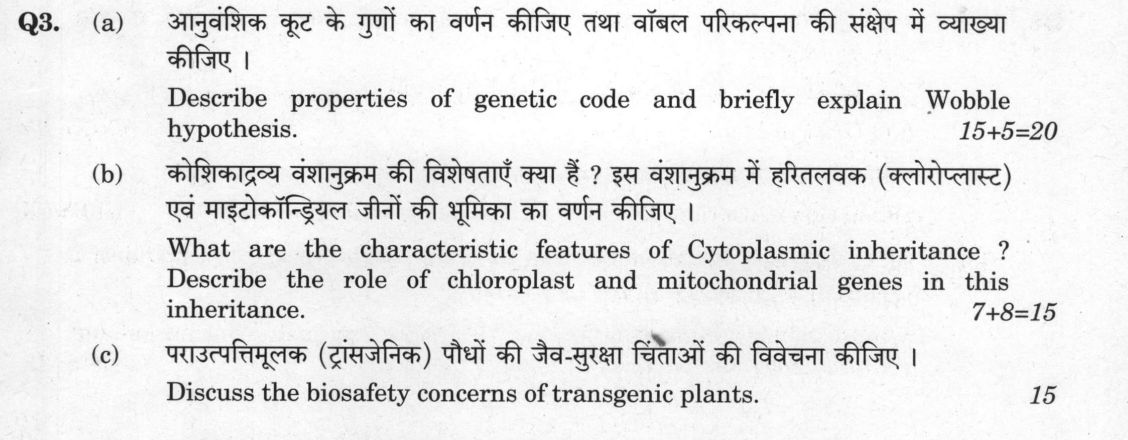
(a) Describe properties of genetic code and briefly explain Wobble hypothesis. 15+5=20 (b) What are the characteristic features…
Describe properties of genetic code and briefly explain Wobble hypothesis. 15+5=20
What are the characteristic features of Cytoplasmic inheritance ? Describe the role of chloroplast and mitochondrial genes in this inheritance. 7+8=15
Discuss the biosafety concerns of transgenic plants. 15 marks
हिंदी में प्रश्न पढ़ें
आनुवंशिक कूट के गुणों का वर्णन कीजिए तथा वॉबल परिकल्पना की संक्षेप में व्याख्या कीजिए । 15+5=20
कोशिकाद्रव्य वंशानुक्रम की विशेषताएं क्या हैं ? इस वंशानुक्रम में हरितलवक (क्लोरोप्लास्ट) एवं माइटोकॉन्ड्रियल जीनों की भूमिका का वर्णन कीजिए । 7+8=15
पराउपतिमूलक (ट्रांसजेनिक) पौधों की जैव-सुरक्षा चिंताओं की विवेचना कीजिए । 15
Model answer
Written by UPSC Answer Check against this question's marking rubric, to the expected length. UPSC does not publish answers for Mains — this is one way to score well, not an official key.
The genetic code, the set of rules by which information encoded in genetic material is translated into proteins, possesses distinct properties that ensure accurate biological function. First, it is a triplet code, where three nucleotides form a codon specifying one amino acid; this was demonstrated by Crick, Brenner, and colleagues through frame-shift mutation analysis. Second, it is degenerate, meaning multiple codons can specify the same amino acid (e.g., six codons for leucine), which buffers against mutations. Third, it is non-overlapping, with each nucleotide participating in only one codon. Fourth, it is commaless, lacking punctuation between codons. Fifth, it is non-ambiguous (specific), as each codon specifies only one amino acid or stop signal. Sixth, it is nearly universal across organisms, supporting common ancestry. Finally, it has specific start and stop codons; AUG initiates translation (coding for methionine), while UAA, UAG, and UGA signal termination.
The Wobble Hypothesis, proposed by Francis Crick, explains how a limited number of tRNAs can recognize all 61 sense codons. It posits that base-pairing rules are strict at the first two positions of the codon but flexible at the third (wobble) position. This allows a single tRNA anticodon to pair with multiple codons. For instance, an anticodon ending in inosine (I) can pair with U, C, or A at the codon’s third position, while guanine (G) in the anticodon can pair with cytosine (C) or uracil (U). This flexibility reduces the number of tRNA species required for protein synthesis.
Cytoplasmic Inheritance refers to the transmission of genetic information via organelles (chloroplasts and mitochondria) rather than nuclear chromosomes. Its characteristic features include: (1) Maternal (uniparental) transmission, where traits are inherited exclusively from the female parent because the egg contributes the bulk of the cytoplasm; (2) Absence of Mendelian segregation, as organellar genes do not follow 3:1 or 1:1 ratios; (3) Reciprocal cross differences, where the phenotype of the F1 generation depends on the sex of the parent contributing the cytoplasm; and (4) Vegetative segregation, leading to variegation or mosaic patterns rather than uniform expression, as seen in Mirabilis jalapa.
Chloroplast and mitochondrial genes play specific roles in this inheritance. Chloroplast genes encode components of the photosynthetic machinery (photosystems, cytochrome b6f) and ribosomal RNAs. Mutations in these genes can cause albino sectors or variegation, as famously observed by Correns in Mirabilis. In agriculture, chloroplast transformation is explored for traits like herbicide resistance (e.g., atrazine resistance in Solanum), offering containment because chloroplasts are rarely transmitted via pollen. Mitochondrial genes encode subunits of the respiratory chain (Complex I, II, III, IV). A critical application is Cytoplasmic Male Sterility (CMS), where mitochondrial mutations disrupt pollen development. In maize, T-cytoplasm CMS is widely used. In India, CMS lines are pivotal for hybrid seed production in crops like rice and pearl millet (using sources like Tift 23A), enabling the commercial success of hybrid varieties.
Biosafety concerns of transgenic plants are multifaceted. Gene flow to wild relatives is a primary risk; for example, Bt cotton genes have been detected in wild Gossypium species, potentially creating superweeds or disrupting wild gene pools. Pest resistance is another issue, as target pests like Helicoverpa armigera have developed resistance to Bt toxins in Indian fields, necessitating refuge strategies. Non-target effects must be assessed, as Bt proteins might impact beneficial insects like Trichogramma or Coccinella, though field studies generally show minimal impact. Allergenicity and toxicity of novel proteins require rigorous testing to ensure food safety. Horizontal gene transfer to soil microbes, while theoretically possible, remains a low-probability risk. Furthermore, transgenics may impact biodiversity by reducing genetic diversity in monocultures and affecting traditional farming systems.
Regulatory frameworks in India, such as the Environment (Protection) Act, 1986, and the Genetic Engineering Appraisal Committee (GEAC), oversee risk assessment. The moratorium on Bt brinjal highlights the need for public participation and case-by-case risk assessment. Understanding the precision of the genetic code and the mechanisms of cytoplasmic inheritance is essential for designing safer transgenic crops, such as using chloroplast transformation to prevent gene escape, thereby balancing agricultural productivity with ecological safety.
What "Describe" is asking you to do
Give a full, ordered account of the thing named — its parts, stages or mechanism — in the sequence in which it actually exists or occurs. Most describe questions come from the science optionals, where the marks sit in correct technical detail and, where the stem says so, a labelled diagram.
Structure that answers it
One-line identification of the subject → the parts or stages in their real order, each with its defining detail → labelled diagram where the subject is structural → closing line on function or significance
Where marks are lost
Loose general prose where the examiner is ticking named parts, correct terminology and their sequence; and in the General Studies papers, turning to evaluation before the description is finished.
How this answer will be evaluated
Approach
Framework: UPSC Botany Paper 2. (a) describe: define > structure or process in order > labelled diagram > significance | (b) describe: define > structure or process in order > labelled diagram > significance | (c) discuss: intro > 3-4 dimensions > example > balanced close Full marks: Comprehensive, accurate, with specific examples and labelled diagrams where appropriate.
Key points expected
- Define genetic code and list 4-5 properties (e.g., degenerate, unambiguous)
- Explain Wobble hypothesis (Crick) regarding 3rd base pairing
- Mention specific base pairing examples (e.g., G-U, I-A/C/U)
- Provide a labelled diagram of tRNA anticodon-mRNA codon interaction
- Define cytoplasmic inheritance (maternal inheritance)
- List characteristic features (e.g., non-Mendelian, maternal effect)
- Describe role of chloroplast genes (e.g., variegation in *Mirabilis*)
- Describe role of mitochondrial genes (e.g., cytoplasmic male sterility)
Evaluation rubric
Each sub-part is marked on its own, against the marks and word limit printed on the paper.
- (a) List properties of genetic code and explain the Wobble hypothesis. 20 marks
describe— define → structure or process in order → labelled diagram → significance
Must cover
- Define genetic code and list 4-5 properties (e.g., degenerate, unambiguous)
- Explain Wobble hypothesis (Crick) regarding 3rd base pairing
- Mention specific base pairing examples (e.g., G-U, I-A/C/U)
- Provide a labelled diagram of tRNA anticodon-mRNA codon interaction
Loses marks
- Unlabelled diagram of codon-anticodon pairing
- Confusing Wobble with general degeneracy without specific base rules
Earns more
- Mention non-overlapping nature of code
- Reference Francis Crick's 1966 proposal
- Mention universal nature of the code
Extra mark
- Mention specific amino acid examples for degeneracy
- Reference specific tRNA isoacceptors
- (b) List features of cytoplasmic inheritance and describe roles of chloroplast/mitochondrial genes. 15 marks
describe— define → structure or process in order → labelled diagram → significance
Must cover
- Define cytoplasmic inheritance (maternal inheritance)
- List characteristic features (e.g., non-Mendelian, maternal effect)
- Describe role of chloroplast genes (e.g., variegation in *Mirabilis*)
- Describe role of mitochondrial genes (e.g., cytoplasmic male sterility)
Loses marks
- Confusing cytoplasmic with nuclear inheritance
- Failing to distinguish chloroplast vs mitochondrial roles
Earns more
- Mention *Mirabilis jalapa* (Four o'clock plant) as a classic example
- Mention *Spartina* (cordgrass) for mitochondrial inheritance
- Mention maternal transmission mechanism
Extra mark
- Mention specific gene names (e.g., *suF* for CMS)
- Reference specific cultivars used in breeding
- (c) Discuss the biosafety concerns of transgenic plants. 15 marks
discuss— intro → 3-4 dimensions → example → balanced close
Must cover
- Define biosafety in context of transgenic plants
- Discuss gene flow to wild relatives (weedyness)
- Discuss impact on non-target organisms (e.g., *Bt* and pollinators)
- Discuss allergenicity and food safety concerns
Loses marks
- Vague generalities without specific examples
- Failing to address both ecological and food safety concerns
Earns more
- Mention specific examples (e.g., *Bt* cotton, Golden Rice)
- Reference regulatory bodies (e.g., GEAC, USDA)
- Mention containment strategies
Extra mark
- Mention specific studies on *Bt* and monarch butterflies
- Reference specific regulatory frameworks (e.g., Cartagena Protocol)
Practice this exact question
Write your answer and it is marked point by point against the model answer above — what you covered, what you missed, what you got wrong.
Evaluate my answer →More from Botany 2021 Paper II
- Q1 Write short notes on the following : 10×5=50 (a) Cell adhesion molecules 10 (b) Ribosomal…
- Q2 (a) Describe types and composition of chromatin. How is DNA packaged in a eukaryotic cell…
- Q3 (a) Describe properties of genetic code and briefly explain Wobble hypothesis. 15+5=20 (b…
- Q4 (a) Describe various methods of gene transfer in plants. 20 (b) Give an account of Operon…
- Q5 Write short notes on the following : 10×5=50 (a) Alkaloids and their significance 10 (b)…
- Q6 (a) Describe C₄ cycle of photosynthesis and differentiate amongst C₃, C₄ and CAM plants.…