Paper II — Q6
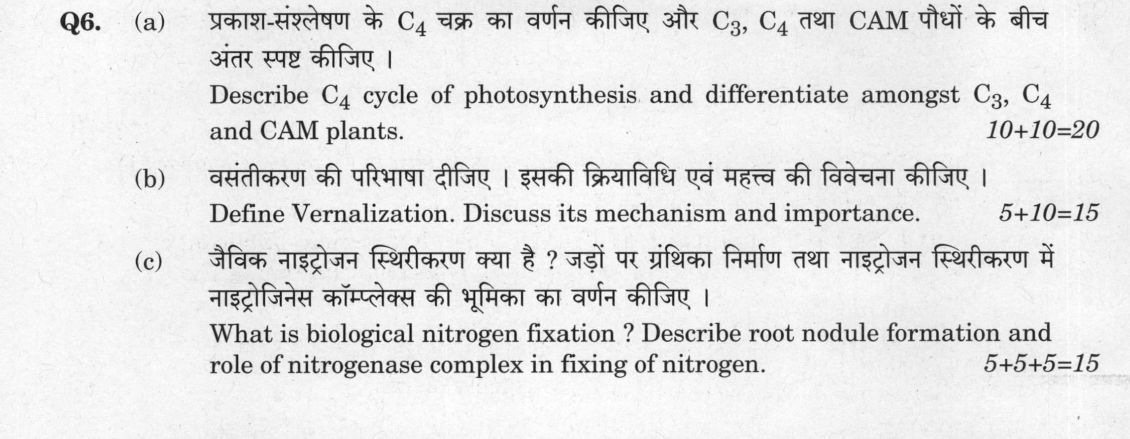
(a) Describe C₄ cycle of photosynthesis and differentiate amongst C₃, C₄ and CAM plants. 10+10=20 (b) Define Vernalization…
Describe C₄ cycle of photosynthesis and differentiate amongst C₃, C₄ and CAM plants. 10+10=20
Define Vernalization. Discuss its mechanism and importance. 5+10=15
What is biological nitrogen fixation ? Describe root nodule formation and role of nitrogenase complex in fixing of nitrogen. 5+5+5=15
हिंदी में प्रश्न पढ़ें
प्रकाश-संश्लेषण के C₄ चक्र का वर्णन कीजिए और C₃, C₄ तथा CAM पौधों के बीच अंतर स्पष्ट कीजिए । 10+10=20
वसंतीकरण की परिभाषा दीजिए । इसकी क्रियाविधि एवं महत्व की विवेचना कीजिए । 5+10=15
जैविक नाइट्रोजन स्थिरीकरण क्या है ? जड़ों पर प्रथिका निर्माण तथा नाइट्रोजन स्थिरीकरण में नाइट्रोजिनेस कॉम्प्लेक्स की भूमिका का वर्णन कीजिए । 5+5+5=15
Model answer
Written by UPSC Answer Check against this question's marking rubric, to the expected length. UPSC does not publish answers for Mains — this is one way to score well, not an official key.
Part (a): C₄ Cycle and Differentiation
The C₄ cycle, or Hatch-Slack pathway, is a photosynthetic mechanism that minimizes photorespiration by spatially separating initial CO₂ fixation from the Calvin cycle. It occurs in plants with Kranz anatomy, characterized by a ring of large, chloroplast-rich bundle-sheath cells surrounding the vascular bundles, encircled by mesophyll cells. In mesophyll cells, phosphoenolpyruvate (PEP) carboxylase, which has a high affinity for HCO₃⁻, fixes carbon into oxaloacetate (OAA). OAA is reduced to malate (in NAD-ME subtype) or converted to pyruvate (in NADP-ME subtype). This C₄ acid is transported to bundle-sheath cells, where it is decarboxylated, releasing CO₂. This concentrated CO₂ is then fixed by RuBisCO in the Calvin cycle. Note that while NADP-ME plants like maize have agranal bundle-sheath chloroplasts, NAD-ME and PCK subtypes possess granal chloroplasts, and suberized walls are not universal across all C₄ types.
The differentiation among C₃, C₄, and CAM plants is as follows:
- CO₂ Acceptor: C₃ uses RuBisCO; C₄ uses PEP carboxylase initially; CAM uses PEP carboxylase at night.
- First Stable Product: C₃ produces 3-phosphoglycerate (3-PGA); C₄ produces OAA/Malate; CAM produces OAA/Malate.
- Photorespiration: High in C₃; negligible in C₄ and CAM.
- Water Use Efficiency (WUE): Expressed as g DM/g H₂O, WUE increases from C₃ (lowest) to C₄ to CAM (highest) due to reduced stomatal conductance and CO₂ concentration mechanisms.
- Stomatal Behavior: C₃ opens during the day; C₄ opens during the day but with lower conductance; CAM opens at night to fix CO₂.
- Distribution: C₃ dominates temperate regions; C₄ thrives in hot, dry, high-light environments (e.g., tropical savannas); CAM is common in arid regions (e.g., cacti, pineapple).
Part (b): Vernalization
Vernalization is the induction of flowering by exposure to prolonged low temperatures, typically between 0°C and 10°C, which is essential for many winter annuals and biennials.
Mechanism: The molecular mechanism involves the epigenetic regulation of the FLOWERING LOCUS C (FLC) gene, a major repressor of flowering. In un-vernalized plants, FLC expression is high, inhibiting the FT (Flowering Locus T) gene. Exposure to cold induces the expression of VIN3 (Vernalization Insensitive 3) and VRN (Vernalization Responsive) genes. These proteins facilitate the recruitment of Polycomb Repressive Complex 2 (PRC2) to the FLC locus, leading to histone methylation (H3K27me3) and chromatin compaction. This silences FLC expression. With the repressor removed, the FT gene is activated in the phloem companion cells of leaves. FT protein moves to the shoot apical meristem, where it interacts with FD protein to activate floral meristem identity genes, initiating flowering.
Importance: In agriculture, vernalization is crucial for breeding and crop management. In wheat, it ensures that plants do not flower prematurely in winter, allowing them to accumulate biomass. In sugar beet, vernalization is required to trigger bolting and seed production. Understanding this mechanism allows breeders to develop spring-sown varieties that do not require a cold period, expanding the geographical range of cultivation. It also helps in synchronizing flowering for pollination and harvest.
Part (c): Biological Nitrogen Fixation
Biological Nitrogen Fixation (BNF) is the enzymatic reduction of atmospheric nitrogen (N₂) to ammonia (NH₃) by nitrogenase. It is divided into symbiotic (e.g., Rhizobium in legumes) and asymbiotic (e.g., Azotobacter, Clostridium) types.
Root Nodule Formation: The process begins with the recognition of flavonoids released by legume roots by Rhizobium bacteria. This triggers the expression of nod genes in bacteria, producing Nod factors. These factors induce root hair curling and the formation of an infection thread, a tubular structure through which bacteria enter the root cortex. The bacteria are released into the cytoplasm of cortical cells, where they differentiate into bacteroids. Simultaneously, the plant initiates nodule organogenesis, forming a vascular connection to supply nutrients to the nodule.
Nitrogenase Complex: Nitrogenase is a two-component enzyme system: the Fe protein (Gn) and the Mo-Fe protein (Gp). The reaction is: N₂ + 8H⁺ + 8e⁻ + 16 Mg-ATP → 2NH₃ + H₂ + 16 Mg-ADP + 16 Pi. The Fe protein transfers electrons to the Mo-Fe protein, where N₂ is reduced. The process is strictly anaerobic; oxygen inhibits nitrogenase. In symbiotic nodules, leghemoglobin, a heme protein, binds oxygen, maintaining a low O₂ concentration that protects nitrogenase while allowing respiration. The nif genes encode the nitrogenase components, while nod genes control nodule formation. This process is vital for sustainable agriculture, reducing the need for synthetic fertilizers.
What "Describe" is asking you to do
Give a full, ordered account of the thing named — its parts, stages or mechanism — in the sequence in which it actually exists or occurs. Most describe questions come from the science optionals, where the marks sit in correct technical detail and, where the stem says so, a labelled diagram.
Structure that answers it
One-line identification of the subject → the parts or stages in their real order, each with its defining detail → labelled diagram where the subject is structural → closing line on function or significance
Where marks are lost
Loose general prose where the examiner is ticking named parts, correct terminology and their sequence; and in the General Studies papers, turning to evaluation before the description is finished.
How this answer will be evaluated
Approach
Framework: UPSC Botany Paper 2. (a) describe: define > structure or process in order > labelled diagram > significance | (b) discuss: intro > 3-4 dimensions > example > balanced close | (c) describe: define > structure or process in order > labelled diagram > significance Full marks: Accurate stepwise mechanisms, labelled diagrams, specific species names, and clear differentiation.
Key points expected
- Stepwise C4 cycle: PEP carboxylase, mesophyll, bundle sheath
- Differentiation: Leaf anatomy (Kranz vs non-Kranz)
- Differentiation: CO2 fixation sites and primary products
- Differentiation: Stomatal behavior (day/night) for CAM
- Precise definition: Chilling requirement for flowering
- Mechanism: Physiological changes (e.g., gibberellin, mRNA stability)
- Importance: Crop management (winter wheat, biennial plants)
- Distinction between vernalization and photoperiodism
Evaluation rubric
Each sub-part is marked on its own, against the marks and word limit printed on the paper.
- (a) Stepwise C4 cycle mechanism and a comparative analysis of C3, C4, and CAM plants. 20 marks
describe— define → structure or process in order → labelled diagram → significance
Must cover
- Stepwise C4 cycle: PEP carboxylase, mesophyll, bundle sheath
- Differentiation: Leaf anatomy (Kranz vs non-Kranz)
- Differentiation: CO2 fixation sites and primary products
- Differentiation: Stomatal behavior (day/night) for CAM
Loses marks
- Unlabelled diagrams
- Confusing C4 and CAM mechanisms
- Omitting the role of bundle sheath cells
Earns more
- Labelled diagram of C4 cycle or Kranz anatomy
- Mention of specific C4 crops (e.g., *Zea mays*, *Sorghum bicolor*)
- Reference to photorespiration differences
Extra mark
- Mention of recent biotech application (e.g., C4 rice project)
- (b) Definition of vernalization, its physiological mechanism, and its agricultural importance. 15 marks
discuss— intro → 3-4 dimensions → example → balanced close
Must cover
- Precise definition: Chilling requirement for flowering
- Mechanism: Physiological changes (e.g., gibberellin, mRNA stability)
- Importance: Crop management (winter wheat, biennial plants)
- Distinction between vernalization and photoperiodism
Loses marks
- Confusing vernalization with stratification
- Vague mechanism without physiological basis
Earns more
- Mention of specific species (e.g., *Triticum aestivum*, *Brassica napus*)
- Reference to 'vernalins' or specific gene regulation (FLC)
Extra mark
- Mention of 'devernalization' or 'reversion'
- (c) Definition of biological nitrogen fixation, the process of root nodule formation, and the role of the nitrogenase complex. 15 marks
describe— define → structure or process in order → labelled diagram → significance
Must cover
- Definition: Conversion of N2 to NH3 by bacteria
- Root nodule formation: Rhizobium-legume symbiosis steps
- Nitrogenase complex: Fe-protein and Mo-protein roles
- Role of leghemoglobin in protecting nitrogenase
Loses marks
- Omitting the role of leghemoglobin
- Confusing nitrogenase with nitrate reductase
Earns more
- Labelled diagram of nodule structure or nitrogenase complex
- Mention of specific bacteria (e.g., *Rhizobium leguminosarum*)
Extra mark
- Mention of ATP requirement (16 ATP per N2)
Practice this exact question
Write your answer and it is marked point by point against the model answer above — what you covered, what you missed, what you got wrong.
Evaluate my answer →More from Botany 2021 Paper II
- Q3 (a) Describe properties of genetic code and briefly explain Wobble hypothesis. 15+5=20 (b…
- Q4 (a) Describe various methods of gene transfer in plants. 20 (b) Give an account of Operon…
- Q5 Write short notes on the following : 10×5=50 (a) Alkaloids and their significance 10 (b)…
- Q6 (a) Describe C₄ cycle of photosynthesis and differentiate amongst C₃, C₄ and CAM plants.…
- Q7 (a) What is unique of Indian plant biodiversity ? Discuss briefly the threats and various…
- Q8 (a) What are the different types and causes of seed dormancy ? Describe various methods u…