Paper II — Q7
(a) What is unique of Indian plant biodiversity ? Discuss briefly the threats and various conservation strategies. 5+15=20 (b)…
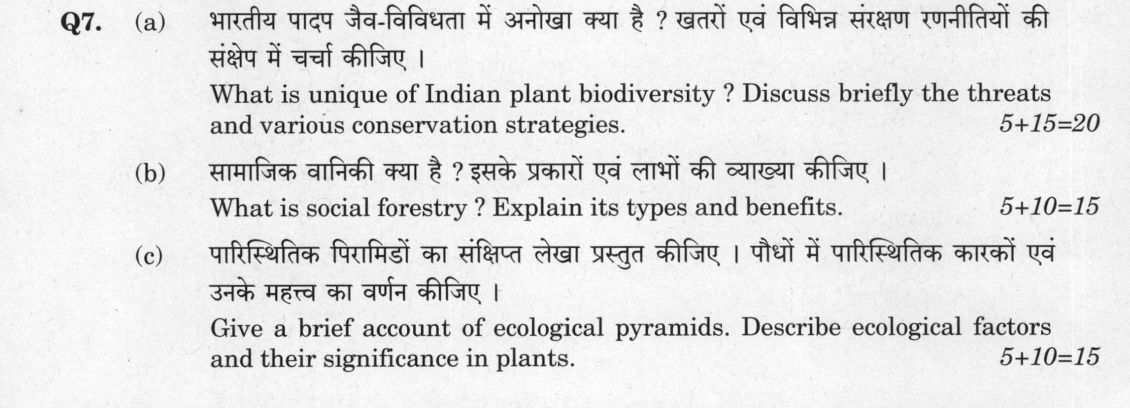
What is unique of Indian plant biodiversity ? Discuss briefly the threats and various conservation strategies. 5+15=20
What is social forestry ? Explain its types and benefits. 5+10=15
Give a brief account of ecological pyramids. Describe ecological factors and their significance in plants. 5+10=15
हिंदी में प्रश्न पढ़ें
भारतीय पादप जैव-विविधता में अनोखा क्या है ? खतरों एवं विभिन्न संरक्षण रणनीतियों की संक्षेप में चर्चा कीजिए । 5+15=20
सामाजिक वानिकी क्या है ? इसके प्रकारों एवं लाभों की व्याख्या कीजिए । 5+10=15
पारिस्थितिक पिरामिडों का संक्षिप्त लेखा प्रस्तुत कीजिए । पौधों में पारिस्थितिक कारकों एवं उनके महत्व का वर्णन कीजिए । 5+10=15
Model answer
Written by UPSC Answer Check against this question's marking rubric, to the expected length. UPSC does not publish answers for Mains — this is one way to score well, not an official key.
Indian Plant Biodiversity, Threats, and Conservation Strategies
India is recognized as one of the world's 17 megadiverse nations, housing nearly 8% of global floral and faunal species within just 2.4% of the global landmass. This uniqueness stems from its evolutionary history across ten distinct biogeographical zones, spanning four global biodiversity hotspots including the Western Ghats, Eastern Himalayas, Indo-Burma, and Sundaland. The flora exhibits remarkable endemism, with approximately 36% of vascular plant species restricted to the Indian subcontinent. Moreover, as identified by Nikolai Vavilov, India represents a primary center of origin and diversity for economically vital crops, notably rice, sugarcane, and numerous pulses, alongside rich wild relatives.
Despite this richness, plant diversity faces severe anthropogenic pressures. Habitat destruction and fragmentation, historically driving deforestation rates upwards of 1.5 million hectares annually, disrupt viable populations. Biological invasions by aggressive alien taxa like Lantana camara and Parthenium hysterophorus suppress native regeneration. Overexploitation poses existential risks to economically prized and medicinal taxa, exemplified by the decline of Taxus wallichiana due to taxol harvesting. Furthermore, climate-induced range shifts threaten narrow-endemic alpine and montane ecosystems.
Conservation strategies encompass both in-situ and ex-situ approaches. In-situ protection is operationalized through a protected area network comprising 18 Biosphere Reserves, 106 National Parks, 564 Wildlife Sanctuaries, and indigenous sacred groves. Ex-situ preservation is spearheaded by institutions such as the National Bureau of Plant Genetic Resources (NBPGR) for germplasm conservation, the Botanical Survey of India (BSI) gardens, and the Forest Research Institute (FRI), Dehradun. These frameworks are reinforced globally by India’s commitments under the Convention on Biological Diversity (CBD) and the Nagoya Protocol on Access and Benefit Sharing.
Social Forestry: Types and Benefits
Social forestry refers to the management and protection of forests as well as afforestation on barren, degraded, and non-forest lands to aid environmental, social, and rural development. It is broadly categorized into four types:
- Farm forestry, where individual farmers raise commercial and multipurpose tree crops on bunds and marginal agricultural holdings;
- Community forestry, involving the collective planting of trees on public or panchayat-owned common lands to benefit the community directly;
- Extension forestry, which encompasses linear strip plantations along canal banks, railway lines, and highways to expand green cover outside traditional forests;
- Urban forestry, focused on raising green belts, arboriculture, and recreational parks in peri-urban and urban landscapes.
The benefits are multidimensional. It secures rural requirements for fuelwood, small timber, and livestock fodder, reducing biotic interference on natural forests. It acts as a massive rural livelihood driver, generating approximately 30 million person-days of employment annually. Environmentally, social forestry enhances carbon sequestration, mitigates microclimatic extremes, controls soil erosion, and promotes watershed stabilization.
Ecological Pyramids and Ecological Factors in Plants
Ecological pyramids graphically represent trophic structure. The pyramid of numbers illustrates individual abundance at each trophic level; it is upright in grasslands but spindle-shaped or inverted in single-tree, parasite-dominated systems. The pyramid of biomass shows standing dry weight, remaining upright in terrestrial forests but characteristically inverted in aquatic ecosystems where primary producers (phytoplankton) exhibit rapid turnover and lower standing biomass than consumers. The pyramid of energy is universally upright, governed by Lindeman’s 10% law of thermodynamic transfer between successive trophic tiers.
Ecological factors governing plants comprise abiotic components (light quality and photoperiod, temperature regimes, water availability, edaphic profiles, and topographic slope/aspect) and biotic interactions (interspecific competition, herbivory, mycorrhizal and pollinator mutualisms). In plant life, these factors fundamentally dictate latitudinal and altitudinal zonation, control phenological events such as vernalization and flowering, and drive physiological adaptations like C4 and CAM photosynthetic pathways in arid regimes. Ultimately, the interplay of these factors shapes community assembly, stratification, and the directional trajectories of ecological succession.
A synergistic approach that integrates traditional ecological knowledge, rigorous in-situ and ex-situ linkages, and community-led social forestry is essential to sustainably manage India's botanical heritage amidst accelerating environmental change.
What "Discuss" is asking you to do
Lay the issue out from more than one side — how it arose, what is claimed for it, what is held against it, and where it now stands. UPSC attaches discuss to broad topics with several live dimensions, so coverage of the dimensions earns more than the strength of your opinion.
Structure that answers it
Set the issue up → the case as it is made → the case against → the dimension both sides leave out → where the balance now lies
Where marks are lost
Listing facts with no thread between them, or arguing one side throughout and calling it a discussion.
How this answer will be evaluated
Approach
Framework: UPSC Botany Paper 2. (a) discuss: intro > 3-4 dimensions > example > balanced close | (b) explain: definition/context > points in order > small example > short close | (c) describe: define > structure or process in order > labelled diagram > significance Full marks: Comprehensive, specific, and well-structured answers with named species and legal references.
Key points expected
- Mention high endemism and ancient flora (Gymnosperms)
- Identify threats: deforestation, habitat loss, over-exploitation
- List strategies: in-situ (National Parks), ex-situ (Botanical Gardens)
- Reference legal framework: Wildlife Protection Act 1972
- Define social forestry (planting trees on public land)
- List types: Urban, Farm, and Extension forestry
- Explain benefits: fuel, fodder, soil conservation
- Mention specific tree species used (e.g., *Neem*, *Babool*)
Evaluation rubric
Each sub-part is marked on its own, against the marks and word limit printed on the paper.
- (a) Define uniqueness of Indian plant biodiversity and discuss threats and conservation strategies. 20 marks
discuss— intro → 3-4 dimensions → example → balanced close
Must cover
- Mention high endemism and ancient flora (Gymnosperms)
- Identify threats: deforestation, habitat loss, over-exploitation
- List strategies: in-situ (National Parks), ex-situ (Botanical Gardens)
- Reference legal framework: Wildlife Protection Act 1972
Loses marks
- Confusing plant and animal biodiversity
- Vague threats without specific examples
- Ignoring legal/conservation strategies
Earns more
- Mention specific endemic species (e.g., *Ginkgo biloba*)
- Reference Project Tiger or specific sanctuaries
- Mention IUCN Red List status of threatened species
Extra mark
- Mention specific recent biotech conservation (e.g., tissue culture of *Vanda*)
- Reference specific state-level conservation acts
- (b) Define social forestry and explain its types and benefits. 15 marks
explain— definition/context → points in order → small example → short close
Must cover
- Define social forestry (planting trees on public land)
- List types: Urban, Farm, and Extension forestry
- Explain benefits: fuel, fodder, soil conservation
- Mention specific tree species used (e.g., *Neem*, *Babool*)
Loses marks
- Confusing social forestry with agroforestry
- Vague benefits without specific examples
- Ignoring types of social forestry
Earns more
- Mention specific government schemes (e.g., National Afforestation Programme)
- Discuss economic benefits for rural communities
- Mention specific soil conservation techniques
Extra mark
- Reference specific state-level social forestry initiatives
- Mention specific economic data on fuelwood savings
- (c) Describe ecological pyramids and ecological factors in plants. 15 marks
describe— define → structure or process in order → labelled diagram → significance
Must cover
- Define ecological pyramids (Energy, Biomass, Numbers)
- Explain ecological factors: Biotic and Abiotic
- Mention specific abiotic factors: Light, Temperature, Water
- Explain significance of factors in plant growth
Loses marks
- Confusing ecological pyramids with food chains
- Vague ecological factors without specific examples
- Ignoring significance of factors in plant growth
Earns more
- Mention specific biotic factors: Predators, Parasites
- Discuss specific plant adaptations to abiotic factors
- Reference specific ecological studies or experiments
Extra mark
- Mention specific recent ecological studies on plant adaptation
- Reference specific ecological models or theories
Practice this exact question
Write your answer and it is marked point by point against the model answer above — what you covered, what you missed, what you got wrong.
Evaluate my answer →More from Botany 2021 Paper II
- Q4 (a) Describe various methods of gene transfer in plants. 20 (b) Give an account of Operon…
- Q5 Write short notes on the following : 10×5=50 (a) Alkaloids and their significance 10 (b)…
- Q6 (a) Describe C₄ cycle of photosynthesis and differentiate amongst C₃, C₄ and CAM plants.…
- Q7 (a) What is unique of Indian plant biodiversity ? Discuss briefly the threats and various…
- Q8 (a) What are the different types and causes of seed dormancy ? Describe various methods u…