Paper II — Q2
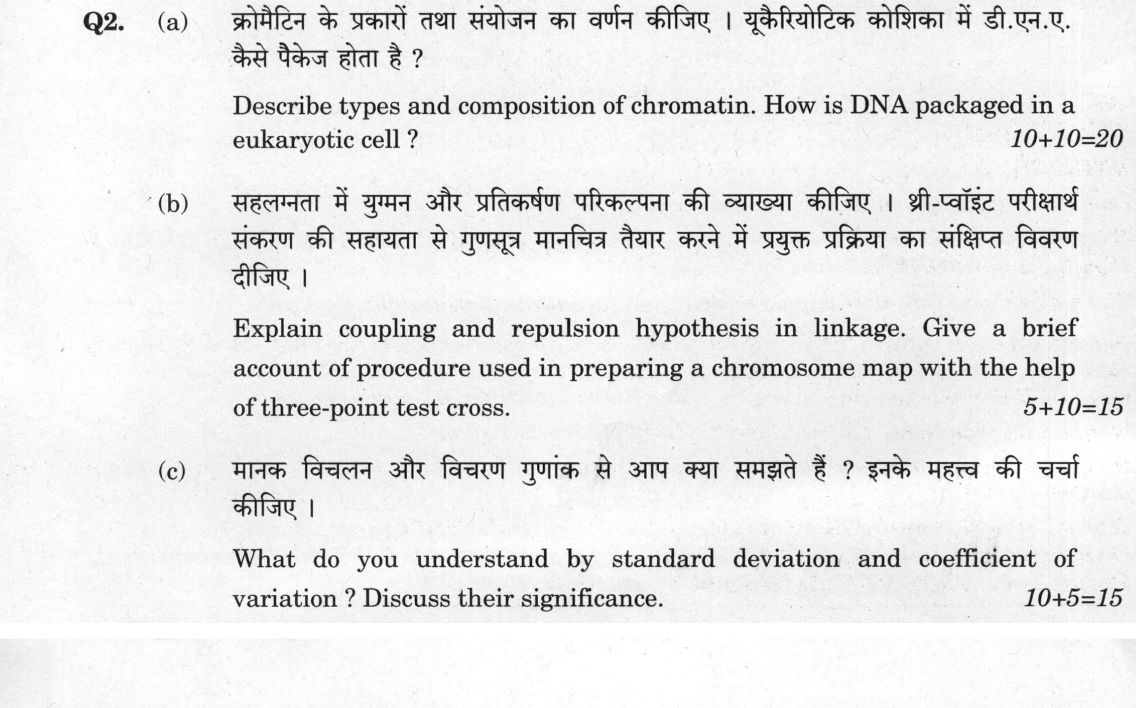
(a) Describe types and composition of chromatin. How is DNA packaged in a eukaryotic cell ? 10+10=20 (b) Explain coupling and…
Describe types and composition of chromatin. How is DNA packaged in a eukaryotic cell ? 10+10=20
Explain coupling and repulsion hypothesis in linkage. Give a brief account of procedure used in preparing a chromosome map with the help of three-point test cross. 5+10=15
What do you understand by standard deviation and coefficient of variation ? Discuss their significance. 10+5=15
हिंदी में प्रश्न पढ़ें
क्रोमेटिन के प्रकारों तथा संयोजन का वर्णन कीजिए । यूकेरियोटिक कोशिका में डी.एन.ए. कैसे पैकेज होता है ? 10+10=20
सहलग्नता में युग्मन और प्रतिकर्षण परिकल्पना की व्याख्या कीजिए । त्री-पॉइंट परीक्षार्थ संकरण की सहायता से गुणसूत्र मानचित्र तैयार करने में प्रयुक्त प्रक्रिया का संक्षिप्त विवरण दीजिए । 5+10=15
मानक विचलन और विचरण गुणांक से आप क्या समझते हैं ? इनके महत्व की चर्चा कीजिए । 10+5=15
Model answer
Written by UPSC Answer Check against this question's marking rubric, to the expected length. UPSC does not publish answers for Mains — this is one way to score well, not an official key.
Types and Composition of Chromatin
Chromatin is the nucleoprotein complex constituting eukaryotic chromosomes. Functionally and structurally, it is classified into Euchromatin and Heterochromatin. Euchromatin is lightly packed, transcriptionally active, and enriched in hyperacetylated core histones. Heterochromatin is densely packed, transcriptionally silent, and characterized by hypoacetylated histones and specific epigenetic marks such as trimethylated histone H3 lysine 9 (H3K9me3). Heterochromatin is further divided into constitutive heterochromatin (permanently condensed across all cell types, e.g., centromeric and telomeric regions) and facultative heterochromatin (condensed conditionally in response to developmental cues, such as the mammalian Barr body).
Chemically, chromatin comprises double-stranded DNA, basic histone proteins, non-histone chromosomal proteins (NHCPs), and trace amounts of nascent RNA. Histones occur in equimolar amounts as an octamer containing two molecules each of H2A, H2B, H3, and H4, alongside linker histone H1.
DNA Packaging in Eukaryotes
DNA compaction proceeds through a hierarchical series of structural orders:
- Nucleosome Fibre (11 nm): The fundamental repeating unit is the nucleosome ("beads-on-a-string"), where 146 base pairs of DNA wrap 1.65 turns around the core histone octamer (H2A-H2B-H3-H4)₂. Linker DNA (20–60 bp) joins adjacent nucleosomes.
- Solenoid Fibre (30 nm): Histone H1 binds the entry-exit site of linker DNA, condensing the 11 nm nucleosome chain into a regular 30 nm solenoid or zigzag higher-order fibre with approximately six nucleosomes per turn.
- Looped Domains (300 nm): The 30 nm fibre forms loop domains anchored to an internal non-histone protein scaffold (topoisomerase II and condensins).
- Chromonema (700 nm) to Metaphase Chromosome (1400 nm): During cell division, loops undergo progressive radial coiling to form 700 nm chromatids, culminating in the fully condensed 1400 nm metaphase chromosome.
Coupling and Repulsion Hypothesis
Discovered by Bateson and Punnett in Lathyrus odoratus, the hypothesis described non-random gametic combinations. Coupling occurs when two dominant alleles (AB) or two recessive alleles (ab) are inherited together from the same parent (cis-configuration). Repulsion occurs when a dominant allele of one locus is inherited alongside a recessive allele of another (Ab and aB) from opposite parents (trans-configuration). T.H. Morgan later established that both phenomena are manifestations of chromosomal linkage, where alleles residing on the same chromosome stay together unless separated by crossing over.
Three-Point Test Cross and Chromosome Mapping
A three-point test cross involves mating a trihybrid individual (AaBbCc) with a homozygous triple recessive tester (aabbcc). The mapping procedure involves:
- Phenotypic Classification: The resulting progeny are sorted into eight distinct phenotypic classes: two parental classes (most frequent), four single crossover classes (SCO1 and SCO2, intermediate frequency), and two double crossover classes (DCO, least frequent).
- Gene Order Determination: The gene order is established by comparing the DCO phenotypes with the parental phenotypes; the locus that is switched relative to the parental arrangement represents the middle gene.
- Recombination Frequency (RF) and Map Construction: Recombination distances between adjacent pairs of genes are calculated as: RF = (Total SCO + Total DCO)/(Total Progeny) × 100 Each 1% recombination equals 1 centiMorgan (cM) or map unit (mu). Aligning these additive map intervals establishes the linear chromosome map.
Standard Deviation, Coefficient of Variation, and Significance
Standard Deviation (SD, σ) is an absolute measure of dispersion, defined as the positive square root of the mean squared deviations of individual observations from their arithmetic mean.
Coefficient of Variation (CV) is a relative measure of dispersion, expressed as the percentage ratio of standard deviation to the mean: CV = ((σ)/(X̄)) × 100
Significance:
- Scale-Independent Comparison: While SD is expressed in the original units of measurement, CV is dimensionless, permitting valid comparisons of variability between traits with vastly different magnitudes or units (e.g., comparing plant height in cm with yield in kg/plot).
- Experimental Precision: In agricultural breeding and field trials (such as ICAR multi-location trials), a lower CV indicates greater experimental accuracy, consistency of replicates, and reduced experimental error.
- Quantitative Genetics: SD defines the distribution spread in polygenic inheritance, whereas CV quantifies the extent of phenotypic stability across diverse genetic lines.
An understanding of chromatin architecture provides the structural foundation for chromosome mechanics and recombination, which, when analyzed through linkage mapping and biometrical measures like standard deviation and coefficient of variation, enables precise genetic analysis and crop breeding strategies.
What "Describe" is asking you to do
Give a full, ordered account of the thing named — its parts, stages or mechanism — in the sequence in which it actually exists or occurs. Most describe questions come from the science optionals, where the marks sit in correct technical detail and, where the stem says so, a labelled diagram.
Structure that answers it
One-line identification of the subject → the parts or stages in their real order, each with its defining detail → labelled diagram where the subject is structural → closing line on function or significance
Where marks are lost
Loose general prose where the examiner is ticking named parts, correct terminology and their sequence; and in the General Studies papers, turning to evaluation before the description is finished.
How this answer will be evaluated
Approach
Framework: Botany Paper 2: Define > Structure/Process > Labelled Diagram > Significance. (a) describe: define > structure or process in order > labelled diagram > significance | (b) explain: definition/context > points in order > small example > short close | (c) discuss: intro > 3-4 dimensions > example > balanced close Full marks: Complete definitions, accurate diagrams, stepwise processes, specific examples, and clear significance
Key points expected
- Distinguish euchromatin and heterochromatin
- Identify histone proteins (H1-H4) and nucleosome structure
- Describe DNA packaging levels (beads-on-string to 30nm fiber)
- Include a labelled diagram of chromatin structure
- Define coupling and repulsion phases
- Explain three-point test cross procedure stepwise
- Describe recombination frequency calculation
- Show how gene order is determined
Evaluation rubric
Each sub-part is marked on its own, against the marks and word limit printed on the paper.
- (a) Define chromatin types/composition and explain eukaryotic DNA packaging hierarchy. 20 marks
describe— define → structure or process in order → labelled diagram → significance
Must cover
- Distinguish euchromatin and heterochromatin
- Identify histone proteins (H1-H4) and nucleosome structure
- Describe DNA packaging levels (beads-on-string to 30nm fiber)
- Include a labelled diagram of chromatin structure
Loses marks
- Unlabelled or missing diagram
- Confusing prokaryotic and eukaryotic packaging
- Omitting histone composition details
Earns more
- Mention specific histone modifications
- Reference specific eukaryotic model organism
- Link to gene expression regulation
- Mention recent biotech application in chromatin engineering
Extra mark
- Named specific histone variant
- Recent CRISPR-based chromatin modification example
- (b) Explain coupling/repulsion in linkage and describe three-point test cross mapping procedure. 15 marks
explain— definition/context → points in order → small example → short close
Must cover
- Define coupling and repulsion phases
- Explain three-point test cross procedure stepwise
- Describe recombination frequency calculation
- Show how gene order is determined
Loses marks
- Confusing coupling with repulsion
- Omitting recombination frequency calculation
- Not showing how gene order is determined
Earns more
- Include worked example with specific genes
- Mention interference and coefficient of coincidence
- Reference specific organism used in classic experiments
- Link to modern genetic mapping applications
Extra mark
- Named specific classic experiment (e.g., Sturtevant's Drosophila work)
- Recent application in crop genome mapping
- (c) Define standard deviation and coefficient of variation, discuss their significance in biological data. 15 marks
discuss— intro → 3-4 dimensions → example → balanced close
Must cover
- Define standard deviation with formula
- Define coefficient of variation with formula
- Explain significance of each measure
- Provide biological example or application
Loses marks
- Missing or incorrect formulas
- Not distinguishing between SD and CV
- No biological context or example
Earns more
- Compare when to use SD vs CV
- Reference specific biological dataset or study
- Link to experimental design or statistical analysis
- Mention limitations of each measure
Extra mark
- Named specific statistical software or package
- Recent application in genomic or phenotypic data analysis
Practice this exact question
Write your answer and it is marked point by point against the model answer above — what you covered, what you missed, what you got wrong.
Evaluate my answer →More from Botany 2021 Paper II
- Q1 Write short notes on the following : 10×5=50 (a) Cell adhesion molecules 10 (b) Ribosomal…
- Q2 (a) Describe types and composition of chromatin. How is DNA packaged in a eukaryotic cell…
- Q3 (a) Describe properties of genetic code and briefly explain Wobble hypothesis. 15+5=20 (b…
- Q4 (a) Describe various methods of gene transfer in plants. 20 (b) Give an account of Operon…
- Q5 Write short notes on the following : 10×5=50 (a) Alkaloids and their significance 10 (b)…