Paper II — Q4
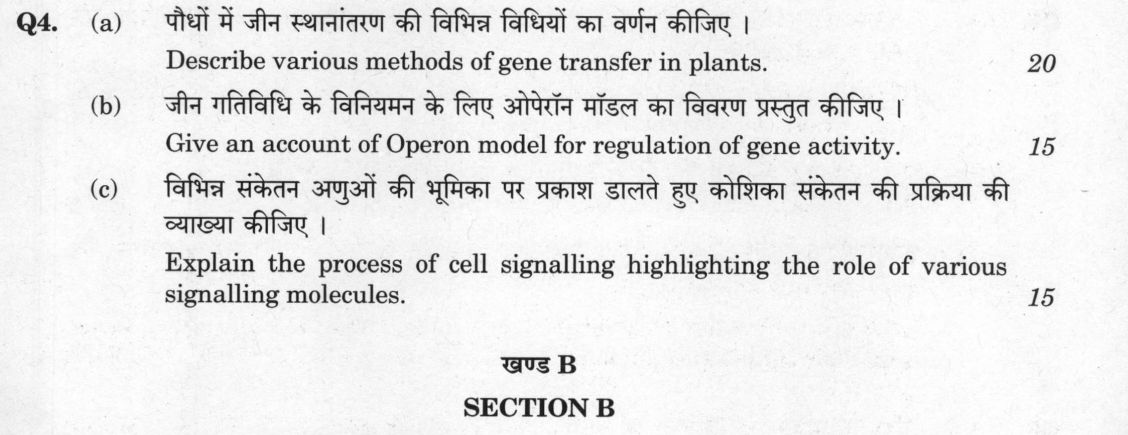
(a) Describe various methods of gene transfer in plants. 20 (b) Give an account of Operon model for regulation of gene activity…
Describe various methods of gene transfer in plants. 20 marks
Give an account of Operon model for regulation of gene activity. 15 marks
Explain the process of cell signalling highlighting the role of various signalling molecules. 15 marks
हिंदी में प्रश्न पढ़ें
पौधों में जीन स्थानांतरण की विभिन्न विधियों का वर्णन कीजिए । 20
जीन गतिविधि के विनियमन के लिए ऑपेरॉन मॉडल का विवरण प्रस्तुत कीजिए । 15
विभिन्न संकेतन अणुओं की भूमिका पर प्रकाश डालते हुए कोशिका संकेतन की प्रक्रिया की व्याख्या कीजिए । 15
Model answer
Written by UPSC Answer Check against this question's marking rubric, to the expected length. UPSC does not publish answers for Mains — this is one way to score well, not an official key.
Plant genetic engineering, regulation of gene activity, and physiological coordination operate as an interconnected continuum, wherein gene transfer facilitates genetic modification, operon dynamics illustrate transcriptional control, and cell signalling orchestrates downstream phenotypic responses.
Methods of Gene Transfer in Plants
Gene transfer methods in plants are broadly classified into vector-mediated (indirect) and direct (physical/chemical) systems.
Vector-mediated transfer predominantly relies on Agrobacterium tumefaciens and Agrobacterium rhizogenes carrying modified Ti (Tumor-inducing) and Ri plasmids, respectively. The T-DNA region, flanked by 25-bp direct border repeats, is excised and transferred into the host plant genome upon induction of virulence (vir) genes (e.g., virA, virG, virD, virE) triggered by plant phenolics like acetosyringone. Disarmed binary vector systems, separating T-DNA and vir helper plasmids, enable targeted transgene delivery. Plant viral vectors derived from Tobacco Mosaic Virus (TMV) and Cauliflower Mosaic Virus (CaMV) are also utilized for transient and high-yield expression.
Direct gene transfer overcomes host-range limitations of Agrobacterium and includes:
- Particle Bombardment (Biolistics/Gene Gun): Microprojectiles of heavy metals (gold or tungsten) coated with plasmid DNA are accelerated under helium pressure to penetrate intact tissues and monocot embryogenic calli.
- Electroporation: High-voltage electrical pulses create transient micropores in protoplast or pollen membranes, allowing naked DNA uptake.
- Chemical Methods (PEG-mediated): Polyethylene glycol in the presence of divalent cations (Ca²⁺) alters plasma membrane permeability in isolated protoplasts.
- Other physical techniques: Microinjection (direct injection into the nucleus using glass micropipettes), silicon carbide fibres (whiskers creating mechanical micro-wounds), ultrasound-mediated sonication, and laser microbeam-induced perforation.
In comparison, *Agrobacterium*-mediated transformation yields lower copy numbers, clean integration patterns, and stable Mendelian inheritance, making it standard for dicots, whereas biolistics permits broad explant competence (including monocots and plastids) but frequently causes multi-copy insertion and gene silencing. Transformation constructs incorporate selectable markers (e.g., nptII, hpt, bar) and reporter genes (gusA, gfp), widely applied in Indian crop improvement, such as Bt cotton approved by GEAC and biofortified lines developed by ICAR institutions.
Operon Model for Regulation of Gene Activity
Formulated by François Jacob and Jacques Monod (1961), the operon represents a polycistronic functional unit of prokaryotic gene regulation comprising structural genes, a promoter (P), an operator (O), and an independent regulatory gene (I).
In the inducible lac operon (lacZ, lacY, lacA):
- Negative control: In the absence of lactose, the LacI repressor binds the operator, sterically hindering RNA polymerase. When present, the inducer allolactose (or synthetic IPTG) binds allosterically to the repressor, causing conformational changes that release it from the operator to permit transcription.
- Positive control (Catabolite Repression): Under low glucose conditions, elevated cyclic AMP (cAMP) binds Catabolite Activator Protein (CAP). The CAP-cAMP complex binds upstream of the promoter, bending DNA to recruit RNA polymerase.
In the repressible tryptophan (trp) operon (trpE to trpA), excess corepressor (L-tryptophan) binds the TrpR aporepressor to activate operator binding, arresting synthesis. It is fine-tuned by attenuation, where ribosome stalling at the tryptophan-rich leader (trpL) sequence determines alternative secondary RNA hairpin formations (antiterminator 2:3 loop vs. terminator 3:4 loop). While prokaryotic operons coordinate polycistronic transcripts, eukaryotic plant genomes are predominantly monocistronic, relying on complex promoter architecture, chromatin remodeling, and enhancers.
Cell Signalling and Signalling Molecules
Cellular signalling operates through signal perception, intracellular transduction, amplification, and cellular response.
Perception occurs via cell-surface or intracellular receptors, including Receptor-Like Kinases (RLKs such as BRI1), G-protein-coupled receptors (GPCRs), and ligand-gated ion channels. Transduction recruits second messengers including cytosolic Ca²⁺, inositol 1,4,5-trisphosphate (IP₃), diacylglycerol (DAG), and cyclic nucleotides. Amplification occurs through protein phosphorylation cascades, particularly Mitogen-Activated Protein Kinase (MAPK) cascades and Calcium-Dependent Protein Kinases (CDPKs), which alter phosphorylation states of target transcription factors (e.g., WRKY, MYB, bZIP) to modify gene expression.
Key plant signalling molecules include:
- Phytohormones: Auxin (sensed by TIR1-Aux/IAA promoting growth), Abscisic acid (PYR/PYL/RCAR-PP2C-SnRK2 pathway mediating stomatal closure and stress tolerance), Gibberellins (GID1-DELLA degradation), Cytokinins (two-component phosphorelay via AHK receptors), Ethylene (ETR1-CTR1-EIN2 pathway for ripening), and Brassinosteroids (BRI1-BAK1 complex).
- Peptide hormones: Systemin triggering systemic wound responses and CLAVATA3 (CLV3) maintaining shoot apical meristem homeostasis.
- Defense and lipid signals: Jasmonic acid (via COI1-JAZ) mediating herbivory defense, Salicylic acid (via NPR1) activating Systemic Acquired Resistance (SAR), and Reactive Oxygen Species (ROS, e.g., H_2O₂) acting as localized oxidative burst triggers.
Modern plant biotechnology harnesses these interconnected paradigms, integrating operon-inspired multigene constructs, signal-responsive synthetic promoters, and precision CRISPR-Cas genome editing under ICAR mandates to deliver climate-resilient and pest-resistant Indian agriculture.
What "Describe" is asking you to do
Give a full, ordered account of the thing named — its parts, stages or mechanism — in the sequence in which it actually exists or occurs. Most describe questions come from the science optionals, where the marks sit in correct technical detail and, where the stem says so, a labelled diagram.
Structure that answers it
One-line identification of the subject → the parts or stages in their real order, each with its defining detail → labelled diagram where the subject is structural → closing line on function or significance
Where marks are lost
Loose general prose where the examiner is ticking named parts, correct terminology and their sequence; and in the General Studies papers, turning to evaluation before the description is finished.
How this answer will be evaluated
Approach
Framework: Botany Paper 2: Define > Structure/Process > Labelled Diagram > Significance. (a) describe: define > structure or process in order > labelled diagram > significance | (b) account for: state the phenomenon > the causes in order of weight > conclusion | (c) explain: definition/context > points in order > small example > short close Full marks: Comprehensive coverage of all methods/mechanisms with accurate labelled diagrams, specific examples, and clear logical flow.
Key points expected
- Agrobacterium-mediated transformation (Ti plasmid, T-DNA integration)
- Direct methods: Gene gun (biolistics) and Electroporation
- Protoplast transformation (PEG-mediated) and Microinjection
- Labelled diagram of Agrobacterium or Gene gun mechanism
- Components: Promoter, Operator, Structural genes, Regulator gene
- Repressible vs Inducible operons (e.g., *lac* vs *trp*)
- Mechanism of repressor binding and RNA polymerase interaction
- Labelled diagram of *lac* operon structure
Evaluation rubric
Each sub-part is marked on its own, against the marks and word limit printed on the paper.
- (a) Systematic account of plant gene transfer methods with mechanisms and applications. 20 marks
describe— define → structure or process in order → labelled diagram → significance
Must cover
- Agrobacterium-mediated transformation (Ti plasmid, T-DNA integration)
- Direct methods: Gene gun (biolistics) and Electroporation
- Protoplast transformation (PEG-mediated) and Microinjection
- Labelled diagram of Agrobacterium or Gene gun mechanism
Loses marks
- Unlabelled diagrams of transformation vectors
- Confusing animal gene transfer methods with plant
- Lack of distinction between direct and indirect methods
Earns more
- Viral vectors (e.g., CaMV 35S promoter context)
- Recent biotech application (e.g., Bt cotton, Golden Rice)
- Comparison of efficiency between direct and indirect methods
- Mention of specific cultivars or species (e.g., *Nicotiana tabacum*)
Extra mark
- Specific named cultivar (e.g., Bt Brinjal)
- Recent CRISPR/Cas9 application in plants
- (b) Detailed explanation of the Operon model mechanism for gene regulation. 15 marks
account for— state the phenomenon → the causes in order of weight → conclusion
Must cover
- Components: Promoter, Operator, Structural genes, Regulator gene
- Repressible vs Inducible operons (e.g., *lac* vs *trp*)
- Mechanism of repressor binding and RNA polymerase interaction
- Labelled diagram of *lac* operon structure
Loses marks
- Confusing promoter with operator function
- Omitting the role of the repressor protein
- Unlabelled or incorrect operon diagram
Earns more
- Role of CAP (Catabolite Activator Protein) in *lac* operon
- Attenuation mechanism in *trp* operon
- Comparison of prokaryotic vs eukaryotic regulation
- Specific mention of *E. coli* as the model organism
Extra mark
- Mention of specific mutations (e.g., *lacI^s*)
- Link to metabolic pathway efficiency
- (c) Stepwise process of cell signalling with specific roles of signalling molecules. 15 marks
explain— definition/context → points in order → small example → short close
Must cover
- Three stages: Reception, Transduction, Response
- Role of ligands (hormones, neurotransmitters) and receptors
- Signal transduction cascades (e.g., second messengers like cAMP, Ca2+)
- Labelled diagram of a signalling pathway (e.g., G-protein coupled)
Loses marks
- Vague description without naming specific molecules
- Omitting the signal transduction step
- Unlabelled diagrams of signalling pathways
Earns more
- Specific examples: Insulin signalling, Acetylcholine at neuromuscular junction
- Role of kinases and phosphatases in transduction
- Distinction between autocrine, paracrine, and endocrine signalling
- Mention of specific signalling molecules (e.g., cGMP, IP3)
Extra mark
- Specific disease linked to signalling defect (e.g., diabetes)
- Mention of specific receptor types (e.g., RTK, GPCR)
Practice this exact question
Write your answer and it is marked point by point against the model answer above — what you covered, what you missed, what you got wrong.
Evaluate my answer →More from Botany 2021 Paper II
- Q1 Write short notes on the following : 10×5=50 (a) Cell adhesion molecules 10 (b) Ribosomal…
- Q2 (a) Describe types and composition of chromatin. How is DNA packaged in a eukaryotic cell…
- Q3 (a) Describe properties of genetic code and briefly explain Wobble hypothesis. 15+5=20 (b…
- Q4 (a) Describe various methods of gene transfer in plants. 20 (b) Give an account of Operon…
- Q5 Write short notes on the following : 10×5=50 (a) Alkaloids and their significance 10 (b)…
- Q6 (a) Describe C₄ cycle of photosynthesis and differentiate amongst C₃, C₄ and CAM plants.…
- Q7 (a) What is unique of Indian plant biodiversity ? Discuss briefly the threats and various…