Paper II — Q1
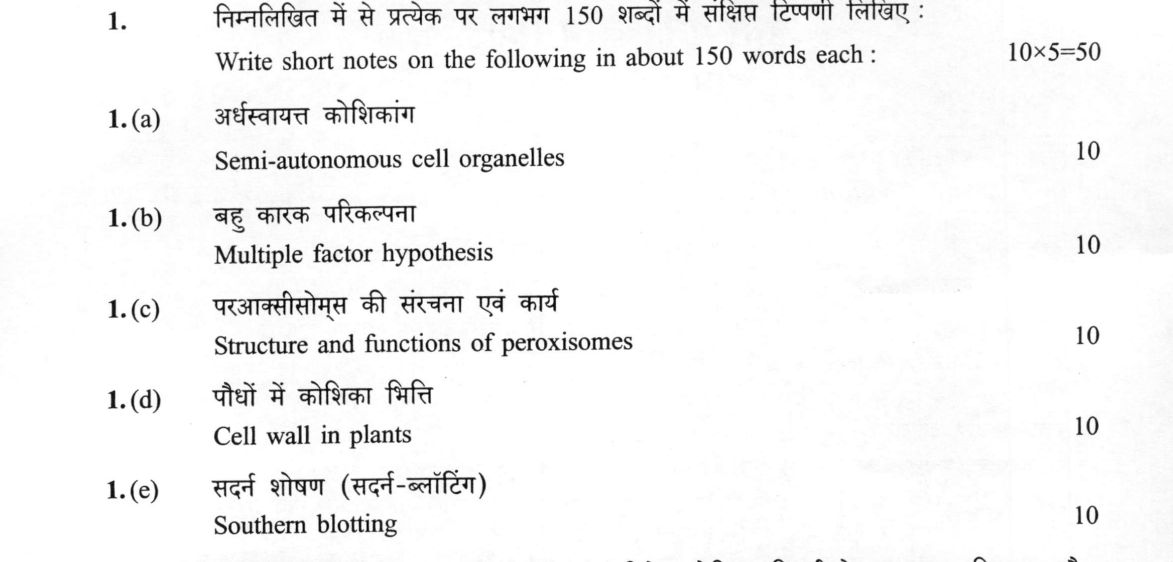
Write short notes on the following in about 150 words each: (a) Semi-autonomous cell organelles (10 marks) (b) Multiple factor…
Write short notes on the following in about 150 words each: Semi-autonomous cell organelles 10 marks
Multiple factor hypothesis 10 marks
Structure and functions of peroxisomes 10 marks
Cell wall in plants 10 marks
Southern blotting 10 marks
हिंदी में प्रश्न पढ़ें
निम्नलिखित में से प्रत्येक पर लगभग 150 शब्दों में संक्षिप्त टिप्पणी लिखिए : अर्धस्वायत्त कोशिकांग (10 अंक)
बहु कारक परिकल्पना (10 अंक)
परऑक्सीसोम्स की संरचना एवं कार्य (10 अंक)
पौधों में कोशिका भित्ति (10 अंक)
सदर्न शोषण (सदर्न-ब्लॉटिंग) (10 अंक)
Model answer
Written by UPSC Answer Check against this question's marking rubric, to the 150-word length. UPSC does not publish answers for Mains — this is one way to score well, not an official key.
Semi-autonomous Cell Organelles Semi-autonomous organelles, primarily mitochondria and chloroplasts, possess unique characteristics that distinguish them from other cellular components. They are enclosed by a double membrane and contain their own circular, double-stranded DNA, which is not associated with histones. Crucially, they harbor 70S ribosomes, distinct from the 80S ribosomes of the cytosol, which are responsible for translating their own mRNA into proteins. While they can synthesize some of their own proteins, they rely heavily on the nuclear genome for the majority of their protein synthesis, with these nuclear-encoded proteins being imported through specific translocase complexes. Their origin is explained by the Endosymbiotic Theory, which posits that they evolved from free-living prokaryotes engulfed by ancestral eukaryotic cells. Their semi-autonomy is further evidenced by their ability to replicate independently of the nuclear cell cycle, maintaining a constant number relative to cell volume. This dual genetic control system allows for rapid adaptation to metabolic demands, making them vital for energy production and photosynthesis.
Multiple Factor Hypothesis The Multiple Factor Hypothesis, proposed by H. Nilsson-Ehle, explains quantitative inheritance in traits controlled by multiple genes, known as polygenic inheritance. Nilsson-Ehle’s classic experiments on wheat kernel color demonstrated that the intensity of red coloration was not governed by simple Mendelian dominance but by the cumulative effect of several gene pairs. He observed that the F2 generation exhibited a continuous range of phenotypes rather than discrete classes, with a ratio approximating 15:1 for two gene pairs, indicating additive gene action. In this model, each dominant allele contributes a small, equal increment to the phenotype, while recessive alleles contribute nothing. The phenotype is thus a result of the sum of these genetic effects, modified by environmental factors. This hypothesis bridges the gap between qualitative and quantitative genetics, explaining why traits like height, skin color, and yield in crops show continuous variation in populations. It underscores that complex traits are not determined by single genes but by the interaction of many loci, each with a minor effect, providing the foundational framework for understanding heritability in agricultural and human genetics.
Structure and Functions of Peroxisomes Peroxisomes are single-membrane-bound organelles found in nearly all eukaryotic cells, playing a critical role in metabolism and detoxification. Structurally, they often contain a dense, crystalline core, which in plant peroxisomes is primarily composed of catalase, an enzyme that breaks down hydrogen peroxide. In animal cells, the core may contain urate oxidase, but in plants, the high concentration of catalase is the defining feature. Their primary function is the detoxification of reactive oxygen species (ROS) generated during metabolic processes, preventing oxidative damage to cellular components. In plants, peroxisomes are central to photorespiration, where they house enzymes like glycolate oxidase and glutamate synthase, facilitating the recycling of carbon lost during the Calvin cycle in C3 plants. Additionally, in germinating seeds, specialized peroxisomes called glyoxysomes perform the glyoxylate cycle, converting stored fats into carbohydrates for energy. This metabolic versatility makes peroxisomes essential for lipid metabolism, amino acid degradation, and the maintenance of cellular redox balance, highlighting their significance in both plant development and stress response.
Cell Wall in Plants The plant cell wall is a rigid extracellular matrix that provides structural support, protection, and shape to plant cells. It is composed of several distinct layers, each with specific chemical compositions and functions. The outermost layer is the middle lamella, rich in calcium and magnesium pectates, which acts as a cementing material binding adjacent cells together. Beneath this lies the primary wall, formed during cell growth, consisting of cellulose microfibrils embedded in a matrix of hemicellulose and pectin. This layer is flexible and allows for cell expansion. In many mature cells, a secondary wall is deposited inside the primary wall, characterized by a higher cellulose content and often impregnated with lignin, a complex phenolic polymer that provides rigidity and water resistance, particularly in xylem vessels. The cell wall is not a static barrier; it contains plasmodesmata, microscopic channels that traverse the wall, allowing for cytoplasmic continuity and communication between cells. The plasticity of the cell wall, regulated by enzymes like expansins, is crucial for cell growth. Lignification in secondary walls is vital for the transport of water and nutrients, making the cell wall a dynamic structure essential for plant integrity and function.
Southern Blotting Southern blotting is a molecular biology technique used to detect specific DNA sequences within a complex mixture. The process begins with the digestion of genomic DNA using restriction endonucleases, which cut the DNA at specific recognition sites, generating fragments of varying sizes. These fragments are then separated based on size via gel electrophoresis. Following separation, the DNA is denatured to single strands and transferred from the gel to a solid support membrane, typically nitrocellulose or nylon, through capillary action. This transfer preserves the spatial arrangement of the DNA bands. The membrane is then hybridized with a labeled probe, a single-stranded DNA or RNA sequence complementary to the target sequence of interest. The probe binds specifically to its complementary sequence on the membrane. Unbound probe is washed away, and the presence of the target DNA is detected through autoradiography if the probe is radioactively labeled, or via chemiluminescence if a non-radioactive label is used. This technique is fundamental in genetic mapping, diagnosis of genetic disorders, and DNA fingerprinting, allowing for the precise identification of specific genes or mutations in a genome.
What "Write short notes" is asking you to do
Five or six self-contained answers, marked separately, typically 10 marks and about 150 words each. Each note must carry its own definition, its two or three defining features and a line on why it matters; a common introduction or conclusion across the notes earns nothing.
Structure that answers it
Per note: one-line definition or identification → two or three features, mechanisms or named examples → one line of significance or Indian application
Where marks are lost
Writing the first two notes at essay length and rationing the rest. Each note is marked on its own, so marks surrendered on a compressed or unattempted note cannot be won back by the long ones.
How this answer will be evaluated
Approach
Framework: Botany Paper 2: Define > Structure/Process > Labelled Diagram > Significance. (a) write short notes: define > 3-4 key features > one example > one-line significance | (b) write short notes: define > 3-4 key features > one example > one-line significance | (c) write short notes: define > 3-4 key features > one example > one-line significance | (d) write short notes: define > 3-4 key features > one example > one-line significance | (e) write short notes: define > 3-4 key features > one example > one-line significance Full marks: All parts: precise definitions, labelled diagrams, specific examples, biotech links.
Key points expected
- Identify mitochondria and chloroplasts as primary examples
- Mention presence of own circular DNA
- Describe independent protein synthesis machinery
- Note endosymbiotic origin
- Define the hypothesis (e.g., by Bohnert or similar)
- List multiple factors (genetic, environmental, hormonal)
- Explain interaction of factors in differentiation
- Provide one example of cell differentiation
Evaluation rubric
Each sub-part is marked on its own, against the marks and word limit printed on the paper.
- (a) Define semi-autonomous organelles and explain their independent replication. 10 marks · 150 words
write short notes— define → 3-4 key features → one example → one-line significance
Must cover
- Identify mitochondria and chloroplasts as primary examples
- Mention presence of own circular DNA
- Describe independent protein synthesis machinery
- Note endosymbiotic origin
Loses marks
- Confusing with fully autonomous organelles
- Omitting the endosymbiotic theory link
Earns more
- Mention double membrane structure
- Reference specific plant species (e.g., *Oryza sativa*)
Extra mark
- Mention specific biotech application (e.g., cytoplasmic male sterility)
- (b) Explain the multiple factor hypothesis regarding cell differentiation. 10 marks · 150 words
write short notes— define → 3-4 key features → one example → one-line significance
Must cover
- Define the hypothesis (e.g., by Bohnert or similar)
- List multiple factors (genetic, environmental, hormonal)
- Explain interaction of factors in differentiation
- Provide one example of cell differentiation
Loses marks
- Confusing with single factor hypothesis
- Vague description of factors
Earns more
- Mention specific plant tissue (e.g., xylem, phloem)
- Reference specific researcher (e.g., Bohnert)
Extra mark
- Link to tissue culture or biotech application
- (c) Describe structure and functions of peroxisomes. 10 marks · 150 words
write short notes— define → 3-4 key features → one example → one-line significance
Must cover
- Describe single membrane structure
- Mention matrix enzymes (catalase, oxidase)
- Explain role in photorespiration (glycolate metabolism)
- Note function in fatty acid oxidation
Loses marks
- Confusing with lysosomes
- Omitting photorespiration link
Earns more
- Mention specific enzyme (e.g., catalase)
- Reference specific plant (e.g., *Nicotiana tabacum*)
Extra mark
- Mention specific biotech application (e.g., stress tolerance)
- (d) Describe the cell wall in plants. 10 marks · 150 words
write short notes— define → 3-4 key features → one example → one-line significance
Must cover
- Define cell wall (primary, secondary)
- Mention composition (cellulose, hemicellulose, pectin)
- Describe structure (lamella, middle lamella)
- Note function (support, protection)
Loses marks
- Confusing with cell membrane
- Omitting composition details
Earns more
- Mention specific component (e.g., lignin)
- Reference specific plant (e.g., *Triticum aestivum*)
Extra mark
- Mention specific biotech application (e.g., cell wall engineering)
- (e) Explain Southern blotting technique. 10 marks · 150 words
write short notes— define → 3-4 key features → one example → one-line significance
Must cover
- Define Southern blotting (DNA transfer)
- Describe steps (restriction digestion, gel electrophoresis, transfer, hybridization)
- Mention use of labeled probe
- Note application (gene detection, fingerprinting)
Loses marks
- Confusing with Northern/Western blotting
- Omitting key steps (e.g., hybridization)
Earns more
- Mention specific probe (e.g., radioactive, non-radioactive)
- Reference specific application (e.g., GMO detection)
Extra mark
- Mention specific biotech application (e.g., forensic analysis)
Practice this exact question
Write your answer and it is marked point by point against the model answer above — what you covered, what you missed, what you got wrong.
Evaluate my answer →More from Botany 2022 Paper II
- Q1 Write short notes on the following in about 150 words each: (a) Semi-autonomous cell orga…
- Q2 (a) Discuss the different processes by which solute moves across cell membrane. (10+10=20…
- Q3 (a) What is organic evolution ? Highlight the mechanisms governing organic evolution. (5+…
- Q4 (a) How male sterility helps in heterosis breeding ? Discuss the application of barnase-b…