Paper II — Q2
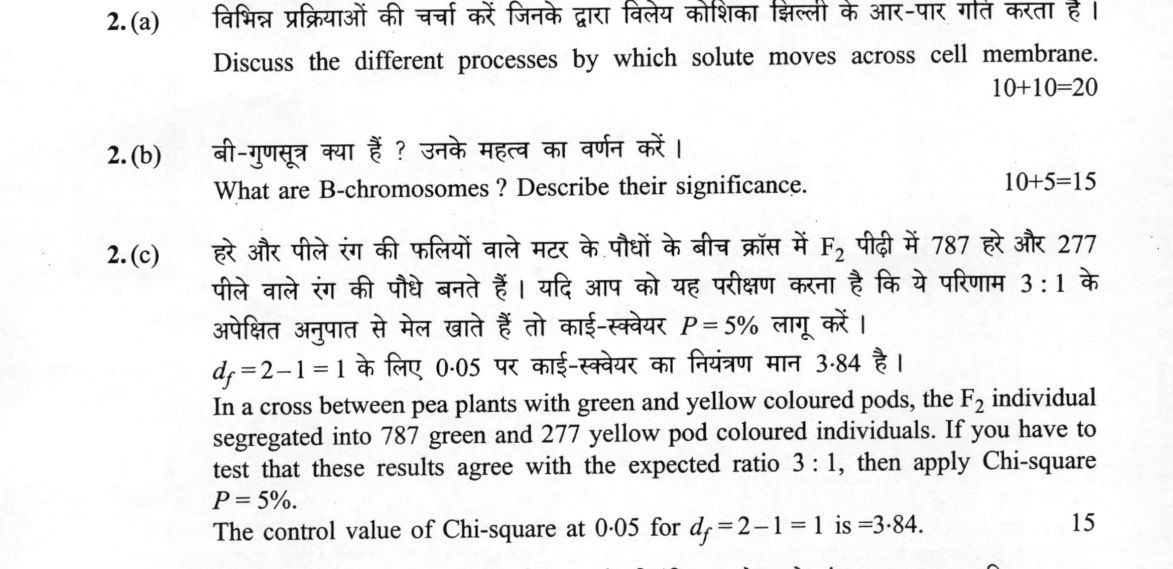
(a) Discuss the different processes by which solute moves across cell membrane. (10+10=20 marks) (b) What are B-chromosomes ?…
Discuss the different processes by which solute moves across cell membrane. (10+10=20 marks)
What are B-chromosomes ? Describe their significance. (10+5=15 marks)
In a cross between pea plants with green and yellow coloured pods, the F₂ individual segregated into 787 green and 277 yellow pod coloured individuals. If you have to test that these results agree with the expected ratio 3 : 1, then apply Chi-square P = 5%. The control value of Chi-square at 0.05 for d_f = 2-1 = 1 is =3.84. 15 marks
हिंदी में प्रश्न पढ़ें
विभिन्न प्रक्रियाओं की चर्चा करें जिनके द्वारा विलेय कोशिका झिल्ली के आर-पार गति करता है । (10+10=20 अंक)
बी-गुणसूत्र क्या हैं ? उनके महत्व का वर्णन करें । (10+5=15 अंक)
हरे और पीले रंग की फलियों वाले मटर के पौधों के बीच क्रॉस में F₂ पीढ़ी में 787 हरे और 277 पीले वाले रंग की पौधे बनते हैं । यदि आप को यह परीक्षण करना है कि ये परिणाम 3 : 1 के अपेक्षित अनुपात से मेल खाते हैं तो काई-स्क्वेयर P = 5% लागू करें । d_f = 2-1 = 1 के लिए 0.05 पर काई-स्क्वेयर का नियंत्रण मान 3.84 है । (15 अंक)
Model answer
Written by UPSC Answer Check against this question's marking rubric, to the expected length. UPSC does not publish answers for Mains — this is one way to score well, not an official key.
Processes of Solute Movement Across Cell Membrane
Solute transport across biological membranes is determined by the selectively permeable lipid bilayer described in Singer and Nicolson’s Fluid Mosaic Model. Transport operates through passive, active, and vesicular pathways modulated by electrochemical gradients.
Passive Transport: Occurs spontaneously down an electrochemical or concentration gradient without metabolic energy expenditure. Simple diffusion allows small, non-polar molecules (O₂, CO₂) to pass directly through the lipid bilayer. Facilitated diffusion utilizes integral membrane proteins: channel proteins (voltage-gated, ligand-gated, and mechanosensitive) facilitate rapid, selective ion flux, while carrier proteins (uniporters) undergo solute-induced conformational changes. Osmotic movement of water and small solutes is accelerated by specialized channel proteins known as aquaporins.
Active Transport: Uphill movement against electrochemical gradients requiring metabolic energy. Primary active transport couples solute movement directly to ATP hydrolysis via pumps such as the plant plasma membrane H⁺-ATPase and animal Na⁺/K⁺-ATPase, generating a membrane potential. Secondary active transport exploits the potential energy of these electrochemical gradients through cotransporters, functioning as symporters (e.g., H⁺/sucrose symport in phloem loading) or antiporters (e.g., Na⁺/H⁺ antiporters in vacuolar compartmentalization).
Vesicular Transport: Transports macromolecules and bulk solutes via membrane-bound vesicles through endocytosis (pinocytosis and receptor-mediated uptake) and exocytosis (secretory vesicle fusion).
B-Chromosomes and Their Significance
B-chromosomes (accessory or supernumerary chromosomes) are dispensable, genetically non-essential, predominantly heterochromatic chromosomes occurring in addition to the standard A-chromosome complement. They are observed in several angiosperms including Zea mays, Secale cereale, and Indian taxa such as Coix aquatica and Plantago coronopus.
Significance: B-chromosomes lack major functional genes and do not produce overt qualitative phenotypic effects, though high numbers can reduce plant vigour and fertility. They bypass Mendelian segregation through specialized accumulation mechanisms (drive systems) involving directed non-disjunction during pollen mitosis. Functionally, they influence nuclear architecture by increasing total nuclear DNA content and cell cycle duration. Crucially, B-chromosomes alter chiasma frequency and recombination patterns among A-chromosomes, modulating genetic variability and acting as evolutionary reservoirs in plant genome dynamics.
Chi-Square (χ²) Goodness-of-Fit Analysis
Null Hypothesis (H₀): There is no significant difference between the observed and expected phenotypic frequencies; the segregation of pod colour conforms to the standard Mendelian monohybrid ratio of 3 Green : 1 Yellow.
Calculations: Total observed individuals (N) = 787 (Green) + 277 (Yellow) = 1064. Expected number of Green pods (E₁) = 3/4 × 1064 = 798. Expected number of Yellow pods (E₂) = 1/4 × 1064 = 266.
Applying the Chi-square formula: χ² = Σ ((O - E)²)/E
χ² = ((787 - 798)²)/798 + ((277 - 266)²)/266
χ² = ((-11)²)/798 + ((11)²)/266 = 121/798 + 121/266 = 0.1516 + 0.4549 = 0.6065 ≈ 0.61
Statistical Inference: Degrees of freedom (df) = n - 1 = 2 - 1 = 1. The critical value of χ² at P = 0.05 (5% significance level) for df = 1 is 3.84. Since the calculated value (χ² = 0.61) is less than the critical table value (3.84), the null hypothesis (H₀) is accepted. The observed deviation is statistically non-significant and attributable purely to random chance, confirming that the pod colour segregation strictly follows the Mendelian 3:1 ratio.
Conclusion
A robust understanding of membrane transport mechanisms, non-canonical chromosomal elements like B-chromosomes, and empirical statistical validation via Chi-square analysis forms the foundational triad for advancing crop physiology, cytogenetic mapping, and targeted plant breeding programs.
What "Discuss" is asking you to do
Lay the issue out from more than one side — how it arose, what is claimed for it, what is held against it, and where it now stands. UPSC attaches discuss to broad topics with several live dimensions, so coverage of the dimensions earns more than the strength of your opinion.
Structure that answers it
Set the issue up → the case as it is made → the case against → the dimension both sides leave out → where the balance now lies
Where marks are lost
Listing facts with no thread between them, or arguing one side throughout and calling it a discussion.
How this answer will be evaluated
Approach
Framework: Mendelian Genetics & Cell Physiology. (a) discuss: intro > 3-4 dimensions > example > balanced close | (b) explain: definition/context > points in order > small example > short close | (c) derive: given > assumptions > stepwise derivation > result > check Full marks: Complete working, labelled diagrams, and precise biological terminology.
Key points expected
- Facilitated diffusion vs active transport
- B-chromosomes as supernumerary elements
- Chi-square calculation: (787-790)²/790 + (277-263)²/263
Evaluation rubric
Each sub-part is marked on its own, against the marks and word limit printed on the paper.
- (a) Detailed analysis of passive and active transport mechanisms across the membrane. 20 marks
discuss— intro → 3-4 dimensions → example → balanced close
Must cover
- Simple diffusion and facilitated diffusion
- Active transport (Na+/K+ pump)
- Bulk transport (endocytosis/exocytosis)
- Labelled diagram of membrane transport
Loses marks
- Unlabelled diagrams
- Confusing osmosis with diffusion
Earns more
- Osmosis and plasmolysis
- Role of ATP in active transport
- Specific carrier proteins (aquaporins)
Extra mark
- Reference to specific plant species
- Biotech application of transporters
- (b) Definition of B-chromosomes and their biological significance. 15 marks
explain— definition/context → points in order → small example → short close
Must cover
- Definition: supernumerary/extra chromosomes
- Non-essential for viability
- Significance: genetic variation
- Significance: evolutionary studies
Loses marks
- Confusing with A-chromosomes
- Vague significance without examples
Earns more
- Example: *Triticum aestivum* (wheat)
- Example: *Allium cepa* (onion)
- Mechanism of non-disjunction
Extra mark
- Link to crop improvement
- Specific cytological observation
- (c) Stepwise calculation of Chi-square value and comparison with critical value. 15 marks
derive— given → assumptions → stepwise derivation → result → check
Must cover
- Calculate expected values (787+277)/4
- Apply Chi-square formula (O-E)²/E
- Compare calculated value with 3.84
- State conclusion on 3:1 ratio
Loses marks
- Skipping calculation steps
- Incorrect conclusion despite right math
Earns more
- Correct tabular presentation
- Explicit statement of degrees of freedom
Extra mark
- Mention of P-value interpretation
- Reference to Mendel's original data
Practice this exact question
Write your answer and it is marked point by point against the model answer above — what you covered, what you missed, what you got wrong.
Evaluate my answer →More from Botany 2022 Paper II
- Q1 Write short notes on the following in about 150 words each: (a) Semi-autonomous cell orga…
- Q2 (a) Discuss the different processes by which solute moves across cell membrane. (10+10=20…
- Q3 (a) What is organic evolution ? Highlight the mechanisms governing organic evolution. (5+…
- Q4 (a) How male sterility helps in heterosis breeding ? Discuss the application of barnase-b…
- Q5 Write short notes on the following in about 150 words each: (a) Symptoms of mineral defic…