Paper II — Q3
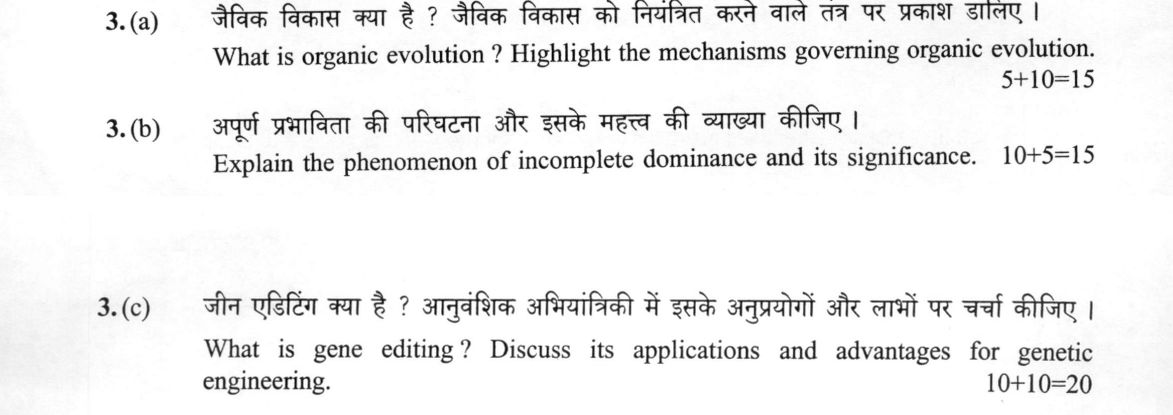
(a) What is organic evolution ? Highlight the mechanisms governing organic evolution. (5+10=15 marks) (b) Explain the phenomenon…
What is organic evolution ? Highlight the mechanisms governing organic evolution. (5+10=15 marks)
Explain the phenomenon of incomplete dominance and its significance. (10+5=15 marks)
What is gene editing ? Discuss its applications and advantages for genetic engineering. (10+10=20 marks)
हिंदी में प्रश्न पढ़ें
जैविक विकास क्या है ? जैविक विकास को नियंत्रित करने वाले तंत्र पर प्रकाश डालिए । (5+10=15 अंक)
अपूर्ण प्रभाविता की परिघटना और इसके महत्व की व्याख्या कीजिए । (10+5=15 अंक)
जीन एडिटिंग क्या है ? आनुवंशिक अभियांत्रिकी में इसके अनुप्रयोगों और लाभों पर चर्चा कीजिए । (10+10=20 अंक)
Model answer
Written by UPSC Answer Check against this question's marking rubric, to the expected length. UPSC does not publish answers for Mains — this is one way to score well, not an official key.
Organic Evolution and Genetic Mechanisms
Organic evolution is defined as the change in the heritable characteristics of biological populations over successive generations, a process Darwin termed "descent with modification." It is not merely a historical fact but an ongoing biological process driven by specific mechanisms. Microevolution refers to changes in allele frequencies within a population, while macroevolution encompasses the emergence of new species and higher taxonomic groups. The Hardy-Weinberg equilibrium serves as the null hypothesis for evolutionary change; any deviation from this equilibrium indicates that evolutionary forces are at work. The primary mechanisms governing these changes include mutation, which introduces new genetic variation; natural selection, which acts non-randomly on phenotypes to increase fitness; genetic drift, which causes random fluctuations in allele frequencies, particularly in small populations; gene flow, which introduces or removes alleles through migration; and non-random mating, which alters genotype frequencies without changing allele frequencies directly.
Incomplete Dominance
Incomplete dominance is a form of intermediate inheritance in which one allele for a specific trait is not completely expressed over its paired allele. This results in a third phenotype, distinct from either homozygous parent. A classic example is found in Mirabilis jalapa (Four o’clock plant) or Antirrhinum majus (Snapdragon). When a red-flowered plant (RR) is crossed with a white-flowered plant (rr), the F1 generation produces pink-flowered plants (Rr). In this context, neither allele is recessive; rather, the heterozygote exhibits an intermediate phenotype due to the partial expression of the pigment-producing enzyme. Self-pollination of the F1 generation yields an F2 phenotypic ratio of 1 Red : 2 Pink : 1 White. This 1:2:1 ratio is the key distinction from complete dominance (3:1) and codominance, where both parental traits are expressed simultaneously and distinctly (e.g., blood type AB). The significance of incomplete dominance lies in its contribution to genetic variation. By producing intermediate phenotypes, it expands the phenotypic range within a population, providing more raw material for natural selection and enhancing evolutionary potential.
Gene Editing
Gene editing refers to a group of technologies that allow scientists to make precise changes to the DNA of a cell. Unlike traditional transgenic approaches that insert foreign DNA, gene editing modifies the organism’s existing genome. The most prominent technology is CRISPR-Cas9, which utilizes a guide RNA (gRNA) to direct the Cas9 nuclease to a specific DNA sequence. The Cas9 protein cuts the DNA at a site adjacent to a Protospacer Adjacent Motif (PAM), triggering repair mechanisms that can be harnessed to knock out or edit genes. This represents a significant advancement over earlier techniques like Zinc Finger Nucleases (ZFNs) and Transcription Activator-Like Effector Nucleases (TALENs), which were more complex, expensive, and less efficient to design.
The applications of gene editing are vast. In agriculture, it is used to develop disease-resistant crops and improve nutritional content. For instance, researchers have used CRISPR to develop wheat varieties resistant to powdery mildew and to enhance the shelf life of tomatoes. In medicine, it holds promise for treating genetic disorders such as sickle cell anemia and beta-thalassemia by correcting the defective gene in patient cells. In India, the National Academy of Sciences has emphasized the need for a robust regulatory framework to govern gene-edited crops, distinguishing them from transgenic organisms under the Biological Diversity Act and the Environment (Protection) Act.
The advantages of gene editing for genetic engineering are profound. It offers high precision, allowing for single-base pair modifications. It is highly efficient and cost-effective compared to older methods, making it accessible to a wider range of laboratories. Furthermore, it enables multiplexing, where multiple genes can be edited simultaneously in a single experiment. However, the technology also raises ethical concerns, particularly regarding "off-target" effects where unintended mutations occur, and the moral implications of germline editing in humans. As gene editing extends our understanding of evolutionary mechanisms by allowing us to manipulate the very tools of evolution—mutation and selection—it demands a balanced approach that harnesses its potential for human welfare while strictly adhering to safety and ethical standards.
What "Discuss" is asking you to do
Lay the issue out from more than one side — how it arose, what is claimed for it, what is held against it, and where it now stands. UPSC attaches discuss to broad topics with several live dimensions, so coverage of the dimensions earns more than the strength of your opinion.
Structure that answers it
Set the issue up → the case as it is made → the case against → the dimension both sides leave out → where the balance now lies
Where marks are lost
Listing facts with no thread between them, or arguing one side throughout and calling it a discussion.
How this answer will be evaluated
Approach
Framework: Modern Synthesis / Neo-Darwinism. (a) explain: definition/context > points in order > small example > short close | (b) explain: definition/context > points in order > small example > short close | (c) discuss: intro > 3-4 dimensions > example > balanced close Full marks: Precise definitions, correct mechanisms, named species, clear diagrams.
Key points expected
- Organic evolution definition
- Natural selection mechanism
- Incomplete dominance definition
- *Antirrhinum majus* example
- Gene editing definition
- CRISPR-Cas9 technology
- Crop improvement application
Evaluation rubric
Each sub-part is marked on its own, against the marks and word limit printed on the paper.
- (a) Define organic evolution and list the governing mechanisms. 15 marks
explain— definition/context → points in order → small example → short close
Must cover
- Definition: change in heritable traits over generations
- Mechanism: Natural selection (survival of the fittest)
- Mechanism: Mutation and genetic recombination
- Mechanism: Genetic drift and gene flow
Loses marks
- Confusing evolution with development (ontogeny)
- Listing mechanisms without explaining their role
Earns more
- Mention of Hardy-Weinberg equilibrium
- Reference to Darwin's *On the Origin of Species*
- Distinction between micro and macro evolution
Extra mark
- Diagram of peppered moth (*Biston betularia*) industrial melanism
- Reference to *H. sapiens* evolution
- (b) Define incomplete dominance and explain its significance with an example. 15 marks
explain— definition/context → points in order → small example → short close
Must cover
- Definition: Heterozygote phenotype intermediate to parents
- Example: *Antirrhinum majus* (Snapdragon) red x white = pink
- Genotypic ratio 1:2:1 matches phenotypic ratio
- Significance: Demonstrates non-Mendelian inheritance patterns
Loses marks
- Confusing incomplete dominance with codominance
- Failing to show the 1:2:1 ratio
Earns more
- Mention of codominance as a related concept
- Reference to *Mirabilis jalapa* (Four o'clock flower)
- Explanation of dosage effect in gene expression
Extra mark
- Punnett square diagram for *Antirrhinum* cross
- Reference to ABO blood group as codominance
- (c) Define gene editing and discuss its applications and advantages. 20 marks
discuss— intro → 3-4 dimensions → example → balanced close
Must cover
- Definition: Precise modification of DNA sequences
- Technology: CRISPR-Cas9 system (guide RNA + Cas9)
- Application: Crop improvement (disease resistance, yield)
- Advantage: High precision and efficiency over T-DNA
Loses marks
- Confusing gene editing with traditional transgenics
- Listing applications without explaining the mechanism
Earns more
- Mention of ZFNs or TALENs as older tools
- Reference to *Oryza sativa* (rice) or *Zea mays* (maize) editing
- Discussion of off-target effects as a limitation
Extra mark
- Diagram of CRISPR-Cas9 mechanism
- Reference to Doudna and Charpentier (Nobel Prize)
Practice this exact question
Write your answer and it is marked point by point against the model answer above — what you covered, what you missed, what you got wrong.
Evaluate my answer →More from Botany 2022 Paper II
- Q1 Write short notes on the following in about 150 words each: (a) Semi-autonomous cell orga…
- Q2 (a) Discuss the different processes by which solute moves across cell membrane. (10+10=20…
- Q3 (a) What is organic evolution ? Highlight the mechanisms governing organic evolution. (5+…
- Q4 (a) How male sterility helps in heterosis breeding ? Discuss the application of barnase-b…
- Q5 Write short notes on the following in about 150 words each: (a) Symptoms of mineral defic…
- Q6 (a) Differentiate between enzymes and coenzymes and describe their mechanisms of action.…