Paper II — Q7
(a) Describe the key goals of the convention on Biological Diversity. What steps have been taken in India to implement the…
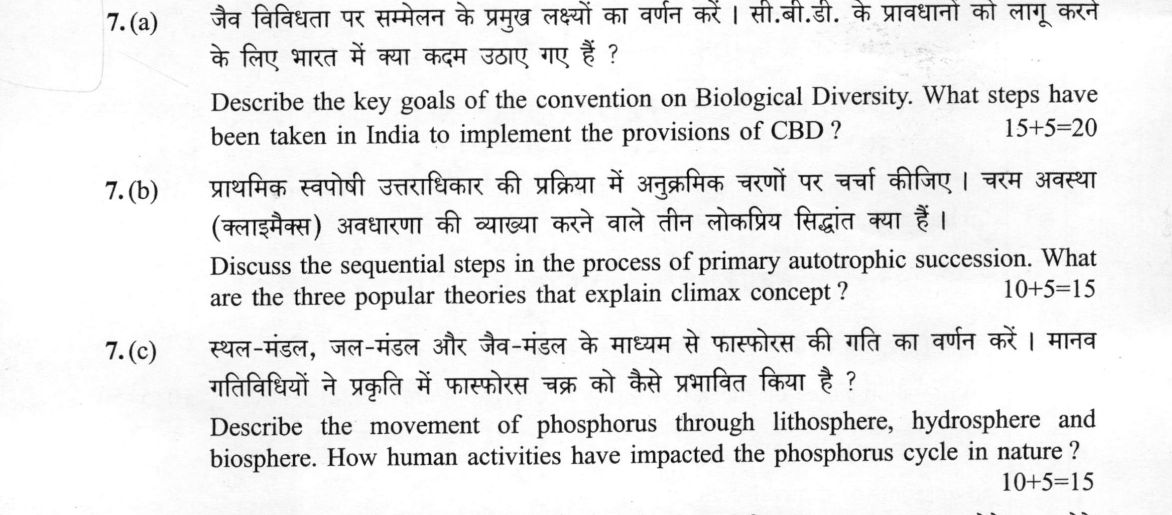
Describe the key goals of the convention on Biological Diversity. What steps have been taken in India to implement the provisions of CBD ? (15+5=20 marks)
Discuss the sequential steps in the process of primary autotrophic succession. What are the three popular theories that explain climax concept ? (10+5=15 marks)
Describe the movement of phosphorus through lithosphere, hydrosphere and biosphere. How human activities have impacted the phosphorus cycle in nature ? (10+5=15 marks)
हिंदी में प्रश्न पढ़ें
जैव विविधता पर सम्मेलन के प्रमुख लक्ष्यों का वर्णन करें । सी.बी.डी. के प्रावधानों को लागू करने के लिए भारत में क्या कदम उठाए गए हैं ? (15+5=20 अंक)
प्राथमिक स्वपोषी उत्तराधिकार की प्रक्रिया में अनुक्रमिक चरणों पर चर्चा कीजिए । चरम अवस्था (क्लाइमेक्स) अवधारणा की व्याख्या करने वाले तीन लोकप्रिय सिद्धांत क्या हैं । (10+5=15 अंक)
स्थल-मंडल, जल-मंडल और जैव-मंडल के माध्यम से फास्फोरस की गति का वर्णन करें । मानव गतिविधियों ने प्रकृति में फास्फोरस चक्र को कैसे प्रभावित किया है ? (10+5=15 अंक)
Model answer
Written by UPSC Answer Check against this question's marking rubric, to the expected length. UPSC does not publish answers for Mains — this is one way to score well, not an official key.
Ecosystem stability depends fundamentally on the interplay between nutrient cycles, dynamic vegetational succession, and the conservation frameworks that safeguard biodiversity.
Convention on Biological Diversity and Indian Implementation
The 1992 Convention on Biological Diversity (CBD) enshrines three overarching goals: the conservation of biological diversity, the sustainable use of its biological components, and the fair and equitable sharing of benefits arising from the utilization of genetic resources.
To implement CBD mandates, India enacted the Biological Diversity Act, 2002, establishing a decentralized three-tier institutional architecture. The National Biodiversity Authority (NBA) operates at the apex, coordinating with State Biodiversity Boards (SBBs) and grassroots-level Biodiversity Management Committees (BMCs) tasked with preparing People’s Biodiversity Registers. India ratified the Nagoya Protocol to enforce statutory Access and Benefit Sharing (ABS) mechanisms. Under Section 37 of the Act, state governments notify Biodiversity Heritage Sites (BHS) to protect ecologically fragile areas outside traditional protected areas, exemplified by the Nallur Tamarind Grove in Karnataka, Ameenpur Lake in Telangana, and the unique fluvial ecosystem of Majuli Island in Assam.
Primary Autotrophic Succession and Climax Concepts
Primary autotrophic succession represents community development on previously unoccupied, barren substrates. In a classic lithosere, the sequential process initiates with the pioneer stage, where crustose and foliose lichens colonize bare rock, secreting organic acids that initiate pedogenesis. This is succeeded by the moss stage, which accumulates organic matter and retains moisture, facilitating the establishment of annual and perennial herbaceous communities. As soil depth and nutrient availability increase, a shrub stage invades, eventually giving way to a multi-stratified forest community, reflecting patterns observed in successional studies along the Western Ghats and Himalayan elevational gradients.
Three primary theories explain the terminal climax state:
Monoclimax Theory (F.E. Clements): Posits that within a given climatic region, vegetation will progressively converge toward a single, regionally uniform climatic climax, with climate being the sole controlling factor.
Polyclimax Theory (A.G. Tansley): Argues that climate is not the sole determinant; local differences in edaphic factors, topography, animal activity, or fire regimes produce multiple distinct, stable climax communities within the same macroclimate.
Climax-Pattern Hypothesis (R.H. Whittaker): Formulates climax as a continuous pattern of communities distributed along complex environmental gradients, rejecting absolute, discrete climax types in favor of continuous spatial variation.
Phosphorus Biogeochemical Cycle and Anthropogenic Impact
Phosphorus follows a sedimentary biogeochemical cycle. The lithosphere serves as the primary reservoir in the form of phosphate-bearing minerals such as apatite. Weathering releases soluble orthophosphates into the soil solution and aquatic environments (hydrosphere). Autotrophs absorb dissolved inorganic phosphates, incorporating them into nucleic acids, phospholipids, and ATP in the biosphere. Phosphorus then moves through heterotrophic food chains. Microbial decomposition of organic detritus releases phosphorus back into soil and aquatic sinks, while a fraction precipitates into marine and freshwater sediments, returning to the lithosphere over geological timescales.
Anthropogenic activities have profoundly disrupted this cycle through extensive phosphate rock mining for agricultural fertilizers and the widespread use of phosphorus-based domestic detergents. Agricultural runoff and untreated municipal sewage deliver excessive phosphorus loads into aquatic ecosystems, driving cultural eutrophication. In critical Indian water bodies such as Chilika Lake and Dal Lake, excess phosphorus induces severe algal blooms, hypolimnetic oxygen depletion, and shifts in macrophyte community structure.
Integrating CBD-aligned sustainable nutrient management with the protection of successional sere integrity offers the most effective pathway for mitigating eutrophication and ensuring long-term landscape restoration across India.
What "Describe" is asking you to do
Give a full, ordered account of the thing named — its parts, stages or mechanism — in the sequence in which it actually exists or occurs. Most describe questions come from the science optionals, where the marks sit in correct technical detail and, where the stem says so, a labelled diagram.
Structure that answers it
One-line identification of the subject → the parts or stages in their real order, each with its defining detail → labelled diagram where the subject is structural → closing line on function or significance
Where marks are lost
Loose general prose where the examiner is ticking named parts, correct terminology and their sequence; and in the General Studies papers, turning to evaluation before the description is finished.
How this answer will be evaluated
Approach
Framework: UPSC Botany Paper 2. (a) describe: define > structure or process in order > labelled diagram > significance | (b) discuss: intro > 3-4 dimensions > example > balanced close | (c) describe: define > structure or process in order > labelled diagram > significance Full marks: Precise terminology, clear diagrams, and specific statutory/ecological examples.
Key points expected
- Conservation of biological diversity
- Sustainable use of components
- Fair and equitable benefit sharing
- Biological Diversity Act, 2002
- Nudation and invasion stages
- Ecological release and stabilization
- Climax concept definition
- Climax-Frequency theory
Evaluation rubric
Each sub-part is marked on its own, against the marks and word limit printed on the paper.
- (a) Outline CBD goals and India's implementation steps. 20 marks
describe— define → structure or process in order → labelled diagram → significance
Must cover
- Conservation of biological diversity
- Sustainable use of components
- Fair and equitable benefit sharing
- Biological Diversity Act, 2002
Loses marks
- Confusing CBD with CITES or Ramsar
- Listing generic environmental laws without CBD context
Earns more
- National Biodiversity Authority (NBA)
- State Biodiversity Boards (SBBs)
- National Biodiversity Strategy and Action Plan (NBSAP)
- Gene Bank and Germplasm Conservation
Extra mark
- Specific mention of Nagoya Protocol
- Reference to specific Indian biodiversity hotspots
- (b) Sequence primary succession stages and explain climax theories. 15 marks
discuss— intro → 3-4 dimensions → example → balanced close
Must cover
- Nudation and invasion stages
- Ecological release and stabilization
- Climax concept definition
- Climax-Frequency theory
Loses marks
- Confusing primary with secondary succession
- Failing to distinguish autotrophic from heterotrophic
Earns more
- Climax-Topography theory
- Climax-Physiography theory
- Climax-Edaphic theory
- Climax-Physiographic theory
Extra mark
- Mention of Clements vs Gleason debate
- Specific example of primary succession (e.g., lava flow)
- (c) Trace phosphorus movement and human impacts on the cycle. 15 marks
describe— define → structure or process in order → labelled diagram → significance
Must cover
- Weathering of rocks (lithosphere)
- Uptake by plants and animals (biosphere)
- Sedimentation in oceans (hydrosphere)
- Use of phosphate fertilizers
Loses marks
- Describing the nitrogen cycle instead
- Ignoring the geological timescale of the cycle
Earns more
- Eutrophication due to runoff
- Mining of phosphate rocks
- Role of mycorrhizae in uptake
- Phosphorus as a limiting nutrient
Extra mark
- Mention of specific phosphate rock deposits
- Reference to specific eutrophication events
Practice this exact question
Write your answer and it is marked point by point against the model answer above — what you covered, what you missed, what you got wrong.
Evaluate my answer →More from Botany 2022 Paper II
- Q4 (a) How male sterility helps in heterosis breeding ? Discuss the application of barnase-b…
- Q5 Write short notes on the following in about 150 words each: (a) Symptoms of mineral defic…
- Q6 (a) Differentiate between enzymes and coenzymes and describe their mechanisms of action.…
- Q7 (a) Describe the key goals of the convention on Biological Diversity. What steps have bee…
- Q8 (a) Define the terms photoperiodism and florigen. Describe the mechanism of response in s…