Paper II — Q4
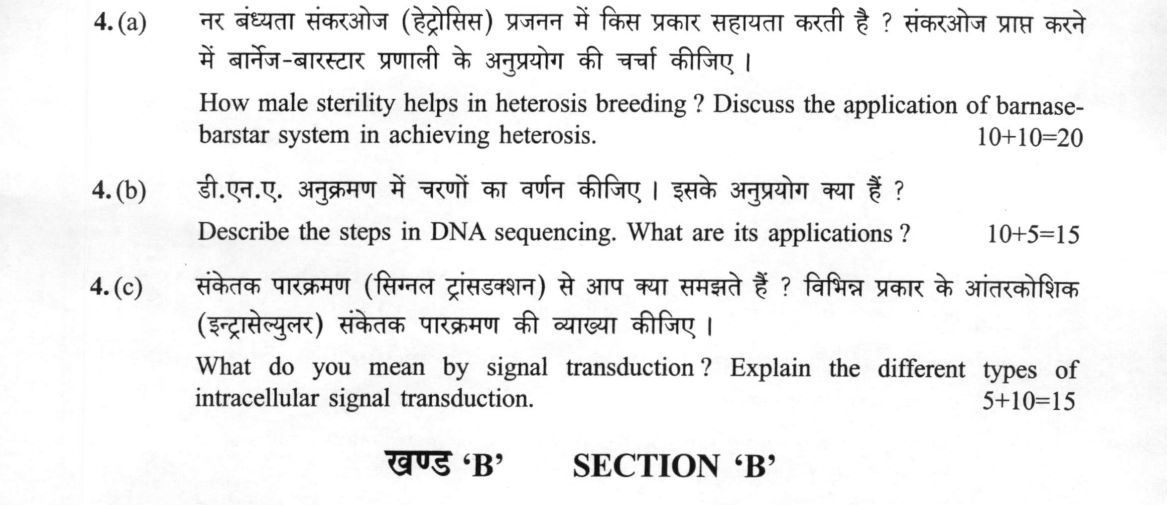
(a) How male sterility helps in heterosis breeding ? Discuss the application of barnase-barstar system in achieving heterosis…
How male sterility helps in heterosis breeding ? Discuss the application of barnase-barstar system in achieving heterosis. (10+10=20 marks)
Describe the steps in DNA sequencing. What are its applications ? (10+5=15 marks)
What do you mean by signal transduction ? Explain the different types of intracellular signal transduction. (5+10=15 marks)
हिंदी में प्रश्न पढ़ें
नर बंध्यता संकरओज (हेट्रोसिस) प्रजनन में किस प्रकार सहायता करती है ? संकरओज प्राप्त करने में बार्नज-बारस्टर प्रणाली के अनुप्रयोग की चर्चा कीजिए । (10+10=20 अंक)
डी.एन.ए. अनुक्रमण में चरणों का वर्णन कीजिए । इसके अनुप्रयोग क्या हैं ? (10+5=15 अंक)
संकेतक पारक्रमण (सिग्नल ट्रांसडक्शन) से आप क्या समझते हैं ? विभिन्न प्रकार के अंतरकोशिक (इंट्रासेल्युलर) संकेतक पारक्रमण की व्याख्या कीजिए । (5+10=15 अंक)
Model answer
Written by UPSC Answer Check against this question's marking rubric, to the expected length. UPSC does not publish answers for Mains — this is one way to score well, not an official key.
Male sterility—the inability of plants to produce viable functional pollen—serves as an indispensable tool in heterosis (hybrid vigour) breeding. In self-pollinated and bisexual crops, manual emasculation is tedious and economically unfeasible. Genetic Male Sterility (GMS) and Cytoplasmic-Nuclear Male Sterility (CMS) bypass manual emasculation, ensuring complete cross-pollination. In the classic three-line system, an A-line (male sterile), B-line (maintainer), and R-line (restorer carrying nuclear fertility restorer genes) facilitate hybrid seed production, utilized extensively in crops like pearl millet, sorghum, and hybrid rice (e.g., WA-CMS).
Barnase-Barstar System in Heterosis Breeding
The Barnase-Barstar system, derived from the bacterium Bacillus amyloliquefaciens, provides a genetic engineering approach to overcome the limitations of CMS, such as cytoplasmic vulnerability and lack of natural restorer genes.
The male-sterile line is created by expressing the barnase gene (encoding a cytotoxic extracellular ribonuclease) under the strict control of a tapetum-specific promoter (such as TA29). During microsporogenesis, expression of barnase selectively lyses the nutritive tapetal cell layer, starving developing microspores and resulting in complete male sterility without affecting vegetative vigour.
To restore male fertility in the commercial F1 generation, the pollinator line is engineered with the barstar gene under the same TA29 promoter. Barstar acts as an intracellular inhibitor that binds to barnase with high affinity in a one-to-one stoichiometric complex, completely neutralizing its ribonuclease activity. In India, this technology was adopted in developing the transgenic hybrid mustard DMH-11 (by the Centre for Genetic Manipulation of Crop Plants, Delhi University) using a bar-barnase-barstar cassette to exploit heterosis between Indian and East European mustard lines.
Steps in DNA Sequencing and Applications
DNA sequencing determines the exact order of nucleotides in a DNA molecule. In the classical Sanger chain-termination method, the process follows four key steps:
- Template preparation and primer annealing: Target DNA is denatured into single strands, and a complementary oligonucleotide primer is annealed.
- Enzymatic extension: DNA polymerase extends the primer in reaction mixtures containing standard deoxynucleotide triphosphates (dNTPs) along with limiting concentrations of four distinct fluorescently labelled dideoxynucleotide triphosphates (ddNTPs).
- Chain termination: Because ddNTPs lack the 3'-OH group required for phosphodiester bond formation, their random incorporation terminates synthesis, generating fragments of variable lengths.
- Electrophoresis and detection: Fragments are resolved by high-resolution capillary electrophoresis, where laser excitation of the fluorophores yields an electropherogram readout. Modern Next-Generation Sequencing (NGS) executes this massively in parallel via library preparation, clonal amplification (cluster generation), and sequencing-by-synthesis.
Applications include whole-genome sequencing of crops (e.g., Indian initiatives in rice, chickpea, and pigeonpea), Marker-Assisted Selection (MAS) and QTL mapping, transcriptomics and functional genomics, forensic profiling, clinical diagnostics, and resolving phylogenetic lineages.
Signal Transduction Mechanisms
Signal transduction is the biological cascade wherein an extracellular stimulus (hormone, ligand, physical stress) is recognized by a specific receptor, converted into an intracellular signal via secondary messengers and protein cascades, and ultimately translated into a cellular or genomic response.
Intracellular signal transduction proceeds through several major receptor mechanisms:
- G-Protein Coupled Receptors (GPCRs): Ligand binding causes conformational shifts that activate heterotrimeric G-proteins, which trigger downstream effectors like adenylyl cyclase (producing cyclic AMP) or phospholipase C (yielding inositol 1,4,5-trisphosphate [IP₃] and diacylglycerol [DAG]), mobilizing cytosolic Ca²⁺.
- Receptor Kinases and MAPK Cascades: Extracellular binding induces receptor dimerization and autophosphorylation (e.g., Receptor-Like Kinases in plants), activating mitogen-activated protein kinase cascades (MAPKKK → MAPKK → MAPK) that modulate target transcription factors.
- Ion Channel-Linked and Intracellular Receptors: Ligand-gated channels alter membrane potential via ion fluxes, whereas lipophilic signals traverse the membrane to bind cytoplasmic or nuclear receptors acting directly as transcriptional regulators.
In plants, these pathways mediate phytohormone responses—such as Abscisic acid (ABA)-induced stomatal closure via PYR/PYL/RCAR receptors and Ca²⁺ flux, and Auxin signalling via TIR1/AFB ubiquitin-ligase degradation of Aux/IAA repressors—as well as Pathogen-Associated Molecular Pattern (PAMP)-triggered immunity (PTI) via surface pattern-recognition receptors.
A deeper understanding of male sterility, high-throughput sequencing, and cellular signaling networks provides the necessary framework for genomic selection and developing climate-resilient crop cultivars.
What "Discuss" is asking you to do
Lay the issue out from more than one side — how it arose, what is claimed for it, what is held against it, and where it now stands. UPSC attaches discuss to broad topics with several live dimensions, so coverage of the dimensions earns more than the strength of your opinion.
Structure that answers it
Set the issue up → the case as it is made → the case against → the dimension both sides leave out → where the balance now lies
Where marks are lost
Listing facts with no thread between them, or arguing one side throughout and calling it a discussion.
How this answer will be evaluated
Approach
Framework: Botany Paper 2: Define > Structure/Process > Labelled Diagram > Significance. (a) discuss: intro > 3-4 dimensions > example > balanced close | (b) describe: define > structure or process in order > labelled diagram > significance | (c) explain: definition/context > points in order > small example > short close Full marks: Comprehensive, accurate, and well-structured with labelled diagrams and specific examples.
Key points expected
- Define male sterility and its role in hybrid seed production
- Explain the mechanism of the barnase-barstar system
- Describe the application of the system in achieving heterosis
- Provide a labelled diagram of the barnase-barstar mechanism
- Define DNA sequencing
- Describe the steps in DNA sequencing in order
- Provide a labelled diagram of the sequencing process
- List at least three applications of DNA sequencing
Evaluation rubric
Each sub-part is marked on its own, against the marks and word limit printed on the paper.
- (a) Explain the utility of male sterility in heterosis and the mechanism of the barnase-barstar system. 20 marks
discuss— intro → 3-4 dimensions → example → balanced close
Must cover
- Define male sterility and its role in hybrid seed production
- Explain the mechanism of the barnase-barstar system
- Describe the application of the system in achieving heterosis
- Provide a labelled diagram of the barnase-barstar mechanism
Loses marks
- Unlabelled diagrams
- Loose common names instead of binomials
- Failure to link to crops or biotechnology
Earns more
- Mention specific crops where male sterility is used
- Explain the genetic basis of the barnase-barstar system
- Discuss the advantages of the system over traditional methods
- Provide a balanced view of the system's limitations
Extra mark
- Name a specific cultivar or species where the system is applied
- Mention a recent biotech application of the system
- (b) Outline the steps in DNA sequencing and list its applications. 15 marks
describe— define → structure or process in order → labelled diagram → significance
Must cover
- Define DNA sequencing
- Describe the steps in DNA sequencing in order
- Provide a labelled diagram of the sequencing process
- List at least three applications of DNA sequencing
Loses marks
- Unlabelled diagrams
- Loose common names instead of binomials
- Failure to link to crops or biotechnology
Earns more
- Mention specific techniques like Sanger or Next-Gen sequencing
- Explain the significance of each step
- Link applications to crops or biotechnology
- Provide a balanced view of the technique's limitations
Extra mark
- Name a specific species or cultivar where sequencing is applied
- Mention a recent biotech application of sequencing
- (c) Define signal transduction and explain the different types of intracellular signal transduction. 15 marks
explain— definition/context → points in order → small example → short close
Must cover
- Define signal transduction
- Explain the different types of intracellular signal transduction
- Provide a labelled diagram of a signal transduction pathway
- Give a small example of signal transduction in plants
Loses marks
- Unlabelled diagrams
- Loose common names instead of binomials
- Failure to link to crops or biotechnology
Earns more
- Mention specific pathways like MAPK or calcium signaling
- Explain the significance of each type
- Link to crops or biotechnology
- Provide a balanced view of the process's limitations
Extra mark
- Name a specific species or cultivar where signal transduction is studied
- Mention a recent biotech application of signal transduction
Practice this exact question
Write your answer and it is marked point by point against the model answer above — what you covered, what you missed, what you got wrong.
Evaluate my answer →More from Botany 2022 Paper II
- Q1 Write short notes on the following in about 150 words each: (a) Semi-autonomous cell orga…
- Q2 (a) Discuss the different processes by which solute moves across cell membrane. (10+10=20…
- Q3 (a) What is organic evolution ? Highlight the mechanisms governing organic evolution. (5+…
- Q4 (a) How male sterility helps in heterosis breeding ? Discuss the application of barnase-b…
- Q5 Write short notes on the following in about 150 words each: (a) Symptoms of mineral defic…
- Q6 (a) Differentiate between enzymes and coenzymes and describe their mechanisms of action.…
- Q7 (a) Describe the key goals of the convention on Biological Diversity. What steps have bee…