Paper II — Q8
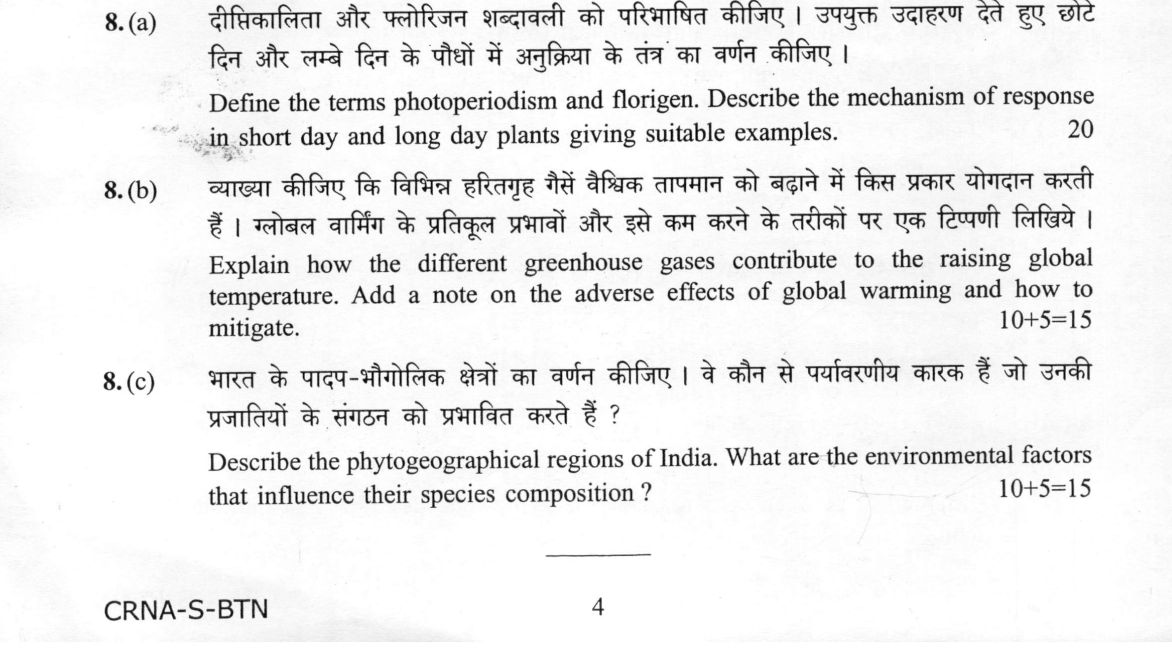
(a) Define the terms photoperiodism and florigen. Describe the mechanism of response in short day and long day plants giving…
Define the terms photoperiodism and florigen. Describe the mechanism of response in short day and long day plants giving suitable examples. 20 marks
Explain how the different greenhouse gases contribute to the raising global temperature. Add a note on the adverse effects of global warming and how to mitigate. (10+5=15 marks)
Describe the phytogeographical regions of India. What are the environmental factors that influence their species composition ? (10+5=15 marks)
हिंदी में प्रश्न पढ़ें
दीप्तिकालिता और फ्लोरिजन शब्दावली को परिभाषित कीजिए । उपयुक्त उदाहरण देते हुए छोटे दिन और लम्बे दिन के पौधों में अनुक्रिया के तंत्र का वर्णन कीजिए । (20 अंक)
व्याख्या कीजिए कि विभिन्न हरितगृह गैसें वैश्विक तापमान को बढ़ाने में किस प्रकार योगदान करती हैं । ग्लोबल वार्मिंग के प्रतिकूल प्रभावों और इसे कम करने के तरीकों पर एक टिप्पणी लिखिये । (10+5=15 अंक)
भारत के पादप-भौगोलिक क्षेत्रों का वर्णन कीजिए । वे कौन से पर्यावरणीय कारक हैं जो उनकी प्रजातियों के संगठन को प्रभावित करते हैं ? (10+5=15 अंक)
Model answer
Written by UPSC Answer Check against this question's marking rubric, to the expected length. UPSC does not publish answers for Mains — this is one way to score well, not an official key.
Plant Physiology, Climate Dynamics, and Phytogeography
The interplay between plant physiological responses to light, atmospheric composition, and geographical distribution forms the core of botanical ecology. Understanding photoperiodism, global warming mechanisms, and phytogeographical zonation is essential for addressing contemporary environmental challenges.
Photoperiodism and Flowering Mechanisms
Photoperiodism, defined by Garner and Allard (1920), is the physiological response of plants to the relative lengths of day and night. Florigen, a term coined by Chailakhyan (1937), refers to the hypothetical mobile signal produced in leaves that induces flowering in the shoot apical meristem. Modern molecular biology has identified this signal as the FT (Flowering Locus T) protein.
In Short-Day Plants (SDPs) like Chrysanthemum and rice, flowering is induced when the night period exceeds a critical length. Conversely, Long-Day Plants (LDPs) such as wheat and barley flower when the night period is shorter than the critical length. The mechanism is mediated by phytochrome, a photoreversible pigment. In SDPs, prolonged darkness allows the accumulation of FT protein in the phloem, which translocates to the meristem. There, FT interacts with the bZIP transcription factor TD3 to activate the FLOWERING LOCUS T (FT) gene, overriding the floral repressor TFL1. It is crucial to note that TFL1 acts as a local floral repressor within the meristem, inhibiting flowering until the FT signal is sufficient; it is not a mobile anti-florigen. In LDPs, short nights prevent the accumulation of FT, allowing TFL1 to remain active and suppress flowering. This photoperiodic adaptation dictates the latitudinal distribution of crops and wild species.
Greenhouse Gases and Global Warming
Global temperature rise is driven by the greenhouse effect, where gases trap outgoing longwave radiation. Carbon dioxide (CO2) is the primary contributor to total anthropogenic radiative forcing, absorbing infrared radiation in the 15 µm band. Methane (CH4), with a Global Warming Potential (GWP) of 28-30 times that of CO2 over 100 years, absorbs strongly at 7.7 µm, a region outside the atmospheric infrared window where absorption is relatively weak. Nitrous oxide (N2O) and Chlorofluorocarbons (CFCs) also contribute significantly, with CFCs having a GWP exceeding 4,000. Water vapour acts as a feedback mechanism, amplifying warming.
Adverse effects in India include the retreat of Himalayan glaciers, threatening water security for the Ganga and Indus basins. Monsoon variability is increasing, leading to erratic rainfall and crop failures. Coastal regions like the Sundarbans face submergence due to sea-level rise. Mitigation strategies include adhering to India’s Intended Nationally Determined Contributions (INDCs) under the Paris Agreement, aiming for 45% non-fossil fuel capacity by 2030. Agroforestry and soil carbon sequestration are vital for agricultural mitigation.
Phytogeographical Regions of India
India’s phytogeography is classified into ten regions by D. Chatterjee, distinct from the forest-type classification by Champion and Seth. These regions include the Tropical Evergreen Forests of the Western Ghats, Tropical Moist Deciduous Forests of the Eastern Ghats, and the Tropical Dry Deciduous Forests of the Deccan Plateau. The Himalayan regions feature Temperate Coniferous Forests and Alpine Meadows.
Species composition is influenced by climatic factors such as temperature and rainfall gradients, which determine biome boundaries. Edaphic factors, including soil pH and nutrient availability, shape local diversity. Topography creates microclimates, leading to high endemism in the Western Ghats and Eastern Himalayas. Anthropogenic pressures, such as deforestation and fragmentation, further alter species composition. The link between photoperiodic adaptation and latitudinal distribution is evident, as species in higher latitudes (Himalayas) exhibit different flowering cues compared to tropical lowlands.
Conclusion
The integration of plant physiology, climate science, and phytogeography reveals a complex system where molecular mechanisms like FT protein transport are linked to macro-scale ecological shifts. Addressing global warming requires precise understanding of these interactions to preserve India’s rich biodiversity and agricultural stability.
What "Describe" is asking you to do
Give a full, ordered account of the thing named — its parts, stages or mechanism — in the sequence in which it actually exists or occurs. Most describe questions come from the science optionals, where the marks sit in correct technical detail and, where the stem says so, a labelled diagram.
Structure that answers it
One-line identification of the subject → the parts or stages in their real order, each with its defining detail → labelled diagram where the subject is structural → closing line on function or significance
Where marks are lost
Loose general prose where the examiner is ticking named parts, correct terminology and their sequence; and in the General Studies papers, turning to evaluation before the description is finished.
How this answer will be evaluated
Approach
Framework: UPSC Botany Paper 2. (a) define: precise definition > the distinguishing feature > one example | (b) explain: definition/context > points in order > small example > short close | (c) describe: define > structure or process in order > labelled diagram > significance Full marks: Comprehensive, accurate, with specific examples and clear mechanisms.
Key points expected
- Precise definition of photoperiodism and florigen
- Mechanism of response in short-day plants
- Mechanism of response in long-day plants
- Suitable examples for both plant types
- Explanation of how greenhouse gases raise temperature
- Note on adverse effects of global warming
- Note on mitigation strategies
- Description of phytogeographical regions of India
Evaluation rubric
Each sub-part is marked on its own, against the marks and word limit printed on the paper.
- (a) Definitions of photoperiodism/florigen and mechanism of response in SD/LD plants. 20 marks
define— precise definition → the distinguishing feature → one example
Must cover
- Precise definition of photoperiodism and florigen
- Mechanism of response in short-day plants
- Mechanism of response in long-day plants
- Suitable examples for both plant types
Loses marks
- Confusing short-day and long-day mechanisms
- Missing examples for either plant type
- Vague definition of florigen
Earns more
- Mention of critical day length
- Reference to phytochrome system
- Distinction between day length and night length
Extra mark
- Named species (e.g., *Chenopodium album*)
- Diagram of photoperiodic response
- (b) Contribution of greenhouse gases to global warming, adverse effects, and mitigation. 15 marks
explain— definition/context → points in order → small example → short close
Must cover
- Explanation of how greenhouse gases raise temperature
- Note on adverse effects of global warming
- Note on mitigation strategies
Loses marks
- Failing to link gases to temperature rise
- Vague or generic adverse effects
- Missing mitigation strategies
Earns more
- Specific examples of greenhouse gases (CO2, CH4)
- Link to specific environmental impacts
- Practical mitigation examples
Extra mark
- Recent biotech application in mitigation
- Specific data on temperature rise
- (c) Phytogeographical regions of India and environmental factors influencing species composition. 15 marks
describe— define → structure or process in order → labelled diagram → significance
Must cover
- Description of phytogeographical regions of India
- Identification of environmental factors
- Link between factors and species composition
Loses marks
- Vague description of regions
- Missing environmental factors
- No link between factors and species
Earns more
- Specific regions (e.g., Himalayan, Deccan)
- Specific environmental factors (e.g., altitude, rainfall)
- Examples of species in specific regions
Extra mark
- Map of phytogeographical regions
- Named species or cultivars
Practice this exact question
Write your answer and it is marked point by point against the model answer above — what you covered, what you missed, what you got wrong.
Evaluate my answer →More from Botany 2022 Paper II
- Q5 Write short notes on the following in about 150 words each: (a) Symptoms of mineral defic…
- Q6 (a) Differentiate between enzymes and coenzymes and describe their mechanisms of action.…
- Q7 (a) Describe the key goals of the convention on Biological Diversity. What steps have bee…
- Q8 (a) Define the terms photoperiodism and florigen. Describe the mechanism of response in s…