Paper II — Q6
(a) Differentiate between enzymes and coenzymes and describe their mechanisms of action. (10+10=20 marks) (b) Define secondary…
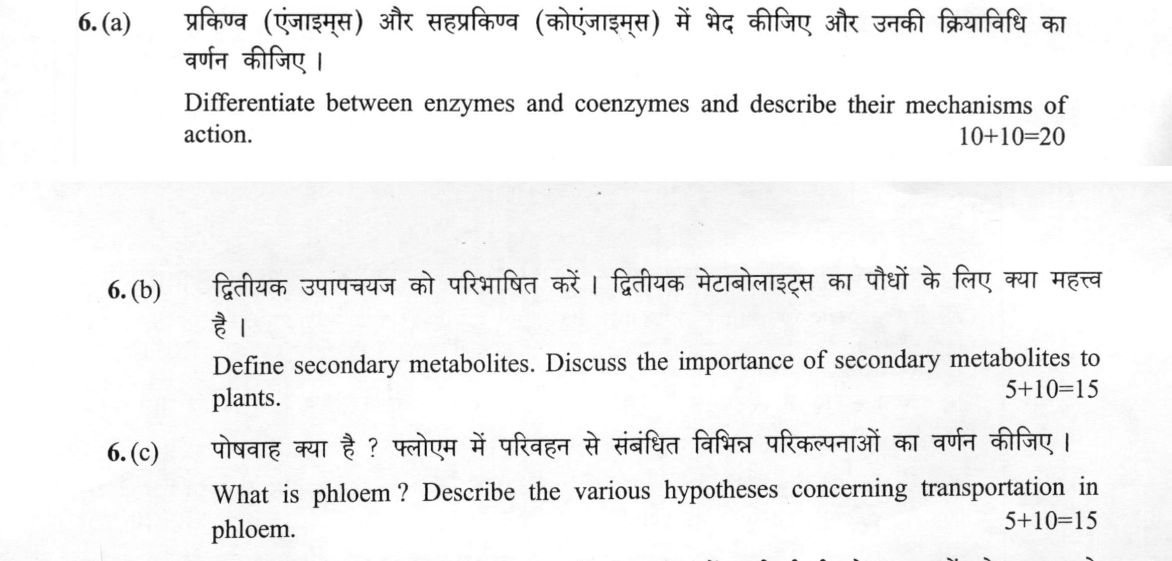
Differentiate between enzymes and coenzymes and describe their mechanisms of action. (10+10=20 marks)
Define secondary metabolites. Discuss the importance of secondary metabolites to plants. (5+10=15 marks)
What is phloem ? Describe the various hypotheses concerning transportation in phloem. (5+10=15 marks)
हिंदी में प्रश्न पढ़ें
प्रकिण्व (एंजाइम्स) और सहप्रकिण्व (कोएंजाइम्स) में भेद कीजिए और उनकी क्रियाविधि का वर्णन कीजिए । (10+10=20 अंक)
द्वितीयक उपापचयज को परिभाषित करें । द्वितीयक मेटाबोलाइट्स का पौधों के लिए क्या महत्व है । (5+10=15 अंक)
पोषवाह क्या है ? फ्लोएम में परिवहन से संबंधित विभिन्न परिकल्पनाओं का वर्णन कीजिए । (5+10=15 अंक)
Model answer
Written by UPSC Answer Check against this question's marking rubric, to the expected length. UPSC does not publish answers for Mains — this is one way to score well, not an official key.
Enzymes versus Coenzymes and their Mechanisms of Action
Enzymes and coenzymes function cooperatively in cellular catalysis but exhibit fundamental structural and functional differences. Enzymes are high-molecular-weight, heat-labile macromolecular biocatalysts that are almost exclusively proteinaceous in nature (excluding catalytic RNAs/ribozymes), possessing distinct primary-to-quaternary conformations with specialized active sites. In contrast, coenzymes are low-molecular-weight, dialysable, heat-stable, non-protein organic or metallo-organic accessory molecules, frequently derived from water-soluble vitamins, that transiently or stably associate with the inactive apoenzyme to constitute the catalytically active holoenzyme. Unlike enzymes, which remain structurally intact post-reaction, coenzymes participate as stoichiometric co-substrates, undergoing transient chemical modifications before being enzymatically regenerated.
Enzymatic catalysis operates by stabilizing the transition state and dramatically lowering the free energy of activation (Δ G^ddagger) without altering the equilibrium constant. Substrate binding at the active site occurs either through rigid steric complementarity (Fischer’s Lock and Key model) or dynamic structural reconfiguration upon binding (Koshland’s Induced Fit model), utilizing precise catalytic strategies such as acid-base catalysis, covalent intermediate formation, and electrostatic stabilization. Conversely, the mechanism of coenzymes involves chemical group or electron transfers. Redox coenzymes like Nicotinamide Adenine Dinucleotide (NAD⁺) and Flavin Adenine Dinucleotide (FAD) act as reversible acceptors of hydride ions (H⁻) and hydrogen atoms (H⁺ + e⁻), respectively, in dehydrogenase-mediated reactions. Transfer coenzymes such as Coenzyme A (CoA-SH) and Pyridoxal Phosphate (PLP) function by covalently forming reactive intermediates to shuttle acyl groups and amino groups between donor and acceptor substrates.
Secondary Metabolites: Definition, Classification, and Plant Significance
Secondary metabolites are diverse organic compounds derived from primary metabolic pathways (shikimate, mevalonate, and acetate pathways) that are not directly required for fundamental vegetative growth, development, or cellular respiration, and exhibit restricted taxonomic distribution among plant lineages. They are broadly categorized into: Terpenoids (e.g., azadirachtin from Azadirachta indica), Phenolics (e.g., curcumin from Curcuma longa, anthocyanins, and lignin), and Nitrogen-containing Alkaloids (e.g., morphine from Papaver somniferum and reserpine from Rauvolfia serpentina).
Ecologically and physiologically, secondary metabolites are essential for plant survival and adaptation. Terpenoids and bitter alkaloids serve as constitutive or inducible chemical defenses against herbivory and microbial phytopathogens. Phenolics like flavonoids absorb damaging UV-B radiation, protecting photosynthetic machinery, while anthocyanins and volatile terpenes impart floral pigments and scents to attract specific pollinators and seed dispersers. Lignin provides structural rigidity to tracheary elements, facilitating water transport under negative pressure. Furthermore, exudates such as juglone mediate allelopathic suppression of competing neighboring flora, and select alkaloids function as mobile nitrogen storage pools, which secondarily provide invaluable pharmacophores in modern therapeutics.
Phloem Structure and Hypotheses of Translocation
Phloem is the specialized, complex living vascular tissue responsible for the multi-directional translocation of photoassimilates (chiefly sucrose) from source to sink. In angiosperms, it comprises enucleated sieve tube elements interconnected end-to-end via perforated sieve plates, metabolically coupled nucleated companion cells, storage-oriented phloem parenchyma, and supportive sclerenchyma fibres.
Several hypotheses have been formulated to explain phloem translocation. The Münch Pressure-Flow Hypothesis remains the most widely accepted mechanism. It postulates that active proton-coupled symport of sucrose at source tissues lowers the sieve-tube water potential (Ψ_w), driving osmotic water influx from adjacent xylem. This generates a high localized hydrostatic turgor pressure (P). Concurrent sucrose unloading and water efflux at sink tissues generate a low hydrostatic pressure, driving bulk mass flow of the aqueous solution along the physical pressure gradient.
Alternative hypotheses include the Electro-osmotic Hypothesis (Spanner), which suggests that potassium ion (K⁺) circulation across sieve plates maintains an electrical potential gradient that propels polar water and sugar molecules. The Cytoplasmic Streaming Hypothesis (de Vries) attributes assimilate distribution to ATP-dependent cyclosis within sieve elements. The Contractile Protein Hypothesis (Thaine) proposes transcellular peristaltic movement facilitated by undulating P-protein filaments, while Interfacial Flow Hypotheses rely on spreading across phase boundaries.
Experimental evidence from aphid stylet exudation, radioactive ¹⁴CO₂ tracing, and measured positive turgor gradients conclusively establishes that while P-proteins and cytoplasmic streaming aid structural sealing and short-distance mobilization, osmotically driven bulk pressure flow represents the true physiological mechanism of long-distance phloem transport.
What "Differentiate" is asking you to do
Fix the criteria on which the two differ and apply each criterion to both, so the pair can no longer be mixed up. Differentiate stems usually carry a further task attached — describe the mechanism, set out the principles, discuss the applications — and that task carries its own marks.
Structure that answers it
Criterion 1 applied to both → criterion 2 → criterion 3 → summary line or table → the attached second demand answered in full
Where marks are lost
Two standalone definitions placed side by side, leaving the reader to extract the difference. The second common loss is running out of space before the attached task, which is often worth as much as the differentiation.
How this answer will be evaluated
Approach
Framework: Botany, Paper 2. (a) compare: paired headings or table > key differences > significance > conclusion | (b) define: precise definition > the distinguishing feature > one example | (c) describe: define > structure or process in order > labelled diagram > significance Full marks: Precise definitions, clear differentiation, detailed mechanisms with specific examples and diagrams.
Key points expected
- Enzymes are proteins; coenzymes are non-protein organic cofactors
- Enzymes bind substrate; coenzymes bind enzyme (apoenzyme)
- Enzyme mechanism: lock-and-key or induced fit model
- Coenzyme mechanism: carrier of atoms/groups (e.g., NAD+, FAD)
- Definition: not essential for primary growth/development
- Importance: defense against herbivores/pathogens
- Importance: UV protection (e.g., flavonoids)
- Importance: pollination/seed dispersal (pigments, scents)
Evaluation rubric
Each sub-part is marked on its own, against the marks and word limit printed on the paper.
- (a) Differentiate enzymes/coenzymes and describe their mechanisms of action. 20 marks
compare— paired headings or table → key differences → significance → conclusion
Must cover
- Enzymes are proteins; coenzymes are non-protein organic cofactors
- Enzymes bind substrate; coenzymes bind enzyme (apoenzyme)
- Enzyme mechanism: lock-and-key or induced fit model
- Coenzyme mechanism: carrier of atoms/groups (e.g., NAD+, FAD)
Loses marks
- Confusing coenzymes with vitamins (though related)
- Failing to distinguish between cofactor and coenzyme
- Describing only one mechanism without comparison
Earns more
- Mention of holoenzyme (apoenzyme + coenzyme)
- Specific examples: hexokinase (enzyme), NAD+ (coenzyme)
- Distinction between coenzyme and prosthetic group
- Mention of metal ions as inorganic cofactors
Extra mark
- Labelled diagram of enzyme-substrate complex
- Reference to specific metabolic pathway (e.g., TCA cycle)
- (b) Define secondary metabolites and discuss their importance to plants. 15 marks
define— precise definition → the distinguishing feature → one example
Must cover
- Definition: not essential for primary growth/development
- Importance: defense against herbivores/pathogens
- Importance: UV protection (e.g., flavonoids)
- Importance: pollination/seed dispersal (pigments, scents)
Loses marks
- Confusing with primary metabolites (sugars, amino acids)
- Failing to link structure to function
- Vague statements without specific examples
Earns more
- Classification: phenolics, alkaloids, terpenoids
- Specific examples: tannins, nicotine, pyrethrin
- Mention of ecological interactions
- Link to medicinal/agricultural value
Extra mark
- Mention of specific plant species (e.g., *Nicotiana tabacum*)
- Reference to biotech application (e.g., metabolic engineering)
- (c) Define phloem and describe hypotheses concerning transportation in phloem. 15 marks
describe— define → structure or process in order → labelled diagram → significance
Must cover
- Definition: vascular tissue for translocation of organic nutrients
- Pressure flow hypothesis (Münch): bulk flow driven by osmotic pressure
- Mechanism: loading at source, unloading at sink
- Role of companion cells in active transport
Loses marks
- Confusing phloem with xylem transport
- Failing to explain the pressure gradient mechanism
- Describing only structure without transport mechanism
Earns more
- Mention of other hypotheses (e.g., cytoplasmic streaming)
- Distinction between source and sink
- Labelled diagram of phloem structure
- Mention of phloem sap composition (sucrose)
Extra mark
- Reference to Münch (1930) specifically
- Mention of phloem exudation experiments
Practice this exact question
Write your answer and it is marked point by point against the model answer above — what you covered, what you missed, what you got wrong.
Evaluate my answer →More from Botany 2022 Paper II
- Q3 (a) What is organic evolution ? Highlight the mechanisms governing organic evolution. (5+…
- Q4 (a) How male sterility helps in heterosis breeding ? Discuss the application of barnase-b…
- Q5 Write short notes on the following in about 150 words each: (a) Symptoms of mineral defic…
- Q6 (a) Differentiate between enzymes and coenzymes and describe their mechanisms of action.…
- Q7 (a) Describe the key goals of the convention on Biological Diversity. What steps have bee…
- Q8 (a) Define the terms photoperiodism and florigen. Describe the mechanism of response in s…