Paper II — Q5
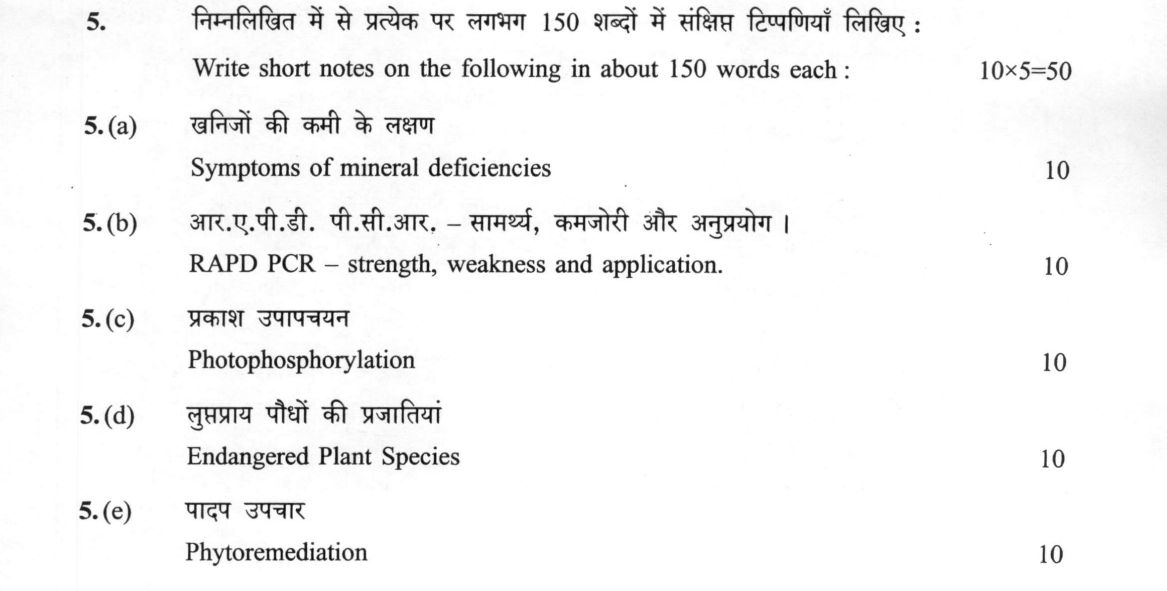
Write short notes on the following in about 150 words each: (a) Symptoms of mineral deficiencies (10 marks) (b) RAPD PCR –…
Write short notes on the following in about 150 words each: Symptoms of mineral deficiencies 10 marks
RAPD PCR – strength, weakness and application. 10 marks
Photophosphorylation 10 marks
Endangered Plant Species 10 marks
Phytoremediation 10 marks
हिंदी में प्रश्न पढ़ें
निम्नलिखित में से प्रत्येक पर लगभग 150 शब्दों में संक्षिप्त टिप्पणियाँ लिखिए : खनिजों की कमी के लक्षण (10 अंक)
आर.ए.पी.डी. पी.सी.आर. – सामर्थ्य, कमजोरी और अनुप्रयोग । (10 अंक)
प्रकाश उपापचयन (10 अंक)
लुप्तप्राय पौधों की प्रजातियाँ (10 अंक)
पादप उपचार (10 अंक)
Model answer
Written by UPSC Answer Check against this question's marking rubric, to the 150-word length. UPSC does not publish answers for Mains — this is one way to score well, not an official key.
Symptoms of Mineral Deficiencies Mineral deficiency symptoms in plants are diagnostic indicators of nutrient imbalance, varying based on the mobility of the element within the phloem. Nitrogen, being mobile, shows symptoms in older leaves first, manifesting as general chlorosis (yellowing) and stunted growth due to reduced protein synthesis. Phosphorus deficiency results in dark green or purplish leaves, poor root development, and delayed maturity, often accompanied by necrotic spots. Potassium deficiency, also mobile, causes marginal leaf scorching (necrosis) and weak stems leading to lodging, as it regulates stomatal function and structural integrity. In contrast, immobile micronutrients like Iron and Manganese show symptoms in young, expanding leaves. Iron deficiency causes interveinal chlorosis where veins remain green while the interveinal tissue yellows. Manganese deficiency in oats is known as "grey speck," characterized by greyish-brown spots on young leaves. Distinguishing between mobile and immobile nutrients is critical for accurate diagnosis and targeted fertilization strategies in agricultural management.
RAPD PCR Random Amplified Polymorphic DNA (RAPD) PCR is a molecular marker technique using a single, arbitrary 10-base oligonucleotide primer to amplify random segments of genomic DNA. Its primary strength lies in its simplicity; it requires no prior knowledge of the target sequence, making it rapid, cost-effective, and highly versatile for initial genetic screening. It is widely applied in assessing genetic diversity, cultivar identification, and constructing phylogenetic trees in plant breeding programs. However, RAPD has significant weaknesses. The markers are dominant, meaning heterozygotes cannot be distinguished from homozygotes, limiting the precision of genetic mapping. Reproducibility is often low due to sensitivity to minor variations in PCR conditions, such as annealing temperature and primer concentration. Furthermore, the technique is highly susceptible to contamination, as even trace amounts of foreign DNA can produce spurious bands. Despite these limitations, RAPD remains a valuable tool for preliminary studies where high-resolution genotyping is not yet required.
Photophosphorylation Photophosphorylation is the light-dependent process of ATP synthesis in chloroplasts, driven by the energy of photons. It occurs in two modes: non-cyclic and cyclic. In non-cyclic photophosphorylation, both Photosystem II (PS-II) and Photosystem I (PS-I) are involved. Light excites electrons in PS-II, which are passed through an electron transport chain to PS-I, generating a proton gradient across the thylakoid membrane. This gradient drives ATP synthase (CF0-CF1 complex) to produce ATP via chemiosmosis. Cyclic photophosphorylation involves only PS-I, where electrons cycle back to the reaction center, producing ATP without NADPH or oxygen evolution. This process helps balance the ATP/NADPH ratio required for the Calvin cycle. According to the chemiosmotic theory, the flow of protons down their electrochemical gradient through ATP synthase is the direct mechanism of energy conversion, with approximately three protons required for the synthesis of one ATP molecule.
Endangered Plant Species Endangered plant species are those facing a very high risk of extinction in the wild, as defined by the IUCN Red List. The IUCN categorizes species into Critically Endangered (CR), Endangered (EN), and Vulnerable (VU), collectively termed "threatened." Listing criteria (A-E) assess population decline, geographic range, and population size. In India, notable examples include Pterocarpus santalinus (Red Sanders), listed as Endangered due to illegal logging for its valuable red heartwood; Nepenthes khasiana, a pitcher plant endemic to Meghalaya, threatened by habitat loss; and Saussurea obvallata (Brahma Kamal), a high-altitude medicinal plant in the Himalayas, vulnerable to climate change and over-harvesting. The primary drivers of endangerment include habitat destruction from deforestation and urbanization, overexploitation for medicinal and ornamental purposes, and the spread of invasive alien species. Conservation efforts involve ex-situ cultivation in botanical gardens and in-situ protection within national parks, guided by the Wildlife Protection Act and CITES regulations.
Phytoremediation Phytoremediation is an eco-friendly technology using plants to remove, degrade, or immobilize pollutants from soil, water, and air. Key mechanisms include phytoextraction, where plants absorb and accumulate heavy metals in their shoots for harvest; phytostabilization, which reduces pollutant mobility by binding them in the root zone; phytodegradation, where plants or associated microbes break down organic contaminants; phytovolatilization, where plants convert pollutants into volatile forms released into the atmosphere; and rhizofiltration, which cleans water by absorbing pollutants through roots. Hyperaccumulator species are particularly effective; for instance, Brassica juncea (Mustard) accumulates selenium, Helianthus annuus (Sunflower) extracts lead, and Vetiveria zizanioides stabilizes eroded soils. Advantages include low cost, minimal soil disturbance, and aesthetic appeal. Limitations include slow remediation rates, limited depth of root penetration, and the need for proper disposal of harvested biomass to prevent secondary contamination.
What "Write short notes" is asking you to do
Five or six self-contained answers, marked separately, typically 10 marks and about 150 words each. Each note must carry its own definition, its two or three defining features and a line on why it matters; a common introduction or conclusion across the notes earns nothing.
Structure that answers it
Per note: one-line definition or identification → two or three features, mechanisms or named examples → one line of significance or Indian application
Where marks are lost
Writing the first two notes at essay length and rationing the rest. Each note is marked on its own, so marks surrendered on a compressed or unattempted note cannot be won back by the long ones.
How this answer will be evaluated
Approach
Framework: Botany Paper 2: Define > Structure/Process > Diagram > Significance. (a) write short notes: define > 3-4 key features > one example > one-line significance | (b) write short notes: define > 3-4 key features > one example > one-line significance | (c) write short notes: define > 3-4 key features > one example > one-line significance | (d) write short notes: define > 3-4 key features > one example > one-line significance | (e) write short notes: define > 3-4 key features > one example > one-line significance Full marks: All parts: precise definitions, 3-4 key features, one example, one-line significance, labelled diagrams where applicable.
Key points expected
- Define mineral deficiency
- List 3-4 specific symptoms (e.g., chlorosis, necrosis)
- Link symptoms to specific minerals (e.g., N, P, K)
- One-line significance for crop health
- Define RAPD PCR (Random Amplified Polymorphic DNA)
- List 2-3 strengths (e.g., no prior sequence needed)
- List 2-3 weaknesses (e.g., dominant markers)
- One application (e.g., fingerprinting, mapping)
Evaluation rubric
Each sub-part is marked on its own, against the marks and word limit printed on the paper.
- (a) Define mineral deficiency and list 3-4 key symptoms with one example. 10 marks · 150 words
write short notes— define → 3-4 key features → one example → one-line significance
Must cover
- Define mineral deficiency
- List 3-4 specific symptoms (e.g., chlorosis, necrosis)
- Link symptoms to specific minerals (e.g., N, P, K)
- One-line significance for crop health
Loses marks
- Unlabelled diagrams
- Loose common names for minerals
- Missing specific mineral names
Earns more
- Mention specific deficiency disease (e.g., Scurvy, Rickets)
- Reference to diagnostic leaf analysis
Extra mark
- Named crop example (e.g., *Triticum aestivum*)
- Recent biotech application (e.g., biofortification)
- (b) Define RAPD PCR and list its strengths, weaknesses, and applications. 10 marks · 150 words
write short notes— define → 3-4 key features → one example → one-line significance
Must cover
- Define RAPD PCR (Random Amplified Polymorphic DNA)
- List 2-3 strengths (e.g., no prior sequence needed)
- List 2-3 weaknesses (e.g., dominant markers)
- One application (e.g., fingerprinting, mapping)
Loses marks
- Unlabelled diagrams
- Loose common names for techniques
- Missing specific strengths/weaknesses
Earns more
- Mention specific primer type (e.g., 10-mer)
- Reference to specific study or application
Extra mark
- Named species or cultivar
- Recent biotech application (e.g., GMO detection)
- (c) Define photophosphorylation and describe its process with a labelled diagram. 10 marks · 150 words
write short notes— define → 3-4 key features → one example → one-line significance
Must cover
- Define photophosphorylation
- Describe light-dependent reactions
- Labelled diagram of electron transport chain
- Significance for ATP production
Loses marks
- Unlabelled diagrams
- Loose common names for photosystems
- Missing specific steps in process
Earns more
- Mention specific photosystems (PSI, PSII)
- Reference to specific organism (e.g., *Chlorella*)
Extra mark
- Named species or cultivar
- Recent biotech application (e.g., artificial photosynthesis)
- (d) Define endangered plant species and list 3-4 key features with one example. 10 marks · 150 words
write short notes— define → 3-4 key features → one example → one-line significance
Must cover
- Define endangered plant species
- List 3-4 key features (e.g., habitat loss, overexploitation)
- One example of endangered species
- One-line significance for conservation
Loses marks
- Unlabelled diagrams
- Loose common names for species
- Missing specific features of endangerment
Earns more
- Mention specific conservation status (e.g., IUCN Red List)
- Reference to specific conservation program
Extra mark
- Named species or cultivar
- Recent biotech application (e.g., cryopreservation)
- (e) Define phytoremediation and describe its process with one example. 10 marks · 150 words
write short notes— define → 3-4 key features → one example → one-line significance
Must cover
- Define phytoremediation
- Describe process (e.g., phytoextraction, phytodegradation)
- One example of phytoremediation
- One-line significance for environmental cleanup
Loses marks
- Unlabelled diagrams
- Loose common names for plants
- Missing specific process steps
Earns more
- Mention specific plant species (e.g., *Sunflower*)
- Reference to specific pollutant (e.g., heavy metals)
Extra mark
- Named species or cultivar
- Recent biotech application (e.g., transgenic plants)
Practice this exact question
Write your answer and it is marked point by point against the model answer above — what you covered, what you missed, what you got wrong.
Evaluate my answer →More from Botany 2022 Paper II
- Q2 (a) Discuss the different processes by which solute moves across cell membrane. (10+10=20…
- Q3 (a) What is organic evolution ? Highlight the mechanisms governing organic evolution. (5+…
- Q4 (a) How male sterility helps in heterosis breeding ? Discuss the application of barnase-b…
- Q5 Write short notes on the following in about 150 words each: (a) Symptoms of mineral defic…
- Q6 (a) Differentiate between enzymes and coenzymes and describe their mechanisms of action.…
- Q7 (a) Describe the key goals of the convention on Biological Diversity. What steps have bee…
- Q8 (a) Define the terms photoperiodism and florigen. Describe the mechanism of response in s…