Paper I — Q1
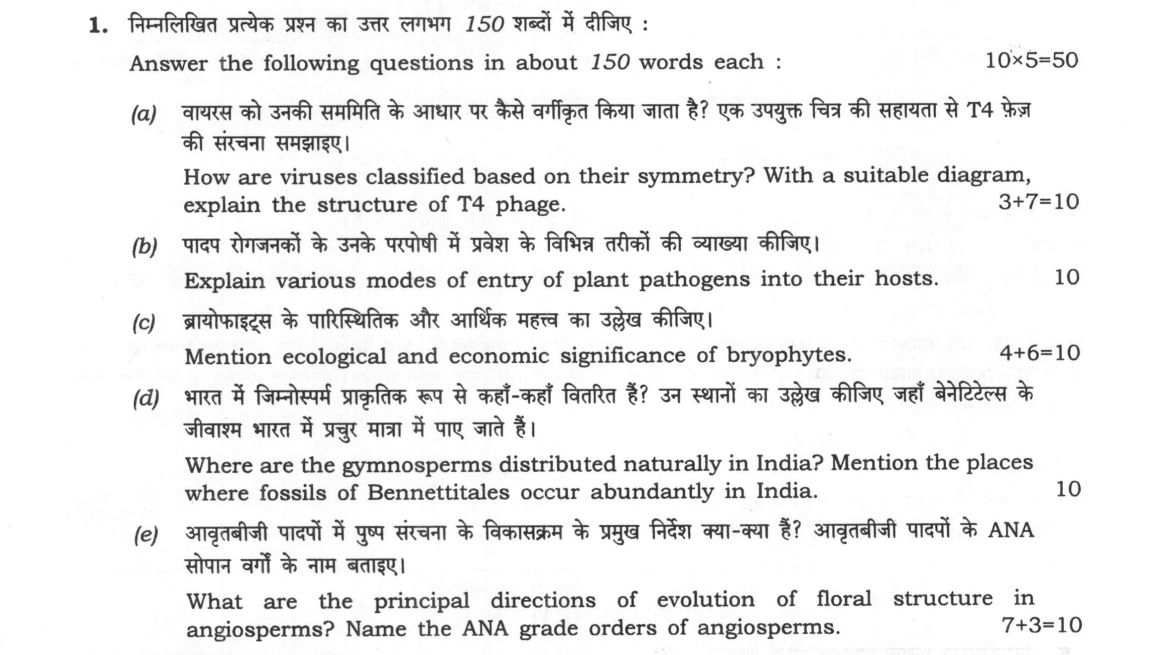
Answer the following questions in about 150 words each: (a) How are viruses classified based on their symmetry? With a suitable…
Answer the following questions in about 150 words each:
How are viruses classified based on their symmetry? With a suitable diagram, explain the structure of T4 phage. 3+7=10
Explain various modes of entry of plant pathogens into their hosts. 10 marks
Mention ecological and economic significance of bryophytes. 4+6=10
Where are the gymnosperms distributed naturally in India? Mention the places where fossils of Bennettitales occur abundantly in India. 10 marks
What are the principal directions of evolution of floral structure in angiosperms? Name the ANA grade orders of angiosperms. 7+3=10
हिंदी में प्रश्न पढ़ें
निम्नलिखित प्रत्येक प्रश्न का उत्तर लगभग 150 शब्दों में दीजिए :
वायरस को उनकी सममिति के आधार पर कैसे वर्गीकृत किया जाता है? एक उपयुक्त चित्र की सहायता से T4 फेज की संरचना समझाइए। 3+7=10
पादप रोगजनकों के उनके परपोषी में प्रवेश के विभिन्न तरीकों की व्याख्या कीजिए। 10
ब्रायोफाइट्स के पारिस्थितिक और आर्थिक महत्व का उल्लेख कीजिए। 4+6=10
भारत में जिम्नोस्पर्म प्राकृतिक रूप से कहाँ-कहाँ वितरित हैं? उन स्थानों का उल्लेख कीजिए जहाँ बेनेटिटेल्स के जीवाश्म भारत में प्रचुर मात्रा में पाए जाते हैं। 10
आवृतबीजी पादपों में पुष्प संरचना के विकासक्रम के प्रमुख निर्देश क्या-क्या हैं? आवृतबीजी पादपों के ANA सोपान वर्गों के नाम बताइए। 7+3=10
Model answer
Written by UPSC Answer Check against this question's marking rubric, to the 150-word length. UPSC does not publish answers for Mains — this is one way to score well, not an official key.
Plant diversity encompasses a spectrum of structural complexities, from sub-cellular entities like viruses to complex seed-bearing plants. Understanding their classification, pathology, ecology, distribution, and evolutionary trends is fundamental to botany.
(a) Virus Symmetry and T4 Phage Structure Viruses are classified based on their capsid symmetry into three main types: helical, icosahedral, and complex. Helical viruses, such as Tobacco Mosaic Virus (TMV) and Influenza, have capsomeres arranged in a spiral. Icosahedral viruses, like Adenovirus and Polio, possess a polyhedral capsid with 20 triangular faces. Complex viruses, such as Poxviruses and bacteriophages, exhibit mixed symmetry.
The T4 bacteriophage, a classic example of complex symmetry, has a distinct binal structure. It consists of a prolate icosahedral head, which is elongated rather than perfectly hexagonal, containing double-stranded DNA. Attached to the head is a contractile tail sheath surrounding a central tail tube. The base of the tail features a base plate with six long tail fibers that recognize and bind to specific receptors on the host bacterial cell surface. Upon attachment, the tail sheath contracts, driving the tail tube into the host cell to inject the genetic material.
(b) Modes of Entry of Plant Pathogens Plant pathogens employ diverse strategies to breach host defenses. Direct penetration is rare but occurs in fungi like Ustilago and Puccinia, which produce appressoria to mechanically pierce the cuticle. Most pathogens enter through natural openings. Stomata are primary entry points for rust fungi and some bacteria, while lenticels allow entry for storage rots like Sclerotium rolfsii. Hydathodes serve as entry sites for xylem-limited bacteria such as Xanthomonas. Wounds, caused by insects, mechanical injury, or environmental stress, provide easy access for bacteria and fungi. Seed transmission is another critical mode, where pathogens like Ustilago survive within seeds. Vector-mediated entry is also significant; insects like aphids and leafhoppers transmit viruses, while certain nematodes act as vectors. It is crucial to distinguish that root-knot nematodes (Meloidogyne) are not virus vectors but cause feeding sites, whereas ectoparasitic nematodes like Xiphinema and Longidorus transmit phloem-limited viruses.
(c) Ecological and Economic Significance of Bryophytes Ecologically, bryophytes are pioneer colonizers on bare rocks, initiating primary succession by breaking down rock into soil. They retain water in bogs, acting as natural sponges, and accumulate humus, aiding in soil formation. They also serve as bio-indicators for air and water pollution due to their sensitivity to environmental changes.
Economically, bryophytes have significant utility. Sphagnum moss is harvested for peat, used as fuel and in horticulture for its water-retaining properties. It is also used as packing material and in wound dressing due to its antiseptic properties. Liverworts like Marchantia contain medicinal compounds, and some species are used in traditional medicine for their therapeutic values.
(d) Gymnosperm Distribution and Bennettitales Fossils in India Gymnosperms in India are primarily distributed in the Himalayas and Western Ghats. The Western Himalayas host Pinus, Cedrus, and Abies, while the Eastern Himalayas feature Tsuga and Picea. The Khasi Hills and Nilgiris are home to Podocarpus species.
Fossils of Bennettitales, an extinct group of seed plants, are found abundantly in India. Major localities include the Rajmahal Hills in Jharkhand and the South Rewa region in Madhya Pradesh, where Williamsonia fossils are prominent. Additionally, the Kachchh region in Gujarat is a significant site for Bennettitales fossils, including Williamsonia and Ptilophyllum. These fossils provide crucial insights into the paleobotany of the Cretaceous period in India.
(e) Evolution of Floral Structure and ANA Grade The evolution of floral structure in angiosperms follows several principal directions. There is a trend from polypetaly (free petals) to sympetaly (fused petals), and from actinomorphy (radial symmetry) to zygomorphy (bilateral symmetry). The position of the ovary shifts from hypogyny (superior) to perigyny to epigyny (inferior). Carpels tend to fuse from apocarpy to syncarpy, and floral parts reduce in number from numerous free parts to fewer fused parts. Phyllotaxy also evolves from spiral to whorled.
The ANA grade represents the basal angiosperms, consisting of three orders: Amborellales, Nymphaeales, and Austrobaileyales. These groups are considered the earliest diverging lineages in the angiosperm phylogeny, providing a foundation for understanding the evolution of complex floral structures in other angiosperm clades.
In conclusion, the study of these diverse plant groups reveals the intricate mechanisms of survival, adaptation, and evolutionary progression that define the plant kingdom.
What "Explain" is asking you to do
Make the working of something clear — what sets it off, what follows from what, and what it produces. Explain is the Commission's mechanism word: it dominates the technical papers and the “explain why” stems, where the marks sit in the causal chain and not in the label.
Structure that answers it
State what it is → the initiating condition → the chain of cause, step by step → an instance where it plays out → what the chain produces
Where marks are lost
Describing what something looks like instead of why it works that way. Naming the stages without linking them reads as description too.
How this answer will be evaluated
Approach
Framework: UPSC Botany Paper 1. (a) explain: definition/context > points in order > small example > short close | (b) explain: definition/context > points in order > small example > short close | (c) highlight: name the salient points > one line of substance each > close | (d) map: locate accurately > label > one line on why it matters | (e) explain: definition/context > points in order > small example > short close Full marks: Precise, labelled diagrams, specific examples, and clear logical flow.
Key points expected
- List icosahedral, helical, and complex symmetry types
- Draw labelled diagram of T4 phage
- Identify head, collar, tail, and baseplate
- Describe tail fibers and sheath structure
- Entry through natural openings (stomata/lenticels)
- Entry through wounds (mechanical/animal)
- Direct penetration of intact cuticle
- Entry through specialized structures (haustoria)
Evaluation rubric
Each sub-part is marked on its own, against the marks and word limit printed on the paper.
- (a) Classification of viruses by symmetry and structural description of T4 phage. 10 marks · 150 words
explain— definition/context → points in order → small example → short close
Must cover
- List icosahedral, helical, and complex symmetry types
- Draw labelled diagram of T4 phage
- Identify head, collar, tail, and baseplate
- Describe tail fibers and sheath structure
Loses marks
- Unlabelled or missing diagram of T4 phage
- Confusing helical and icosahedral symmetry
Earns more
- Mention 20 triangular faces of icosahedron
- Note T4 as a complex bacteriophage
Extra mark
- Mention specific dimensions of T4 head
- (b) Description of various modes of entry for plant pathogens into hosts. 10 marks · 150 words
explain— definition/context → points in order → small example → short close
Must cover
- Entry through natural openings (stomata/lenticels)
- Entry through wounds (mechanical/animal)
- Direct penetration of intact cuticle
- Entry through specialized structures (haustoria)
Loses marks
- Omitting direct penetration mode
- Confusing entry with multiplication
Earns more
- Mention specific pathogens for each mode
- Note role of vectors in entry
Extra mark
- Mention specific example of haustorial penetration
- (c) Ecological and economic significance of bryophytes. 10 marks · 150 words
highlight— name the salient points → one line of substance each → close
Must cover
- Soil formation and erosion control
- Water retention and moisture regulation
- Medicinal uses (e.g., Sphagnum)
- Indicator species for environmental health
Loses marks
- Focusing only on economic value
- Ignoring ecological role in soil
Earns more
- Mention specific species like *Sphagnum* or *Marchantia*
- Note role in carbon sequestration
Extra mark
- Mention specific medicinal compound from bryophyte
- (d) Natural distribution of gymnosperms in India and locations of Bennettitales fossils. 10 marks · 150 words
map— locate accurately → label → one line on why it matters
Must cover
- Himalayan region for *Cedrus* and *Pinus*
- Western Ghats for *Taxus* and *Podocarpus*
- Specific locations for Bennettitales fossils
- Mention specific states or regions
Loses marks
- Vague geographical references
- Omitting Bennettitales fossil locations
Earns more
- Name specific species like *Cedrus deodara*
- Mention specific fossil sites in India
Extra mark
- Mention specific geological age of fossils
- (e) Principal directions of floral evolution in angiosperms and ANA grade orders. 10 marks · 150 words
explain— definition/context → points in order → small example → short close
Must cover
- Transition from actinomorphic to zygomorphic
- Reduction in floral parts
- Increase in carpel fusion
- List ANA grade orders (e.g., Nymphaeales, Magnoliales)
Loses marks
- Omitting ANA grade orders
- Confusing evolutionary directions
Earns more
- Mention specific examples for each direction
- Note trend towards reduced perianth
Extra mark
- Mention specific ANA grade order examples
Practice this exact question
Write your answer and it is marked point by point against the model answer above — what you covered, what you missed, what you got wrong.
Evaluate my answer →More from Botany 2024 Paper I
- Q1 Answer the following questions in about 150 words each: (a) How are viruses classified ba…
- Q2 (a) Describe the five distinct stages in the life cycle of Puccinia graminis with suitabl…
- Q3 (a) Enumerate the beneficial and harmful effects of algae. Add a note on their commercial…
- Q4 (a) Describe the male and female gametophytes of Pinus. How are the processes of pollinat…