Paper I — Q2
(a) Describe the five distinct stages in the life cycle of Puccinia graminis with suitable diagrams. 20 (b) With suitable…
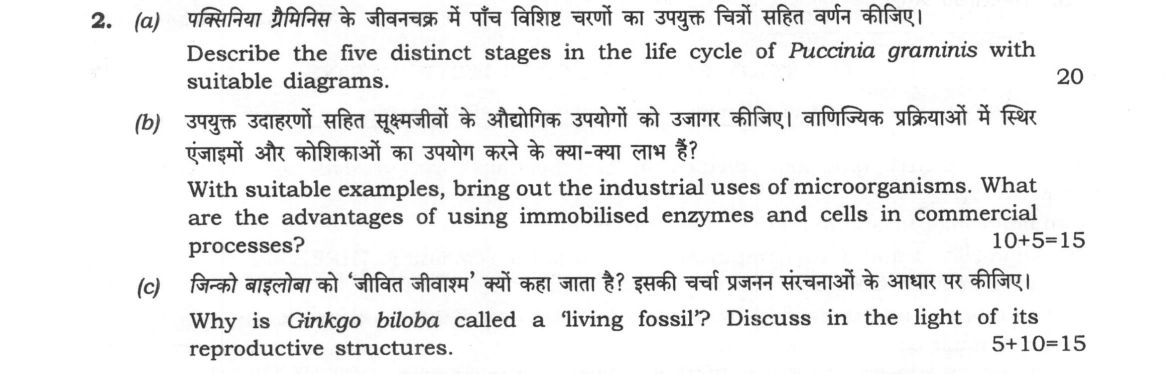
Describe the five distinct stages in the life cycle of Puccinia graminis with suitable diagrams. 20 marks
With suitable examples, bring out the industrial uses of microorganisms. What are the advantages of using immobilised enzymes and cells in commercial processes? 10+5=15
Why is Ginkgo biloba called a 'living fossil'? Discuss in the light of its reproductive structures. 5+10=15
हिंदी में प्रश्न पढ़ें
पक्सिनिया ग्रैमिनिस के जीवनचक्र में पाँच विशिष्ट चरणों का उपयुक्त चित्रों सहित वर्णन कीजिए। 20
उपयुक्त उदाहरणों सहित सूक्ष्मजीवों के औद्योगिक उपयोगों को उजागर कीजिए। वाणिज्यिक प्रक्रियाओं में स्थिर एंजाइमों और कोशिकाओं का उपयोग करने के क्या-क्या लाभ हैं? 10+5=15
जिन्को बाइलोबा को 'जीवित जीवाश्म' क्यों कहा जाता है? इसकी चर्चा प्रजनन संरचनाओं के आधार पर कीजिए। 5+10=15
Model answer
Written by UPSC Answer Check against this question's marking rubric, to the expected length. UPSC does not publish answers for Mains — this is one way to score well, not an official key.
**Life Cycle of *Puccinia graminis tritici***
Puccinia graminis tritici is a macrocyclic, heteroecious rust fungus that completes its polymorphic life cycle across two distinct host plants: primary host wheat (Triticum aestivum) and alternate host barberry (Berberis vulgaris). The five morphologically and functionally distinct stages occur in an obligate sequence:
`` [ Berbis vulgaris ] [ Triticum aestivum ] Stage 0: Pycniospores (+) & (-) -----> Dikaryotisation Stage I: Aeciospores (n+n) -----> Infects Wheat Stage II: Uredospores (n+n, repeating) Stage III: Teliospores (n+n -> 2n) Stage IV: Basidiospores (n) <----- (Meiosis on germination in soil) ``
Stage II: Uredinial Stage (Wheat). Dikaryotic uredospores develop within reddish-brown uredinia on host culms and leaves. Each spore is unicellular, oval, binucleate, with an echinulate wall and four equatorial germ pores, borne on a short pedicel. It serves as the repeating asexual stage propagating epidemics in the plains of India.
Stage III: Telial Stage (Wheat). As wheat matures, uredinia convert to dark telia producing teleutospores (teliospores). These are bicellular, spindle-shaped, thick-walled, smooth, dark-brown resting spores with a prominent pedicel. Each cell is initially dikaryotic; karyogamy occurs before dormancy, forming a diploid (2n) nucleus.
Stage IV: Basidial Stage (Soil/Stubble). In spring, the overwintered teleutospore germinates. Each cell produces an epibasidium (promycelium). The diploid nucleus undergoes meiosis, and four haploid basidiospores (two of + and two of - strain) are formed on sterigmata, which are wind-dispersed to infect Berberis vulgaris.
Stage V: Pycnial/Spermogonial Stage (Barberry). Basidiospores germinate on the adaxial leaf surface of barberry, producing haploid, flask-shaped pycnia (spermogonia). Pycnia produce uninucleate, tiny pycniospores (spermatia) and flexuous (receptive) hyphae. Spermatisation between opposite strains establishes the dikaryon (n+n).
Stage I: Aecial Stage (Barberry). Dikaryotic mycelium forms cup-like aecia (cluster cups) on the abaxial leaf surface. Inverted, bell-shaped peridia release polyhedral, orange, binucleate aeciospores in chains. These cannot reinfect barberry and are wind-borne to reinfect wheat, completing the cycle.
---
Industrial Uses of Microorganisms and Immobilisation
Microorganisms serve as versatile biocatalysts across diverse industrial sectors:
- Fermentation and Chemical Production: Saccharomyces cerevisiae is employed in industrial ethanol production; Aspergillus niger is used for high-yield citric acid fermentation.
- Antibiotics: Secondary metabolites like penicillin are produced commercially using Penicillium chrysogenum, and streptomycin via Streptomyces griseus.
- Industrial Enzymes: Bacillus subtilis synthesises thermo-tolerant alpha-amylases for starch saccharification, while Aspergillus oryzae yields proteases for detergents and leather tanning.
- Biofertilizers and Single Cell Protein (SCP): Nitrogen-fixing symbionts (Rhizobium) and free-living Azotobacter augment agro-ecosystem fertility, while Spirulina and Methylophilus methylotrophus yield protein-rich biomass for human and animal nutrition.
`` Matrix/Entrapment Bed: | [Cell/Enzyme] [Cell/Enzyme] | ==> Continuous Substrate Inflow | [Cell/Enzyme] [Cell/Enzyme] | ==> Pure Product Outflow (No catalyst contamination) ``
Advantages of Immobilised Enzymes and Cells:
- Reusability and Cost Efficiency: Catalysts are retained in solid supports (e.g., calcium alginate beads, polyacrylamide gels), enabling repeated catalytic cycles and reducing downstream recovery costs.
- Enhanced Stability: Immobilisation provides thermal and conformational stability against extreme pH, temperature, and shear stresses.
- Continuous Processing: Facilitates automated, packed-bed continuous bioreactor operations without wash-out phenomena.
- High Product Purity: Minimises contamination of the final effluent by residual microbial cells or denatured proteins.
---
_Ginkgo biloba_ as a Living Fossil and Its Reproductive Structures
Ginkgo biloba (Maidenhair tree) is designated a "living fossil" because it is the sole surviving representative of the order Ginkgoales (Division Ginkgophyta), retaining essentially unchanged morphological and anatomical features since the Mesozoic Era (Triassic-Jurassic). It displays phylogenetic stasis and primitive vegetative traits, notably fan-shaped deciduous leaves with open, dichotomous venation.
`` MALE STROBILUS: FEMALE STRUCTURE: Axis Long stalk (peduncle) ├── Microsporophyll ├── Collar (rim-like aril) │ └── 2 Microsporangia └── Naked Ovule (integument + micropyle) │ └── Motile antherozoids └── Pollen chamber & Archegonial chamber ``
Reproductive Structures Demonstrating Evolutionary Significance:
- Dioecious Habit: Male and female organs occur on separate individuals on dwarf shoots.
- Male Fructification: Microsporangiate strobili are catkin-like and lax, bearing microsporophylls that terminate in two pendulous microsporangia. Microspores produce multiflagellated, motile antherozoids (spermatozoids)—an archaic zooidogamous feature shared exclusively with cycads and pteridophytes, linking non-seed and seed plants.
- Female Fructification: Megasporangiate structures lack an organised cone, consisting of a long peduncle bifurcating into two (rarely more) collar-like platforms, each supporting a single, erect, naked ovule without an ovary wall (true gymnospermy).
- Pollination and Fertilisation: Pollination occurs via a fluid pollination drop. The pollen grains lodge in the deep pollen chamber; free-swimming ciliated male gametes traverse the liquid medium of the archegonial chamber to fertilise the egg inside the archegonium. The fleshy outer sarcotesta mimics an angiospermic pericarp but develops purely from the 3-layered ovular integument.
These reproductive characteristics establish Ginkgo biloba as a vital evolutionary bridge between primitive vascular cryptogams and advanced spermatophytes, demonstrating morphological stasis alongside conserved transitional traits.
What "Describe" is asking you to do
Give a full, ordered account of the thing named — its parts, stages or mechanism — in the sequence in which it actually exists or occurs. Most describe questions come from the science optionals, where the marks sit in correct technical detail and, where the stem says so, a labelled diagram.
Structure that answers it
One-line identification of the subject → the parts or stages in their real order, each with its defining detail → labelled diagram where the subject is structural → closing line on function or significance
Where marks are lost
Loose general prose where the examiner is ticking named parts, correct terminology and their sequence; and in the General Studies papers, turning to evaluation before the description is finished.
How this answer will be evaluated
Approach
Framework: UPSC Botany Paper 1. (a) describe: define > structure or process in order > labelled diagram > significance | (b) explain: definition/context > points in order > small example > short close | (c) explain: definition/context > points in order > small example > short close Full marks: Comprehensive, accurate, and well-structured answers with clear diagrams and specific examples.
Key points expected
- Identify the five distinct stages (0, I, II, III, IV)
- Describe the nature of each spore type (e.g., uredospores, teliospores)
- Provide suitable labelled diagrams for the stages
- Mention the host plants (e.g., Triticum, Barberry)
- List industrial uses with suitable examples (e.g., fermentation)
- Explain the concept of immobilised enzymes and cells
- State the advantages of immobilisation in commercial processes
- Provide specific examples of industrial products
Evaluation rubric
Each sub-part is marked on its own, against the marks and word limit printed on the paper.
- (a) Stepwise account of the five stages in the life cycle of Puccinia graminis with diagrams. 20 marks
describe— define → structure or process in order → labelled diagram → significance
Must cover
- Identify the five distinct stages (0, I, II, III, IV)
- Describe the nature of each spore type (e.g., uredospores, teliospores)
- Provide suitable labelled diagrams for the stages
- Mention the host plants (e.g., Triticum, Barberry)
Loses marks
- Unlabelled or missing diagrams
- Confusing the order of spore stages
- Using loose common names for the fungus
Earns more
- Correctly italicize Puccinia graminis
- Mention the alternate host (Berberis)
- Label spores clearly in diagrams
- Mention the specific disease name (e.g., stem rust)
Extra mark
- Mention specific cultivars of wheat
- Reference to recent resistance mechanisms
- (b) Industrial applications of microorganisms and the benefits of immobilised enzymes/cells. 15 marks
explain— definition/context → points in order → small example → short close
Must cover
- List industrial uses with suitable examples (e.g., fermentation)
- Explain the concept of immobilised enzymes and cells
- State the advantages of immobilisation in commercial processes
- Provide specific examples of industrial products
Loses marks
- Vague examples without specific microorganisms
- Failing to distinguish between free and immobilised enzymes
- Lack of specific commercial examples
Earns more
- Mention specific microorganisms used (e.g., Saccharomyces)
- Explain the mechanism of immobilisation (e.g., entrapment)
- Link to biotechnology applications
- Mention specific commercial products (e.g., citric acid)
Extra mark
- Reference to recent biotech applications
- Mention specific industrial processes (e.g., bioleaching)
- (c) Reasons for Ginkgo biloba being a 'living fossil' and its reproductive structures. 15 marks
explain— definition/context → points in order → small example → short close
Must cover
- Define 'living fossil' in the context of Ginkgo biloba
- Describe the reproductive structures of Ginkgo biloba
- Explain the evolutionary significance of these structures
- Link the reproductive features to its fossil status
Loses marks
- Confusing Ginkgo with other gymnosperms
- Failing to describe reproductive structures in detail
- Lack of link between fossil status and reproductive features
Earns more
- Mention the lack of flowers and fruits
- Describe the male and female cones
- Mention the presence of motile sperm
- Link to its ancient lineage
Extra mark
- Mention specific fossil records
- Reference to recent conservation efforts
Practice this exact question
Write your answer and it is marked point by point against the model answer above — what you covered, what you missed, what you got wrong.
Evaluate my answer →More from Botany 2024 Paper I
- Q1 Answer the following questions in about 150 words each: (a) How are viruses classified ba…
- Q2 (a) Describe the five distinct stages in the life cycle of Puccinia graminis with suitabl…
- Q3 (a) Enumerate the beneficial and harmful effects of algae. Add a note on their commercial…
- Q4 (a) Describe the male and female gametophytes of Pinus. How are the processes of pollinat…
- Q5 Answer the following questions in about 150 words each: (a) What are the consequences of…