Paper I — Q3
(a) Enumerate the beneficial and harmful effects of algae. Add a note on their commercial cultivation. 10+5+5=20 (b) Draw the…
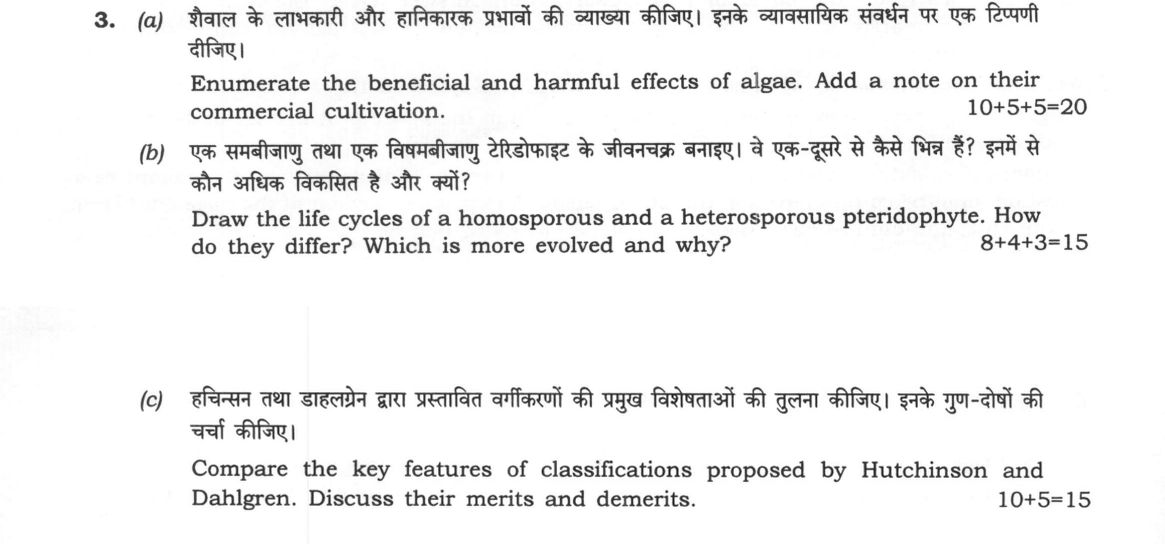
Enumerate the beneficial and harmful effects of algae. Add a note on their commercial cultivation. 10+5+5=20
Draw the life cycles of a homosporous and a heterosporous pteridophyte. How do they differ? Which is more evolved and why? 8+4+3=15
Compare the key features of classifications proposed by Hutchinson and Dahlgren. Discuss their merits and demerits. 10+5=15
हिंदी में प्रश्न पढ़ें
शैवाल के लाभकारी और हानिकारक प्रभावों की व्याख्या कीजिए। इनके व्यावसायिक संवर्धन पर एक टिप्पणी दीजिए। 10+5+5=20
एक समबीजाणु तथा एक विषमबीजाणु टेरिडोफाइट के जीवनचक्र बनाइए। वे एक-दूसरे से कैसे भिन्न हैं? इनमें से कौन अधिक विकसित है और क्यों? 8+4+3=15
हचिंसन तथा डाहलग्रेन द्वारा प्रस्तावित वर्गीकरणों की प्रमुख विशेषताओं की तुलना कीजिए। इनके गुण-दोषों की चर्चा कीजिए। 10+5=15
Model answer
Written by UPSC Answer Check against this question's marking rubric, to the expected length. UPSC does not publish answers for Mains — this is one way to score well, not an official key.
Algae, as basal plant groups and primary producers, form the foundation of aquatic ecosystems. Their significance spans ecological, economic, and evolutionary dimensions.
Beneficial and Harmful Effects Algae are vital for global oxygen production, contributing approximately 50% of the Earth’s atmospheric oxygen through photosynthesis. They serve as a direct food source; Spirulina and Chlorella are rich in protein and vitamins, widely used in dietary supplements. In agriculture, cyanobacteria like Nostoc and Anabaena act as biofertilizers in paddy fields, fixing atmospheric nitrogen. Industrially, they yield essential products: agar from red algae (Gracilaria), algin from brown algae, and carrageenan. Furthermore, Botryococcus braunii holds significant potential for biofuel production due to its high hydrocarbon content.
Conversely, algae pose several hazards. Eutrophication leads to algal blooms, which deplete dissolved oxygen upon decay, causing fish kills. Certain species produce toxins; Microcystis and Anabaena release hepatotoxins and neurotoxins, posing severe risks to human and animal health. Biofouling by algae damages ships, pipelines, and desalination plants, increasing maintenance costs. In water supplies, algae cause taste and odor problems. Additionally, invasive species like Caulerpa taxifolia have devastated coral reefs, disrupting marine biodiversity.
Commercial Cultivation Commercial algal farming is expanding globally. In India, the Tamil Nadu Marine Fisheries Department (TNMC) promotes Spirulina production in raceway ponds, leveraging the state’s coastal climate. Along the Gujarat coast, Kappaphycus alvarezii is cultivated for carrageenan extraction, providing livelihoods to coastal communities. Gracilaria is also farmed for agar. Cultivation methods range from open raceway ponds, which are cost-effective but susceptible to contamination, to closed photobioreactors, which offer higher productivity and purity but at greater capital cost.
Life Cycles of Pteridophytes The life cycle of a homosporous pteridophyte, exemplified by Dryopteris, involves the production of a single type of spore. These spores germinate to form a free-living, bisexual prothallus (gametophyte). The prothallus bears antheridia (male) and archegonia (female) on the same plant. Fertilization requires water for sperm to swim to the egg, resulting in a diploid sporophyte that is the dominant, independent phase.
In contrast, the heterosporous life cycle, seen in Selaginella, involves two distinct spore types: microspores and megaspores. Microspores develop into male gametophytes within the microsporangium, while megaspores develop into female gametophytes within the megasporangium. This endosporic development means the gametophytes are reduced and dependent on the sporophyte. Fertilization still requires water, but the gametophytes are not free-living.
Comparison and Evolution The key difference lies in spore size and gametophyte development. Homosporous plants produce uniform spores leading to bisexual, free-living gametophytes. Heterosporous plants produce dimorphic spores leading to unisexual, endosporic gametophytes. Heterospory is considered more evolved because it represents a step towards the seed habit. By retaining the gametophyte within the sporangium, the plant reduces dependence on external water for gametophyte survival and provides initial nutrition to the developing embryo. This structural integration is a precursor to the ovule and seed, offering greater reproductive assurance in drier environments.
Hutchinson vs. Dahlgren Classifications J. Hutchinson’s system (1926, revised 1959) was phylogenetic, emphasizing evolutionary relationships. He divided angiosperms into two major divisions: Herbaceae (monocots) and Lignosae (dicots). He recognized Ranales as the primitive order of dicots and placed monocots as a monophyletic group derived from this ancestral stock. His system was based on morphological characters and was widely accepted for its logical, evolutionary framework.
G. T. Dahlgren’s system (1985) was a superordinal classification that integrated micromolecular chemical characters (such as flavonoids, iridoids, and ellagitannins), embryology, anatomy, and ultrastructure. It divided angiosperms into Magnoliopsida and Liliopsida, using chemical data to refine groupings that morphology alone could not resolve. While Dahlgren’s system offered more natural groupings based on biochemical evidence, it was criticized for its complexity and the subjective weighting of chemical characters.
Conclusion While Hutchinson’s system provided a clear evolutionary narrative, Dahlgren’s approach highlighted the importance of chemical systematics. Today, both are largely superseded by molecular phylogenetics (APG system), but they remain crucial for understanding the historical progression of plant classification from morphology to integrated multi-character analysis.
What "Enumerate" is asking you to do
Produce the complete set of items asked for, countable and correctly named. The examiner marks against a checklist, so a missing item costs and an elaborated one gains nothing — where discussion is wanted the stem asks for it as a separate sub-part.
Structure that answers it
One line naming the basis on which the set is drawn → items numbered, each in a phrase or a single line → the discussion sub-part taken up separately, after the list is complete
Where marks are lost
Treating it as an essay. Six items named in six lines score better than three items explained at length.
How this answer will be evaluated
Approach
Framework: Botanical Taxonomy & Life Cycle Analysis. (a) explain: definition/context > points in order > small example > short close | (b) compare: paired headings or table > key differences > significance > conclusion | (c) compare: paired headings or table > key differences > significance > conclusion Full marks: Precise diagrams, specific species, clear comparative structure, strong evolutionary/taxonomic reasoning.
Key points expected
- Algae: beneficial (oxygen, food), harmful (blooms), cultivation (ponds, bioreactors)
- Pteridophytes: homosporous (one spore type) vs heterosporous (micro/macro), heterospory is more evolved
- Angiosperms: Hutchinson (monocots/dicots) vs Dahlgren (4 subclasses), merits/demerits of each
Evaluation rubric
Each sub-part is marked on its own, against the marks and word limit printed on the paper.
- (a) Categorize algae impacts and detail commercial farming methods. 20 marks
explain— definition/context → points in order → small example → short close
Must cover
- Beneficial effects (food, oxygen, biotech)
- Harmful effects (blooms, toxins)
- Commercial cultivation techniques (ponds, photobioreactors)
- Specific algal species examples
Loses marks
- Unlabelled diagrams
- Loose common names
- Vague generalities without species
Earns more
- Mention of specific toxins (e.g., saxitoxin)
- Biotech applications (carotenoids, biofuels)
- Environmental impact of blooms
Extra mark
- Recent biotech application (e.g., spirulina supplements)
- Specific commercial cultivar name
- (b) Contrast homosporous vs heterosporous pteridophyte life cycles and evolution. 15 marks
compare— paired headings or table → key differences → significance → conclusion
Must cover
- Labelled life cycle diagrams (both types)
- Spore type differences (micro/macro)
- Gametophyte development differences
- Evolutionary significance of heterospory
Loses marks
- Unlabelled diagrams
- Loose common names
- Missing evolutionary reasoning
Earns more
- Specific examples (e.g., *Marsilea*, *Selaginella*)
- Clear distinction of sporangia types
- Link to seed evolution
Extra mark
- Named species or cultivar
- Recent biotech application
- (c) Contrast Hutchinson and Dahlgren angiosperm classifications and evaluate them. 15 marks
compare— paired headings or table → key differences → significance → conclusion
Must cover
- Hutchinson's key features (monocots/dicots)
- Dahlgren's key features (4 subclasses)
- Merits of each system
- Demerits of each system
Loses marks
- Unlabelled diagrams
- Loose common names
- One-sided listing without comparison
Earns more
- Specific subclass names (e.g., Rosidae)
- Mention of morphological vs molecular basis
- Comparison of order counts
Extra mark
- Named committee or recent revision
- Specific taxonomic example
Practice this exact question
Write your answer and it is marked point by point against the model answer above — what you covered, what you missed, what you got wrong.
Evaluate my answer →More from Botany 2024 Paper I
- Q1 Answer the following questions in about 150 words each: (a) How are viruses classified ba…
- Q2 (a) Describe the five distinct stages in the life cycle of Puccinia graminis with suitabl…
- Q3 (a) Enumerate the beneficial and harmful effects of algae. Add a note on their commercial…
- Q4 (a) Describe the male and female gametophytes of Pinus. How are the processes of pollinat…
- Q5 Answer the following questions in about 150 words each: (a) What are the consequences of…
- Q6 (a) Describe different types of endosperm development in angiosperms. What is the signifi…