Paper I — Q6
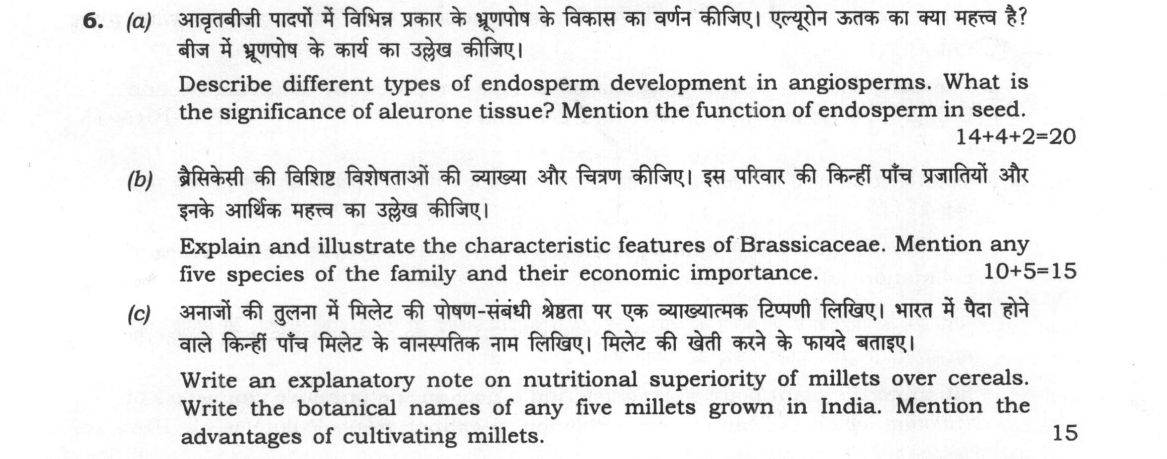
(a) Describe different types of endosperm development in angiosperms. What is the significance of aleurone tissue? Mention the…
Describe different types of endosperm development in angiosperms. What is the significance of aleurone tissue? Mention the function of endosperm in seed. 14+4+2=20
Explain and illustrate the characteristic features of Brassicaceae. Mention any five species of the family and their economic importance. 10+5=15
Write an explanatory note on nutritional superiority of millets over cereals. Write the botanical names of any five millets grown in India. Mention the advantages of cultivating millets. 15 marks
हिंदी में प्रश्न पढ़ें
आवृतबीजी पादपों में विभिन्न प्रकार के भ्रूणपोष के विकास का वर्णन कीजिए। एल्यूरोन उत्तक का क्या महत्व है? बीज में भ्रूणपोष के कार्य का उल्लेख कीजिए। 14+4+2=20
ब्रैसिकेसी की विशिष्ट विशेषताओं की व्याख्या और चित्रण कीजिए। इस परिवार की किन्हीं पाँच प्रजातियों और इनके आर्थिक महत्व का उल्लेख कीजिए। 10+5=15
अनाजों की तुलना में मिलेट की पोषण-संबंधी श्रेष्ठता पर एक व्याख्यात्मक टिप्पणी लिखिए। भारत में पैदा होने वाले किन्हीं पाँच मिलेट के वानस्पतिक नाम लिखिए। मिलेट की खेती करने के फायदे बताइए। 15
Model answer
Written by UPSC Answer Check against this question's marking rubric, to the expected length. UPSC does not publish answers for Mains — this is one way to score well, not an official key.
Endosperm development in angiosperms is a critical phase of seed maturation, primarily involving the triploid (3n) tissue formed by the fusion of the secondary nucleus with one male gamete. Three distinct patterns are recognized based on the timing of cell wall formation. In nuclear endosperm development, the primary endosperm nucleus undergoes repeated free-nuclear divisions without cytokinesis, resulting in a multinucleate syncytium. Only after a certain number of divisions do cell walls form, as seen in Zea mays and Triticum. In cellular endosperm development, the first division of the primary endosperm nucleus is immediately followed by cytokinesis, leading to the formation of distinct cells from the outset, characteristic of Ranunculus and Cucurbita. Helobial endosperm development is an intermediate type where the first division is transverse, creating a smaller apical cell and a larger basal cell. The apical cell divides freely to form a syncytium, while the basal cell divides periclinally to form cellular layers, as observed in monocots like Oryza sativa.
The aleurone tissue is a specialized, protein-rich layer of cells located at the periphery of the endosperm, separated from the starchy endosperm by a thin layer of cells. Its significance lies in its high enzymatic content, particularly proteases and amylases, which are crucial for mobilizing stored nutrients during seed germination. It also serves as a major reservoir for proteins and lipids. The broader function of endosperm in the seed is to provide nutrition to the developing embryo during maturation and to the seedling during early germination. It acts as a storage organ for carbohydrates, proteins, and lipids, ensuring the seedling has sufficient energy reserves until it can establish photosynthetic autonomy.
Brassicaceae is a large family of dicotyledonous plants characterized by distinct morphological features. The floral formula is ⊕ K₂₊₂ C₄× A₂₊₄ G(₂), indicating actinomorphic flowers, a calyx of four sepals in two whorls, a corolla of four petals in a cruciform arrangement, six stamens (four long and two short, known as tetradynamous), and a bicarpellary, syncarpous, superior ovary. The fruit is a characteristic silique (long, slender) or silicle (short, broad), which is a dry, dehiscent fruit with two valves. Inside, the seeds are attached to a false septum called the replum, resulting in parietal placentation. The family includes five economically significant species: Brassica juncea (Mustard, source of oil and spice), Brassica napus (Rapeseed, major oil crop), Brassica oleracea (Cabbage/Cauliflower, vegetable), Raphanus sativus (Radish, vegetable and fodder), and Eruca sativa (Tahini, vegetable). These crops are vital for India’s oilseed and vegetable production.
Millets possess nutritional superiority over major cereals like wheat and rice. They are gluten-free, high in dietary fiber, and rich in micronutrients such as iron, zinc, and calcium. Their low glycemic index makes them suitable for diabetic management, and they contain higher levels of essential amino acids and antioxidants. Five millets grown in India include Pennisetum glaucum (Sorghum), Sorghum bicolor (Jowar), Eleusine coracana (Ragi), Setaria italica (Kodo), and Panicum miliaceum (Bajra). The advantages of cultivating millets are significant for climate-resilient agriculture. They require less water and fertilizer compared to cereals, making them ideal for drought-prone regions. Their hardy nature supports food security in marginal lands, aligning with the UN International Year of Millets (2023) and India’s push for sustainable, low-input farming.
In conclusion, understanding endosperm biology aids in crop improvement for storage efficiency, while the distinct features of Brassicaceae and the nutritional and agronomic advantages of millets highlight their collective importance in sustaining agricultural productivity and public health in India.
What "Describe" is asking you to do
Give a full, ordered account of the thing named — its parts, stages or mechanism — in the sequence in which it actually exists or occurs. Most describe questions come from the science optionals, where the marks sit in correct technical detail and, where the stem says so, a labelled diagram.
Structure that answers it
One-line identification of the subject → the parts or stages in their real order, each with its defining detail → labelled diagram where the subject is structural → closing line on function or significance
Where marks are lost
Loose general prose where the examiner is ticking named parts, correct terminology and their sequence; and in the General Studies papers, turning to evaluation before the description is finished.
How this answer will be evaluated
Approach
Framework: Botany Paper 1: Define > Structure/Process > Labelled Diagram > Significance. (a) describe: define > structure or process in order > labelled diagram > significance | (b) explain: definition/context > points in order > small example > short close | (c) describe: define > structure or process in order > labelled diagram > significance Full marks: Precise definitions, labelled diagrams, correct binomials, and clear comparative analysis.
Key points expected
- Nuclear, helobial, cellular endosperm types
- Aleurone tissue significance and structure
- Brassicaceae flower/fruit features with illustration
- Five Brassicaceae species with economic importance
- Millet nutritional superiority over cereals
- Five Indian millet species with botanical names
- Advantages of millet cultivation
Evaluation rubric
Each sub-part is marked on its own, against the marks and word limit printed on the paper.
- (a) Classify endosperm types, explain aleurone significance, and state seed functions. 20 marks
describe— define → structure or process in order → labelled diagram → significance
Must cover
- Define nuclear, helobial, and cellular endosperm development
- Provide labelled diagram of endosperm development stages
- Explain aleurone tissue significance (nutrient storage/enzymes)
- Mention endosperm function in seed (embryo nutrition)
Loses marks
- Unlabelled diagrams of endosperm development
- Confusing endosperm types with embryo development
Earns more
- Mention specific angiosperm examples for each type
- Describe aleurone layer structure (single cell layer)
Extra mark
- Link to biotech applications in seed storage
- Mention specific cultivars with distinct endosperm types
- (b) Detail Brassicaceae features with illustration and list five species with economic value. 15 marks
explain— definition/context → points in order → small example → short close
Must cover
- Explain characteristic features (calyx, corolla, androecium, gynoecium)
- Provide labelled illustration of Brassicaceae flower/fruit
- List five species with botanical names (italicised)
- State economic importance of each species
Loses marks
- Unlabelled illustrations of flower/fruit
- Using loose common names instead of binomials
Earns more
- Mention specific fruit types (silique/silicle)
- Describe stamen arrangement (tetradynamous)
Extra mark
- Mention specific cultivars of Brassica species
- Link to recent biotech applications in Brassicaceae
- (c) Explain millet nutritional superiority, list five Indian species, and state cultivation advantages. 15 marks
describe— define → structure or process in order → labelled diagram → significance
Must cover
- Explain nutritional superiority over cereals (protein, minerals)
- List five millets with botanical names (italicised)
- Mention advantages of cultivating millets (drought resistance)
- Provide comparative analysis with cereals
Loses marks
- Using loose common names instead of binomials
- Listing without comparative analysis with cereals
Earns more
- Mention specific nutrient values (protein, iron, zinc)
- Describe specific cultivation advantages (low water requirement)
Extra mark
- Mention specific Indian millet cultivars
- Link to recent conservation efforts for millets
Practice this exact question
Write your answer and it is marked point by point against the model answer above — what you covered, what you missed, what you got wrong.
Evaluate my answer →More from Botany 2024 Paper I
- Q3 (a) Enumerate the beneficial and harmful effects of algae. Add a note on their commercial…
- Q4 (a) Describe the male and female gametophytes of Pinus. How are the processes of pollinat…
- Q5 Answer the following questions in about 150 words each: (a) What are the consequences of…
- Q6 (a) Describe different types of endosperm development in angiosperms. What is the signifi…
- Q7 (a) Write an explanatory account of ethnobotany. Give a critical account of whether ethno…
- Q8 (a) Basal media, growth regulators, sterilization and culture conditions are essential co…