Paper I — Q7
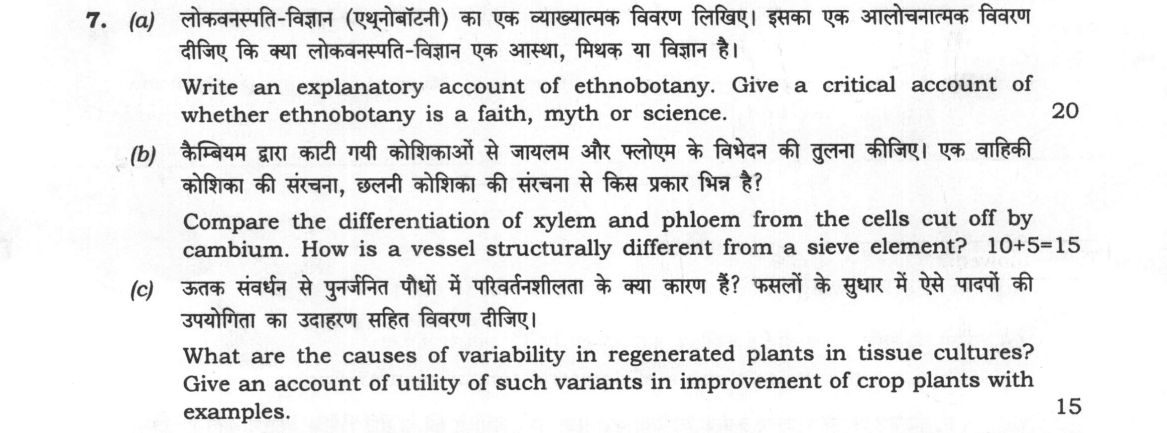
(a) Write an explanatory account of ethnobotany. Give a critical account of whether ethnobotany is a faith, myth or science…
Write an explanatory account of ethnobotany. Give a critical account of whether ethnobotany is a faith, myth or science. 20 marks
Compare the differentiation of xylem and phloem from the cells cut off by cambium. How is a vessel structurally different from a sieve element? 10+5=15
What are the causes of variability in regenerated plants in tissue cultures? Give an account of utility of such variants in improvement of crop plants with examples. 15 marks
हिंदी में प्रश्न पढ़ें
लोकवनस्पति-विज्ञान (एथनोबॉटनी) का एक व्याख्यात्मक विवरण लिखिए। इसका एक आलोचनात्मक विवरण दीजिए कि क्या लोकवनस्पति-विज्ञान एक आस्था, मिथक या विज्ञान है। 20
कैम्बियम द्वारा काटी गयी कोशिकाओं से जायलम और फ्लोएम के विभेदन की तुलना कीजिए। एक वाहिका कोशिका की संरचना, छलनी कोशिका की संरचना से किस प्रकार भिन्न है? 10+5=15
उत्तक संवर्धन से पुनर्जीवित पौधों में परिवर्तनशीलता के क्या कारण हैं? फसलों के सुधार में ऐसे पादपों की उपयोगिता का उदाहरण सहित विवरण दीजिए। 15
Model answer
Written by UPSC Answer Check against this question's marking rubric, to the expected length. UPSC does not publish answers for Mains — this is one way to score well, not an official key.
Ethnobotany: Conceptual Evolution and Epistemic Critique
Ethnobotany, coined by J.W. Harshberger (1895) and expanded by R.I. Ford and Richard Evans Schultes, is the scientific investigation of reciprocal relationships between human cultures and plants. Historically transitioning from descriptive folklore catalogs into an interdisciplinary science combining botany, anthropology, and biochemistry, ethnobotany occupies a unique epistemological position.
Critically examined, ethnobotany is neither mere faith nor mythological dogma, but a systematic, empirical science operating within cultural idioms. While ritualistic taboos, totemic worship, and magico-religious doctrines surrounding plants are often perceived as faith or superstition, modern validation demonstrates that indigenous knowledge is grounded in longitudinal empirical observations, selective breeding, and natural experimentation.
When evaluated against scientific benchmarks—reproducibility, testable hypotheses, and chemical verification—ethnobotanical claims consistently demonstrate validity. Sacred groves, such as the Law Kyntang of the Khasi in Meghalaya and the Orans of the Bishnois in Rajasthan, utilize socio-religious sanctification (faith) to achieve demonstrable watershed conservation and germplasm preservation (science). Similarly, indigenous pharmacopoeias have provided validated leads for modern drug discovery, notably the extraction of the antihypertensive alkaloid reserpine from Rauvolfia serpentina and photosensitizing psoralens from Psoralea corylifolia. Thus, while ethnobotanical customs are packaged in cultural symbolism, the underlying core represents an empirical, falsifiable science.
Cambial Differentiation and Structural Contrasts in Vascular Elements
Vascular cambium consists of fusiform and ray initials. Fusiform initials undergo periclinal divisions to produce derivatives on two faces: inward (centripetally) differentiating into secondary xylem and outward (centrifugally) into secondary phloem.
Cellular differentiation is governed by positional signals, mechanical stress, and hormonal gradients. High auxin (IAA) concentrations combined with brassinosteroids upregulate HD-ZIP III transcription factors, driving xylem fate. This pathway triggers cell expansion, extensive secondary cell wall deposition (cellulose, hemicellulose, and lignin), and culminates in vacuole collapse and programmed cell death (PCD). Conversely, lower auxin ratios combined with cytokinin signaling activate KANADI and APL transcription factors, directing derivatives toward phloem differentiation.
Structurally, a vessel element differs markedly from a sieve element:
- Vessel Element: Dead and non-living at functional maturity following PCD; secondary wall is heavily lignified with bordered pits; possesses open perforation plates (simple or scalariform) at end walls, forming a continuous, hollow conduit for unidirectional water transport.
- Sieve Element: Living at functional maturity with an intact plasma membrane, but enucleate; walls are thin, non-lignified, and primary cellulosic; possesses specialized sieve plates with sieve pores lined by callose and traversed by P-protein (phloem-specific protein); contains degenerate peripheral cytoplasm with modified endoplasmic reticulum and plastids, remaining metabolically dependent on sister companion cells via dense plasmodesmata.
Variability in Tissue Culture Regenerants (Somaclonal Variation)
Variability in regenerated plants originates through three primary mechanisms:
- Pre-existing Heterogeneity: Polysomaty, cryptic aneuploidy, and somatic mosaicism already present in the donor explant tissue.
- Culture-Induced Genetic Mutations: Chromosomal aberrations (aneuploidy, polyploidy, translocations), point mutations, and the activation of retrotransposons induced by high concentrations of synthetic growth regulators (such as 2,4-D).
- Epigenetic Alterations: Stable yet non-mutational modifications, primarily altered DNA methylation patterns and histone modifications induced by in vitro oxidative stress.
Utility in Crop Improvement: Somaclonal variation provides a non-transgenic tool to generate novel variants, especially in vegetatively propagated or narrow-gene-pool crops:
- Disease Resistance: Isolation of Fiji disease and downy mildew resistance in sugarcane, and mosaic virus-resistant somaclones in sugarcane cultivar Co 86032.
- Abiotic Stress: Regeneration of salt- and aluminum-tolerant lines in rice and drought-tolerant lines in wheat.
- Agronomic Quality: Tomato lines with elevated total soluble solids (TSS) for processing, and Fusarium wilt-resistant variants in banana (cv. Nendran).
- Indian Initiatives: CSIR-CIMAP (Central Institute of Medicinal and Aromatic Plants) has generated elite, high-yielding somaclonal somavariants in Artemisia annua (higher artemisinin content), Mentha arvensis, and improved selections in sandalwood (Santalum album) and cardamom.
However, utility is constrained by chimeric regenerants, undesirable pleiotropic defects, and epigenetic instability, necessitating rigorous multi-locational clonal trials prior to commercial release.
Ethnobotanical empiricism and in vitro cellular reprogramming both illustrate the dynamic plasticity of plant systems; translating traditional botanical knowledge into pharmacology and somaclonal variation into field-stable crops requires rigorous quantitative screening and genetic stabilization.
What "Critically examine" is asking you to do
Test the proposition the question puts to you and return a finding on how far it holds. Examine stems carry a claim, or ask whether something has happened, and expect evidence weighed both ways before the extent is stated — often with remedial measures attached. “Critically” is not a section added at the end: name the yardstick you are judging by — the evidence, the stated objective, a constitutional principle, a rival explanation — and let a verdict close each part of the body. Where the question quotes a claim, that verdict must land on the claim itself, accepted, qualified or rejected, and not on the theme in general.
Structure that answers it
Restate the claim as the question frames it → evidence that supports it → evidence that undercuts it → the conditions under which it holds → verdict on how far it stands
Where marks are lost
Merits in one paragraph, demerits in the next, and a conclusion calling for a balanced and holistic approach. That is a survey with the judgement left out and it holds the answer in the middle band. The opposite error is reading “critically” as permission to attack — and with the odd pairings, critically describe or critically explain, the exposition still carries most of the marks, the judgement being a layer on it rather than a substitute for it.
How this answer will be evaluated
Approach
Framework: UPSC Botany Paper 1. (a) critique: the claim > its strengths > its weaknesses > your judgment | (b) compare: paired headings or table > key differences > significance > conclusion | (c) account for: state the phenomenon > the causes in order of weight > conclusion Full marks: Comprehensive, critical, and well-structured with specific examples and diagrams.
Key points expected
- Definition of ethnobotany and its scope
- Arguments supporting it as a science (evidence-based)
- Arguments for faith/myth (traditional beliefs)
- Critical judgment on its scientific validity
- Differentiation of xylem elements (tracheids, vessels, fibers)
- Differentiation of phloem elements (sieve tubes, companion cells)
- Structural difference: Vessel (lignified, dead) vs Sieve element (living, P-protein)
- Comparison of origin from cambium
Evaluation rubric
Each sub-part is marked on its own, against the marks and word limit printed on the paper.
- (a) Explanatory account of ethnobotany and critical evaluation of its status as faith, myth, or science. 20 marks
critique— the claim → its strengths → its weaknesses → your judgment
Must cover
- Definition of ethnobotany and its scope
- Arguments supporting it as a science (evidence-based)
- Arguments for faith/myth (traditional beliefs)
- Critical judgment on its scientific validity
Loses marks
- Treating it purely as folklore without scientific analysis
- Ignoring the 'critical' aspect of the question
- Lack of specific plant examples
Earns more
- Examples of medicinal plants (e.g., *Artemisia annua*)
- Mention of pharmacognosy or phytochemistry
- Reference to indigenous knowledge systems
Extra mark
- Specific case study of a plant used in traditional medicine
- Mention of modern bioprospecting applications
- (b) Comparison of xylem and phloem differentiation from cambium and structural differences between vessels and sieve elements. 15 marks
compare— paired headings or table → key differences → significance → conclusion
Must cover
- Differentiation of xylem elements (tracheids, vessels, fibers)
- Differentiation of phloem elements (sieve tubes, companion cells)
- Structural difference: Vessel (lignified, dead) vs Sieve element (living, P-protein)
- Comparison of origin from cambium
Loses marks
- Confusing primary and secondary differentiation
- Failing to distinguish dead vs living nature
- Omitting the cambium origin aspect
Earns more
- Mention of secondary xylem and phloem
- Description of pit membranes in vessels
- Role of companion cells in phloem
Extra mark
- Labelled diagram of xylem and phloem
- Mention of tyloses in vessels
- (c) Causes of variability in tissue culture plants and their utility in crop improvement with examples. 15 marks
account for— state the phenomenon → the causes in order of weight → conclusion
Must cover
- Causes: Somaclonal variation, epigenetic changes
- Utility: Disease resistance, stress tolerance
- Examples of improved crops (e.g., banana, potato)
- Link to biotechnology applications
Loses marks
- Confusing somaclonal variation with genetic mutation
- Lack of specific crop examples
- Ignoring the 'utility' aspect of the question
Earns more
- Mention of somaclonal variation mechanism
- Examples of specific cultivars
- Reference to conservation of endangered species
Extra mark
- Specific example of a somaclonal variant
- Mention of gene editing in context
Practice this exact question
Write your answer and it is marked point by point against the model answer above — what you covered, what you missed, what you got wrong.
Evaluate my answer →More from Botany 2024 Paper I
- Q4 (a) Describe the male and female gametophytes of Pinus. How are the processes of pollinat…
- Q5 Answer the following questions in about 150 words each: (a) What are the consequences of…
- Q6 (a) Describe different types of endosperm development in angiosperms. What is the signifi…
- Q7 (a) Write an explanatory account of ethnobotany. Give a critical account of whether ethno…
- Q8 (a) Basal media, growth regulators, sterilization and culture conditions are essential co…