Paper I — Q8
(a) Basal media, growth regulators, sterilization and culture conditions are essential components of plant tissue culture…
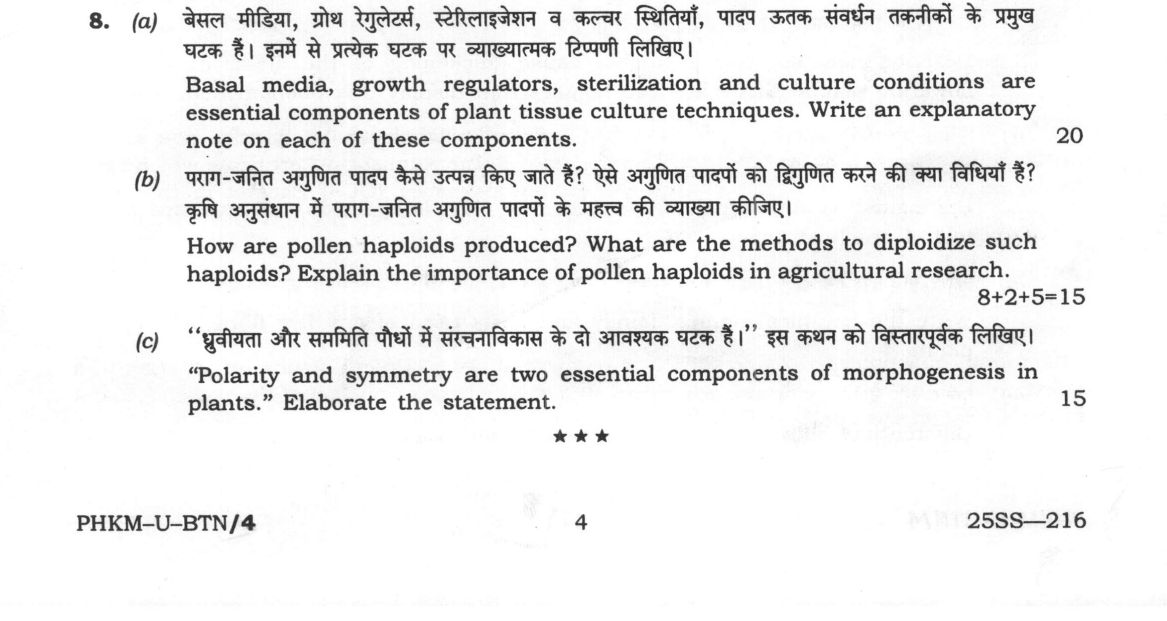
Basal media, growth regulators, sterilization and culture conditions are essential components of plant tissue culture techniques. Write an explanatory note on each of these components. 20 marks
How are pollen haploids produced? What are the methods to diploidize such haploids? Explain the importance of pollen haploids in agricultural research. 8+2+5=15
"Polarity and symmetry are two essential components of morphogenesis in plants." Elaborate the statement. 15 marks
हिंदी में प्रश्न पढ़ें
बेसल मीडिया, ग्रोथ रेगुलेटर्स, स्टेरिलाइजेशन व कल्चर स्थितियाँ, पादप उत्तक संवर्धन तकनीकों के प्रमुख घटक हैं। इनमें से प्रत्येक घटक पर व्याख्यात्मक टिप्पणी लिखिए। 20
पराग-जनित अगुणित पादप कैसे उत्पन्न किए जाते हैं? ऐसे अगुणित पादपों को द्विगुणित करने की क्या विधियाँ हैं? कृषि अनुसंधान में पराग-जनित अगुणित पादपों के महत्व की व्याख्या कीजिए। 8+2+5=15
"ध्रुवीयता और सममिति पौधों में संरचनाविकास के दो आवश्यक घटक हैं।" इस कथन को विस्तारपूर्वक लिखिए। 15
Model answer
Written by UPSC Answer Check against this question's marking rubric, to the expected length. UPSC does not publish answers for Mains — this is one way to score well, not an official key.
Plant tissue culture (PTC) relies on precise control of environmental and chemical variables to induce totipotency. The success of these techniques, including haploid production and morphogenesis, hinges on the interplay between basal media, growth regulators, sterilization, and culture conditions.
Basal Media and Growth Regulators The basal medium provides the essential nutritional foundation. Standard formulations like Murashige and Skoog (MS), B5, and White’s media contain macronutrients (N, P, K, Ca, Mg, S), micronutrients (Fe, Mn, Zn, Cu, B, Mo, Cl), vitamins, and a carbon source, typically 30 g/L sucrose, which serves as an energy source since explants are often non-photosynthetic initially. The composition is critical; for instance, high nitrogen in MS media promotes vigorous callus formation, while B5 is often preferred for root induction due to lower nitrate levels.
Growth regulators (GRs), primarily auxins and cytokinins, dictate developmental pathways through dose-dependent ratios. A high auxin-to-cytokinin ratio favors root initiation, while a high cytokinin ratio promotes shoot formation. Balanced ratios induce callus proliferation. Specific compounds like 2,4-D (a synthetic auxin) are potent callus inducers, whereas NAA is preferred for rooting, and BAP (6-benzylaminopurine) is a standard cytokinin. The precise concentration and combination determine whether the explant remains undifferentiated or differentiates into specific organs.
Sterilization and Culture Conditions Surface sterilization is a prerequisite for aseptic culture. Protocols typically involve a gradient of disinfectants: initial rinsing with water and detergent, followed by 70% ethanol for 1–2 minutes, and then 0.1% HgCl₂ or 10% NaOCl for 10–20 minutes. The explant is then rinsed with sterile water to remove residual chemicals. Failure at this stage leads to microbial contamination, which outcompetes plant tissues for nutrients.
Physical culture conditions optimize metabolic rates. Temperature is maintained at 25±2°C, with a day/night cycle of 27/22°C for some species. Light intensity (2000–3000 lux) and photoperiod (16h light/8h dark) influence chlorophyll synthesis and morphogenesis. High humidity (80–90%) prevents explant desiccation. These conditions must be synchronized with the chemical environment to ensure consistent growth.
Pollen Haploids: Production and Diploidization Pollen haploids are produced via anther culture or isolated microspore culture. In anther culture, mature anthers are placed on media, and microspores undergo embryogenesis to form haploid plants. Isolated microspore culture involves enzymatic separation of microspores from anthers, often after stress pretreatments like cold (4°C), starvation, or osmotic stress, which trigger the switch from vegetative to embryogenic development.
Diploidization converts haploids into fertile, homozygous diploids. Methods include:
- Chemical Induction: Treatment with colchicine or oryzalin inhibits spindle formation during mitosis, resulting in chromosome doubling.
- Spontaneous Doubling: Occurs naturally in a small percentage of haploid embryos due to endoreduplication (DNA replication without mitosis) or somatic hybridization of two haploid cells.
- Nitrous Oxide: N₂O treatment can also induce polyploidy.
Importance in Agriculture Pollen haploids are vital for rapid breeding. Doubled haploids (DHs) are completely homozygous, allowing immediate selection of desirable traits without multiple backcrossing generations. This accelerates the development of pure lines and hybrids. In India, DH technology has been instrumental in rice improvement at the Central Rice Research Institute (CRRI), enabling the fixation of disease-resistant genes. It is also used in mutation breeding to screen for recessive mutations in a homozygous background.
Polarity and Symmetry in Morphogenesis Morphogenesis is governed by the establishment of polarity and the breaking of symmetry. Polarity refers to the directional asymmetry in cells and tissues, essential for organ orientation. It is established by cytoplasmic gradients and the polar transport of auxin via PIN proteins. In the zygote, initial polarity is set by cytoplasmic streaming, leading to asymmetric cell divisions.
Symmetry describes the geometric arrangement of organs. Plants exhibit radial symmetry (actinomorphic flowers), bilateral symmetry (zygomorphic flowers), or spherical symmetry (some fruits). The transition from radial to bilateral symmetry is a key morphogenetic event, seen in leaf primordia where the adaxial-abaxial axis is established. Experimental evidence, such as Sinnott’s work on Fucus zygotes, demonstrates that cytoplasmic factors determine polarity, which in turn dictates the plane of cell division and subsequent symmetry.
In organogenesis, polarity and symmetry are interdependent. For example, in shoot apical meristems, the radial symmetry of the stem is maintained by the polar transport of auxin, which creates a gradient that determines the position of leaf primordia. Disruption of polarity leads to disorganized symmetry, resulting in malformed organs. Understanding these mechanisms is crucial for micropropagation, where controlling polarity ensures the formation of organized shoots rather than callus.
Conclusion In summary, the success of plant tissue culture and haploid breeding depends on the precise integration of media composition, growth regulator dynamics, and aseptic protocols. The production of doubled haploids offers a powerful tool for crop improvement, while the understanding of polarity and symmetry provides the mechanistic basis for controlling morphogenesis. These principles are central to modern agricultural biotechnology, enabling the rapid development of superior crop varieties.
What "Explain" is asking you to do
Make the working of something clear — what sets it off, what follows from what, and what it produces. Explain is the Commission's mechanism word: it dominates the technical papers and the “explain why” stems, where the marks sit in the causal chain and not in the label.
Structure that answers it
State what it is → the initiating condition → the chain of cause, step by step → an instance where it plays out → what the chain produces
Where marks are lost
Describing what something looks like instead of why it works that way. Naming the stages without linking them reads as description too.
How this answer will be evaluated
Approach
Framework: Plant Tissue Culture & Developmental Biology. (a) explain: definition/context > points in order > small example > short close | (b) explain: definition/context > points in order > small example > short close | (c) explain: definition/context > points in order > small example > short close Full marks: Precise definitions, specific examples, clear diagrams, strong links to applications.
Key points expected
- Basal media (MS, B5)
- Growth regulators (auxins, cytokinins)
- Sterilization (autoclave, surface)
- Culture conditions (light, temp)
- Pollen culture (anther)
- Diploidization (colchicine)
- Haploid importance (breeding)
- Polarity (apical-basal)
- Symmetry (radial, bilateral)
- Morphogenesis link
Evaluation rubric
Each sub-part is marked on its own, against the marks and word limit printed on the paper.
- (a) Explanatory notes on basal media, growth regulators, sterilization, and culture conditions. 20 marks
explain— definition/context → points in order → small example → short close
Must cover
- Basal media composition (e.g., MS, B5)
- Growth regulators (auxins, cytokinins) roles
- Sterilization methods (surface, media)
- Culture conditions (light, temp, humidity)
Loses marks
- Vague generalities without specific components
- Ignoring one of the four components
Earns more
- Specific media names (MS, WPM)
- Hormone ratios for organogenesis
- Autoclave parameters for sterilization
- Photoperiod details
Extra mark
- Diagram of tissue culture setup
- Specific sterilant concentrations
- (b) Production of pollen haploids, diploidization methods, and agricultural importance. 15 marks
explain— definition/context → points in order → small example → short close
Must cover
- Pollen culture technique (anther/pollen)
- Diploidization methods (colchicine, EMS)
- Importance in breeding (homozygous lines)
- Importance in research (genetics)
Loses marks
- Confusing haploids with hybrids
- Vague importance without specific applications
Earns more
- Specific plant species examples
- Mechanism of haploid induction
- Double haploid lines in crops
- Speed breeding advantages
Extra mark
- Diagram of anther culture
- Specific colchicine concentration
- (c) Elaborate on polarity and symmetry as components of plant morphogenesis. 15 marks
explain— definition/context → points in order → small example → short close
Must cover
- Definition of polarity in plants
- Definition of symmetry in plants
- Role of polarity in development
- Role of symmetry in development
Loses marks
- Defining without elaborating on morphogenesis
- Ignoring one of the two components
Earns more
- Apical-basal polarity examples
- Radial vs bilateral symmetry
- Hormonal control (auxin gradients)
- Specific organ examples (leaf, root)
Extra mark
- Diagram showing polarity/symmetry
- Molecular markers for polarity
Practice this exact question
Write your answer and it is marked point by point against the model answer above — what you covered, what you missed, what you got wrong.
Evaluate my answer →More from Botany 2024 Paper I
- Q5 Answer the following questions in about 150 words each: (a) What are the consequences of…
- Q6 (a) Describe different types of endosperm development in angiosperms. What is the signifi…
- Q7 (a) Write an explanatory account of ethnobotany. Give a critical account of whether ethno…
- Q8 (a) Basal media, growth regulators, sterilization and culture conditions are essential co…