Paper I — Q4
(a) Describe the male and female gametophytes of Pinus. How are the processes of pollination and fertilization accomplished in…
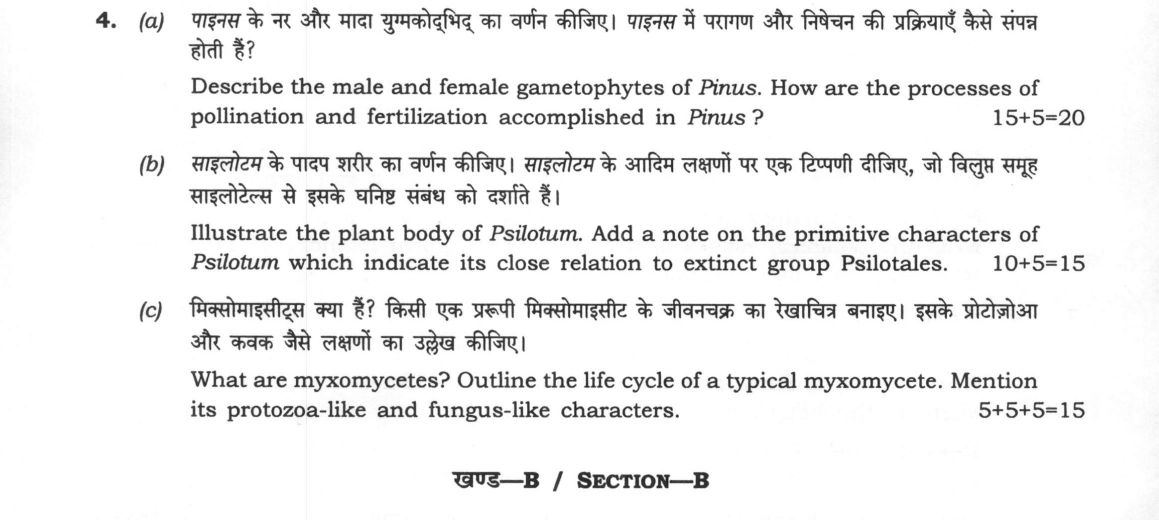
Describe the male and female gametophytes of Pinus. How are the processes of pollination and fertilization accomplished in Pinus? 15+5=20
Illustrate the plant body of Psilotum. Add a note on the primitive characters of Psilotum which indicate its close relation to extinct group Psilotales. 10+5=15
What are myxomycetes? Outline the life cycle of a typical myxomycete. Mention its protozoa-like and fungus-like characters. 5+5+5=15
हिंदी में प्रश्न पढ़ें
पाइनस के नर और मादा युग्मकोद्भिद का वर्णन कीजिए। पाइनस में परागण और निषेचन की प्रक्रियाएँ कैसे संपन्न होती हैं? 15+5=20
साइलोटम के पादप शरीर का वर्णन कीजिए। साइलोटम के आदिम लक्षणों पर एक टिप्पणी दीजिए, जो विलुप्त समूह साइलोटेल्स से इसके घनिष्ठ संबंध को दर्शाते हैं। 10+5=15
मिक्सोमाइसीड्स क्या हैं? किसी एक प्ररूपी मिक्सोमाइसीट के जीवनचक्र का रेखाचित्र बनाइए। इसके प्रोटोजोआ और कवक जैसे लक्षणों का उल्लेख कीजिए। 5+5+5=15
Model answer
Written by UPSC Answer Check against this question's marking rubric, to the expected length. UPSC does not publish answers for Mains — this is one way to score well, not an official key.
Part (a): Gametophytes, Pollination, and Fertilization in Pinus
The male gametophyte of Pinus is highly reduced, existing as a pollen grain. It is a 2- to 3-celled structure comprising a large prothallial (tube) cell, a generative cell, and often a small haustorial cell. The prothallial cell facilitates pollen tube growth, while the generative cell divides mitotically to form two sperm cells. The female gametophyte develops within the nucellus of the ovule. It begins as a megaspore mother cell that undergoes meiosis to produce four megaspores; three degenerate, and the functional one undergoes free-nuclear divisions to form a coenocytic prothallus. At the micropylar end, the prothallus differentiates into archegonia, each containing a ventral canal cell and a single egg cell at the apex.
Pollination is anemophilous. Winged pollen grains are carried by wind to the receptive cone. Upon landing near the micropyle, the pollen grain absorbs fluid from the nucellus, causing the prothallial cell to elongate into a pollen tube. The pollen tube grows through the nucellus, guided by the archegonial chamber, eventually reaching the archegonium. Fertilization is siphonogamous. The pollen tube discharges its contents into the archegonial chamber. The generative cell divides to release two sperm cells. One sperm fuses with the egg to form the zygote, while the other degenerates. The zygote develops into the embryo, and the nucellus becomes the seed coat.
Part (b): Plant Body and Primitive Characters of Psilotum
Psilotum is a small, herbaceous, dichotomously branched plant. The aerial stem is green and photosynthetic, bearing small, scale-like enations (microphylls) that lack veins. At the tips of branches, synangia (fused sporangia) are produced. Underground, the plant possesses a rhizome with rhizoids for anchorage and absorption, but lacks true roots. The vascular tissue is organized as a protostele, specifically an actinostele, where xylem and phloem are arranged in a star-like pattern around a central pith.
Psilotum exhibits several primitive characters indicating its close relation to extinct Psilotales like Rhynia and Horneophyton. It is homosporous, producing only one type of spore. The absence of true roots and leaves, replaced by rhizoids and enations, is a plesiomorphic trait. The synangial structure, where sporangia are fused into a single unit, is a key feature shared with early Devonian fossils found in the Rhynie chert. The protostelic vascular organization further supports its position as a basal lineage in vascular plant evolution.
Part (c): Myxomycetes: Life Cycle and Dual Nature
Myxomycetes, or plasmodial slime molds (Class Myxogastria, Phylum Mycetozoa), are eukaryotic organisms that exhibit characteristics of both protozoa and fungi. Their life cycle begins with spore germination, releasing motile swarm cells or myxamoebae. These cells aggregate to form a coenocytic, multinucleate plasmodium, which is the vegetative stage. Under unfavorable conditions, the plasmodium migrates to a suitable site and differentiates into fruiting bodies called sporangia. Within the sporangium, the plasmodium differentiates into a spore mass, which is released upon maturity.
Myxomycetes display protozoa-like characters in their vegetative phase. The plasmodium moves by cytoplasmic streaming, and the swarm cells are ciliated and amoeboid. Nutrition is phagotrophic (holozoic), as they engulf bacteria and other organic particles. They lack a cell wall during the plasmodial stage. Conversely, they exhibit fungus-like characters in their reproductive phase. They produce spores within sporangia, which have cellulosic walls. The sporangia often possess stalks, and the spores are released passively, resembling fungal spore dispersal. This dual nature places them in a transitional group between protozoa and fungi.
In conclusion, Pinus demonstrates advanced siphonogamous reproduction, Psilotum retains primitive vascular traits linking it to early land plants, and Myxomycetes bridge the gap between protozoan and fungal biology, highlighting evolutionary transitions in eukaryotic life.
What "Describe" is asking you to do
Give a full, ordered account of the thing named — its parts, stages or mechanism — in the sequence in which it actually exists or occurs. Most describe questions come from the science optionals, where the marks sit in correct technical detail and, where the stem says so, a labelled diagram.
Structure that answers it
One-line identification of the subject → the parts or stages in their real order, each with its defining detail → labelled diagram where the subject is structural → closing line on function or significance
Where marks are lost
Loose general prose where the examiner is ticking named parts, correct terminology and their sequence; and in the General Studies papers, turning to evaluation before the description is finished.
How this answer will be evaluated
Approach
Framework: Botany Paper 1: Define > Structure/Process > Labelled Diagram > Significance. (a) describe: define > structure or process in order > labelled diagram > significance | (b) explain: define > structure or process in order > labelled diagram > significance | (c) explain: definition/context > points in order > small example > short close Full marks: Accurate, labelled diagrams; precise terminology; clear distinction between stages; specific examples.
Key points expected
- Pinus: male/female gametophytes, pollination, fertilization
- Psilotum: plant body, primitive characters, Psilotales link
- Myxomycetes: definition, life cycle, protozoan/fungal traits
Evaluation rubric
Each sub-part is marked on its own, against the marks and word limit printed on the paper.
- (a) Detailed morphology of male/female gametophytes and stepwise pollination/fertilization sequence. 20 marks
describe— define → structure or process in order → labelled diagram → significance
Must cover
- Male gametophyte: microspore, pollen grain, tube cell, generative cell
- Female gametophyte: megasporangium, archegonium, egg, antipodal cells
- Pollination: pollen tube growth, release of male gametes
- Fertilization: double fertilization, zygote formation, seed development
Loses marks
- Unlabelled diagrams of cones or gametophytes
- Confusing pollination with fertilization
- Omitting the role of the pollen tube
Earns more
- Labelled diagram of male cone (microsporangium) and female cone (megasporangium)
- Mention of *Pinus* species (e.g., *Pinus roxburghii*)
- Distinction between pollination and fertilization timing
- Role of ovule in seed formation
Extra mark
- Mention of specific *Pinus* species used in forestry
- Link to biotech: genetic modification in conifers
- (b) Diagram of *Psilotum* plant body and list of primitive characters linking to Psilotales. 15 marks
explain— define → structure or process in order → labelled diagram → significance
Must cover
- Plant body: dichotomously branched stems, reduced leaves (phyllodes)
- Roots: adventitious, mycorrhizal association
- Reproductive: sporangia in synangia, homosporous
- Primitive characters: lack of true roots, vascular tissue, homosporous
Loses marks
- Unlabelled diagram of *Psilotum*
- Confusing *Psilotum* with *Equisetum* or *Lycopodium*
- Omitting the link to extinct Psilotales
Earns more
- Labelled diagram of *Psilotum nudum* showing stems and synangia
- Mention of mycorrhizal symbiosis
- Comparison with extinct Psilotales
- Note on evolutionary significance (living fossil)
Extra mark
- Mention of specific *Psilotum* species (e.g., *Psilotum complanatum*)
- Link to conservation: endangered status
- (c) Definition of myxomycetes, stepwise life cycle, and comparison of protozoan/fungal traits. 15 marks
explain— definition/context → points in order → small example → short close
Must cover
- Definition: slime moulds, plasmodial or cellular stages
- Life cycle: spore germination, amoeboid/plasmodial stage, sporulation
- Protozoa-like: motile, amoeboid, feeding on bacteria
- Fungus-like: spore formation, fruiting bodies, non-motile spores
Loses marks
- Unlabelled life cycle diagram
- Confusing myxomycetes with true fungi
- Omitting the protozoan-like characteristics
Earns more
- Labelled diagram of life cycle (e.g., *Physarum polycephalum*)
- Mention of specific species (e.g., *Stemonitis*, *Comatricha*)
- Distinction between plasmodial and cellular slime moulds
- Note on ecological role (decomposers)
Extra mark
- Mention of specific species (e.g., *Physarum polycephalum*)
- Link to biotech: slime moulds in computing (maze solving)
Practice this exact question
Write your answer and it is marked point by point against the model answer above — what you covered, what you missed, what you got wrong.
Evaluate my answer →More from Botany 2024 Paper I
- Q1 Answer the following questions in about 150 words each: (a) How are viruses classified ba…
- Q2 (a) Describe the five distinct stages in the life cycle of Puccinia graminis with suitabl…
- Q3 (a) Enumerate the beneficial and harmful effects of algae. Add a note on their commercial…
- Q4 (a) Describe the male and female gametophytes of Pinus. How are the processes of pollinat…
- Q5 Answer the following questions in about 150 words each: (a) What are the consequences of…
- Q6 (a) Describe different types of endosperm development in angiosperms. What is the signifi…
- Q7 (a) Write an explanatory account of ethnobotany. Give a critical account of whether ethno…