Paper I — Q5
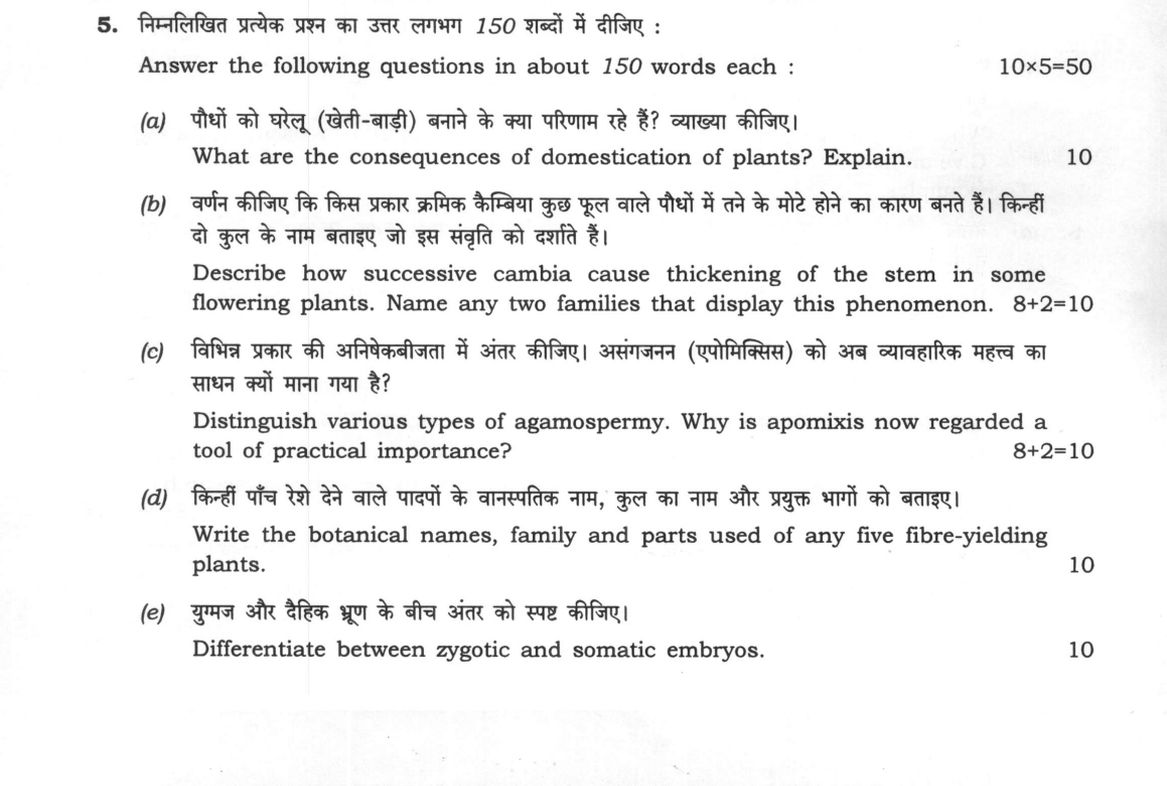
Answer the following questions in about 150 words each: (a) What are the consequences of domestication of plants? Explain…
Answer the following questions in about 150 words each:
What are the consequences of domestication of plants? Explain. 10 marks
Describe how successive cambia cause thickening of the stem in some flowering plants. Name any two families that display this phenomenon. 8+2=10
Distinguish various types of agamospermy. Why is apomixis now regarded a tool of practical importance? 8+2=10
Write the botanical names, family and parts used of any five fibre-yielding plants. 10 marks
Differentiate between zygotic and somatic embryos. 10 marks
हिंदी में प्रश्न पढ़ें
निम्नलिखित प्रत्येक प्रश्न का उत्तर लगभग 150 शब्दों में दीजिए :
पौधों को घरेलु (खेती-बाड़ी) बनाने के क्या परिणाम रहे हैं? व्याख्या कीजिए। 10
वर्णन कीजिए कि किस प्रकार क्रमिक कैम्बिया कुछ फूल वाले पौधों में तने के मोटे होने का कारण बनते हैं। किन्हीं दो कुल के नाम बताइए जो इस संवृत्ति को दर्शाते हैं। 8+2=10
विभिन्न प्रकार की अनिषेकबीजता में अंतर कीजिए। असंगजन (एपोमिक्सिस) को अब व्यावहारिक महत्व का साधन क्यों माना गया है? 8+2=10
किन्हीं पाँच रेशे देने वाले पादपों के वानस्पतिक नाम, कुल का नाम और प्रयुक्त भागों को बताइए। 10
युग्मज और दैहिक भ्रूण के बीच अंतर को स्पष्ट कीजिए। 10
Model answer
Written by UPSC Answer Check against this question's marking rubric, to the 150-word length. UPSC does not publish answers for Mains — this is one way to score well, not an official key.
(a) Consequences of Plant Domestication
Domestication is a process of artificial selection that fundamentally alters plant genetics, morphology, and physiology, leading to specific consequences. Genetically, it causes severe erosion of allelic diversity; wild populations like Oryza rufipogon possess vast genetic variation, whereas cultivated rice (Oryza sativa) retains only a fraction, increasing vulnerability to pests and climate change. Morphologically, selection favors traits beneficial to humans, such as increased seed size, synchronous ripening to facilitate harvesting, and the loss of shattering mechanisms, which prevents seed dispersal and ensures harvest efficiency. Physiologically, domesticated plants often exhibit reduced seed dormancy to allow immediate germination upon sowing and become less sensitive to photoperiod, enabling cultivation across diverse latitudes. However, these adaptations come at a cost: reduced fitness in wild conditions, as domesticated plants lose competitive abilities and defense mechanisms against natural predators. In the Indian context, the transition from wild to cultivated wheat in the Fertile Crescent and subsequent adoption in Mehrgarh illustrates how these changes enabled the shift from foraging to settled agriculture, forming the basis of the Indus Valley Civilization’s agrarian economy.
(b) Successive Cambia and Stem Thickening
In some flowering plants, secondary thickening is achieved through the formation of successive cambia rather than a single continuous vascular cambium. Initially, a primary vascular cambium forms between the xylem and phloem. As this cambium matures, it differentiates into xylem and phloem. Crucially, the innermost layer of the newly formed phloem (or sometimes the pericycle) retains meristematic activity and differentiates into a new, secondary vascular cambium. This new cambium produces another set of xylem and phloem, and the innermost layer of this new phloem again becomes a cambium. This cycle repeats, resulting in concentric rings of vascular bundles, each surrounded by its own cambium. This phenomenon is known as anomalous secondary growth. Two families that display this phenomenon are Chenopodiaceae (e.g., Chenopodium album, where stem successive cambia are prominent) and Nyctaginaceae (e.g., Boerhaavia diffusa). This structural adaptation allows for significant stem thickening without the formation of a single, continuous cylindrical cambium, providing mechanical support in certain herbaceous or shrubby species.
(c) Types of Agamospermy and Importance of Apomixis
Agamospermy is the formation of seeds without fertilization (syngamy), though meiosis may or may not occur. It is distinguished into three main types. First, Adventitious Embryony (Sporophytic apomixis), where embryos arise from nucellar or integumentary cells, often resulting in polyembryony; meiosis is typically absent. Second, Gametophytic Apomixis, where the embryo develops from an unreduced gamete. This is further divided into Apospory (embryo from a megaspore mother cell or its daughter cell) and Diplospory (embryo from a haploid egg cell that undergoes mitotic doubling). Third, Apogamy, a rare type where the embryo develops from a synergid or antipodal cell. Apomixis is now regarded as a tool of practical importance because it allows for the fixation of heterosis (hybrid vigor) in seeds. Unlike sexual reproduction, which leads to segregation and loss of hybrid traits, apomixis produces clonal seeds that are genetically identical to the parent. This enables the mass production of hybrid crops, such as in Citrus, mango, and guava, ensuring uniformity, high yield, and the preservation of desirable traits without the need for repeated cross-breeding, thereby bypassing incompatibility barriers and reducing breeding time.
(d) Fibre-Yielding Plants
Five important fibre-yielding plants are:
- Cotton (Gossypium hirsutum): Family Malvaceae; Part used: Seed hairs (lint).
- Jute (Corchorus capsularis): Family Malvaceae; Part used: Phloem fibre (bast).
- Flax (Linum usitatissimum): Family Linaceae; Part used: Phloem fibre (bast).
- Sunn Hemp (Crotalaria juncea): Family Fabaceae; Part used: Phloem fibre (bast).
- Sisal (Agave sisalana): Family Asparagaceae; Part used: Leaf fibre.
(e) Zygotic vs. Somatic Embryos
Zygotic and somatic embryos differ in origin, genetics, and structure. A zygotic embryo originates sexually from the fusion of male and female gametes (zygote). It is genetically variable due to recombination and fertilization. Structurally, it typically possesses a suspensor and is associated with the formation of endosperm (usually triploid) which provides nutrition. In contrast, a somatic embryo originates asexually from somatic cells, such as those from callus cultures or nucellar tissue (in vivo). It is genetically uniform, being a clone of the parent plant. Somatic embryos generally lack a suspensor or have a reduced one and do not form endosperm; instead, they rely on maternal tissues (in vivo) or culture media (in vitro) for nutrition. While zygotic embryos ensure genetic diversity essential for evolution, somatic embryogenesis is crucial in plant tissue culture for mass propagation and genetic transformation, allowing the rapid cloning of elite genotypes without the variability introduced by sexual reproduction.
What "Explain" is asking you to do
Make the working of something clear — what sets it off, what follows from what, and what it produces. Explain is the Commission's mechanism word: it dominates the technical papers and the “explain why” stems, where the marks sit in the causal chain and not in the label.
Structure that answers it
State what it is → the initiating condition → the chain of cause, step by step → an instance where it plays out → what the chain produces
Where marks are lost
Describing what something looks like instead of why it works that way. Naming the stages without linking them reads as description too.
How this answer will be evaluated
Approach
Framework: UPSC Botany Paper 1. (a) explain: definition/context > points in order > small example > short close | (b) describe: define > structure or process in order > labelled diagram > significance | (c) compare: paired headings or table > key differences > significance > conclusion | (d) explain: definition/context > points in order > small example > short close | (e) compare: paired headings or table > key differences > significance > conclusion Full marks: Comprehensive, accurate, with specific examples and diagrams
Key points expected
- Loss of genetic diversity
- Altered seed dispersal mechanisms
- Increased yield and uniformity
- Dependence on human intervention
- Definition of successive cambia
- Process of secondary growth
- Two specific plant families
- Labelled diagram of stem cross-section
Evaluation rubric
Each sub-part is marked on its own, against the marks and word limit printed on the paper.
- (a) Consequences of plant domestication 10 marks · 150 words
explain— definition/context → points in order → small example → short close
Must cover
- Loss of genetic diversity
- Altered seed dispersal mechanisms
- Increased yield and uniformity
- Dependence on human intervention
Loses marks
- Vague generalities without examples
- Ignoring negative consequences
Earns more
- Mention of specific crops (e.g., rice, wheat)
- Link to modern biotechnology
- Reference to 'Green Revolution'
Extra mark
- Specific cultivar names
- Recent biotech application
- (b) Successive cambia and stem thickening 10 marks · 150 words
describe— define → structure or process in order → labelled diagram → significance
Must cover
- Definition of successive cambia
- Process of secondary growth
- Two specific plant families
- Labelled diagram of stem cross-section
Loses marks
- Unlabelled diagrams
- Incorrect family names
Earns more
- Mention of specific species (e.g., *Cinnamomum*)
- Comparison with normal secondary growth
- Reference to commercial importance
Extra mark
- Specific species names
- Recent biotech application
- (c) Types of agamospermy and apomixis importance 10 marks · 150 words
compare— paired headings or table → key differences → significance → conclusion
Must cover
- Definition of agamospermy
- Types: apomixis, parthenogenesis
- Practical importance of apomixis
- Link to crop improvement
Loses marks
- Confusing agamospermy with apomixis
- Ignoring practical applications
Earns more
- Mention of specific crops (e.g., *Taraxacum*)
- Reference to hybrid seed production
- Comparison with sexual reproduction
Extra mark
- Specific species names
- Recent biotech application
- (d) Five fibre-yielding plants 10 marks · 150 words
explain— definition/context → points in order → small example → short close
Must cover
- Botanical names (italicised)
- Family names
- Parts used for fibre
- Five distinct plants
Loses marks
- Incorrect botanical names
- Missing family names
Earns more
- Mention of commercial importance
- Reference to specific fibre types (e.g., cotton, jute)
- Comparison of fibre quality
Extra mark
- Specific cultivar names
- Recent biotech application
- (e) Zygotic vs somatic embryos 10 marks · 150 words
compare— paired headings or table → key differences → significance → conclusion
Must cover
- Definition of zygotic embryo
- Definition of somatic embryo
- Key differences in origin
- Comparison of genetic stability
Loses marks
- Confusing zygotic and somatic origins
- Ignoring genetic implications
Earns more
- Mention of specific techniques (e.g., tissue culture)
- Reference to applications in plant breeding
- Comparison of morphological features
Extra mark
- Specific species names
- Recent biotech application
Practice this exact question
Write your answer and it is marked point by point against the model answer above — what you covered, what you missed, what you got wrong.
Evaluate my answer →More from Botany 2024 Paper I
- Q2 (a) Describe the five distinct stages in the life cycle of Puccinia graminis with suitabl…
- Q3 (a) Enumerate the beneficial and harmful effects of algae. Add a note on their commercial…
- Q4 (a) Describe the male and female gametophytes of Pinus. How are the processes of pollinat…
- Q5 Answer the following questions in about 150 words each: (a) What are the consequences of…
- Q6 (a) Describe different types of endosperm development in angiosperms. What is the signifi…
- Q7 (a) Write an explanatory account of ethnobotany. Give a critical account of whether ethno…
- Q8 (a) Basal media, growth regulators, sterilization and culture conditions are essential co…