Paper II — Q1
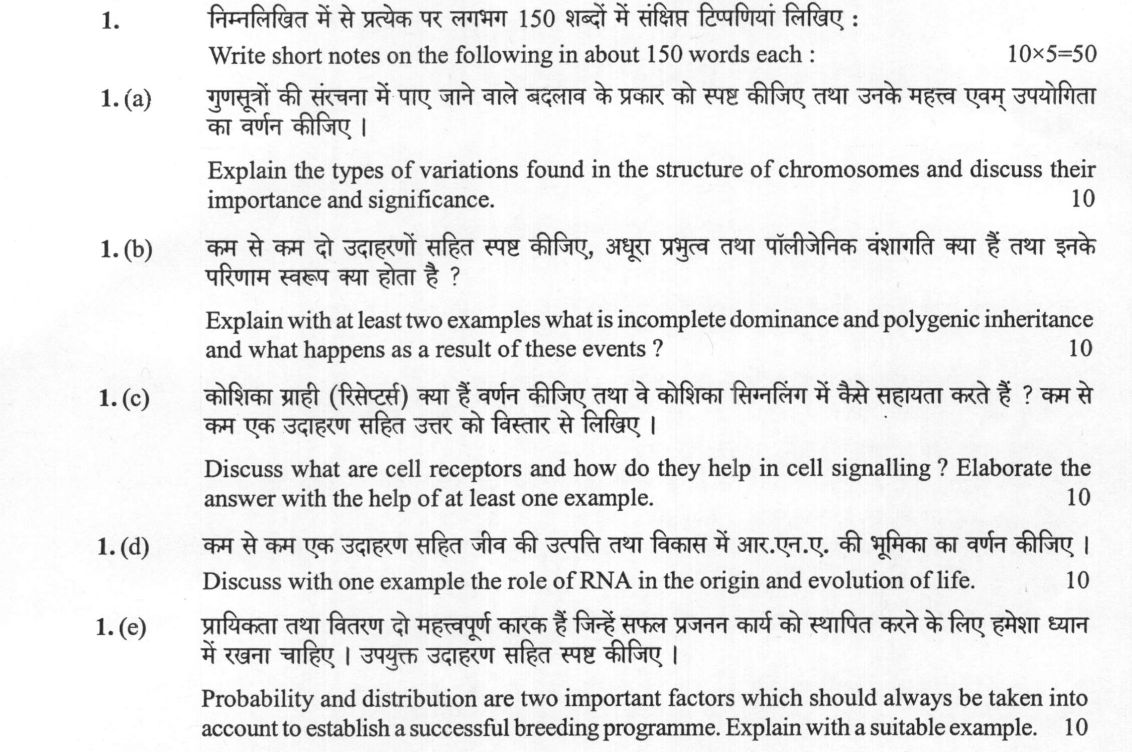
Write short notes on the following in about 150 words each : 10×5=50 (a) Explain the types of variations found in the structure…
Write short notes on the following in about 150 words each : 10×5=50
Explain the types of variations found in the structure of chromosomes and discuss their importance and significance. 10 marks
Explain with at least two examples what is incomplete dominance and polygenic inheritance and what happens as a result of these events ? 10 marks
Discuss what are cell receptors and how do they help in cell signalling ? Elaborate the answer with the help of at least one example. 10 marks
Discuss with one example the role of RNA in the origin and evolution of life. 10 marks
Probability and distribution are two important factors which should always be taken into account to establish a successful breeding programme. Explain with a suitable example. 10 marks
हिंदी में प्रश्न पढ़ें
निम्नलिखित में से प्रत्येक पर लगभग 150 शब्दों में संक्षिप्ट टिप्पणियाँ लिखिए : 10×5=50
गुणसूत्रों की संरचना में पाए जाने वाले बदलाव के प्रकार को स्पष्ट कीजिए तथा उनके महत्व एवं उपयोगिता का वर्णन कीजिए । 10
कम से कम दो उदाहरणों सहित स्पष्ट कीजिए, अधूरा प्रभुत्व तथा पॉलीजेनिक वंशागति क्या है तथा इनके परिणाम स्वरूप क्या होता है ? 10 marks
कोशिका ग्राही (रिसेप्टर्स) क्या हैं वर्णन कीजिए तथा वे कोशिका सिग्नलिंग में कैसे सहायता करते हैं ? कम से कम एक उदाहरण सहित उत्तर को विस्तार से लिखिए । 10
कम से कम एक उदाहरण सहित जीव की उत्पत्ति तथा विकास में आर.एन.ए. की भूमिका का वर्णन कीजिए । 10
प्रायिकता तथा वितरण दो महत्वपूर्ण कारक हैं जिन्हें सफल प्रजनन कार्य को स्थापित करने के लिए हमेशा ध्यान में रखना चाहिए । उपयुक्त उदाहरण सहित स्पष्ट कीजिए । 10
Model answer
Written by UPSC Answer Check against this question's marking rubric, to the 150-word length. UPSC does not publish answers for Mains — this is one way to score well, not an official key.
(a) Chromosomal Structural Variations Chromosomal structural variations are permanent changes in the DNA sequence of a chromosome, distinct from numerical aneuploidy. The four primary types are deletion (loss of a segment), duplication (gain of a segment), inversion (reversal of a segment), and translocation (movement of a segment to a non-homologous chromosome). These variations are cytogenetically significant as they alter gene dosage, disrupt gene function, or create novel gene fusions. For instance, the Philadelphia chromosome, a reciprocal translocation between chromosomes 9 and 22, fuses the ABL1 and BCR genes, leading to chronic myeloid leukemia. Evolutionarily, these rearrangements drive speciation by creating reproductive barriers and provide raw material for natural selection, although they often result in genetic disorders due to loss of heterozygosity or position effects.
(b) Incomplete Dominance and Polygenic Inheritance Incomplete dominance occurs when the heterozygous phenotype is an intermediate blend of the two homozygous phenotypes, lacking complete dominance. In Mirabilis jalapa (4 o’clock plant), crossing red-flowered (RR) and white-flowered (rr) parents yields pink-flowered (Rr) offspring, demonstrating a 1:2:1 phenotypic ratio. This contrasts with codominance, where both alleles are expressed distinctly. Polygenic inheritance involves multiple genes contributing additively to a single trait, resulting in continuous variation rather than discrete categories. Examples include wheat kernel color and human skin pigmentation. In wheat, kernel color is controlled by multiple R genes; the F2 generation displays a spectrum of colors from white to dark red, following a binomial distribution. This quantitative inheritance is crucial for understanding complex traits in agriculture and medicine, where environmental factors also modulate the phenotypic expression.
(c) Cell Receptors and Signalling Cell receptors are specialized proteins that bind specific ligands, initiating intracellular signal transduction. They are classified into membrane-bound receptors (such as G-protein coupled receptors and receptor tyrosine kinases) and intracellular receptors (for lipid-soluble ligands). Upon ligand binding, conformational changes trigger downstream cascades involving second messengers like cAMP or Ca²⁺. A key example is the insulin receptor, a receptor tyrosine kinase. Insulin binding activates the receptor’s kinase activity, phosphorylating substrates that regulate glucose uptake and metabolism. This mechanism ensures precise cellular response to extracellular signals, maintaining homeostasis. Dysregulation of these pathways leads to diseases like diabetes, highlighting the critical role of receptor specificity and signal fidelity in physiological regulation.
(d) RNA in Origin and Evolution The RNA World hypothesis posits that RNA preceded DNA and proteins in early life, serving as both genetic material and catalyst. RNA’s unique ability to store genetic information (like DNA) and catalyze chemical reactions (like proteins) makes it a plausible precursor to modern cells. Evidence includes ribozymes, such as the self-splicing introns in Tetrahymena and the peptidyl transferase activity of 23S rRNA in the ribosome, which catalyzes peptide bond formation. This catalytic role of RNA in protein synthesis suggests that early translation was RNA-mediated. The evolution from RNA to DNA-protein systems likely involved the development of reverse transcriptase and the greater stability of DNA for long-term storage, while proteins offered superior catalytic versatility. This transition marks a pivotal step in the evolution of complex life.
(e) Probability and Distribution in Breeding Successful breeding programmes rely on probability theory to predict genetic outcomes and statistical distribution to assess trait variability. Probability rules, such as Mendelian segregation ratios, allow breeders to estimate the likelihood of desirable genotypes in offspring. For example, in a monohybrid cross, the probability of obtaining a homozygous dominant offspring is 1/4. The chi-square test is used to validate observed ratios against expected Mendelian ratios, ensuring data reliability. Distribution analysis, particularly the normal distribution, is critical for polygenic traits like yield in wheat. By calculating heritability and selecting parents from the upper tail of the distribution, breeders can maximize genetic gain. Understanding these statistical principles enables precise selection, reducing trial-and-error and accelerating the development of high-yielding, stress-resistant crop varieties essential for food security.
What "Explain" is asking you to do
Make the working of something clear — what sets it off, what follows from what, and what it produces. Explain is the Commission's mechanism word: it dominates the technical papers and the “explain why” stems, where the marks sit in the causal chain and not in the label.
Structure that answers it
State what it is → the initiating condition → the chain of cause, step by step → an instance where it plays out → what the chain produces
Where marks are lost
Describing what something looks like instead of why it works that way. Naming the stages without linking them reads as description too.
How this answer will be evaluated
Approach
Framework: UPSC Botany Paper 2. (a) explain: definition/context > points in order > small example > short close | (b) explain: definition/context > points in order > small example > short close | (c) discuss: intro > 3-4 dimensions > example > balanced close | (d) discuss: intro > 3-4 dimensions > example > balanced close | (e) explain: definition/context > points in order > small example > short close Full marks: Comprehensive, accurate, with specific examples and clear explanations
Key points expected
- Define chromosomal structural variations
- List types: deletion, duplication, inversion, translocation
- Explain mechanism of each variation
- Discuss biological significance and importance
- Define incomplete dominance
- Define polygenic inheritance
- Provide at least two examples for each concept
- Describe the phenotypic results of these events
Evaluation rubric
Each sub-part is marked on its own, against the marks and word limit printed on the paper.
- (a) Define chromosomal variations and discuss their types, importance, and significance. 10 marks · 150 words
explain— definition/context → points in order → small example → short close
Must cover
- Define chromosomal structural variations
- List types: deletion, duplication, inversion, translocation
- Explain mechanism of each variation
- Discuss biological significance and importance
Loses marks
- Confusing structural with numerical variations
- Failing to explain the mechanism of change
- Lack of specific examples or significance
Earns more
- Mention specific examples (e.g., Philadelphia chromosome)
- Link to genetic disorders or evolution
- Include a simple diagram of a variation
- Mention balanced vs unbalanced translocations
Extra mark
- Reference to specific human disease caused by variation
- Mention of specific plant species with chromosomal variation
- (b) Explain incomplete dominance and polygenic inheritance with two examples each and their results. 10 marks · 150 words
explain— definition/context → points in order → small example → short close
Must cover
- Define incomplete dominance
- Define polygenic inheritance
- Provide at least two examples for each concept
- Describe the phenotypic results of these events
Loses marks
- Confusing incomplete dominance with codominance
- Failing to provide two examples for each
- Not describing the phenotypic results
Earns more
- Mention specific species (e.g., *Mirabilis jalapa*, *Triticum aestivum*)
- Explain the genotypic ratios
- Include a simple Punnett square or diagram
- Link to quantitative traits in crops
Extra mark
- Reference to specific cultivar or variety
- Mention of recent biotech application in polygenic traits
- (c) Discuss cell receptors, their role in cell signalling, and provide at least one example. 10 marks · 150 words
discuss— intro → 3-4 dimensions → example → balanced close
Must cover
- Define cell receptors
- Explain their role in cell signalling
- Describe the signalling pathway
- Provide at least one specific example
Loses marks
- Failing to explain the signalling mechanism
- Lack of specific example
- Confusing receptors with other cell components
Earns more
- Mention types of receptors (e.g., GPCR, RTK)
- Include a labelled diagram of the signalling pathway
- Link to specific physiological process
- Mention specific ligand-receptor interaction
Extra mark
- Reference to specific disease related to receptor dysfunction
- Mention of specific drug targeting a receptor
- (d) Discuss the role of RNA in the origin and evolution of life with one example. 10 marks · 150 words
discuss— intro → 3-4 dimensions → example → balanced close
Must cover
- Explain the RNA world hypothesis
- Describe RNA's role in early life
- Discuss RNA's role in evolution
- Provide at least one specific example
Loses marks
- Failing to explain the RNA world hypothesis
- Lack of specific example
- Confusing RNA with DNA in early life
Earns more
- Mention ribozymes and their function
- Explain the transition from RNA to DNA
- Link to modern RNA functions (e.g., mRNA, tRNA)
- Include a simple diagram of the RNA world
Extra mark
- Reference to specific ribozyme (e.g., RNase P)
- Mention of specific experiment supporting RNA world
- (e) Explain the importance of probability and distribution in breeding programmes with a suitable example. 10 marks · 150 words
explain— definition/context → points in order → small example → short close
Must cover
- Define probability in breeding context
- Define distribution in breeding context
- Explain their importance in breeding programmes
- Provide a suitable example
Loses marks
- Failing to explain the importance of both factors
- Lack of suitable example
- Confusing probability with other statistical concepts
Earns more
- Mention specific breeding method (e.g., hybridization)
- Explain how probability affects trait selection
- Describe how distribution impacts population genetics
- Include a simple graph or diagram
Extra mark
- Reference to specific crop or animal breed
- Mention of specific statistical method used in breeding
Practice this exact question
Write your answer and it is marked point by point against the model answer above — what you covered, what you missed, what you got wrong.
Evaluate my answer →More from Botany 2024 Paper II
- Q1 Write short notes on the following in about 150 words each : 10×5=50 (a) Explain the type…
- Q2 (a) Explain briefly the process and importance of the following : 5+5+5=15 (i) Male steri…
- Q3 (a) Describe along with illustrated diagrams the structure and function of mitochondria a…
- Q4 (a) Discuss briefly the following and comment on their significance : 10+5+5=20 (i) In wh…