Paper II — Q6
(a) Explain the compartmentation of biochemical reactions in photorespiration. Comment upon the significance of the process…
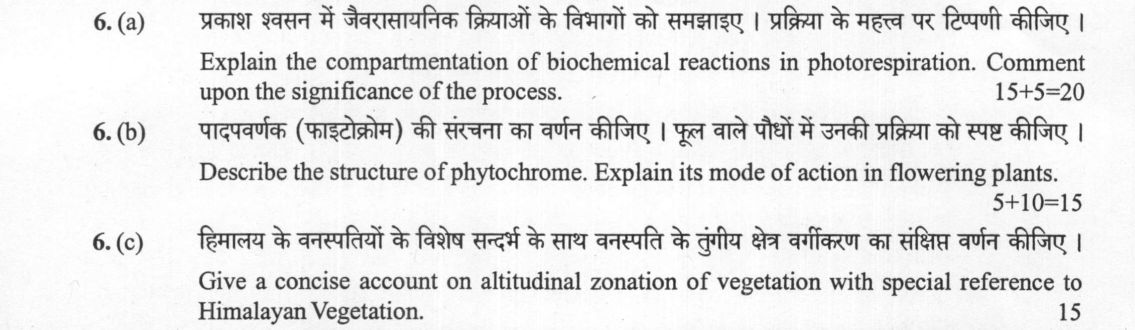
Explain the compartmentation of biochemical reactions in photorespiration. Comment upon the significance of the process. 15+5=20
Describe the structure of phytochrome. Explain its mode of action in flowering plants. 5+10=15
Give a concise account on altitudinal zonation of vegetation with special reference to Himalayan Vegetation. 15 marks
हिंदी में प्रश्न पढ़ें
प्रकाश श्वसन में जैवरासायनिक क्रियाओं के विभागों को समझाइए । प्रक्रिया के महत्व पर टिप्पणी कीजिए । 15+5=20
पादपवर्णक (फाइटोक्रोम) की संरचना का वर्णन कीजिए । फूल वाले पौधों में उनकी प्रक्रिया को स्पष्ट कीजिए । 5+10=15
हिमालय के वनस्पतियों के विशेष संदर्भ के साथ वनस्पति के तुंगीय क्षेत्र वर्गीकरण का संक्षिप्त वर्णन कीजिए । 15
Model answer
Written by UPSC Answer Check against this question's marking rubric, to the expected length. UPSC does not publish answers for Mains — this is one way to score well, not an official key.
Compartmentation and Significance of Photorespiration
Photorespiration is a metabolic cycle that operates in C3 plants when Rubisco acts as an oxygenase rather than a carboxylase. It is spatially organized across three distinct organelles: the chloroplast, peroxisome, and mitochondrion. This compartmentation is essential because the enzymes involved are localized to specific cellular sites, requiring the transport of intermediates between them.
In the chloroplast, the process initiates when Rubisco binds O₂ to RuBP, producing 3-phosphoglycerate and 2-phosphoglycolate. The enzyme phosphoglycolate phosphatase dephosphorylates this to glycolate, which is exported to the peroxisome. Within the peroxisome, glycolate oxidase converts glycolate to glyoxylate, releasing hydrogen peroxide. Catalase detoxifies the H₂O₂. Subsequently, glutamate-glyoxylate aminotransferase transfers an amino group from glutamate to glyoxylate, forming glycine and regenerating oxaloacetate. Two molecules of glycine are then transported to the mitochondrion.
In the mitochondrion, the glycine decarboxylase complex decarboxylates glycine, releasing CO₂ and NH₃. The remaining carbon skeletons are converted into serine by serine hydroxymethyltransferase. Serine returns to the peroxisome, where it is converted back to glyoxylate, re-entering the cycle or being converted to glycerate. Glycerate re-enters the chloroplast to rejoin the Calvin cycle.
The significance of this process is multifaceted. Firstly, it represents a significant carbon cost; in C3 crops like rice and wheat, photorespiration can dissipate up to 25% of the carbon fixed by photosynthesis, particularly under high temperature and light conditions. Secondly, it serves as a crucial mechanism for ammonia recycling. The NH₃ released in the mitochondrion is reassimilated, preventing toxic accumulation. Thirdly, it acts as a safety valve to protect the photosynthetic apparatus against photoinhibition by consuming excess reducing power (NADPH) and ATP when the Calvin cycle is saturated. From an evolutionary perspective, photorespiration became prominent as atmospheric O₂ levels rose and the O₂:CO₂ ratio increased, making Rubisco’s oxygenase activity more frequent. This inefficiency drove the evolution of C4 and CAM pathways (Hatch-Slack pathway) in certain lineages to spatially or temporally separate carbon fixation from the Calvin cycle, thereby minimizing photorespiratory losses.
Structure and Mode of Action of Phytochrome
Phytochrome is a homodimeric chromoprotein that functions as a light sensor in plants. Structurally, each monomer consists of an N-terminal photosensory domain and a C-terminal regulatory domain. The photosensory domain contains a linear tetrapyrrole chromophore, specifically phytochromobilin, which is covalently linked to a specific cysteine residue via a thioether bond. This covalent linkage is critical for the structural changes that occur upon light absorption.
The mode of action begins with photoconversion. In the dark, phytochrome exists in the red-absorbing form (Pr). Upon absorbing red light (660 nm), Pr isomerizes to the far-red-absorbing form (Pfr). Pfr is the biologically active form. In the dark, Pfr slowly reverts to Pr, a process known as dark reversion. The active Pfr form undergoes conformational changes that allow it to translocate from the cytoplasm to the nucleus.
Inside the nucleus, Pfr interacts with transcription factors, primarily Phytochrome Interacting Factors (PIFs). Pfr binds to PIFs, preventing them from activating target genes. Furthermore, Pfr promotes the ubiquitination of PIFs, marking them for degradation via the ubiquitin-proteasome pathway. This degradation relieves the repression on downstream genes, thereby regulating growth and development.
In flowering plants, phytochrome mediates photoperiodism. In Short-Day Plants (SDPs) like Xanthium, a long night allows Pfr to revert to Pr, triggering flowering. In Long-Day Plants (LDPs) like Pharbitis, a short night maintains high levels of Pfr, which inhibits flowering. Thus, phytochrome acts as a molecular timer, measuring night length to synchronize reproductive development with seasonal cues.
Altitudinal Zonation of Himalayan Vegetation
The Himalayas exhibit distinct vegetation zones driven by the temperature lapse rate (approximately 6.5°C per 1000 m), varying rainfall patterns, and slope aspect. These factors create a vertical gradient of ecological conditions.
The lowest zone is the Tropical zone (Tarai, Bhabhar, and Shiwaliks, up to ~1000 m), characterized by moist deciduous forests with species like Shorea robusta and Terminalia arjuna. Above this lies the Subtropical zone (1000–1800 m), dominated by Pinus roxburghii (Chir Pine) and oak species. The Temperate zone (1800–3600 m) features broadleaf and coniferous forests, with Quercus and Rhododendron being prominent. This zone is further divided into lower and upper temperate belts based on species composition.
The Subalpine zone (3600–4500 m) is characterized by coniferous forests of Abies (Himalayan Cedar) and Betula (Birch). As elevation increases, trees give way to shrubs and grasses in the Alpine zone (4500–5500 m), dominated by Kobresia meadows and dwarf shrubs. Finally, the Alpine Desert zone (above 5500 m) is a barren, cold region with sparse vegetation, including lichens and mosses.
This zonation is influenced by anthropogenic influences such as deforestation and grazing, which have altered the natural distribution of species. The Himalayas are also a hotspot for endemism, hosting unique species like Meconopsis (Blue Poppy) and Saussurea obvallata (Brahma Kamal), which are adapted to specific altitudinal niches. Understanding these zones is critical for conservation planning and managing biodiversity in the region.
What "Explain" is asking you to do
Make the working of something clear — what sets it off, what follows from what, and what it produces. Explain is the Commission's mechanism word: it dominates the technical papers and the “explain why” stems, where the marks sit in the causal chain and not in the label.
Structure that answers it
State what it is → the initiating condition → the chain of cause, step by step → an instance where it plays out → what the chain produces
Where marks are lost
Describing what something looks like instead of why it works that way. Naming the stages without linking them reads as description too.
How this answer will be evaluated
Approach
Framework: Botany Paper 2: Define > Structure/Process > Labelled Diagram > Significance. (a) explain: definition/context > points in order > small example > short close | (b) describe: intro > 3-4 dimensions > example > balanced close | (c) explain: definition/context > points in order > small example > short close Full marks: Precise pathways, labelled diagrams, specific species, and clear significance.
Key points expected
- Photorespiration: C2 cycle across chloroplast, mitochondria, peroxisome
- Phytochrome: Pr/Pfr interconversion, nuclear translocation, PIF interaction
- Himalayan Vegetation: Subtropical, Temperate, Alpine, Tundra zones with species
Evaluation rubric
Each sub-part is marked on its own, against the marks and word limit printed on the paper.
- (a) Stepwise pathway of photorespiration across organelles and its physiological role. 20 marks
explain— definition/context → points in order → small example → short close
Must cover
- Chloroplast: RuBisCO oxygenation of RuBP
- Mitochondria: Glycolate to Glycine conversion
- Peroxisome: Glycine to Glyoxylate and Serine
- Significance: Energy cost and CO2 recycling
Loses marks
- Unlabelled or missing diagram
- Confusing photorespiration with respiration
Earns more
- Labelled diagram of C2 cycle
- Mention of C4 or CAM avoidance
- Specific enzyme names (e.g., GLO, GLDC)
Extra mark
- Comparison of C3 vs C4 efficiency
- Reference to specific crop (e.g., Rice)
- (b) Molecular structure of phytochrome and its regulatory mechanism in flowering. 15 marks
describe— intro → 3-4 dimensions → example → balanced close
Must cover
- Chromophore (Bilin) and Apoprotein structure
- Pr (red) and Pfr (far-red) interconversion
- Pfr translocation to nucleus
- Interaction with PIFs or COPIF
Loses marks
- Vague description of 'light sensing'
- Missing the nuclear translocation step
Earns more
- Labelled diagram of Pr/Pfr states
- Mention of Long Day/Short Day plants
- Specific gene names (e.g., FT, CO)
Extra mark
- Reference to specific species (e.g., *Pharbitis*)
- Mention of recent biotech application
- (c) Altitudinal zones of Himalayan vegetation with specific examples. 15 marks
explain— definition/context → points in order → small example → short close
Must cover
- Subtropical zone (e.g., *Shorea*, *Dipterocarpus*)
- Temperate zone (e.g., *Quercus*, *Rhododendron*)
- Alpine zone (e.g., *Juniperus*, *Pinus*)
- Tundra zone (e.g., *Saussurea*, *Draba*)
Loses marks
- Missing specific species names
- Confusing latitudinal with altitudinal zonation
Earns more
- Labelled diagram of altitudinal zones
- Mention of specific altitude ranges
- Reference to Eastern vs Western Himalaya
Extra mark
- Mention of specific endangered species
- Reference to climate change impact
Practice this exact question
Write your answer and it is marked point by point against the model answer above — what you covered, what you missed, what you got wrong.
Evaluate my answer →More from Botany 2024 Paper II
- Q3 (a) Describe along with illustrated diagrams the structure and function of mitochondria a…
- Q4 (a) Discuss briefly the following and comment on their significance : 10+5+5=20 (i) In wh…
- Q5 Write short notes on the following in about 150 words each : 10×5=50 (a) Explain what is…
- Q6 (a) Explain the compartmentation of biochemical reactions in photorespiration. Comment up…
- Q7 (a) Define leaf senescence. Describe important physiological and biochemical changes taki…
- Q8 (a)(i) What are allosteric enzymes ? Explain in detail on the allosteric enzyme modulatio…