Paper II — Q3
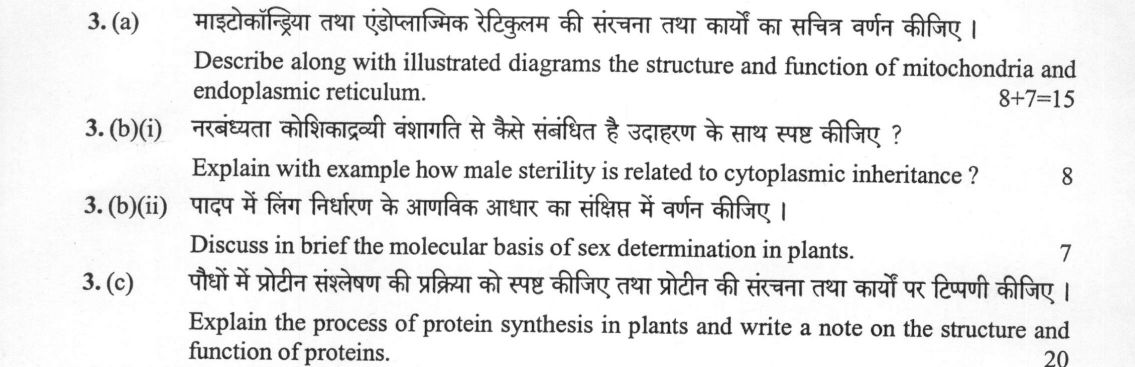
(a) Describe along with illustrated diagrams the structure and function of mitochondria and endoplasmic reticulum. 8+7=15 (b)(i)…
Describe along with illustrated diagrams the structure and function of mitochondria and endoplasmic reticulum. 8+7=15
Explain with example how male sterility is related to cytoplasmic inheritance ? 8 marks
Discuss in brief the molecular basis of sex determination in plants. 7 marks
Explain the process of protein synthesis in plants and write a note on the structure and function of proteins. 20 marks
हिंदी में प्रश्न पढ़ें
माइटोकॉन्ड्रिया तथा एण्डोप्लाज्मिक रेटिकुलम की संरचना तथा कार्यों का सचित्र वर्णन कीजिए । 8+7=15
नरबंधता कोशिकाद्रव्यी वंशागति से कैसे संबंधित है उदाहरण के साथ स्पष्ट कीजिए ? 8 marks
पादप में लिंग निर्धारण के आणविक आधार का संक्षिप्त में वर्णन कीजिए । 7
पौधों में प्रोटीन संश्लेषण की प्रक्रिया को स्पष्ट कीजिए तथा प्रोटीन की संरचना तथा कार्यों पर टिप्पणी कीजिए । 20
Model answer
Written by UPSC Answer Check against this question's marking rubric, to the expected length. UPSC does not publish answers for Mains — this is one way to score well, not an official key.
The eukaryotic cell is a highly compartmentalized unit where organelles like mitochondria and the endoplasmic reticulum (ER) drive energy metabolism and biosynthesis.
Part (a): Mitochondria and ER Mitochondria are double-membrane-bound organelles. The outer membrane is permeable, while the inner membrane is folded into cristae, increasing surface area for the electron transport chain (ETC). The matrix contains mitochondrial DNA (mtDNA), 70S ribosomes, and enzymes for the Krebs cycle. [Diagram: Longitudinal section showing outer membrane, inner membrane with cristae, matrix, and mtDNA loops.] Functionally, mitochondria are the site of aerobic respiration, generating ATP via oxidative phosphorylation. In thermogenic plants like Symplocarpus, the alternative oxidase (AOX) pathway dissipates energy as heat, facilitating pollination. They also regulate apoptosis and maintain calcium homeostasis.
Endoplasmic Reticulum (ER) is a continuous membrane network. Rough ER (RER) is studded with ribosomes, while Smooth ER (SER) lacks them. [Diagram: Schematic of RER with ribosomes and SER tubules connected to the nuclear envelope.] RER is the primary site for synthesizing secretory and membrane proteins, initiating N-linked glycosylation. SER is involved in lipid and steroid synthesis, detoxification of xenobiotics, and calcium storage. In plants, calreticulin acts as the primary calcium-binding protein in the ER lumen, buffering cytosolic Ca²⁺ signals.
Part (b)(i): Cytoplasmic Male Sterility (CMS) CMS is a maternally inherited trait where pollen is non-functional due to mutations in the mitochondrial genome, while female fertility remains normal. This is caused by the expression of chimeric open reading frames (ORFs) that produce toxic peptides. Example: In maize, the Texas male sterile (T) cytoplasm contains the urf13 gene. The toxicity of the URF13 protein is conditional, requiring interaction with the Bm-T toxin (or methomyl) to disrupt inner membrane integrity. Restoration of fertility occurs when nuclear Restorer of fertility (Rf) genes suppress mitochondrial gene expression. This system is crucial for hybrid seed production in crops like maize and sorghum, where sterile female lines (A-lines) are crossed with restorer lines (B-lines) to produce F1 hybrids.
Part (b)(ii): Molecular Basis of Sex Determination In dioecious plants, sex determination is often chromosomal. In Carica papaya, the XY system involves a large Y chromosome containing the MSY (Male Sterility Y) locus. The MSY gene encodes a MADS-box transcription factor that represses floral organ identity genes, leading to male flower development. In Silene latifolia, the Y chromosome is highly degenerate, and sex determination involves dosage compensation of X-linked genes. Epigenetic modifications, such as DNA methylation, also play a role in stabilizing sex-specific gene expression. Environmental factors can occasionally influence sex expression, but the genetic framework remains the primary determinant.
Part (c): Protein Synthesis and Structure Protein Synthesis involves two main stages: transcription and translation.
- Transcription: RNA Polymerase II binds to the promoter region of a gene. The pre-mRNA undergoes 5' 7-methylguanosine capping, spliceosomal intron removal, and 3' polyadenylation to form mature mRNA.
- Translation: The mRNA binds to the 40S ribosomal subunit. Initiation factors position the start codon (AUG) with the initiator tRNA (Met-tRNA). The 60S subunit joins to form the 80S ribosome.
- Elongation: Aminoacyl-tRNAs enter the A-site. Peptide bond formation is catalyzed by the peptidyl transferase center of the 25S rRNA in the large subunit. The ribosome translocates, moving the peptidyl-tRNA to the P-site.
- Termination: Upon reaching a stop codon, release factors trigger the release of the polypeptide chain. Post-translational modifications (e.g., phosphorylation, glycosylation) occur in the ER and Golgi apparatus.
Protein Structure and Function: Proteins have four levels of structure. The primary structure is the linear amino acid sequence. Secondary structures (α-helices, β-sheets) are stabilized by hydrogen bonds. Tertiary structure is the 3D folding driven by R-group interactions. Quaternary structure involves multiple polypeptide subunits. Functions are diverse: enzymes catalyze metabolic reactions; structural proteins (e.g., cellulose synthases) provide support; transport proteins (e.g., aquaporins) move substances; and signaling proteins (e.g., receptors) transmit information.
In conclusion, the intricate coordination between mitochondrial energy production, ER-based protein processing, and genetic regulation of traits like CMS and sex determination underscores the integrative complexity of plant cell biology.
What "Describe" is asking you to do
Give a full, ordered account of the thing named — its parts, stages or mechanism — in the sequence in which it actually exists or occurs. Most describe questions come from the science optionals, where the marks sit in correct technical detail and, where the stem says so, a labelled diagram.
Structure that answers it
One-line identification of the subject → the parts or stages in their real order, each with its defining detail → labelled diagram where the subject is structural → closing line on function or significance
Where marks are lost
Loose general prose where the examiner is ticking named parts, correct terminology and their sequence; and in the General Studies papers, turning to evaluation before the description is finished.
How this answer will be evaluated
Approach
Framework: Cellular Biology & Molecular Genetics. (a) describe: define > structure or process in order > labelled diagram > significance | (b) explain: definition/context > points in order > small example > short close | (c) explain: definition/context > points in order > small example > short close Full marks: Comprehensive, accurate, with clear diagrams and specific examples.
Key points expected
- Mitochondria: double membrane, cristae, matrix, DNA, ATP synthesis
- ER: Rough (ribosomes) vs Smooth (enzymes), protein folding, lipid synthesis
- Cytoplasmic inheritance: maternal transmission, CMS in crops
- Sex determination: genetic vs environmental, MADS-box genes
- Protein synthesis: transcription, translation, post-translational modifications
- Protein structure: primary, secondary, tertiary, quaternary
- Protein functions: enzymes, structural, transport
Evaluation rubric
Each sub-part is marked on its own, against the marks and word limit printed on the paper.
- (a) Detailed structural and functional account of mitochondria and ER with diagrams. 15 marks
describe— define → structure or process in order → labelled diagram → significance
Must cover
- Mitochondria: double membrane, cristae, matrix, DNA
- Mitochondria: ATP synthesis, TCA cycle, respiration
- ER: Rough (ribosomes) vs Smooth (enzymes) structure
- Labelled diagrams for both organelles
Loses marks
- Unlabelled or missing diagrams
- Confusing rough and smooth ER functions
Earns more
- ER: protein folding, lipid synthesis, detoxification
- Mitochondria: plant-specific functions (e.g., photorespiration)
Extra mark
- Mention of specific plant species organelle variations
- (b) Link male sterility to cytoplasmic inheritance and molecular basis of sex determination.
explain— definition/context → points in order → small example → short close
Must cover
- Cytoplasmic inheritance: maternal transmission of sterility
- Example: Cytoplasmic Male Sterility (CMS) in crops
- Sex determination: genetic vs environmental factors
- Molecular basis: sex-determining genes (e.g., MADS-box)
Loses marks
- Ignoring the 'molecular basis' aspect of sex determination
- Vague examples without species names
Earns more
- Specific CMS example (e.g., maize, rice, or sunflower)
- Mention of S-locus in Brassica
Extra mark
- Biotech application: hybrid seed production via CMS
- (c) Stepwise protein synthesis process and a note on protein structure/function. 20 marks
explain— definition/context → points in order → small example → short close
Must cover
- Transcription: DNA to mRNA in nucleus
- Translation: mRNA to protein on ribosomes
- Protein structure: primary, secondary, tertiary, quaternary
- Protein functions: enzymes, structural, transport
Loses marks
- Skipping the 'structure' part of the question
- Confusing transcription and translation steps
Earns more
- Post-translational modifications in plants
- Specific plant protein example (e.g., RuBisCO)
Extra mark
- Biotech application: recombinant protein production in plants
Practice this exact question
Write your answer and it is marked point by point against the model answer above — what you covered, what you missed, what you got wrong.
Evaluate my answer →More from Botany 2024 Paper II
- Q1 Write short notes on the following in about 150 words each : 10×5=50 (a) Explain the type…
- Q2 (a) Explain briefly the process and importance of the following : 5+5+5=15 (i) Male steri…
- Q3 (a) Describe along with illustrated diagrams the structure and function of mitochondria a…
- Q4 (a) Discuss briefly the following and comment on their significance : 10+5+5=20 (i) In wh…
- Q5 Write short notes on the following in about 150 words each : 10×5=50 (a) Explain what is…
- Q6 (a) Explain the compartmentation of biochemical reactions in photorespiration. Comment up…