Paper II — Q7
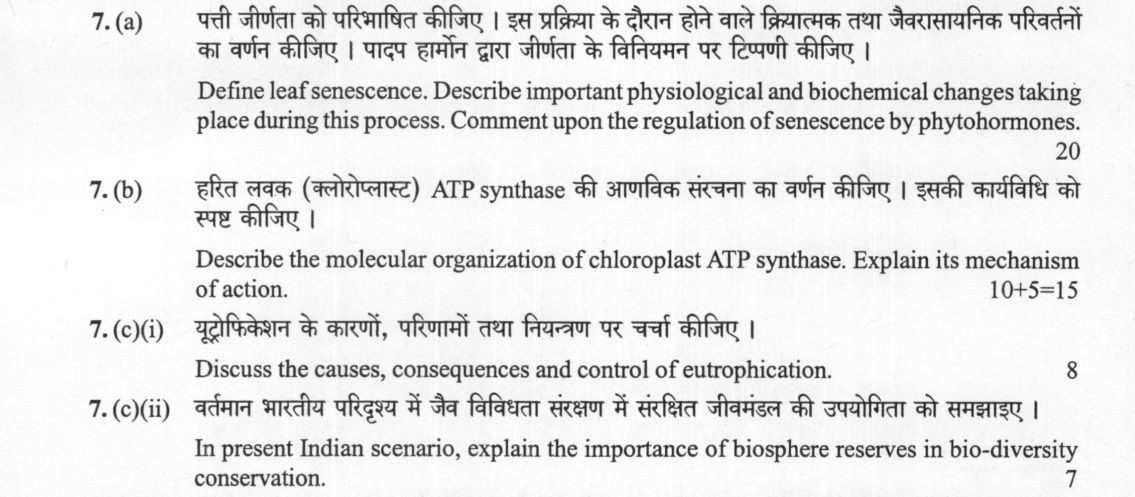
(a) Define leaf senescence. Describe important physiological and biochemical changes taking place during this process. Comment…
Define leaf senescence. Describe important physiological and biochemical changes taking place during this process. Comment upon the regulation of senescence by phytohormones. 20 marks
Describe the molecular organization of chloroplast ATP synthase. Explain its mechanism of action. 10+5=15
Discuss the causes, consequences and control of eutrophication. 8 marks
In present Indian scenario, explain the importance of biosphere reserves in bio-diversity conservation. 7 marks
हिंदी में प्रश्न पढ़ें
पत्ती जीर्णता को परिभाषित कीजिए । इस प्रक्रिया के दौरान होने वाले क्रियात्मक तथा जैवरासायनिक परिवर्तनों का वर्णन कीजिए । पादप हार्मोन द्वारा जीर्णता के विनियमन पर टिप्पणी कीजिए । 20
हरित लवक (क्लोरोप्लास्ट) ATP synthase की आणविक संरचना का वर्णन कीजिए । इसकी कार्यविधि को स्पष्ट कीजिए । 10+5=15
यूट्रोफिकेशन के कारणों, परिणामों तथा नियंत्रण पर चर्चा कीजिए । 8
वर्तमान भारतीय परिदृश्य में जैव विविधता संरक्षण में संरक्षित जीवमंडल की उपयोगिता को समझाइए । 7
Model answer
Written by UPSC Answer Check against this question's marking rubric, to the expected length. UPSC does not publish answers for Mains — this is one way to score well, not an official key.
Leaf Senescence and Bioenergetics
Leaf senescence is a genetically programmed, irreversible process of cell death in leaves, characterized by the breakdown of cellular components and the remobilization of nutrients to sink organs. Physiologically, it manifests as chlorophyll degradation, leading to yellowing, and the hydrolysis of structural proteins and nucleic acids. Biochemically, the process is marked by the accumulation of reactive oxygen species (ROS), which triggers lipid peroxidation and membrane damage. Key enzymatic markers include the upregulation of vacuolar proteases, nucleases, and chlorophyllase, which facilitate the catabolism of macromolecules. This catabolic phase is tightly regulated by phytohormones. Ethylene and abscisic acid (ABA) act as promoters, accelerating the breakdown of chlorophyll and protein. Conversely, cytokinins and auxins inhibit senescence by maintaining protein stability and delaying chlorophyll loss. The balance between these hormones determines the rate of nutrient remobilization, ensuring that nitrogen and phosphorus are recycled to developing seeds or roots, thereby linking leaf physiology to overall plant productivity.
Chloroplast ATP Synthase
The chloroplast ATP synthase is a multi-subunit complex embedded in the thylakoid membrane, organized into two main domains: the membrane-embedded CF0 and the protruding CF1 head. The CF0 domain consists of a central 'a' subunit, a 'b' subunit, a 'b'' subunit, and a ring of multiple 'c' subunits. This domain forms the proton channel. The CF1 domain, located on the stromal side, comprises a catalytic head with three α subunits, three β subunits, and a central stalk formed by γ, δ, and ε subunits. The β subunits contain the catalytic sites for ATP synthesis.
The mechanism of action relies on the proton-motive force generated by the light reactions. Protons flow down their electrochemical gradient through the CF0 channel from the lumen to the stroma. This flow drives the rotation of the c-ring relative to the a subunit. The rotation of the c-ring is coupled to the γ subunit, which acts as a rotor within the α3β3 hexamer. This rotation induces conformational changes in the three β subunits, operating via Boyer’s binding change mechanism. At any given moment, the three catalytic sites exist in distinct conformations: the O (open) site has low affinity for ATP and releases the synthesized ATP; the L (loose) site has moderate affinity and binds ADP and inorganic phosphate (Pi); and the T (tight) site has high affinity for ATP, catalyzing the condensation of ADP and Pi to form ATP. As the γ subunit rotates, each β subunit cycles through these conformations, ensuring continuous ATP production.
Eutrophication and Biosphere Reserves
Eutrophication is the excessive enrichment of water bodies with nutrients, primarily nitrogen and phosphorus. The primary causes include agricultural runoff containing fertilizers, untreated sewage discharge, and industrial effluents. The consequences are severe: nutrient excess triggers algal blooms, which block sunlight and deplete oxygen upon decomposition, leading to hypoxia. This results in biodiversity loss, fish kills, and the formation of dead zones. Control measures involve tertiary sewage treatment to remove nutrients, the establishment of vegetative buffer strips to filter agricultural runoff, and biomanipulation to control algal populations.
In the Indian context, biosphere reserves are crucial for biodiversity conservation. Designated under the UNESCO Man and the Biosphere (MAB) programme, sites like the Nilgiri, Sundarbans, Nanda Devi, and Gulf of Mannar reserves serve as models for sustainable development. They protect endemic species such as the lion-tailed macaque in the Nilgiris and the Bengal tiger in the Sundarbans. These reserves facilitate in-situ conservation, providing core zones for strict protection and buffer zones for sustainable human activity. They also serve as hubs for research, monitoring, and community-based conservation, balancing ecological integrity with local livelihoods.
Conclusion
Understanding the molecular mechanisms of senescence and ATP synthesis highlights the efficiency of plant bioenergetics, which sustains terrestrial food webs. However, anthropogenic pressures like eutrophication threaten aquatic ecosystems. Therefore, integrating physiological knowledge with conservation strategies, such as the management of biosphere reserves, is essential for maintaining global ecological balance.
What "Describe" is asking you to do
Give a full, ordered account of the thing named — its parts, stages or mechanism — in the sequence in which it actually exists or occurs. Most describe questions come from the science optionals, where the marks sit in correct technical detail and, where the stem says so, a labelled diagram.
Structure that answers it
One-line identification of the subject → the parts or stages in their real order, each with its defining detail → labelled diagram where the subject is structural → closing line on function or significance
Where marks are lost
Loose general prose where the examiner is ticking named parts, correct terminology and their sequence; and in the General Studies papers, turning to evaluation before the description is finished.
How this answer will be evaluated
Approach
Framework: UPSC Botany Paper 2. (a) define: precise definition > the distinguishing feature > one example | (b) describe: define > structure or process in order > labelled diagram > significance | (c(i)) discuss: intro > 3-4 dimensions > example > balanced close | (c(ii)) explain: definition/context > points in order > small example > short close Full marks: Comprehensive, accurate, and well-structured answers with labelled diagrams and specific examples.
Key points expected
- Define leaf senescence as programmed cell death
- Describe chlorophyll degradation and protein catabolism
- Explain nutrient remobilization to sink organs
- Detail regulation by ethylene, ABA, and cytokinins
- Describe F1 and Fo subunit organization
- Identify alpha, beta, gamma, delta, epsilon subunits
- Explain the chemiosmotic coupling mechanism
- Describe the binding change mechanism of ATP synthesis
Evaluation rubric
Each sub-part is marked on its own, against the marks and word limit printed on the paper.
- (a) Definition of senescence, physiological/biochemical changes, and phytohormone regulation. 20 marks
define— precise definition → the distinguishing feature → one example
Must cover
- Define leaf senescence as programmed cell death
- Describe chlorophyll degradation and protein catabolism
- Explain nutrient remobilization to sink organs
- Detail regulation by ethylene, ABA, and cytokinins
Loses marks
- Confusing senescence with necrosis
- Omitting the role of cytokinins
- Unlabelled diagrams of leaf changes
Earns more
- Mention specific enzymes like chlorophyllase
- Reference the 'stay-green' mutant phenotype
- Link to crop yield via harvest index
- Include a labelled diagram of senescing leaf
Extra mark
- Cite specific phytohormone concentrations
- Mention recent biotech applications in delaying senescence
- (b) Molecular organization of chloroplast ATP synthase and its mechanism of action. 15 marks
describe— define → structure or process in order → labelled diagram → significance
Must cover
- Describe F1 and Fo subunit organization
- Identify alpha, beta, gamma, delta, epsilon subunits
- Explain the chemiosmotic coupling mechanism
- Describe the binding change mechanism of ATP synthesis
Loses marks
- Confusing chloroplast ATP synthase with mitochondrial
- Omitting the binding change mechanism
- Unlabelled diagrams of ATP synthase
Earns more
- Mention the c-ring of subunits in Fo
- Reference the proton gradient across thylakoid membrane
- Include a labelled diagram of ATP synthase structure
- Mention the role of the stator
Extra mark
- Cite specific PDB structures of ATP synthase
- Mention recent research on ATP synthase inhibitors
- (c(i)) Causes, consequences, and control of eutrophication. 8 marks
discuss— intro → 3-4 dimensions → example → balanced close
Must cover
- Identify nutrient loading (N, P) as primary cause
- Describe algal blooms and oxygen depletion
- Explain fish kills and ecosystem collapse
- Suggest control measures like nutrient management
Loses marks
- Confusing eutrophication with acidification
- Omitting the role of phosphorus
- Unlabelled diagrams of eutrophication
Earns more
- Mention specific eutrophic lakes (e.g., Lake Erie)
- Reference the role of agricultural runoff
- Include a diagram of the eutrophication cycle
- Mention bioremediation techniques
Extra mark
- Cite specific nutrient concentration thresholds
- Mention recent policy interventions for eutrophication
- (c(ii)) Importance of biosphere reserves in Indian bio-diversity conservation. 7 marks
explain— definition/context → points in order → small example → short close
Must cover
- Define biosphere reserves under UNESCO MAB
- Mention specific Indian biosphere reserves (e.g., Nilgiri, Sundarbans)
- Explain the core, buffer, and transition zones
- Link to in-situ conservation and sustainable development
Loses marks
- Confusing biosphere reserves with national parks
- Omitting the role of local communities
- Unlabelled maps of biosphere reserves
Earns more
- Mention the role of local communities
- Reference specific species conserved in Indian reserves
- Include a map of Indian biosphere reserves
- Mention the role of the Ministry of Environment, Forest and Climate Change
Extra mark
- Cite specific conservation success stories
- Mention recent expansions of biosphere reserves
Practice this exact question
Write your answer and it is marked point by point against the model answer above — what you covered, what you missed, what you got wrong.
Evaluate my answer →More from Botany 2024 Paper II
- Q4 (a) Discuss briefly the following and comment on their significance : 10+5+5=20 (i) In wh…
- Q5 Write short notes on the following in about 150 words each : 10×5=50 (a) Explain what is…
- Q6 (a) Explain the compartmentation of biochemical reactions in photorespiration. Comment up…
- Q7 (a) Define leaf senescence. Describe important physiological and biochemical changes taki…
- Q8 (a)(i) What are allosteric enzymes ? Explain in detail on the allosteric enzyme modulatio…