Paper II — Q8
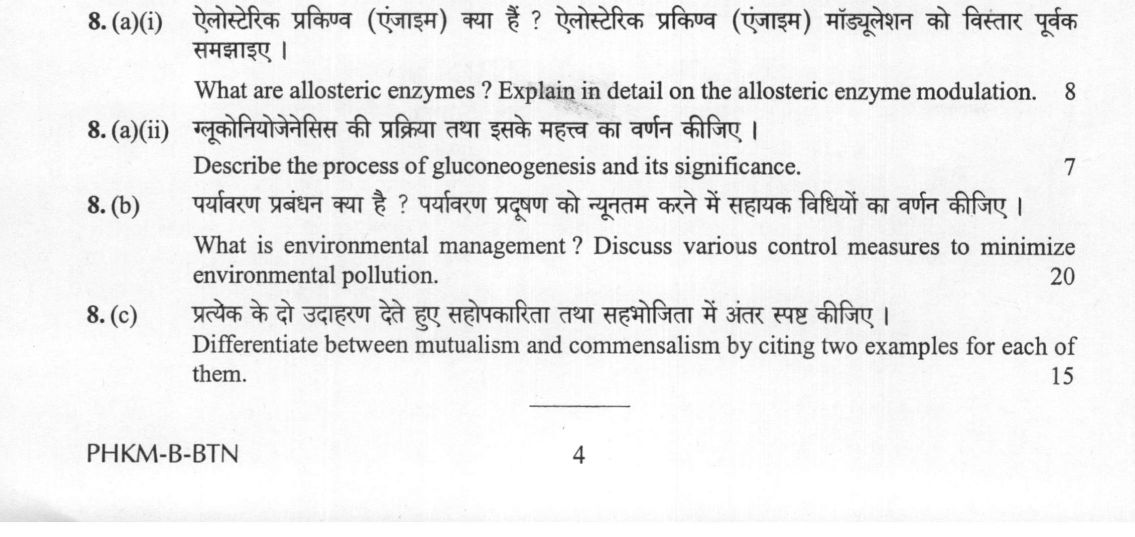
(a)(i) What are allosteric enzymes ? Explain in detail on the allosteric enzyme modulation. 8 (a)(ii) Describe the process of…
What are allosteric enzymes ? Explain in detail on the allosteric enzyme modulation. 8 marks
Describe the process of gluconeogenesis and its significance. 7 marks
What is environmental management ? Discuss various control measures to minimize environmental pollution. 20 marks
Differentiate between mutualism and commensalism by citing two examples for each of them. 15 marks
हिंदी में प्रश्न पढ़ें
एलोस्टेरिक प्रकिण्व (एंजाइम) क्या हैं ? एलोस्टेरिक प्रकिण्व (एंजाइम) मॉड्यूलेशन को विस्तार पूर्वक समझाइए । 8
ग्लूकोनियोजेनेसिस की प्रक्रिया तथा इसके महत्व का वर्णन कीजिए । 7
पर्यावरण प्रबंधन क्या है ? पर्यावरण प्रदूषण को न्यूनतम करने में सहायक विधियों का वर्णन कीजिए । 20
प्रत्येक के दो उदाहरण देते हुए सहोपकारिता तथा सहभोजिता में अंतर स्पष्ट कीजिए । 15
Model answer
Written by UPSC Answer Check against this question's marking rubric, to the expected length. UPSC does not publish answers for Mains — this is one way to score well, not an official key.
Allosteric Enzymes and Metabolic Regulation
Allosteric enzymes are regulatory proteins that undergo conformational changes upon binding of an effector molecule at a site distinct from the active site, known as the allosteric or regulatory site. Unlike Michaelis-Menten enzymes, they exhibit sigmoidal kinetics due to cooperative binding among subunits, characterized by a K₀.5 value rather than a Michaelis constant (Kₘ). The modulation involves a transition between a low-affinity Tense (T) state and a high-affinity Relaxed (R) state. Positive modulators (activators) stabilize the R-state, increasing substrate affinity and shifting the curve leftward, while negative modulators (inhibitors) stabilize the T-state, decreasing affinity and shifting the curve rightward. A classic example is Phosphofructokinase-1 (PFK-1), where ATP acts as a negative modulator and AMP as a positive modulator, ensuring glycolysis matches cellular energy demand. Aspartate Transcarbamoylase (ATCase) in E. coli similarly demonstrates cooperative inhibition by CTP.
Gluconeogenesis: Pathway and Significance
Gluconeogenesis is the metabolic pathway that generates glucose from non-carbohydrate precursors such as lactate, glycerol, and glucogenic amino acids. It is not simply the reversal of glycolysis; it bypasses three irreversible steps via four unique enzymes. First, Pyruvate Carboxylase converts pyruvate to oxaloacetate in the mitochondria, followed by Phosphoenolpyruvate Carboxykinase (PEPCK) converting oxaloacetate to phosphoenolpyruvate. Second, Fructose-1,6-bisphosphatase hydrolyzes fructose-1,6-bisphosphate to fructose-6-phosphate. Third, Glucose-6-phosphatase converts glucose-6-phosphate to free glucose. The process is energetically costly, requiring 4 ATP and 2 GTP per glucose molecule synthesized. Its significance lies in maintaining blood glucose levels during fasting and starvation, preventing hypoglycemia. It is central to the Cori Cycle, where lactate from anaerobic muscle metabolism is converted back to glucose in the liver, ensuring metabolic homeostasis.
Environmental Management and Pollution Control
Environmental management is the systematic process of planning, monitoring, and controlling human activities to minimize their adverse impact on the environment. It integrates legislative frameworks, such as the Environment (Protection) Act, 1986, and the Water (Prevention and Control of Pollution) Act, 1974, with technical interventions.
Air pollution control focuses on reducing particulate matter and gaseous pollutants. In India, the shift to Compressed Natural Gas (CNG) in Delhi’s public transport and the implementation of Bharat Stage VI (BS-VI) emission norms for vehicles have significantly lowered hydrocarbon and nitrogen oxide levels. Industrial emissions are managed using Electrostatic Precipitators (ESPs) and bag filters to capture particulates.
Water pollution management aims to lower Biological Oxygen Demand (BOD) and restore Dissolved Oxygen (DO) levels in water bodies. The Ganga Action Plan and subsequent Namami Gange Mission focus on intercepting sewage through Sewage Treatment Plants (STPs) and promoting Zero Liquid Discharge (ZLD) in industries to prevent effluent release.
Solid waste management emphasizes the 3Rs (Reduce, Reuse, Recycle). The Swachh Bharat Mission drives waste segregation at the source, while bioremediation techniques utilize microbial degradation to treat hazardous waste. Effective management requires strict enforcement of Environmental Impact Assessment (EIA) norms and community participation to ensure sustainable resource use.
Mutualism vs. Commensalism
Mutualism is a symbiotic interaction where both species derive benefit, whereas commensalism involves one species benefiting while the other remains unaffected.
In mutualism, the relationship can be obligate or facultative. A precise example is the symbiosis between Rhizobium bacteria and leguminous plants like Pisum sativum (pea). The bacteria fix atmospheric nitrogen into ammonia for the plant, while the plant provides carbohydrates and a protected niche. Another example is arbuscular mycorrhizal fungi, such as Glomus species, forming associations with the roots of monocots like maize (Zea mays). The fungus enhances phosphorus and water uptake for the plant, while receiving photosynthates.
In commensalism, the interaction is asymmetrical. Epiphytic orchids, such as Vanda, grow on the branches of trees in tropical forests. They derive mechanical support and access to light but do not extract nutrients from the host tree, leaving it unaffected. Similarly, barnacles (Balanus) attach to the skin of whales. The barnacles gain mobility and access to food-rich waters, while the whale experiences no significant harm or benefit.
Conclusion
Understanding the molecular mechanisms of allosteric regulation and gluconeogenesis is vital for appreciating metabolic homeostasis. Concurrently, robust environmental management through legislative and technological measures is essential for sustainable development. Distinguishing ecological interactions like mutualism and commensalism helps in conserving biodiversity and managing ecosystems effectively.
What "Explain" is asking you to do
Make the working of something clear — what sets it off, what follows from what, and what it produces. Explain is the Commission's mechanism word: it dominates the technical papers and the “explain why” stems, where the marks sit in the causal chain and not in the label.
Structure that answers it
State what it is → the initiating condition → the chain of cause, step by step → an instance where it plays out → what the chain produces
Where marks are lost
Describing what something looks like instead of why it works that way. Naming the stages without linking them reads as description too.
How this answer will be evaluated
Approach
Framework: Botany Paper 2: Define > Structure/Process > Labelled Diagram > Significance. (a(i)) explain: definition/context > points in order > small example > short close | (a(ii)) describe: define > structure or process in order > labelled diagram > significance | (b) discuss: intro > 3-4 dimensions > example > balanced close | (c) compare: paired headings or table > key differences > significance > conclusion Full marks: Precise definitions, stepwise pathways, labelled diagrams, and specific scientific examples.
Key points expected
- Definition of allosteric enzymes (multi-subunit, non-active site regulation)
- Distinction between active and allosteric sites
- Mechanism of positive vs negative modulation (activators/inhibitors)
- Mention of sigmoidal kinetics or T/R state transition
- Definition of gluconeogenesis (synthesis of glucose from non-carbs)
- Identification of key bypass enzymes (e.g., PEPCK, F-1,6-BPase)
- Mention of primary substrates (lactate, glycerol, amino acids)
- Statement of significance (blood glucose maintenance during fasting)
Evaluation rubric
Each sub-part is marked on its own, against the marks and word limit printed on the paper.
- (a(i)) Definition of allosteric enzymes and detailed mechanism of modulation. 8 marks
explain— definition/context → points in order → small example → short close
Must cover
- Definition of allosteric enzymes (multi-subunit, non-active site regulation)
- Distinction between active and allosteric sites
- Mechanism of positive vs negative modulation (activators/inhibitors)
- Mention of sigmoidal kinetics or T/R state transition
Loses marks
- Confusing allosteric with competitive inhibition
- Unlabelled or missing diagram of conformational change
Earns more
- Labelled diagram of T-state vs R-state conformational change
- Mention of specific examples (e.g., Aspartate transcarbamoylase)
- Reference to cooperative binding
Extra mark
- Mention of specific biotech application in enzyme engineering
- (a(ii)) Stepwise process of gluconeogenesis and its physiological significance. 7 marks
describe— define → structure or process in order → labelled diagram → significance
Must cover
- Definition of gluconeogenesis (synthesis of glucose from non-carbs)
- Identification of key bypass enzymes (e.g., PEPCK, F-1,6-BPase)
- Mention of primary substrates (lactate, glycerol, amino acids)
- Statement of significance (blood glucose maintenance during fasting)
Loses marks
- Listing glycolysis steps instead of bypass steps
- Omitting the physiological significance
Earns more
- Labelled flowchart of the pathway
- Mention of the Cori cycle
- Reference to the Pasteur effect
Extra mark
- Mention of specific metabolic disorders related to pathway defects
- (b) Definition of environmental management and detailed control measures for pollution. 20 marks
discuss— intro → 3-4 dimensions → example → balanced close
Must cover
- Definition of environmental management (planning, monitoring, control)
- Control measures for air pollution (e.g., scrubbers, catalytic converters)
- Control measures for water pollution (e.g., STP, effluent treatment)
- Control measures for soil/solid waste (e.g., composting, recycling)
Loses marks
- Vague generalities without specific control measures
- Ignoring the 'management' aspect (planning/monitoring)
Earns more
- Mention of specific legislation (e.g., Environment Protection Act)
- Reference to the 3R principle (Reduce, Reuse, Recycle)
- Mention of specific technologies (e.g., bioremediation)
Extra mark
- Reference to a specific recent environmental policy or case study
- (c) Differentiation between mutualism and commensalism with two examples each. 15 marks
compare— paired headings or table → key differences → significance → conclusion
Must cover
- Definition of mutualism (+/+ interaction)
- Definition of commensalism (+/0 interaction)
- Two distinct examples of mutualism (e.g., *Rhizobium*-legume, mycorrhiza)
- Two distinct examples of commensalism (e.g., epiphytes, cattle egrets)
Loses marks
- Confusing commensalism with parasitism
- Using common names instead of binomials
Earns more
- Use of a comparison table
- Italicisation of scientific names
- Brief explanation of the benefit mechanism
Extra mark
- Mention of a specific crop cultivar benefiting from mutualism
Practice this exact question
Write your answer and it is marked point by point against the model answer above — what you covered, what you missed, what you got wrong.
Evaluate my answer →More from Botany 2024 Paper II
- Q5 Write short notes on the following in about 150 words each : 10×5=50 (a) Explain what is…
- Q6 (a) Explain the compartmentation of biochemical reactions in photorespiration. Comment up…
- Q7 (a) Define leaf senescence. Describe important physiological and biochemical changes taki…
- Q8 (a)(i) What are allosteric enzymes ? Explain in detail on the allosteric enzyme modulatio…