Paper II — Q2
(a) Explain briefly the process and importance of the following : 5+5+5=15 (i) Male sterility and heterosis breeding. 5 (ii)…
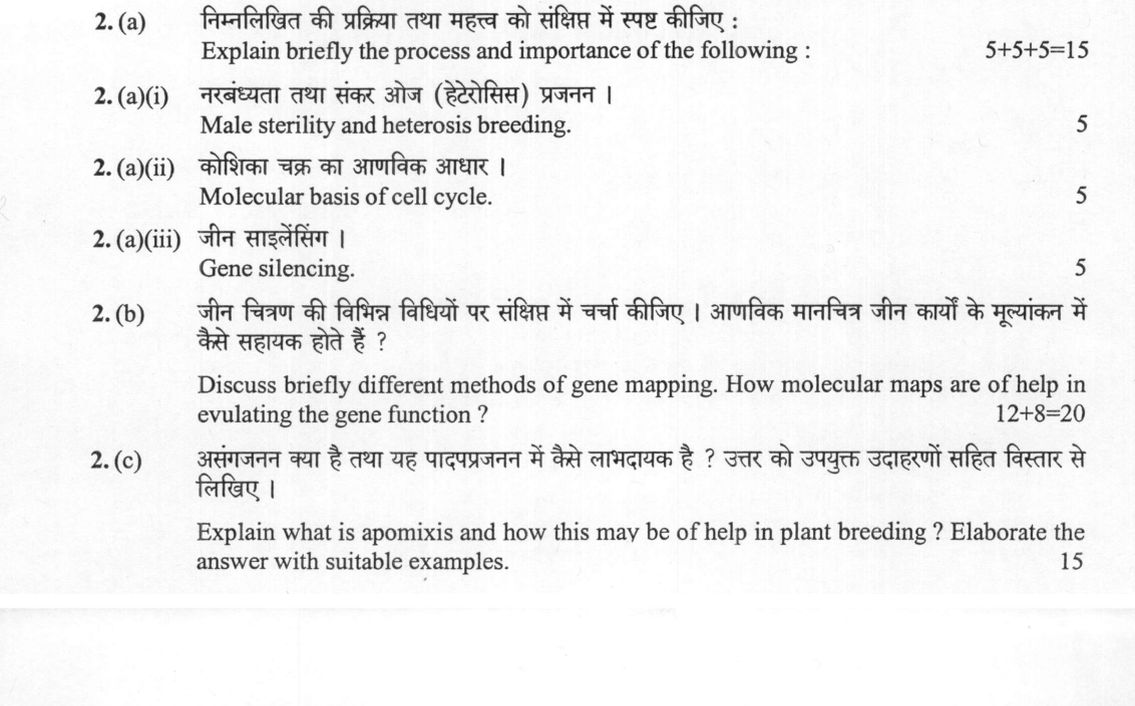
Explain briefly the process and importance of the following : 5+5+5=15
Male sterility and heterosis breeding. 5 marks
Molecular basis of cell cycle. 5 marks
Gene silencing. 5 marks
Discuss briefly different methods of gene mapping. How molecular maps are of help in evulating the gene function ? 12+8=20
Explain what is apomixis and how this may be of help in plant breeding ? Elaborate the answer with suitable examples. 15 marks
हिंदी में प्रश्न पढ़ें
निम्नलिखित की प्रक्रिया तथा महत्व को संक्षिप्त में स्पष्ट कीजिए : 5+5+5=15
नरबंध्यता तथा संकर ओज (हेटेरोसिस) प्रजनन । 5
कोशिका चक्र का आणविक आधार । 5
जीन साइलेंसिंग । 5
जीन चित्रण की विभिन्न विधियों पर संक्षिप्त में चर्चा कीजिए । आणविक मानचित्र जीन कार्यों के मूल्यांकन में कैसे सहायक होते हैं ? 12+8=20
असंगजनन क्या है तथा यह पादपप्रजनन में कैसे लाभदायक है ? उत्तर को उपयुक्त उदाहरणों सहित विस्तार से लिखिए । 15
Model answer
Written by UPSC Answer Check against this question's marking rubric, to the expected length. UPSC does not publish answers for Mains — this is one way to score well, not an official key.
Section (a)
Male Sterility and Heterosis Breeding: Male sterility, the inability of plants to produce functional pollen, occurs through three genetic mechanisms: Genic Male Sterility (GMS, nuclear genes), Cytoplasmic Male Sterility (CMS, mitochondrial genes causing pollen abortion), and Cytoplasmic-Genic Male Sterility (CGMS, nuclear restorer Rf genes suppressing mitochondrial defects). In hybrid breeding, CGMS eliminates manual emasculation using a three-line system: male-sterile A-line, maintainer B-line, and restorer R-line. Crosses between divergent inbreds yield F1 progeny exhibiting heterosis (hybrid vigour), which is commercially exploited in crops like pearl millet (Pennisetum glaucum) and rice (e.g., WA-cytoplasm based hybrids).
Molecular Basis of Cell Cycle: Eukaryotic cell cycle progression is driven by Cyclin-Dependent Kinases (CDKs) forming active complexes with regulatory Cyclins. In G1 phase, Cyclin D-CDK4/6 phosphorylates Retinoblastoma protein (Rb), releasing E2F transcription factors to initiate S-phase. Checkpoints ensure fidelity: the G1/S DNA-damage checkpoint arrests the cycle via p53-mediated induction of p21 (CDK inhibitor); the G2/M checkpoint, regulated by Cyclin B-CDK1 (MPF), halts division if replication is incomplete; and the Spindle Assembly Checkpoint (SAC) prevents anaphase until all kinetochores attach properly via Mad/Bub proteins.
Gene Silencing: Gene silencing suppresses gene expression transcriptionally (TGS, via DNA methylation and histone modification) or post-transcriptionally (PTGS). PTGS operates predominantly via RNA interference (RNAi), where Dicer cleaves double-stranded RNA into small interfering RNAs (siRNAs) or microRNAs (miRNAs). These guide the RNA-Induced Silencing Complex (RISC) to target mRNAs for degradation or translational repression. In reverse genetics, Virus-Induced Gene Silencing (VIGS) transiently knocks down specific genes to decipher plant gene function and enhance biotic stress resistance.
Section (b)
Methods of Gene Mapping and Evaluating Gene Function
Genetic mapping establishes the linear order and relative distances of loci on chromosomes.
Classical Mapping Methods: Based on meiotic recombination, two-point and three-point testcrosses determine gene order and map distances where 1% recombination equals 1 centimorgan (cM). Mapping functions, such as Haldane’s (which assumes no interference) and Kosambi’s (which accounts for positive crossover interference), convert observed recombination frequencies into accurate genetic distances.
Molecular Mapping Methods: DNA markers identify sequence polymorphisms independent of environmental influences. These include hybridization-based markers like Restriction Fragment Length Polymorphisms (RFLPs) and PCR-based markers such as Random Amplified Polymorphic DNA (RAPD), Amplified Fragment Length Polymorphisms (AFLP), Simple Sequence Repeats (SSRs), and Single Nucleotide Polymorphisms (SNPs). High-density SNP linkage maps are constructed using mapping populations (F2, RILs, Backcrosses).
Evaluating Gene Function: Molecular maps provide the framework for positional cloning (map-based cloning), where linked flanking markers allow chromosome walking to isolate uncharacterised genes. Quantitative Trait Loci (QTL) mapping links continuous phenotypic variation (such as drought tolerance or yield) to specific genomic regions. Furthermore, comparative genomics leverages synteny across related taxa (e.g., rice and wheat) to annotate and predict orthologous gene functions.
Section (c)
Apomixis and its Application in Plant Breeding
Apomixis is asexual reproduction through seed (agamospermy) bypassing meiosis and syngamy, producing maternal clones. It occurs via three routes:
- Diplospory: Embryo sac arises from an unreduced megaspore mother cell (e.g., Taraxacum).
- Apospory: Embryo sac develops directly from unreduced nucellar or integument cells (e.g., Hieracium, Pennisetum).
- Adventive embryony: Embryos develop directly from somatic sporophytic tissue into the embryo sac (e.g., polyembryony in Citrus and Mangifera).
Genetic Control and Breeding Utility: Apomixis is genetically controlled, such as by the Apospory-Specific Genomic Region (ASGR) identified in Pennisetum squamulatum. Its greatest breeding application is the fixation of hybrid vigour. Transferring apomictic loci into commercial crops would allow farmers to harvest and resow F1 hybrid seeds across generations without segregational loss of heterosis, seen naturally in apomictic forage grasses and citrus rootstocks.
Limitations: Obligate apomixis impedes novel gene recombination; facultative forms show erratic penetrance; and transferring complex, polygenic apomictic loci from wild relatives into sexual crops like sorghum and maize remains constrained by linkage drag and endosperm-development imbalances. Addressing these barriers via synthetic biology offers a transformative pathway for cost-effective hybrid seed systems.
What "Explain" is asking you to do
Make the working of something clear — what sets it off, what follows from what, and what it produces. Explain is the Commission's mechanism word: it dominates the technical papers and the “explain why” stems, where the marks sit in the causal chain and not in the label.
Structure that answers it
State what it is → the initiating condition → the chain of cause, step by step → an instance where it plays out → what the chain produces
Where marks are lost
Describing what something looks like instead of why it works that way. Naming the stages without linking them reads as description too.
How this answer will be evaluated
Approach
Framework: UPSC Botany Paper 2. (a(i)) explain: definition/context > points in order > small example > short close | (a(ii)) explain: definition/context > points in order > small example > short close | (a(iii)) explain: definition/context > points in order > small example > short close | (b) discuss: intro > 3-4 dimensions > example > balanced close | (c) explain: definition/context > points in order > small example > short close Full marks: All parts answered with precise definitions, mechanisms, and examples; diagrams where appropriate; no errors.
Key points expected
- Define male sterility (e.g., cytoplasmic)
- Explain use in hybrid seed production
- Define heterosis (hybrid vigour)
- State importance in crop improvement
- Identify key regulators (Cyclins, CDKs)
- Explain the G1/S and G2/M checkpoints
- Mention role of p53 or Rb protein
- Link to cell division control
Evaluation rubric
Each sub-part is marked on its own, against the marks and word limit printed on the paper.
- (a(i)) Process and importance of male sterility and heterosis breeding. 5 marks
explain— definition/context → points in order → small example → short close
Must cover
- Define male sterility (e.g., cytoplasmic)
- Explain use in hybrid seed production
- Define heterosis (hybrid vigour)
- State importance in crop improvement
Loses marks
- Confusing male sterility with female sterility
- No mention of hybrid seed production
Earns more
- Mention specific crop (e.g., maize, rice)
- Mention restorer gene mechanism
Extra mark
- Name a specific hybrid cultivar
- (a(ii)) Molecular basis of cell cycle regulation. 5 marks
explain— definition/context → points in order → small example → short close
Must cover
- Identify key regulators (Cyclins, CDKs)
- Explain the G1/S and G2/M checkpoints
- Mention role of p53 or Rb protein
- Link to cell division control
Loses marks
- Describing cell cycle phases without molecular basis
- Omitting CDKs or Cyclins
Earns more
- Mention APC/C complex
- Mention ubiquitin-proteasome pathway
Extra mark
- Mention specific molecular pathway diagram
- (a(iii)) Process and importance of gene silencing. 5 marks
explain— definition/context → points in order → small example → short close
Must cover
- Define gene silencing (transcriptional/post-transcriptional)
- Explain RNA interference (RNAi) mechanism
- Mention siRNA or miRNA role
- State importance in gene function studies
Loses marks
- Confusing gene silencing with gene knockout
- No mention of RNAi mechanism
Earns more
- Mention CRISPR-Cas9 as related tool
- Mention application in crop improvement
Extra mark
- Name a specific gene silenced in a crop
- (b) Methods of gene mapping and role of molecular maps in gene function evaluation. 20 marks
discuss— intro → 3-4 dimensions → example → balanced close
Must cover
- Describe linkage mapping (RFLP, SSR, SNP)
- Describe physical mapping (FISH, optical)
- Explain how molecular maps identify gene location
- Link maps to gene function evaluation
Loses marks
- Only listing methods without explaining
- No link between mapping and gene function
Earns more
- Mention QTL mapping
- Mention association mapping (GWAS)
- Mention specific marker type (e.g., AFLP)
- Mention use in positional cloning
Extra mark
- Name a specific gene mapped in a crop
- Mention recent biotech application of mapping
- (c) Definition of apomixis, its help in plant breeding, with examples. 15 marks
explain— definition/context → points in order → small example → short close
Must cover
- Define apomixis (asexual seed production)
- Explain mechanism (apogamy, apospory, etc.)
- State how it helps in fixing hybrid vigour
- Provide suitable examples (e.g., Taraxacum, Citrus)
Loses marks
- Confusing apomixis with parthenocarpy
- No examples provided
- No link to plant breeding
Earns more
- Mention specific apomictic species
- Mention breeding strategy using apomixis
- Mention advantage over sexual reproduction
- Mention recent biotech application
Extra mark
- Name a specific cultivar or species
- Mention a recent research breakthrough
Practice this exact question
Write your answer and it is marked point by point against the model answer above — what you covered, what you missed, what you got wrong.
Evaluate my answer →More from Botany 2024 Paper II
- Q1 Write short notes on the following in about 150 words each : 10×5=50 (a) Explain the type…
- Q2 (a) Explain briefly the process and importance of the following : 5+5+5=15 (i) Male steri…
- Q3 (a) Describe along with illustrated diagrams the structure and function of mitochondria a…
- Q4 (a) Discuss briefly the following and comment on their significance : 10+5+5=20 (i) In wh…
- Q5 Write short notes on the following in about 150 words each : 10×5=50 (a) Explain what is…