Paper II — Q5
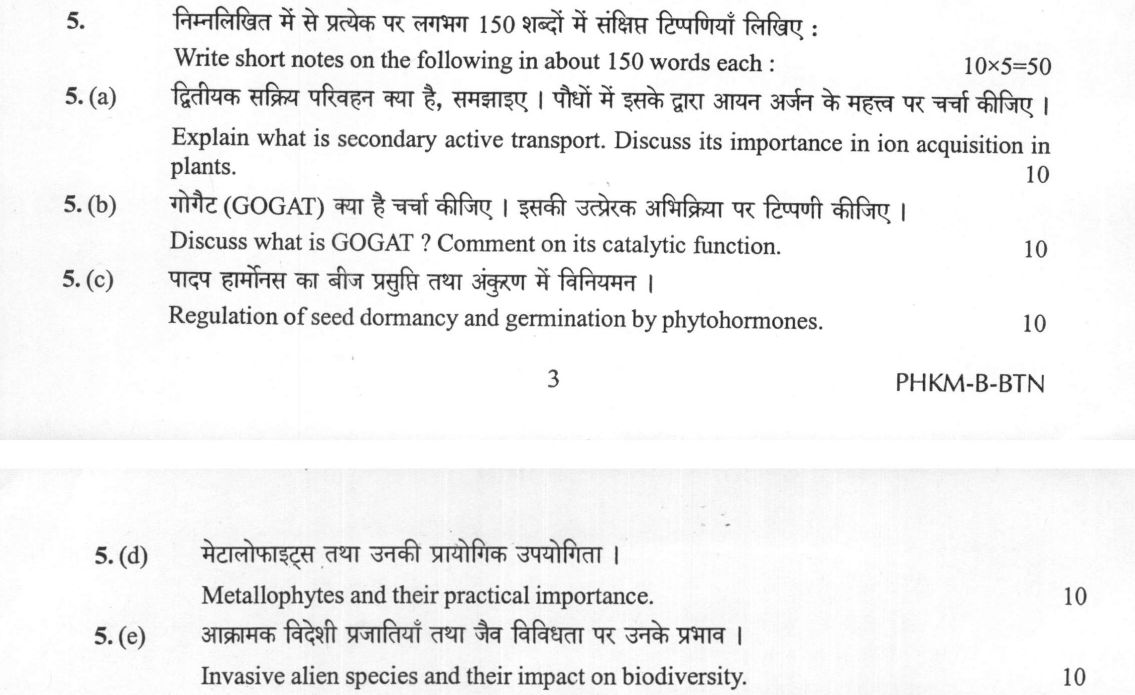
Write short notes on the following in about 150 words each : 10×5=50 (a) Explain what is secondary active transport. Discuss its…
Write short notes on the following in about 150 words each : 10×5=50
Explain what is secondary active transport. Discuss its importance in ion acquisition in plants. 10 marks
Discuss what is GOGAT ? Comment on its catalytic function. 10 marks
Regulation of seed dormancy and germination by phytohormones. 10 marks
Metallophytes and their practical importance. 10 marks
Invasive alien species and their impact on biodiversity. 10 marks
हिंदी में प्रश्न पढ़ें
निम्नलिखित में से प्रत्येक पर लगभग 150 शब्दों में संक्षिप्त टिप्पणियाँ लिखिए : 10×5=50
द्वितीयक सक्रिय परिवहन क्या है, समझाइए । पौधों में इसके द्वारा आयन अर्जन के महत्व पर चर्चा कीजिए । 10
गोगेट (GOGAT) क्या है चर्चा कीजिए । इसकी उत्प्रेरक अभिक्रिया पर टिप्पणी कीजिए । 10
पादप हार्मोन्स का बीज प्रसुप्ति तथा अंकुरण में विनियमन । 10
मेटलोफाइट्स तथा उनकी प्रायोगिक उपयोगिता । 10
आक्रामक विदेशी प्रजातियाँ तथा जैव विविधता पर उनके प्रभाव । 10
Model answer
Written by UPSC Answer Check against this question's marking rubric, to the 150-word length. UPSC does not publish answers for Mains — this is one way to score well, not an official key.
Secondary Active Transport Secondary active transport is the movement of ions or molecules across a membrane, driven by the electrochemical gradient of another ion, typically H⁺, rather than direct ATP hydrolysis. This process relies on the proton-motive force generated by primary active transport via H⁺-ATPases. It operates through two main mechanisms: symport (cotransport) and antiport (counter-transport). In symport, the transported solute moves in the same direction as the driving ion; for instance, H⁺/NO₃⁻ symporters in root cells utilize the inward flux of protons to accumulate nitrate against its concentration gradient. In antiport, solutes move in opposite directions, such as H⁺/Na⁺ antiporters that expel toxic sodium while importing protons. This mechanism is critical for plant ion acquisition, enabling roots to uptake essential nutrients like K⁺, NO₃⁻, and H₂PO₄⁻ from dilute soil solutions. By coupling nutrient uptake to proton gradients, plants efficiently concentrate ions in the cytosol, ensuring adequate supply for metabolic processes even under low external nutrient availability.
GOGAT Glutamate Synthase (GOGAT) is a key enzyme in the glutamine synthetase-glutamate synthase (GS-GOGAT) cycle, responsible for the final step of nitrogen assimilation. It catalyzes the reductive amination of 2-oxoglutarate using glutamine as the nitrogen donor, producing two molecules of glutamate. This reaction is coupled with the reduction of 2-oxoglutarate to glutamate. GOGAT exists in two isoforms: NADH-GOGAT, located in plastids and mitochondria, which uses NADH as the electron donor, and Ferredoxin-GOGAT (Fd-GOGAT), found in chloroplasts, which uses reduced ferredoxin generated by photosynthesis. Fd-GOGAT is particularly significant in C3 and C4 plants, linking nitrogen metabolism directly to photosynthetic electron transport. The catalytic function involves a complex mechanism where glutamine donates its amide nitrogen to 2-oxoglutarate, facilitated by the reduction of the enzyme’s active site. This cycle is vital for synthesizing amino acids, nucleotides, and other nitrogenous compounds, ensuring efficient nitrogen utilization in plant growth and development.
Phytohormone Regulation of Seed Dormancy Seed dormancy is a state of arrested development, regulated by a complex interplay of phytohormones, primarily Abscisic Acid (ABA) and Gibberellins (GA). ABA maintains dormancy by inducing the expression of seed-specific genes and transcription factors such as ABI3, ABI4, and ABI5, which promote desiccation tolerance and quiescence. The DOG1-dependent pathway, involving ABA signaling, reinforces this state. Conversely, GA breaks dormancy by promoting the degradation of DELLA proteins, which are growth repressors. This signaling cascade, mediated by the GID1 receptor, leads to the activation of genes involved in embryo growth and mobilization of reserves. Additionally, GA weakens the seed coat and endosperm layers, facilitating radicle emergence. Ethylene and brassinosteroids also play supportive roles in germination. The balance between ABA and GA levels, influenced by environmental cues like temperature and light, determines the transition from dormancy to germination. This hormonal antagonism ensures that seeds germinate only under favorable conditions, maximizing survival and fitness.
Metallophytes Metallophytes are plants that thrive in soils with high concentrations of heavy metals. They are physiologically classified into three categories: metal excluders, which restrict metal uptake to the roots; metal accumulators, which tolerate moderate metal levels; and hyperaccumulators, which concentrate metals to exceptionally high levels in their shoots. Examples include Rinorea bengalensis, a nickel hyperaccumulator, and Pteris vittata, which accumulates arsenic. These plants employ mechanisms such as enhanced metal chelation, sequestration in vacuoles, and efficient root exclusion to tolerate toxicity. Their practical importance lies in phytoremediation, where they are used to clean up contaminated soils, and phytomining, where they are harvested for metal recovery. In India, Rinorea bengalensis populations in the Andaman Islands and other regions are studied for their potential in nickel extraction. Metallophytes also serve as biomonitoring tools, indicating soil contamination levels. Their ability to accumulate metals makes them valuable for environmental restoration and sustainable mining practices, offering an eco-friendly alternative to conventional remediation methods.
Invasive Alien Species Invasive Alien Species (IAS) are non-native organisms that establish and spread, causing significant harm to biodiversity, ecosystem services, and human health. In India, examples include Lantana camara, Parthenium hysterophorus, and Eichhornia crassipes. Lantana forms dense thickets, reducing native plant diversity and altering soil chemistry. Parthenium produces allergenic pollen, causing respiratory issues, and competes with crops. Eichhornia covers water bodies, aggravating eutrophication and deoxygenation, which harms aquatic life. These species often lack natural predators, allowing rapid proliferation. They disrupt food webs, hybridize with native species, and reduce agricultural yields. The economic cost includes losses in crop production, increased maintenance of waterways, and healthcare expenses. Management strategies include mechanical removal, chemical control, and biological control. However, prevention through strict quarantine and public awareness is crucial. Addressing IAS requires integrated approaches involving policy enforcement, research, and community participation to protect India’s rich biodiversity and ecological balance.
What "Write short notes" is asking you to do
Five or six self-contained answers, marked separately, typically 10 marks and about 150 words each. Each note must carry its own definition, its two or three defining features and a line on why it matters; a common introduction or conclusion across the notes earns nothing.
Structure that answers it
Per note: one-line definition or identification → two or three features, mechanisms or named examples → one line of significance or Indian application
Where marks are lost
Writing the first two notes at essay length and rationing the rest. Each note is marked on its own, so marks surrendered on a compressed or unattempted note cannot be won back by the long ones.
How this answer will be evaluated
Approach
Framework: UPSC Botany Paper 2 (PHKM-B-BTN). (a) explain: definition/context > points in order > small example > short close | (b) discuss: intro > 3-4 dimensions > example > balanced close | (c) write short notes: define > 3-4 key features > one example > one-line significance | (d) write short notes: define > 3-4 key features > one example > one-line significance | (e) write short notes: define > 3-4 key features > one example > one-line significance Full marks: Precise definitions, specific examples, clear mechanisms, and labelled diagrams where appropriate.
Key points expected
- Define secondary active transport (symport/antiport)
- Link to primary active transport (H+ ATPase)
- Explain mechanism of ion uptake (e.g., NO3-, K+)
- Discuss importance in nutrient acquisition
- Define GOGAT (Glutamate Synthase)
- Explain catalytic function (ammonia assimilation)
- Mention reaction (2-oxoglutarate + NH4+ -> glutamate)
- Link to nitrogen metabolism
Evaluation rubric
Each sub-part is marked on its own, against the marks and word limit printed on the paper.
- (a) Define secondary active transport and discuss its role in plant ion acquisition. 10 marks · 150 words
explain— definition/context → points in order → small example → short close
Must cover
- Define secondary active transport (symport/antiport)
- Link to primary active transport (H+ ATPase)
- Explain mechanism of ion uptake (e.g., NO3-, K+)
- Discuss importance in nutrient acquisition
Loses marks
- Confusing with primary active transport
- No mention of energy source (proton gradient)
- Vague description of ion movement
Earns more
- Mention specific transporters (e.g., NRT1.1)
- Reference to root hair or epidermal cells
- Mention energy coupling
Extra mark
- Labelled diagram of symport mechanism
- Mention specific crop example
- (b) Define GOGAT and comment on its catalytic function. 10 marks · 150 words
discuss— intro → 3-4 dimensions → example → balanced close
Must cover
- Define GOGAT (Glutamate Synthase)
- Explain catalytic function (ammonia assimilation)
- Mention reaction (2-oxoglutarate + NH4+ -> glutamate)
- Link to nitrogen metabolism
Loses marks
- Confusing with GS (Glutamine Synthase)
- No mention of ammonia assimilation
- Incorrect reaction equation
Earns more
- Mention GOGAT isozymes (Fe-S and Fd-GOGAT)
- Reference to C4 or CAM plants
- Mention location (chloroplast/mitochondria)
Extra mark
- Labelled diagram of GS-GOGAT cycle
- Mention specific plant species
- (c) Explain regulation of seed dormancy and germination by phytohormones. 10 marks · 150 words
write short notes— define → 3-4 key features → one example → one-line significance
Must cover
- Mention ABA (dormancy) and GA (germination)
- Explain hormonal balance (ABA/GA ratio)
- Mention other hormones (cytokinins, ethylene)
- Link to seed viability
Loses marks
- Only mentioning one hormone
- No explanation of mechanism
- Confusing dormancy with quiescence
Earns more
- Mention specific seed types (recalcitrant/orthodox)
- Reference to stratification or scarification
- Mention hormonal crosstalk
Extra mark
- Labelled diagram of hormonal regulation
- Mention specific crop example
- (d) Define metallophytes and discuss their practical importance. 10 marks · 150 words
write short notes— define → 3-4 key features → one example → one-line significance
Must cover
- Define metallophytes (metal-tolerant plants)
- Mention specific metals (Ni, Zn, Cu)
- Explain practical importance (phytoremediation)
- Mention industrial applications
Loses marks
- Confusing with halophytes
- No mention of specific metals
- Vague description of importance
Earns more
- Mention specific species (e.g., *Noccaea caerulescens*)
- Reference to hyperaccumulation
- Mention phytomining
Extra mark
- Labelled diagram of phytoremediation
- Mention specific location (e.g., New Caledonia)
- (e) Define invasive alien species and discuss their impact on biodiversity. 10 marks · 150 words
write short notes— define → 3-4 key features → one example → one-line significance
Must cover
- Define invasive alien species (IAS)
- Mention specific examples (e.g., *Lantana camara*)
- Explain impact on native species
- Mention ecological consequences
Loses marks
- Confusing with native species
- No mention of specific examples
- Vague description of impact
Earns more
- Mention specific ecosystem (e.g., wetlands)
- Reference to economic impact
- Mention management strategies
Extra mark
- Labelled diagram of invasion process
- Mention specific case study
Practice this exact question
Write your answer and it is marked point by point against the model answer above — what you covered, what you missed, what you got wrong.
Evaluate my answer →More from Botany 2024 Paper II
- Q2 (a) Explain briefly the process and importance of the following : 5+5+5=15 (i) Male steri…
- Q3 (a) Describe along with illustrated diagrams the structure and function of mitochondria a…
- Q4 (a) Discuss briefly the following and comment on their significance : 10+5+5=20 (i) In wh…
- Q5 Write short notes on the following in about 150 words each : 10×5=50 (a) Explain what is…
- Q6 (a) Explain the compartmentation of biochemical reactions in photorespiration. Comment up…
- Q7 (a) Define leaf senescence. Describe important physiological and biochemical changes taki…
- Q8 (a)(i) What are allosteric enzymes ? Explain in detail on the allosteric enzyme modulatio…