Paper II — Q4
(a) Discuss briefly the following and comment on their significance : 10+5+5=20 (i) In what way the transfer of genes in plants…
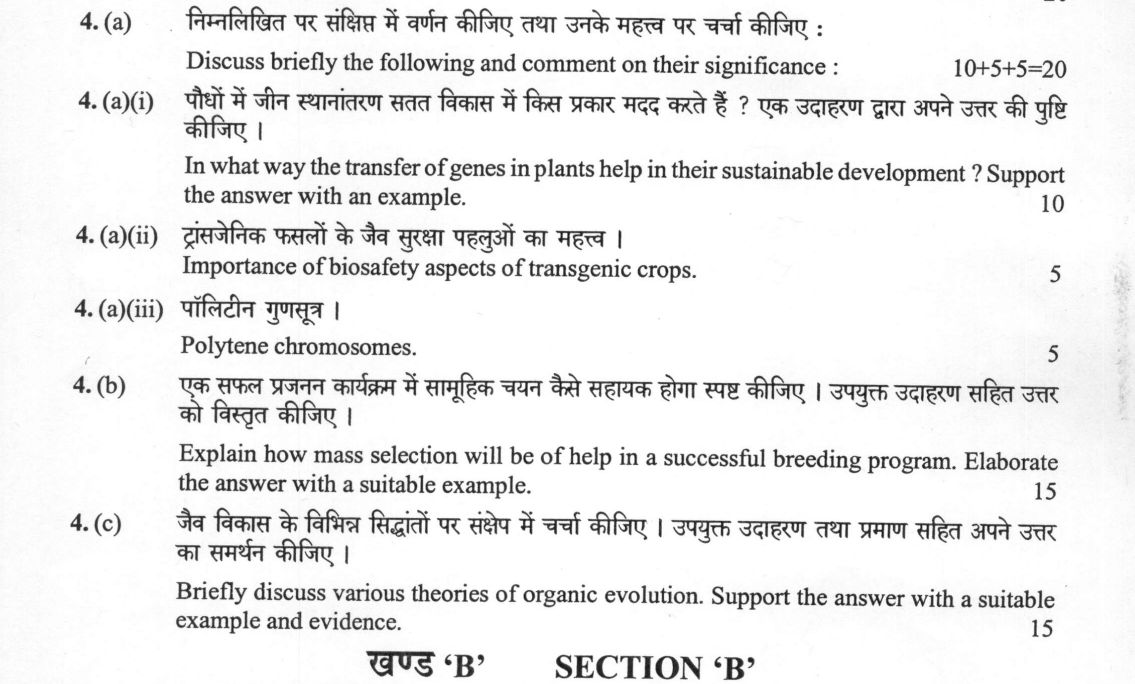
Discuss briefly the following and comment on their significance : 10+5+5=20
In what way the transfer of genes in plants help in their sustainable development ? Support the answer with an example. 10 marks
Importance of biosafety aspects of transgenic crops. 5 marks
Polytene chromosomes. 5 marks
Explain how mass selection will be of help in a successful breeding program. Elaborate the answer with a suitable example. 15 marks
Briefly discuss various theories of organic evolution. Support the answer with a suitable example and evidence. 15 marks
हिंदी में प्रश्न पढ़ें
निम्नलिखित पर संक्षिप्त में वर्णन कीजिए तथा उनके महत्व पर चर्चा कीजिए : 10+5+5=20
पौधों में जीन स्थानांतरण सतत विकास में किस प्रकार मदद करते हैं ? एक उदाहरण द्वारा अपने उत्तर की पुष्टि कीजिए । 10
ट्रांसजेनिक फसलों के जैव सुरक्षा पहलुओं का महत्व । 5
पॉलिटीन गुणसूत्र । 5
एक सफल प्रजनन कार्यक्रम में सामूहिक चयन कैसे सहायक होगा स्पष्ट कीजिए । उपयुक्त उदाहरण सहित उत्तर को विस्तृत कीजिए । 15
जैव विकास के विभिन्न सिद्धांतों पर संक्षेप में चर्चा कीजिए । उपयुक्त उदाहरण तथा प्रमाण सहित अपने उत्तर का समर्थन कीजिए । 15
Model answer
Written by UPSC Answer Check against this question's marking rubric, to the expected length. UPSC does not publish answers for Mains — this is one way to score well, not an official key.
Genetic improvement and evolutionary biology form the twin pillars of modern plant science, bridging molecular manipulation with population-level dynamics.
(a)(i) Gene Transfer and Sustainable Development The transfer of genes into plants, primarily via *Agrobacterium*-mediated transformation or biolistics, facilitates sustainable agriculture by conferring abiotic and biotic stress resistance. This reduces the environmental footprint of farming. A prime example is Bt cotton in India. By introducing Bt genes from Bacillus thuringiensis, the crop produces insecticidal proteins, reducing pesticide use by approximately 40%. This lowers chemical runoff, preserves non-target beneficial insects, and enhances farmer income, thereby supporting ecological and economic sustainability.
(a)(ii) Biosafety of Transgenic Crops Biosafety is critical to prevent unintended ecological and health impacts. Key concerns include gene flow to wild relatives, potential allergenicity, and effects on non-target organisms. Regulatory frameworks like the Cartagena Protocol on Biosafety and India’s GEAC (Genetic Engineering Appraisal Committee) enforce the precautionary principle. Confined field trials and rigorous risk assessment ensure that transgenic crops are safe for human consumption and environmental integrity before commercial release.
(a)(iii) Polytene Chromosomes Polytene chromosomes, found in Drosophila salivary glands, result from repeated endoreduplication without cell division. They exhibit distinct bands (chromomeres) and puffs. Puffs are sites of active transcription, with large puffs known as Balbiani rings. These structures are invaluable for gene mapping and studying chromatin dynamics, providing a visual correlation between gene activity and chromosome morphology.
(b) Mass Selection in Breeding Mass selection involves selecting superior phenotypes from a heterogeneous population without controlled crosses. It is particularly effective for cross-pollinated crops where maintaining a broad genetic base is essential. The response to selection is governed by the breeder’s equation, R = h² S, assuming random mating, no epistasis, and negligible genotype-environment interaction. In cross-pollinated species where only one sex is selected, the response is approximately R = 1/2 h² S.
A well-documented example is the development of the rice variety IR8 (Green Revolution rice). While later improved through hybridization, initial mass selection from landraces identified high-yielding, non-lodging plants. This method maintains genetic diversity, preventing the vulnerability associated with pure lines, and is crucial for adapting crops to local agro-ecological conditions.
(c) Theories of Organic Evolution Evolutionary theory has evolved from early concepts to the modern synthesis.
Lamarckism proposed inheritance of acquired characters and use/disuse. For instance, giraffes stretching their necks to reach leaves supposedly passed longer necks to offspring. However, this lacks empirical support as acquired traits do not alter germline DNA.
Darwinism introduced natural selection, variation, and struggle for existence. Darwin’s finches in the Galapagos Islands demonstrate adaptive radiation, where beak shapes diversified to exploit different food sources.
De Vries’ Mutation Theory suggested that evolution occurs through sudden, discontinuous changes (mutations) rather than gradual selection. De Vries observed evening primrose (Oenothera) mutations, though later shown to be chromosomal changes. This theory highlighted the role of genetic variation.
Neo-Darwinism (Modern Synthesis) integrates Darwin’s selection with Mendelian genetics, mutation, recombination, and genetic drift. Evidence includes industrial melanism in Biston betularia, where dark moths became dominant in polluted areas due to selection pressure. Fossil records, such as Archaeopteryx, bridge reptiles and birds, while molecular phylogenetics confirms common ancestry through DNA similarities.
Conclusion In conclusion, gene transfer and biosafety protocols enable sustainable crop improvement, while mass selection preserves genetic diversity. Understanding evolutionary theories, from Lamarck to Neo-Darwinism, provides the theoretical framework for predicting crop adaptation and conservation. Integrating biotechnology with evolutionary principles is essential for developing resilient food systems.
What "Discuss" is asking you to do
Lay the issue out from more than one side — how it arose, what is claimed for it, what is held against it, and where it now stands. UPSC attaches discuss to broad topics with several live dimensions, so coverage of the dimensions earns more than the strength of your opinion.
Structure that answers it
Set the issue up → the case as it is made → the case against → the dimension both sides leave out → where the balance now lies
Where marks are lost
Listing facts with no thread between them, or arguing one side throughout and calling it a discussion.
How this answer will be evaluated
Approach
Framework: UPSC Botany Paper 2. (a(i)) explain: definition/context > points in order > small example > short close | (a(ii)) highlight: name the salient points > one line of substance each > close | (a(iii)) describe: define > structure or process in order > labelled diagram > significance | (b) explain: definition/context > points in order > small example > short close | (c) discuss: intro > 3-4 dimensions > example > balanced close Full marks: Precise definitions, specific examples (Bt cotton, Drosophila), clear distinction between theories, and logical flow.
Key points expected
- Define gene transfer (transformation/transgenesis)
- Link to sustainable development (e.g., reduced pesticide use)
- Provide a specific example (e.g., Bt cotton)
- Explain the biological mechanism of the trait
- Define biosafety in context of GM crops
- Mention environmental risks (gene flow, superweeds)
- Mention health risks (allergenicity, toxicity)
- Define polytene chromosomes (supercoiled)
Evaluation rubric
Each sub-part is marked on its own, against the marks and word limit printed on the paper.
- (a(i)) Mechanism of gene transfer aiding sustainable development with a specific example. 10 marks
explain— definition/context → points in order → small example → short close
Must cover
- Define gene transfer (transformation/transgenesis)
- Link to sustainable development (e.g., reduced pesticide use)
- Provide a specific example (e.g., Bt cotton)
- Explain the biological mechanism of the trait
Loses marks
- Vague generalities without specific examples
- Confusing gene transfer with hybridization
Earns more
- Mention of specific gene name (e.g., cry1Ac)
- Reference to economic or ecological benefit
- Mention of vector used (Agrobacterium)
Extra mark
- Reference to a specific cultivar (e.g., Bt Brinjal)
- Mention of recent regulatory status
- (a(ii)) Key biosafety concerns regarding transgenic crops. 5 marks
highlight— name the salient points → one line of substance each → close
Must cover
- Define biosafety in context of GM crops
- Mention environmental risks (gene flow, superweeds)
- Mention health risks (allergenicity, toxicity)
Loses marks
- Ignoring ecological impact
- Focusing only on human health
Earns more
- Reference to regulatory bodies (GEAC)
- Mention of containment strategies
Extra mark
- Reference to specific international protocols (Cartagena)
- (a(iii)) Structure and significance of polytene chromosomes. 5 marks
describe— define → structure or process in order → labelled diagram → significance
Must cover
- Define polytene chromosomes (supercoiled)
- Mention location (salivary gland of Drosophila)
- Explain banding pattern significance (gene mapping)
Loses marks
- Confusing with metacentric/acentric chromosomes
- Missing the 'supercoiled' aspect
Earns more
- Mention of puffs (active transcription)
- Reference to Drosophila melanogaster
Extra mark
- Mention of specific banding map usage
- (b) Role of mass selection in breeding with a suitable example. 15 marks
explain— definition/context → points in order → small example → short close
Must cover
- Define mass selection (selecting superior phenotypes)
- Explain the process (selection, selfing, reselection)
- Provide a suitable example (e.g., wheat or rice)
- Discuss advantages (simplicity, low cost)
Loses marks
- Confusing with single plant selection
- Lack of a specific crop example
Earns more
- Mention of limitations (genetic heterogeneity)
- Comparison with pure line selection
- Stepwise description of the cycle
Extra mark
- Reference to a specific historical success (e.g., Sonora 64)
- Mention of specific traits selected
- (c) Overview of organic evolution theories with evidence. 15 marks
discuss— intro → 3-4 dimensions → example → balanced close
Must cover
- Mention Lamarck's theory (use and disuse)
- Mention Darwin's theory (natural selection)
- Provide evidence (fossils, comparative anatomy)
- Briefly mention Modern Synthesis (genetics)
Loses marks
- Presenting Lamarck as fact
- Ignoring the role of genetics in modern theory
Earns more
- Comparison of Lamarck vs Darwin
- Mention of specific fossil evidence (e.g., Archaeopteryx)
- Reference to Wallace
Extra mark
- Mention of specific molecular evidence (DNA)
- Reference to specific evolutionary experiments
Practice this exact question
Write your answer and it is marked point by point against the model answer above — what you covered, what you missed, what you got wrong.
Evaluate my answer →More from Botany 2024 Paper II
- Q1 Write short notes on the following in about 150 words each : 10×5=50 (a) Explain the type…
- Q2 (a) Explain briefly the process and importance of the following : 5+5+5=15 (i) Male steri…
- Q3 (a) Describe along with illustrated diagrams the structure and function of mitochondria a…
- Q4 (a) Discuss briefly the following and comment on their significance : 10+5+5=20 (i) In wh…
- Q5 Write short notes on the following in about 150 words each : 10×5=50 (a) Explain what is…
- Q6 (a) Explain the compartmentation of biochemical reactions in photorespiration. Comment up…
- Q7 (a) Define leaf senescence. Describe important physiological and biochemical changes taki…