Paper I — Q1
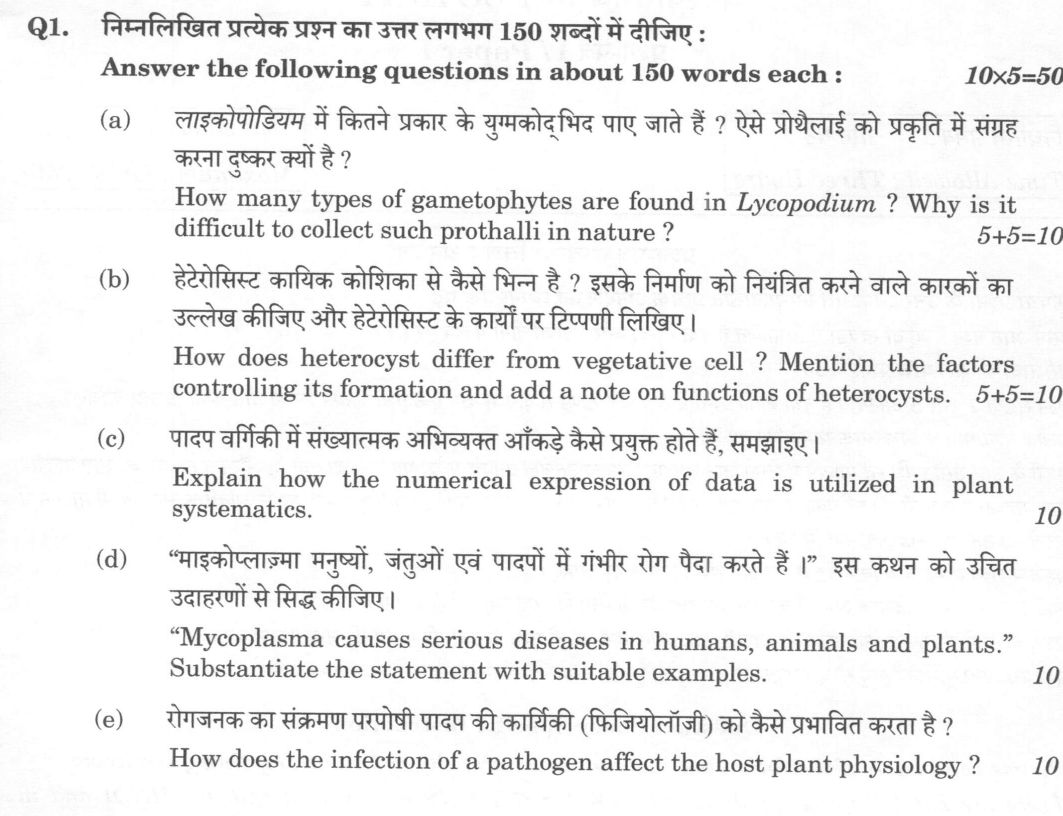
Answer the following questions in about 150 words each: (a) How many types of gametophytes are found in Lycopodium ? Why is it…
Answer the following questions in about 150 words each:
How many types of gametophytes are found in Lycopodium ? Why is it difficult to collect such prothalli in nature ? 5+5=10
How does heterocyst differ from vegetative cell ? Mention the factors controlling its formation and add a note on functions of heterocysts. 5+5=10
Explain how the numerical expression of data is utilized in plant systematics. 10 marks
"Mycoplasma causes serious diseases in humans, animals and plants." Substantiate the statement with suitable examples. 10 marks
How does the infection of a pathogen affect the host plant physiology ? 10 marks
हिंदी में प्रश्न पढ़ें
निम्नलिखित प्रत्येक प्रश्न का उत्तर लगभग 150 शब्दों में दीजिए :
लाइकोपोडियम में कितने प्रकार के युग्मकोद्भिद पाए जाते हैं ? ऐसे प्रोथेलाई को प्रकृति में संग्रह करना दुष्कर क्यों है ? 5+5=10
हेटेरोसिस्ट कायिक कोशिका से कैसे भिन्न है ? इसके निर्माण को नियंत्रित करने वाले कारकों का उल्लेख कीजिए और हेटेरोसिस्ट के कार्यों पर टिप्पणी लिखिए । 5+5=10
पादप वर्गिकी में संख्यात्मक अभिव्यक्त आँकड़े कैसे प्रयुक्त होते हैं, समझाइए । 10
"माइकोप्लाज्मा मनुष्यों, जंतुओं एवं पादपों में गंभीर रोग पैदा करते हैं।" इस कथन को उचित उदाहरणों से सिद्ध कीजिए । 10
रोगजनक का संक्रमण परपोषी पादप की कार्यिकी (फिजियोलॉजी) को कैसे प्रभावित करता है ? 10 marks
Model answer
Written by UPSC Answer Check against this question's marking rubric, to the 150-word length. UPSC does not publish answers for Mains — this is one way to score well, not an official key.
(a) Gametophytes in Lycopodium and Difficulties in Collection
The genus Lycopodium exhibits two primary types of prothalli: the green, cylindrical, surface-living photosynthetic type (such as in L. cernuum), and the subterranean, non-green, tuberous mycorrhizal type (such as in L. clavatum and L. complanatum), alongside epiphytic saprophytic forms (L. phlegmaria). Collecting these prothalli from natural habitats presents extreme difficulty because the subterranean types develop entirely underground or beneath thick leaf litter, remaining completely concealed from direct view. Furthermore, their ontogeny is exceptionally slow, often taking several years to a decade to reach sexual maturity. Because their germination and prolonged development strictly require an obligate endophytic mycorrhizal association (Glomus species), they fail to grow in disturbed soils, occurring only in specialized micro-niches with very low population densities.
(b) Heterocyst Differentiation, Regulation, and Function
Heterocysts are specialized cells differentiated from vegetative cells in filamentous cyanobacteria (e.g., Anabaena, Nostoc). Structurally, a heterocyst differs by possessing a thick, multilayered envelope (composed of glycolipids and polysaccharides) that limits oxygen ingress, polar cyanophycin nodules connecting it to adjacent vegetative cells, and a modified photosynthetic apparatus lacking photosystem II (PS II), thereby preventing oxygen evolution while retaining ATP generation via photosystem I.
The differentiation process is triggered primarily by environmental nitrogen limitation (depletion of ammonium and nitrate) and ambient oxygen levels. Genetically, nitrogen starvation activates the global regulator NtcA, which upregulates the expression of the hetR master regulator gene, initiating irreversible cell differentiation. Functionally, heterocysts provide an anaerobic microenvironment essential for the oxygen-labile enzyme nitrogenase to perform biological nitrogen fixation. Additionally, the fragile junction between heterocysts and vegetative cells serves as a point of filament fragmentation, facilitating the release of hormogonia for reproduction.
(c) Numerical Expression of Data in Plant Systematics
Numerical taxonomy (phenetics) utilizes mathematical and statistical methods to classify plant taxa based on the objective quantification of observed characters. Individual taxa evaluated are designated as Operational Taxonomic Units (OTUs). Multiple qualitative and quantitative morphological, anatomical, and chemical characters are scored and transformed into a character-state data matrix.
Using computer-assisted algorithms, pairwise similarity or dissimilarity coefficients are calculated across all OTUs. Multivariate techniques—principally Cluster Analysis (generating phenograms) and Principal Component Analysis (PCA)—reduce high-dimensional data to visualize character distribution and taxonomic distances without subjective character weighting. While classical phenetics treats all characters with equal weighting (Adansonian principle), modern systematic approaches, including the Angiosperm Phylogeny Group (APG) systems, incorporate quantified numerical data and probabilistic matrices into phylogenetic analysis. This mathematical rigor minimizes human bias, resolves complex species aggregates, and provides objective delimitation of taxa.
(d) Pathogenicity of Mycoplasma in Humans, Animals, and Plants
Mycoplasmas (and related phytoplasmas) are wall-less, pleomorphic, filterable prokaryotes belonging to the class Mollicutes that induce severe pathologies across diverse biological kingdoms.
In humans, Mycoplasma pneumoniae causes primary atypical pneumonia ("walking pneumonia") and tracheobronchitis by attaching to respiratory epithelial cells via terminal organelle adhesins, causing ciliostasis and inflammatory damage. In animals, Mycoplasma mycoides subsp. mycoides is the etiological agent of Contagious Bovine Pleuropneumonia (CBPP), a devastating livestock disease marked by fibrinous pleuropneumonia and severe pulmonary edema. In plants, wall-less prokaryotes known as phytoplasmas infect phloem sieve elements, disrupting physiological development to cause aster yellows in various ornamental and crop species, little leaf of brinjal (Solanum melongena) characterized by severe leaf reduction and bushy phyllody, and witches' broom of potato, which produces abnormal shoot proliferation and total tuber loss.
(e) Impact of Pathogen Infection on Host Plant Physiology
Pathogen invasion profoundly disrupts normal host metabolic homeostasis through sequential physiological alterations:
First, photosynthetic efficiency drops sharply due to pathogen-induced chlorophyll breakdown, down-regulation of light-harvesting complex proteins, and direct inhibition of the Rubisco enzyme. Concurrently, host respiration increases dramatically, shifting metabolic flux toward the pentose phosphate pathway to supply phenolic precursors and ATP for host defense responses.
Second, vascular pathogens occlude xylem vessels via mycelial growth, tyloses, and secreted gums, while phloem-feeding pathogens disrupt nutrient partitioning, impairing source-sink translocation.
Third, pathogens upset hormonal equilibria; overproduction of indole-3-acetic acid (IAA) induces abnormal tissue hypertrophy, whereas elevated ethylene biosynthesis triggers epinasty, chlorosis, and premature senescence. Finally, secreted phytotoxins (such as fusicoccin) cause permanent stomatal opening or guard cell paralysis, precipitating uncontrolled water loss, turgor collapse, and systemic wilting. Thus, pathogen virulence transforms host metabolic machinery from productive growth to unregulated catabolism and structural decline.
What "Explain" is asking you to do
Make the working of something clear — what sets it off, what follows from what, and what it produces. Explain is the Commission's mechanism word: it dominates the technical papers and the “explain why” stems, where the marks sit in the causal chain and not in the label.
Structure that answers it
State what it is → the initiating condition → the chain of cause, step by step → an instance where it plays out → what the chain produces
Where marks are lost
Describing what something looks like instead of why it works that way. Naming the stages without linking them reads as description too.
How this answer will be evaluated
Approach
Framework: UPSC Botany Paper 1. (a) explain: definition/context > points in order > small example > short close | (b) compare: paired headings or table > key differences > significance > conclusion | (c) explain: definition/context > points in order > small example > short close | (d) justify: claim > 3-4 reasons > evidence > conclusion | (e) explain: definition/context > points in order > small example > short close Full marks: Precise terminology, specific examples, and clear logical flow.
Key points expected
- Mention male, female, and bisexual prothalli
- State prothalli are minute and short-lived
- Note they are hidden under leaf litter
- Mention they are sterile in many cases
- Note thickened cell wall of heterocyst
- Mention absence of Photosystem II (PS II)
- State role in nitrogen fixation
- Mention protection from oxygen
Evaluation rubric
Each sub-part is marked on its own, against the marks and word limit printed on the paper.
- (a) Identify gametophyte types and explain collection difficulty. 10 marks · 150 words
explain— definition/context → points in order → small example → short close
Must cover
- Mention male, female, and bisexual prothalli
- State prothalli are minute and short-lived
- Note they are hidden under leaf litter
- Mention they are sterile in many cases
Loses marks
- Confusing prothallus with sporophyte
- Failing to mention the 'hidden' nature
Earns more
- Mention *Lycopodium* is dioecious
- Note prothalli are thalloid and green
Extra mark
- Mention specific species like *L. clavatum*
- (b) Differentiate heterocyst from vegetative cells and list functions. 10 marks · 150 words
compare— paired headings or table → key differences → significance → conclusion
Must cover
- Note thickened cell wall of heterocyst
- Mention absence of Photosystem II (PS II)
- State role in nitrogen fixation
- Mention protection from oxygen
Loses marks
- Saying heterocysts perform photosynthesis
- Ignoring the wall thickness difference
Earns more
- Mention nitrogenase enzyme
- Note heterocysts are non-photosynthetic
Extra mark
- Mention specific cyanobacteria like *Anabaena*
- (c) Explain the use of numerical data in plant systematics. 10 marks · 150 words
explain— definition/context → points in order → small example → short close
Must cover
- Define numerical taxonomy (phenetics)
- Mention use of multivariate analysis
- Note use of distance matrices
- Mention dendrogram construction
Loses marks
- Confusing with cladistics
- Failing to mention data processing
Earns more
- Mention Sokal and Sneath
- Note objectivity over subjective characters
Extra mark
- Mention specific software or algorithms
- (d) Substantiate Mycoplasma disease claims with examples. 10 marks · 150 words
justify— claim → 3-4 reasons → evidence → conclusion
Must cover
- Mention lack of cell wall
- Give human example (e.g., pneumonia)
- Give plant example (e.g., witches' broom)
- Give animal example (e.g., mastitis)
Loses marks
- Saying they have a cell wall
- Failing to provide specific examples
Earns more
- Mention *Mycoplasma pneumoniae*
- Note pleomorphic nature
Extra mark
- Mention specific crop like citrus
- (e) Explain how pathogen infection affects host physiology. 10 marks · 150 words
explain— definition/context → points in order → small example → short close
Must cover
- Mention nutrient depletion
- Note disruption of water transport
- Mention toxin production
- Note hormonal imbalance
Loses marks
- Focusing only on morphology
- Ignoring the physiological mechanism
Earns more
- Mention specific symptoms like wilting
- Note defense response activation
Extra mark
- Mention specific pathogen-host interaction
Practice this exact question
Write your answer and it is marked point by point against the model answer above — what you covered, what you missed, what you got wrong.
Evaluate my answer →More from Botany 2025 Paper I
- Q1 Answer the following questions in about 150 words each: (a) How many types of gametophyte…
- Q2 (a) Enumerate the types of fruiting bodies of Ascomycota and Basidiomycota. Write the var…
- Q3 (a) Discuss how progressive sterilization of sporogenous tissue occurs in bryophytes, wit…
- Q4 (a) Describe the causal organisms, disease cycle and control measures of Early Blight of…