Paper I — Q8
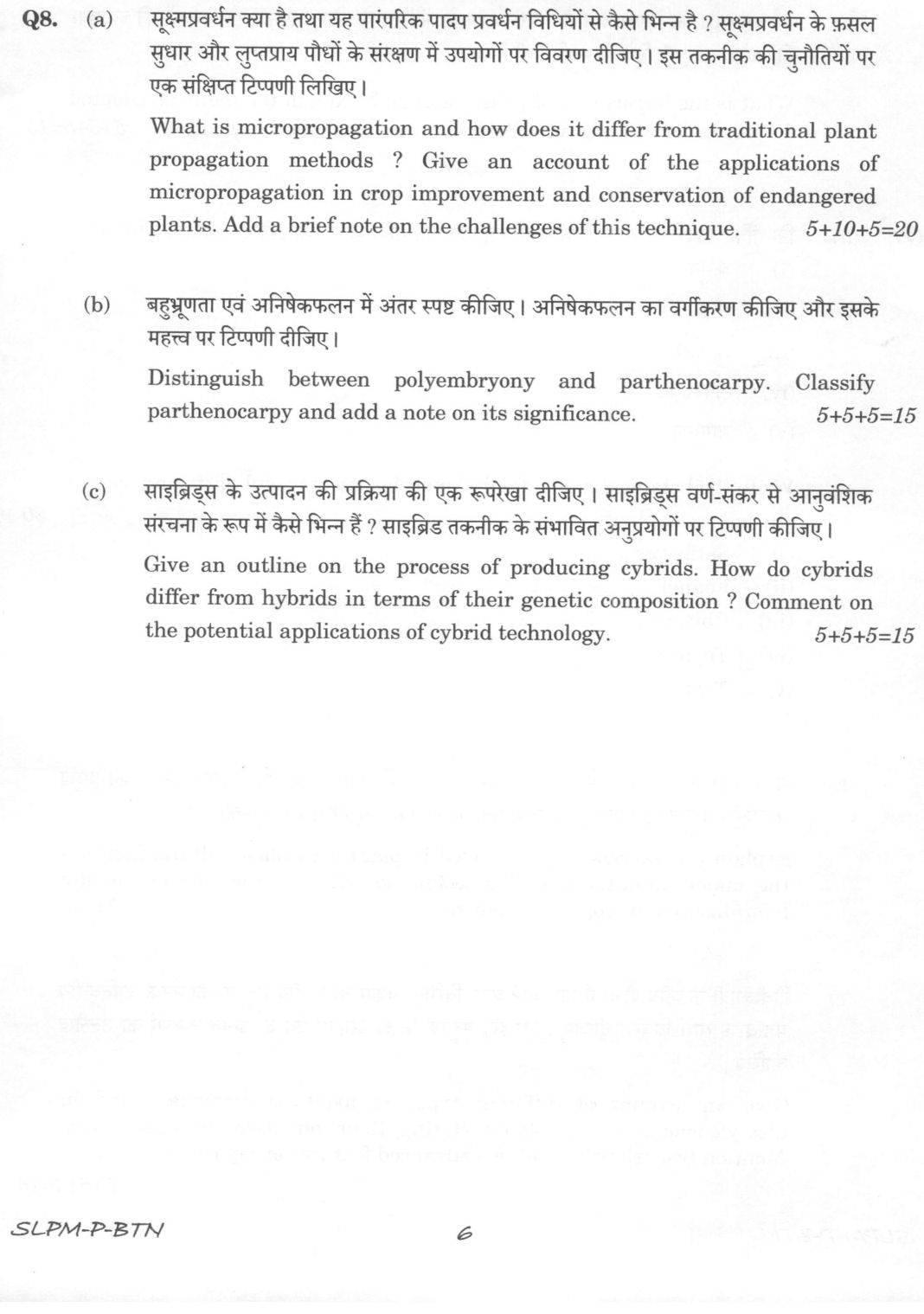
(a) What is micropropagation and how does it differ from traditional plant propagation methods ? Give an account of the…
What is micropropagation and how does it differ from traditional plant propagation methods ? Give an account of the applications of micropropagation in crop improvement and conservation of endangered plants. Add a brief note on the challenges of this technique. 5+10+5=20
Distinguish between polyembryony and parthenocarpy. Classify parthenocarpy and add a note on its significance. 5+5+5=15
Give an outline on the process of producing cybrids. How do cybrids differ from hybrids in terms of their genetic composition ? Comment on the potential applications of cybrid technology. 5+5+5=15
हिंदी में प्रश्न पढ़ें
सूक्ष्मप्रवर्धन क्या है तथा यह पारंपरिक पादप प्रवर्धन विधियों से कैसे भिन्न है ? सूक्ष्मप्रवर्धन के फसल सुधार और लुप्तप्राय पौधों के संरक्षण में उपयोगों पर विवरण दीजिए। इस तकनीक की चुनौतियों पर एक संक्षिप्त टिप्पणी लिखिए। 5+10+5=20
बहुभ्रूणता एवं अनिषेकफलन में अंतर स्पष्ट कीजिए। अनिषेकफलन का वर्गीकरण कीजिए और इसके महत्व पर टिप्पणी दीजिए। 5+5+5=15
साइब्रिड्स के उत्पादन की प्रक्रिया की एक रूपरेखा दीजिए। साइब्रिड वर्ण-संकर से आनुवंशिक संरचना के रूप में कैसे भिन्न हैं ? साइब्रिड तकनीक के संभावित अनुप्रयोगों पर टिप्पणी कीजिए। 5+5+5=15
Model answer
Written by UPSC Answer Check against this question's marking rubric, to the expected length. UPSC does not publish answers for Mains — this is one way to score well, not an official key.
Micropropagation and Applications in Plant Biology
Micropropagation is the in vitro clonal propagation of plants from totipotent explants cultured on defined nutrient media under aseptic conditions. Unlike traditional propagation—which relies on seeds resulting in genetic segregation, or vegetative cuttings and grafting constrained by seasonal cycles, low multiplication rates, and systemic pathogen transmission—micropropagation operates year-round, requires minimal starting tissue, and yields genetically uniform, pathogen-free propagules at an exponential rate.
In crop improvement, it enables rapid clonal multiplication of elite genotypes in commercial crops such as Musa paradisiaca (banana) and disease-free seed tubers in Solanum tuberosum. Shoot apical meristem culture specifically eliminates systemic viruses because high metabolic activity and rapid cell division outpace viral movement, combined with the lack of vascular differentiation in the meristematic dome. For biodiversity conservation, it facilitates ex situ germplasm preservation, slow-growth storage, and cryopreservation of critically endangered Indian species, including Nepenthes khasiana, Madhuca insignis, and Pterocarpus santalinus.
The technique faces several challenges: somaclonal variations induced by prolonged callus phases, high capital infrastructure and labor costs, physiological anomalies such as hyperhydricity (vitrification), microbial contamination risks, and high mortality during ex vitro hardening and acclimatization.
Polyembryony versus Parthenocarpy
Polyembryony and parthenocarpy are distinct developmental phenomena. Polyembryony is the formation of multiple embryos within a single seed, arising from proembryo cleavage or adventitious budding of maternal sporophytic tissue (nucellus or integuments), as seen in Citrus and Mangifera indica. In contrast, parthenocarpy is the development of a fruit without fertilization and seed formation, driven by endogenous auxin and gibberellin synthesis in ovary tissues without syngamy.
Parthenocarpy is classified into three categories:
- Genetic (Obligate): Driven by genetic mutations or polyploidy, operating independently of external stimuli, as seen in commercial triploid bananas, seedless grapes, and specific tomato cultivars.
- Environmental (Facultative): Induced by climatic extremes such as low temperatures, frost, or altered photoperiods that impair pollination but trigger ovary expansion, observed in pear and tomato.
- Artificial (Induced): Achieved by exogenous application of synthetic phytohormones such as indole-3-acetic acid (IAA), α-naphthaleneacetic acid (NAA), 2,4-D, or gibberellic acid (GA₃).
Significance: Parthenocarpy produces seedless fruits with superior edible quality and higher consumer and processing preference, while ensuring reliable fruit set and yield under pollinator-scarce or climatically unfavorable conditions.
Cybrid Production and Applications
Cybrids (cytoplasmic hybrids) are produced through somatic protoplast manipulation. The process involves enzymatic isolation of protoplasts using cellulase and pectinase. To prevent biparental nuclear fusion, the donor protoplast is irradiated with X-rays or gamma rays to fragment its nucleus (or enucleated via ultracentrifugation), while the recipient protoplast is often metabolically inactivated with iodoacetate. The treated protoplasts are fused using polyethylene glycol (PEG) or electrofusion, selected, and regenerated via somatic embryogenesis or organogenesis into intact plants.
Genetically, conventional sexual or somatic hybrids possess combined nuclear and organellar genomes from both parents. Cybrids possess the intact nuclear genome of only one parent combined with the cytoplasmic organelles (chloroplast and mitochondrial DNA) of the donor parent or a recombinant mixture of both parental cytoplasms.
Cybrid technology enables the direct transfer of maternally inherited, organelle-encoded traits without disturbing the adapted nuclear genotype. Major applications include transferring Cytoplasmic Male Sterility (CMS)—governed by mitochondrial genes—into elite breeding lines of Brassica napus and Nicotiana tabacum for hybrid seed production, introducing chloroplast-encoded herbicide resistance (e.g., atrazine resistance), and circumventing pre- and post-zygotic sexual incompatibility barriers that prevent conventional gene transfer.
What "Explain" is asking you to do
Make the working of something clear — what sets it off, what follows from what, and what it produces. Explain is the Commission's mechanism word: it dominates the technical papers and the “explain why” stems, where the marks sit in the causal chain and not in the label.
Structure that answers it
State what it is → the initiating condition → the chain of cause, step by step → an instance where it plays out → what the chain produces
Where marks are lost
Describing what something looks like instead of why it works that way. Naming the stages without linking them reads as description too.
How this answer will be evaluated
Approach
Framework: Botany Paper 1: Define > Structure/Process > Labelled Diagram > Significance. (a) explain: definition/context > points in order > small example > short close | (b) compare: paired headings or table > key differences > significance > conclusion | (c) explain: definition/context > points in order > small example > short close Full marks: Precise definitions, clear comparisons, labelled diagrams, specific examples, and balanced discussion of challenges/applications.
Key points expected
- Micropropagation definition and comparison
- Polyembryony vs Parthenocarpy distinction
- Cybrid production process and genetic makeup
Evaluation rubric
Each sub-part is marked on its own, against the marks and word limit printed on the paper.
- (a) Define micropropagation, contrast with traditional methods, and detail applications in crop improvement and conservation. 20 marks
explain— definition/context → points in order → small example → short close
Must cover
- Definition of micropropagation (in vitro culture)
- Comparison with traditional methods (speed, space, disease)
- Applications in crop improvement (somaclonal variation)
- Conservation of endangered plants (germplasm banks)
Loses marks
- Unlabelled diagrams
- Loose common names
- Ignoring the 'challenges' part
Earns more
- Labelled diagram of tissue culture stages
- Mention of somaclonal variation
- Specific endangered plant example (e.g., *Nepenthes*)
- Note on challenges (contamination, cost)
Extra mark
- Mention of cryopreservation
- Specific biotech application (e.g., banana virus-free)
- (b) Distinguish polyembryony from parthenocarpy, classify parthenocarpy, and state its significance. 15 marks
compare— paired headings or table → key differences → significance → conclusion
Must cover
- Definition of polyembryony (multiple embryos)
- Definition of parthenocarpy (fruit without seed)
- Classification of parthenocarpy (spontaneous, stimulated)
- Significance in horticulture (seedless fruits)
Loses marks
- Confusing the two terms
- Missing the classification of parthenocarpy
- No examples given
Earns more
- Table comparing the two phenomena
- Examples of polyembryony (e.g., *Citrus*)
- Examples of parthenocarpy (e.g., *Vitis*)
- Mention of apomixis in context
Extra mark
- Mention of specific cultivars (e.g., seedless grapes)
- Diagram of fruit development
- (c) Outline cybrid production, contrast with hybrids genetically, and comment on applications. 15 marks
explain— definition/context → points in order → small example → short close
Must cover
- Process of cybrid production (protoplast fusion)
- Genetic composition of cybrids (cytoplasmic + nuclear)
- Difference from hybrids (cytoplasmic inheritance)
- Applications of cybrid technology (disease resistance)
Loses marks
- Confusing cybrids with hybrids
- No diagram of the process
- Vague applications
Earns more
- Labelled diagram of protoplast fusion
- Mention of *Cyathus* or *Cyanidium* (if applicable)
- Example of cybrid (e.g., *Cyanidium* x *Cyanidium*)
- Note on mitochondrial inheritance
Extra mark
- Mention of specific cybrid cultivar
- Recent biotech application
Practice this exact question
Write your answer and it is marked point by point against the model answer above — what you covered, what you missed, what you got wrong.
Evaluate my answer →More from Botany 2025 Paper I
- Q5 Answer the following questions in about 150 words each: (a) Give an account of post-ferti…
- Q6 (a) What are the diagnostic characters of the families – Cucurbitaceae and Poaceae ? Writ…
- Q7 (a) Write the botanical name, family, morphology of useful parts and uses of the followin…
- Q8 (a) What is micropropagation and how does it differ from traditional plant propagation me…