Paper I — Q5
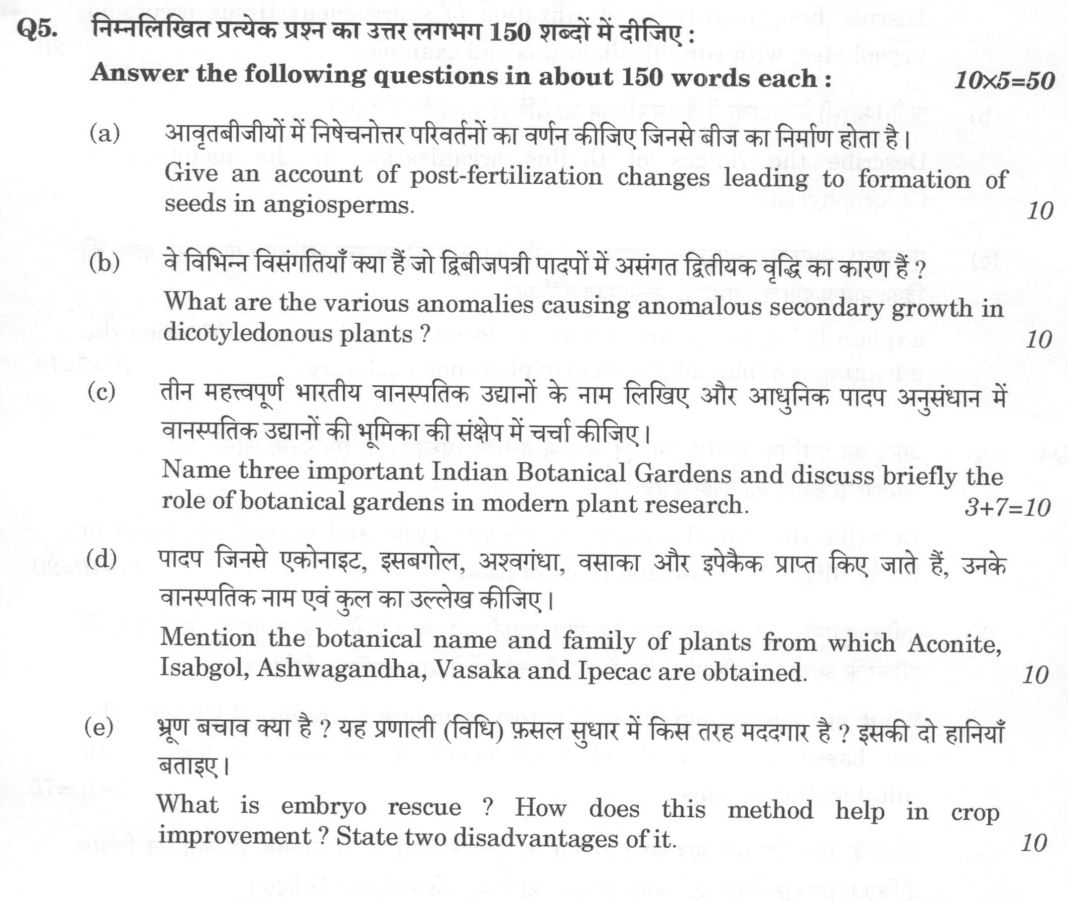
Answer the following questions in about 150 words each: (a) Give an account of post-fertilization changes leading to formation…
Answer the following questions in about 150 words each:
Give an account of post-fertilization changes leading to formation of seeds in angiosperms. 10 marks
What are the various anomalies causing anomalous secondary growth in dicotyledonous plants ? 10 marks
Name three important Indian Botanical Gardens and discuss briefly the role of botanical gardens in modern plant research. 3+7=10
Mention the botanical name and family of plants from which Aconite, Isabgol, Ashwagandha, Vasaka and Ipecac are obtained. 10 marks
What is embryo rescue ? How does this method help in crop improvement ? State two disadvantages of it. 10 marks
हिंदी में प्रश्न पढ़ें
निम्नलिखित प्रत्येक प्रश्न का उत्तर लगभग 150 शब्दों में दीजिए :
आवृतबीजियों में निषेचनोत्तर परिवर्तनों का वर्णन कीजिए जिनसे बीज का निर्माण होता है। 10
वे विभिन्न विसंगतियाँ क्या हैं जो द्विबीजपत्री पादपों में असंगत द्वितीयक वृद्धि का कारण हैं ? 10 marks
तीन महत्त्वपूर्ण भारतीय वानस्पतिक उद्यानों के नाम लिखिए और आधुनिक पादप अनुसंधान में वानस्पतिक उद्यानों की भूमिका की संक्षेप में चर्चा कीजिए। 3+7=10
पादप जिनसे एकोनाइट, इसबगोल, अश्वगंधा, वसाका और इपेकैक प्राप्त किए जाते हैं, उनके वानस्पतिक नाम एवं कुल का उल्लेख कीजिए। 10
भ्रूण बचाव क्या है ? यह प्रणाली (विधि) फसल सुधार में किस तरह मददगार है ? इसकी दो हानियाँ बताइए। 10
Model answer
Written by UPSC Answer Check against this question's marking rubric, to the 150-word length. UPSC does not publish answers for Mains — this is one way to score well, not an official key.
(a) Post-Fertilization Changes in Angiosperms Post-fertilization events in angiosperms are a coordinated sequence leading to seed formation. Following double fertilization, the zygote develops into the embryo, while the secondary nucleus forms the endosperm. Endosperm development varies: in nuclear type (e.g., Zea), free nuclei divide without walls; in cellular type (e.g., Triticum), walls form immediately; and in helobial type (e.g., Lilium), an initial transverse wall creates a suspensor and a free-nuclear region. The embryo develops from the proembryo stage through globular, heart, torpedo, and mature stages, establishing the apical meristem, cotyledons, and radicle. Simultaneously, the integuments differentiate into the seed coat (testa), providing protection. The ovary wall matures into the fruit pericarp. These changes transform the ovule into a dispersal unit, ensuring the survival and propagation of the next generation.
(b) Anomalous Secondary Growth in Dicots Anomalous secondary growth occurs when vascular cambium activity deviates from the standard pattern of concentric rings. In included phloem, as seen in Piperaceae and Cucurbitaceae, the cambium produces phloem internally, trapping it within the xylem. In medullary vascular bundles, found in Piper and Amaranthus, vascular bundles originate in the pith, creating a ring of secondary xylem and phloem within the central pith. Successive cambia are characteristic of Bignonia and Chenopodium, where new cambial rings form inside the primary xylem. Each new cambium produces centripetal xylem (inward) and centrifugal phloem (outward), resulting in multiple concentric rings of xylem and phloem. In anomalous position of cambium, as in Bougainvillea, the cambium is located in the pith rather than the vascular cambium. Finally, abnormal activity of normal cambium, seen in Tecoma, involves irregular radial splitting of xylem elements, creating a star-like pattern. These anomalies complicate wood structure but are key diagnostic features for identification.
(c) Indian Botanical Gardens and Their Role Three prominent Indian botanical gardens are the Indian Botanical Garden (IBG) in Howrah, the Lloyd Botanical Garden in Darjeeling, and the National Botanical Research Institute (NBRI) in Lucknow. These institutions play a pivotal role in modern plant research. Firstly, they serve as critical ex-situ conservation hubs, maintaining living collections of endangered and threatened species. Secondly, they act as germplasm repositories, preserving genetic diversity for future breeding programs. Thirdly, they facilitate taxonomic research by housing herbaria with type specimens, aiding in the classification and nomenclature of Indian flora. Fourthly, they support bioprospecting for medicinal and industrial compounds, linking traditional knowledge with modern pharmacology. Lastly, they engage in public education, raising awareness about biodiversity and environmental sustainability. These gardens are thus indispensable for balancing conservation, research, and societal engagement in plant sciences.
(d) Botanical Names and Families of Medicinal Plants The following table lists the botanical names and families of the specified medicinal plants:
| Common Name | Botanical Name | Family | | :--- | :--- | :--- | | Aconite | Aconitum napellus | Ranunculaceae | | Isabgol | Plantago ovata | Plantaginaceae | | Ashwagandha | Withania somnifera | Solanaceae | | Vasaka | Justicia adhatoda | Acanthaceae | | Ipecac | Cephaelis ipecacuanha | Rubiaceae |
These plants are significant in Indian traditional medicine and modern pharmacology. Aconitum is used for rheumatism, Plantago for digestive health, Withania as an adaptogen, Justicia for respiratory ailments, and Cephaelis as an emetic. Accurate identification is crucial for safe and effective use.
(e) Embryo Rescue and Crop Improvement Embryo rescue is a tissue culture technique where immature embryos are excised from developing fruits and cultured in vitro to prevent abortion. This method is vital in crop improvement, particularly for wide hybridization between distantly related species. It overcomes incompatibility barriers that cause embryo abortion in interspecific or intergeneric crosses, enabling the creation of novel hybrids with desirable traits like disease resistance or stress tolerance. It also helps in shortening breeding cycles by allowing the recovery of seeds that would otherwise be lost. However, it has two main disadvantages. First, success is often genotype-dependent, meaning it may fail for certain genetic backgrounds. Second, it requires significant technical expertise and infrastructure, making it costly and less accessible. Additionally, there is a risk of somaclonal variation, which can introduce unwanted genetic changes. Despite these challenges, embryo rescue remains a powerful tool in plant breeding.
What "Describe" is asking you to do
Give a full, ordered account of the thing named — its parts, stages or mechanism — in the sequence in which it actually exists or occurs. Most describe questions come from the science optionals, where the marks sit in correct technical detail and, where the stem says so, a labelled diagram.
Structure that answers it
One-line identification of the subject → the parts or stages in their real order, each with its defining detail → labelled diagram where the subject is structural → closing line on function or significance
Where marks are lost
Loose general prose where the examiner is ticking named parts, correct terminology and their sequence; and in the General Studies papers, turning to evaluation before the description is finished.
How this answer will be evaluated
Approach
Framework: UPSC Botany Paper 1. (a) account for: state the phenomenon > the causes in order of weight > conclusion | (b) highlight: name the salient points > one line of substance each > close | (c) discuss: intro > 3-4 dimensions > example > balanced close | (d) enumerate: list the items in order > one line each > no commentary | (e) explain: definition/context > points in order > small example > short close Full marks: Precise, stepwise, with labelled diagrams and specific examples.
Key points expected
- Double fertilization (syngamy and triple fusion)
- Endosperm development (haplodiploidy)
- Embryo development (globular to mature)
- Carpel to seed and ovary to fruit
- Intrafascicular and interfascicular cambium
- Fascicular and extrafascicular cambium
- Pericycle cambium (e.g., Datura)
- Medullary rays and anomalous bundles
Evaluation rubric
Each sub-part is marked on its own, against the marks and word limit printed on the paper.
- (a) Sequence of post-fertilization events leading to seed formation. 10 marks · 150 words
account for— state the phenomenon → the causes in order of weight → conclusion
Must cover
- Double fertilization (syngamy and triple fusion)
- Endosperm development (haplodiploidy)
- Embryo development (globular to mature)
- Carpel to seed and ovary to fruit
Loses marks
- Confusing fertilization with pollination
- Omitting endosperm development
- Unlabelled diagrams
Earns more
- Labelled diagram of embryo sac changes
- Distinction between mono and dicot endosperm
- Mention of seed dormancy
Extra mark
- Reference to specific angiosperm example
- (b) List and explain anomalies in dicot secondary growth. 10 marks · 150 words
highlight— name the salient points → one line of substance each → close
Must cover
- Intrafascicular and interfascicular cambium
- Fascicular and extrafascicular cambium
- Pericycle cambium (e.g., Datura)
- Medullary rays and anomalous bundles
Loses marks
- Confusing primary and secondary growth
- Omitting pericycle cambium
- Unlabelled diagrams
Earns more
- Diagram of anomalous secondary growth
- Specific examples (Dioscorea, Datura)
- Comparison with normal secondary growth
Extra mark
- Mention of specific species with anomalous growth
- (c) Name three Indian Botanical Gardens and their research role. 10 marks · 150 words
discuss— intro → 3-4 dimensions → example → balanced close
Must cover
- Name three Indian Botanical Gardens
- Role in plant taxonomy and systematics
- Role in conservation and germplasm
- Role in biotechnology and molecular research
Loses marks
- Naming non-Indian gardens
- Vague description of research role
- Omitting conservation aspect
Earns more
- Mention of specific collections (e.g., herbarium)
- Reference to recent research projects
- Link to crop improvement
Extra mark
- Mention of specific garden director or project
- (d) Botanical name and family for five medicinal plants. 10 marks · 150 words
enumerate— list the items in order → one line each → no commentary
Must cover
- Aconite: Aconitum napellus, Ranunculaceae
- Isabgol: Plantago ovata, Plantaginaceae
- Ashwagandha: Withania somnifera, Solanaceae
- Vasaka: Adhatoda vasica, Acanthaceae
Loses marks
- Incorrect botanical names
- Wrong family assignments
- Non-italicized binomials
Earns more
- Ipecac: Cephaelis ipecacuanha, Rubiaceae
- Correct italicization of binomials
- Mention of active compounds
Extra mark
- Mention of specific medicinal use
- (e) Definition, application, and disadvantages of embryo rescue. 10 marks · 150 words
explain— definition/context → points in order → small example → short close
Must cover
- Definition of embryo rescue
- Application in wide hybridization
- Application in polyploid induction
- Two disadvantages (e.g., low success rate)
Loses marks
- Confusing embryo rescue with micropropagation
- Omitting disadvantages
- Vague description of application
Earns more
- Mention of specific crop example
- Link to biotechnology
- Explanation of tissue culture steps
Extra mark
- Reference to recent biotech application
Practice this exact question
Write your answer and it is marked point by point against the model answer above — what you covered, what you missed, what you got wrong.
Evaluate my answer →More from Botany 2025 Paper I
- Q2 (a) Enumerate the types of fruiting bodies of Ascomycota and Basidiomycota. Write the var…
- Q3 (a) Discuss how progressive sterilization of sporogenous tissue occurs in bryophytes, wit…
- Q4 (a) Describe the causal organisms, disease cycle and control measures of Early Blight of…
- Q5 Answer the following questions in about 150 words each: (a) Give an account of post-ferti…
- Q6 (a) What are the diagnostic characters of the families – Cucurbitaceae and Poaceae ? Writ…
- Q7 (a) Write the botanical name, family, morphology of useful parts and uses of the followin…
- Q8 (a) What is micropropagation and how does it differ from traditional plant propagation me…