Paper I — Q6
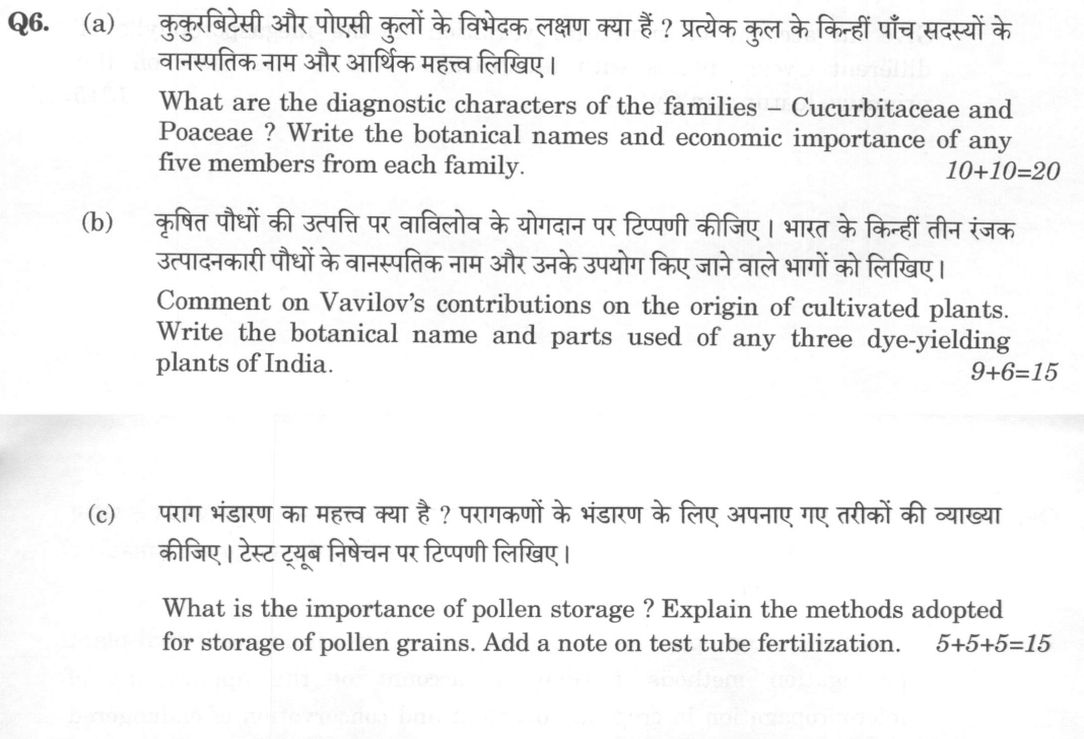
(a) What are the diagnostic characters of the families – Cucurbitaceae and Poaceae ? Write the botanical names and economic…
What are the diagnostic characters of the families – Cucurbitaceae and Poaceae ? Write the botanical names and economic importance of any five members from each family. 10+10=20
Comment on Vavilov's contributions on the origin of cultivated plants. Write the botanical name and parts used of any three dye-yielding plants of India. 9+6=15
What is the importance of pollen storage ? Explain the methods adopted for storage of pollen grains. Add a note on test tube fertilization. 5+5+5=15
हिंदी में प्रश्न पढ़ें
कुकुरबिटेसी और पोएसी कुलों के विभेदक लक्षण क्या हैं ? प्रत्येक कुल के किन्हीं पाँच सदस्यों के वानस्पतिक नाम और आर्थिक महत्त्व लिखिए। 10+10=20
कृषित पौधों की उत्पत्ति पर वाविलोव के योगदान पर टिप्पणी कीजिए। भारत के किन्हीं तीन रंजक उत्पादनकारी पौधों के वानस्पतिक नाम और उनके उपयोग किए जाने वाले भागों को लिखिए। 9+6=15
पराग भंडारण का महत्व क्या है ? परागकणों के भंडारण के लिए अपनाए गए तरीकों की व्याख्या कीजिए। टेस्ट ट्यूब निषेचन पर टिप्पणी लिखिए। 5+5+5=15
Model answer
Written by UPSC Answer Check against this question's marking rubric, to the expected length. UPSC does not publish answers for Mains — this is one way to score well, not an official key.
Diagnostic Characters and Economic Importance of Cucurbitaceae and Poaceae
The families Cucurbitaceae and Poaceae represent distinct morphological strategies in angiosperm evolution, differing significantly in floral architecture, fruit type, and ecological adaptation.
Cucurbitaceae is characterized by herbs or vines with tendrils, often bearing prickles. The leaves are alternate, simple, and cordate. Flowers are unisexual, usually monoecious, with a pentamerous perianth. A key diagnostic feature is the inferior ovary, which is tricarpellary and trilocular. The stamens are typically syngenesious, meaning the anthers are united into a cone while the filaments remain free or variously joined. The fruit is a pepo, a fleshy berry with a hard rind. Five economically important members include:
- Cucumis sativus (Cucumber): Fruits used as vegetables.
- Citrullus lanatus (Watermelon): Fruits for nutrition.
- Cucurbita pepo (Pumpkin): Fruits and seeds for food and oil.
- Luffa aegyptiaca (Sponge Gourd): Fruits for food; dried fibers for sponges.
- Momordica charantia (Bitter Gourd): Fruits used in cuisine and traditional medicine.
Poaceae (Gramineae) comprises mostly annual or perennial herbs with a hollow, jointed stem called a culm. Leaves are alternate, simple, with parallel venation; the sheath is typically open (split) and the ligule is a membranous or hairy outgrowth at the junction of the sheath and blade. The inflorescence is a spikelet, which is the basic floral unit. Flowers are small, bisexual or unisexual, with perianth reduced to lodicules. Stamens are 3 or 6, rarely fewer. The gynoecium consists of two carpels, superior, with a single style and feathery stigma. The fruit is a caryopsis, where the pericarp is fused with the seed coat. Five key members are:
- Oryza sativa (Rice): Cereal grain, staple food in India.
- Triticum aestivum (Wheat): Cereal grain for flour.
- Zea mays (Maize): Cereal grain for food and feed.
- Saccharum officinarum (Sugarcane): Stalks for sugar extraction.
- Cynodon dactylon (Bermuda Grass): Used for turf and fodder.
Vavilov’s Contributions and Dye-Yielding Plants
N.I. Vavilov’s seminal work established the concept of centers of origin for cultivated plants, identifying eight such centers globally. He emphasized the Indian Center (including the Himalayas and Deccan) as a primary source for crops like rice (Oryza sativa), cotton (Gossypium), and jute (Corchorus). His Law of Homologous Series posited that related species exhibit parallel variations in characters, aiding in the identification of wild progenitors. He also introduced the concept of differential phylogenetic species, highlighting that cultivated plants are not static species but dynamic lineages with distinct evolutionary trajectories. This framework underpins modern germplasm conservation efforts in India.
Three significant dye-yielding plants of India are:
- Indigofera tinctoria: Dye extracted from leaves (indigo).
- Crocus sativus: Dye extracted from stigma (saffron).
- Lawsonia inermis: Dye extracted from leaves (henna).
Pollen Storage and Test Tube Fertilization
Pollen storage is critical in plant breeding for maintaining genetic diversity, facilitating hybridization across geographic barriers, and conserving germplasm of rare or endangered species. It allows breeders to use pollen from distant or incompatible parents when fresh material is unavailable.
Methods for pollen storage include:
- Low-temperature storage: Pollen is desiccated to reduce moisture content (often to 5–10%) and stored at -18°C to -20°C. This is suitable for many temperate crops.
- Cryopreservation: Pollen is stored in liquid nitrogen at -196°C. This method preserves viability for extended periods and is essential for species with short pollen shelf-life.
- Viability testing: Stored pollen is regularly tested using staining methods (e.g., Alexander’s stain) or germination assays on artificial media to ensure quality before use.
Test tube fertilization is an in vitro technique used to overcome pre-zygotic barriers in interspecific or intergeneric crosses. It involves culturing the stigma and style on a nutrient medium to induce pollen germination and tube growth. The pollen tubes grow through the style in a controlled environment, bypassing natural incompatibility mechanisms. This technique has been successfully applied to produce hybrids in genera like Triticum and Hordeum, where conventional cross-pollination fails due to pollen rejection or poor tube growth. It is a vital tool for introgressing desirable traits from wild relatives into cultivated crops.
In summary, understanding the diagnostic traits of major families, leveraging Vavilov’s origins theory, and employing advanced techniques like pollen storage and test tube fertilization are essential for sustainable crop improvement and food security in India.
What "Describe" is asking you to do
Give a full, ordered account of the thing named — its parts, stages or mechanism — in the sequence in which it actually exists or occurs. Most describe questions come from the science optionals, where the marks sit in correct technical detail and, where the stem says so, a labelled diagram.
Structure that answers it
One-line identification of the subject → the parts or stages in their real order, each with its defining detail → labelled diagram where the subject is structural → closing line on function or significance
Where marks are lost
Loose general prose where the examiner is ticking named parts, correct terminology and their sequence; and in the General Studies papers, turning to evaluation before the description is finished.
How this answer will be evaluated
Approach
Framework: UPSC Botany Paper 1. (a) describe: define > structure or process in order > labelled diagram > significance | (b) comment: context > arguments both sides > judgment > close | (c) explain: definition/context > points in order > small example > short close Full marks: Comprehensive diagnostic characters, accurate botanical names, clear explanation of Vavilov's work, and detailed methods for pollen storage and fertilization.
Key points expected
- Diagnostic characters of Cucurbitaceae (e.g., coiled tendrils, unisexual flowers, parthenocarpy)
- Diagnostic characters of Poaceae (e.g., hollow nodes, ligule, spikelets, caryopsis)
- 5 botanical names from Cucurbitaceae with economic importance
- 5 botanical names from Poaceae with economic importance
- Vavilov's concept of centers of origin (8 centers)
- Vavilov's concept of crop wild relatives
- 3 botanical names of Indian dye-yielding plants
- Parts used for dye extraction for each of the 3 plants
Evaluation rubric
Each sub-part is marked on its own, against the marks and word limit printed on the paper.
- (a) Diagnostic characters of Cucurbitaceae and Poaceae; 5 members of each with botanical names and economic importance. 20 marks
describe— define → structure or process in order → labelled diagram → significance
Must cover
- Diagnostic characters of Cucurbitaceae (e.g., coiled tendrils, unisexual flowers, parthenocarpy)
- Diagnostic characters of Poaceae (e.g., hollow nodes, ligule, spikelets, caryopsis)
- 5 botanical names from Cucurbitaceae with economic importance
- 5 botanical names from Poaceae with economic importance
Loses marks
- Confusing diagnostic characters between the two families
- Using common names instead of botanical names
- Listing fewer than 5 members for either family
Earns more
- Specific examples like *Citrullus lanatus* or *Oryza sativa* with correct usage
- Mention of specific economic products (e.g., latex, starch, fodder)
Extra mark
- Mention of specific biotech applications in these families
- (b) Vavilov's contributions to origin of cultivated plants; 3 Indian dye-yielding plants with botanical names and parts used. 15 marks
comment— context → arguments both sides → judgment → close
Must cover
- Vavilov's concept of centers of origin (8 centers)
- Vavilov's concept of crop wild relatives
- 3 botanical names of Indian dye-yielding plants
- Parts used for dye extraction for each of the 3 plants
Loses marks
- Confusing Vavilov's centers with other origin theories
- Listing plants that are not primarily dye-yielding
- Omitting the specific parts used for dye extraction
Earns more
- Mention of specific centers (e.g., Mediterranean, Indo-Malayan)
- Specific examples like *Indigofera tinctoria* (leaves) or *Hibiscus cannabinus* (bark)
Extra mark
- Mention of modern conservation efforts based on Vavilov's work
- (c) Importance of pollen storage; methods for storage; note on test tube fertilization. 15 marks
explain— definition/context → points in order → small example → short close
Must cover
- Importance of pollen storage (e.g., for hybridization, conservation)
- Methods for pollen storage (e.g., desiccation, cryopreservation)
- Explanation of test tube fertilization (in vitro fertilization)
- Link between pollen storage and test tube fertilization
Loses marks
- Confusing pollen storage with seed storage
- Vague description of test tube fertilization
- Failing to link the methods to their importance
Earns more
- Specific storage conditions (e.g., temperature, humidity)
- Mention of specific crops where test tube fertilization is used
Extra mark
- Mention of specific biotech applications of test tube fertilization
Practice this exact question
Write your answer and it is marked point by point against the model answer above — what you covered, what you missed, what you got wrong.
Evaluate my answer →More from Botany 2025 Paper I
- Q3 (a) Discuss how progressive sterilization of sporogenous tissue occurs in bryophytes, wit…
- Q4 (a) Describe the causal organisms, disease cycle and control measures of Early Blight of…
- Q5 Answer the following questions in about 150 words each: (a) Give an account of post-ferti…
- Q6 (a) What are the diagnostic characters of the families – Cucurbitaceae and Poaceae ? Writ…
- Q7 (a) Write the botanical name, family, morphology of useful parts and uses of the followin…
- Q8 (a) What is micropropagation and how does it differ from traditional plant propagation me…