Paper I — Q7
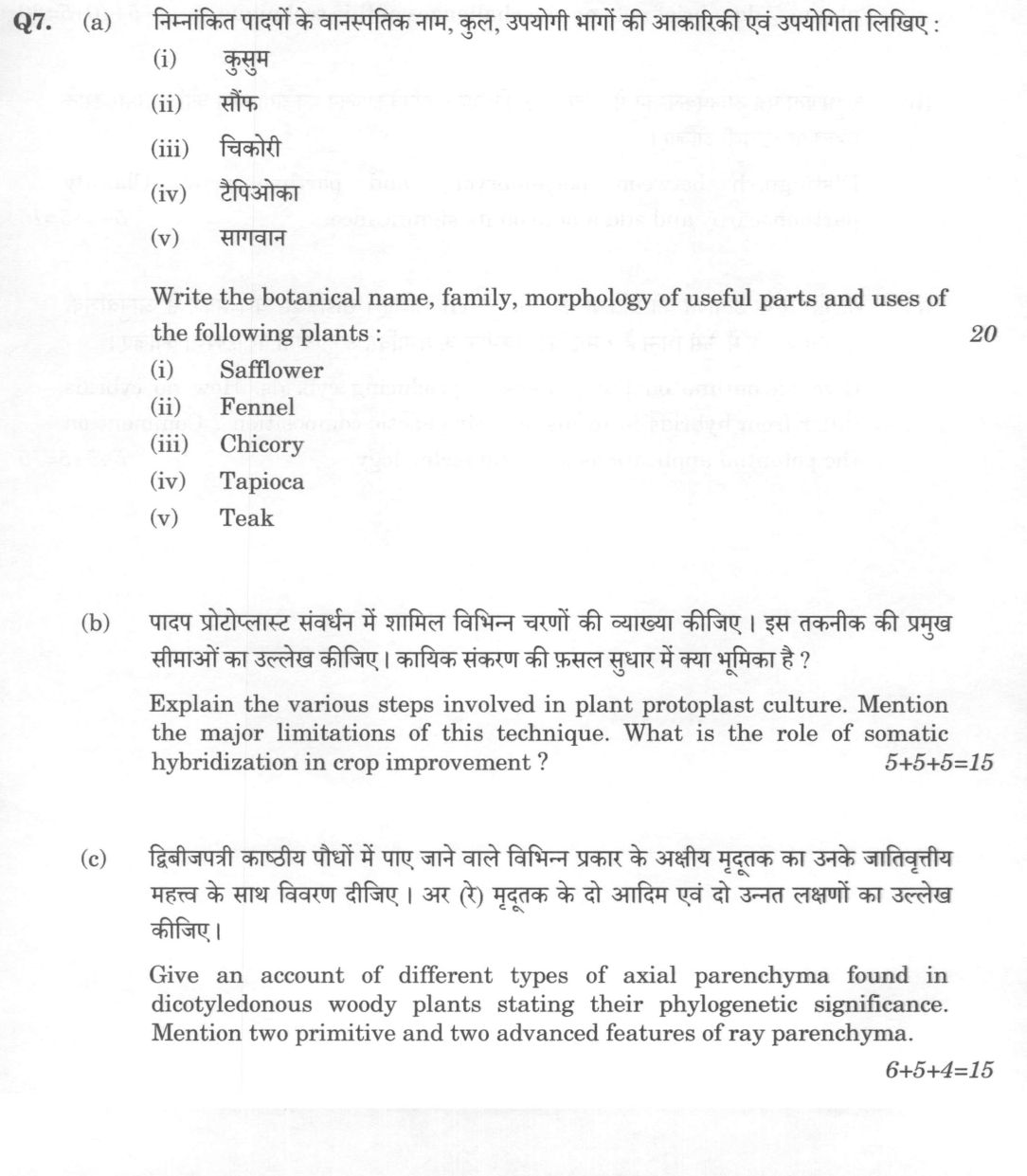
(a) Write the botanical name, family, morphology of useful parts and uses of the following plants: (i) Safflower (ii)…
Write the botanical name, family, morphology of useful parts and uses of the following plants:
Safflower
Fennel
Chicory
Tapioca
Teak 20
Explain the various steps involved in plant protoplast culture. Mention the major limitations of this technique. What is the role of somatic hybridization in crop improvement ? 5+5+5=15
Give an account of different types of axial parenchyma found in dicotyledonous woody plants stating their phylogenetic significance. Mention two primitive and two advanced features of ray parenchyma. 6+5+4=15
हिंदी में प्रश्न पढ़ें
निम्नांकित पादपों के वानस्पतिक नाम, कुल, उपयोगी भागों की आकृति एवं उपयोगिता लिखिए :
कुसुम
सौंफ
चिकोरी
टैपिओका
सागवान 20
पादप प्रोटोप्लास्ट संवर्धन में शामिल विभिन्न चरणों की व्याख्या कीजिए। इस तकनीक की प्रमुख सीमाओं का उल्लेख कीजिए। कायिक संकरण की फसल सुधार में क्या भूमिका है ? 5+5+5=15
द्विबीजपत्री काष्ठीय पौधों में पाए जाने वाले विभिन्न प्रकार के अक्षीय मृदुतक का उनके जातिवृत्तीय महत्व के साथ विवरण दीजिए। अर (रे) मृदुतक के दो आदिम एवं दो उन्नत लक्षणों का उल्लेख कीजिए। 6+5+4=15
Model answer
Written by UPSC Answer Check against this question's marking rubric, to the expected length. UPSC does not publish answers for Mains — this is one way to score well, not an official key.
Part (a): Botanical Profile of Five Plants
(i) Safflower
- Botanical Name: Carthamus tinctorius
- Family: Asteraceae (Compositae)
- Useful Parts & Morphology: The useful part is the flower head. It is a composite inflorescence consisting of numerous small, tubular florets, typically yellow or orange, arranged in a capitulum. The seeds are also used for oil.
- Uses: Primarily cultivated in Maharashtra and Rajasthan for seed oil, which is used in cooking and industrial applications. The petals are used for natural dyeing (red/orange) and as a saffron substitute in some culinary contexts.
(ii) Fennel
- Botanical Name: Foeniculum vulgare
- Family: Apiaceae (Umbelliferae)
- Useful Parts & Morphology: The useful part is the fruit (achene). The plant bears compound umbels of small white or yellow flowers. The fruits are elongated, ridged, and aromatic, containing volatile oils.
- Uses: The seeds are used as a spice and carminative in Indian cuisine. The leaves are used as a flavoring agent. It has medicinal properties for digestive aid.
(iii) Chicory
- Botanical Name: Cichorium intybus
- Family: Asteraceae (Compositae)
- Useful Parts & Morphology: The useful part is the root. The roots are thick, fleshy, and cylindrical, containing inulin (a polysaccharide). The leaves are lanceolate and form a basal rosette.
- Uses: Roasted and ground roots are used as a coffee substitute or extender. It is also used in the production of inulin for food industry and as a fodder crop.
(iv) Tapioca
- Botanical Name: Manihot esculenta
- Family: Euphorbiaceae
- Useful Parts & Morphology: The useful part is the tuberous root. The roots are cylindrical, fleshy, and covered with a thin, brownish skin. They are rich in starch.
- Uses: Widely cultivated in Kerala and Tamil Nadu. The starch is extracted for food (flour, vermicelli), industrial adhesives, and as a feed for livestock. It is a major source of carbohydrate in tropical diets.
(v) Teak
- Botanical Name: Tectona grandis
- Family: Lamiaceae (formerly Verbenaceae)
- Useful Parts & Morphology: The useful part is the wood (xylem). The tree is a large, deciduous hardwood. The wood is dense, durable, and contains silica, giving it a characteristic texture.
- Uses: Highly valued for furniture, shipbuilding, railway sleepers, and construction due to its resistance to decay and insects. Major production in Madhya Pradesh and Kerala.
Part (b): Protoplast Culture and Somatic Hybridization
Steps in Protoplast Culture:
- Isolation: Tissue is treated with enzymes (cellulase, pectinase, hemicellulase) to digest the cell wall, releasing protoplasts. Mechanical methods may assist.
- Purification: Protoplasts are separated from debris and cell wall fragments using density gradient centrifugation or filtration.
- Viability Testing: Protoplasts are stained with fluorescent dyes (e.g., fluorescein diacetate) to assess membrane integrity and viability.
- Culture Initiation: Viable protoplasts are plated on a semi-solid medium containing nutrients, hormones, and osmotic stabilizers (like mannitol) to prevent lysis.
- Cell Wall Regeneration: Protoplasts synthesize a new cell wall, becoming protoplast-derived cells.
- Callus Formation: Cells divide to form an undifferentiated mass of callus.
- Regeneration: Under specific hormonal conditions, callus differentiates into shoots and roots (organogenesis) or embryos (embryogenesis), leading to whole plantlets.
Limitations:
- Genetic Instability: Somaclonal variation can lead to undesirable traits.
- Recalcitrance: Many plant species, especially monocots, are difficult to regenerate from protoplasts.
- Technical Complexity: Requires sterile conditions, specialized enzymes, and precise media formulation.
- Low Efficiency: The process is slow and often yields few viable plants.
Role of Somatic Hybridization: Somatic hybridization involves the fusion of protoplasts from different species or varieties. Its role in crop improvement includes:
- Overcoming Sexual Incompatibility: It allows the combination of genomes from sexually incompatible species.
- Cytoplasmic Transfer: It enables the transfer of cytoplasmic traits (like male sterility or disease resistance) without nuclear genome mixing, creating cybrids.
- Novel Combinations: It creates new nuclear-cytoplasmic combinations that may exhibit heterosis or novel traits not achievable through conventional breeding.
Part (c): Axial Parenchyma and Ray Parenchyma
Types of Axial Parenchyma: Axial parenchyma is classified based on its position relative to vessels.
- Apotracheal: Not associated with vessels.
- Diffuse: Scattered evenly in the wood.
- Diffuse-in-aggregates: Grouped in clusters.
- Banded: Arranged in tangential bands.
- Paratracheal: Associated with vessels.
- Scanty: Few cells around vessels.
- Vasicentric: Forms a complete ring around vessels.
- Aliform: Wing-shaped extensions from vessels.
- Confluent: Aliform parenchyma merges to form a continuous network.
- Lozenge-aliform: Aliform cells form a diamond shape.
- Winged-aliform: Aliform cells extend laterally.
- Banded: Paratracheal cells form tangential bands.
Phylogenetic Significance: The trend from diffuse (apotracheal) to paratracheal types indicates increasing specialization and efficiency in storage and transport. Diffuse parenchyma is considered primitive, while complex paratracheal arrangements (like confluent) are advanced, reflecting evolutionary adaptation to varying environmental stresses and growth rates.
Ray Parenchyma Features:
- Primitive Features:
- Heterocellular Composition: Rays contain a mix of upright and procumbent cells, typical of basal angiosperms.
- Multiseriate/Broad Rays: Rays are often wide (multiseriate), providing more storage space, seen in primitive dicots.
- Advanced Features:
- Homocellular Composition: Rays consist mainly of procumbent cells, indicating specialization for radial transport.
- Storied Arrangement: Rays are aligned in horizontal rows (stories), a feature of advanced angiosperms and gymnosperms, indicating coordinated growth.
Conclusion: Understanding plant morphology, biotechnology, and wood anatomy is crucial for crop improvement and resource management. Protoplast culture and somatic hybridization offer tools for overcoming breeding barriers, while wood anatomy provides insights into evolutionary history and timber quality.
What "Describe" is asking you to do
Give a full, ordered account of the thing named — its parts, stages or mechanism — in the sequence in which it actually exists or occurs. Most describe questions come from the science optionals, where the marks sit in correct technical detail and, where the stem says so, a labelled diagram.
Structure that answers it
One-line identification of the subject → the parts or stages in their real order, each with its defining detail → labelled diagram where the subject is structural → closing line on function or significance
Where marks are lost
Loose general prose where the examiner is ticking named parts, correct terminology and their sequence; and in the General Studies papers, turning to evaluation before the description is finished.
How this answer will be evaluated
Approach
(a) explain: definition/context > points in order > small example > short close | (b) explain: definition/context > points in order > small example > short close | (c) discuss: intro > 3-4 dimensions > example > balanced close Full marks: Precise botanical names, clear stepwise processes, accurate anatomical descriptions with diagrams.
Key points expected
- Carthamus tinctorius (Safflower)
- Foeniculum vulgare (Fennel)
- Cichorium intybus (Chicory)
- Manihot esculenta (Tapioca)
- Tectona grandis (Teak)
- Enzymatic isolation of protoplasts
- Somatic hybridization for cytoplasmic male sterility
- Vessel-associated parenchyma
- Phylogenetic significance of wood anatomy
Evaluation rubric
Each sub-part is marked on its own, against the marks and word limit printed on the paper.
- (a) Tabulate botanical name, family, morphology, and uses for five specific plants. 20 marks
explain— definition/context → points in order → small example → short close
Must cover
- Correct binomial for all five plants
- Correct family for each plant
- Morphology of the specific useful part
- Practical uses of the plant
Loses marks
- Missing botanical names
- Vague morphology descriptions
Earns more
- Italicized binomial names
- Specific part morphology (e.g., achenes, corms)
Extra mark
- Mention of specific cultivars
- Biotech application for one plant
- (b) Stepwise process of protoplast culture, its limitations, and somatic hybridization role. 15 marks
explain— definition/context → points in order → small example → short close
Must cover
- Enzymatic isolation of protoplasts
- Regeneration of cell wall
- Major limitations of the technique
- Role of somatic hybridization in crops
Loses marks
- Skipping regeneration steps
- Vague limitations without specifics
Earns more
- Labelled diagram of protoplast fusion
- Specific crop example (e.g., cytoplasmic male sterility)
Extra mark
- Recent biotech application
- Specific enzyme names (pectinase, cellulase)
- (c) Types of axial parenchyma, phylogenetic significance, and ray parenchyma features. 15 marks
discuss— intro → 3-4 dimensions → example → balanced close
Must cover
- Types of axial parenchyma (vessel-associated, etc.)
- Phylogenetic significance of these types
- Two primitive features of ray parenchyma
- Two advanced features of ray parenchyma
Loses marks
- Missing phylogenetic significance
- Confusing axial and ray parenchyma
Earns more
- Labelled diagram of wood anatomy
- Specific examples of primitive/advanced features
Extra mark
- Comparison of primitive vs advanced
- Specific species examples
Practice this exact question
Write your answer and it is marked point by point against the model answer above — what you covered, what you missed, what you got wrong.
Evaluate my answer →More from Botany 2025 Paper I
- Q4 (a) Describe the causal organisms, disease cycle and control measures of Early Blight of…
- Q5 Answer the following questions in about 150 words each: (a) Give an account of post-ferti…
- Q6 (a) What are the diagnostic characters of the families – Cucurbitaceae and Poaceae ? Writ…
- Q7 (a) Write the botanical name, family, morphology of useful parts and uses of the followin…
- Q8 (a) What is micropropagation and how does it differ from traditional plant propagation me…