Paper I — Q2
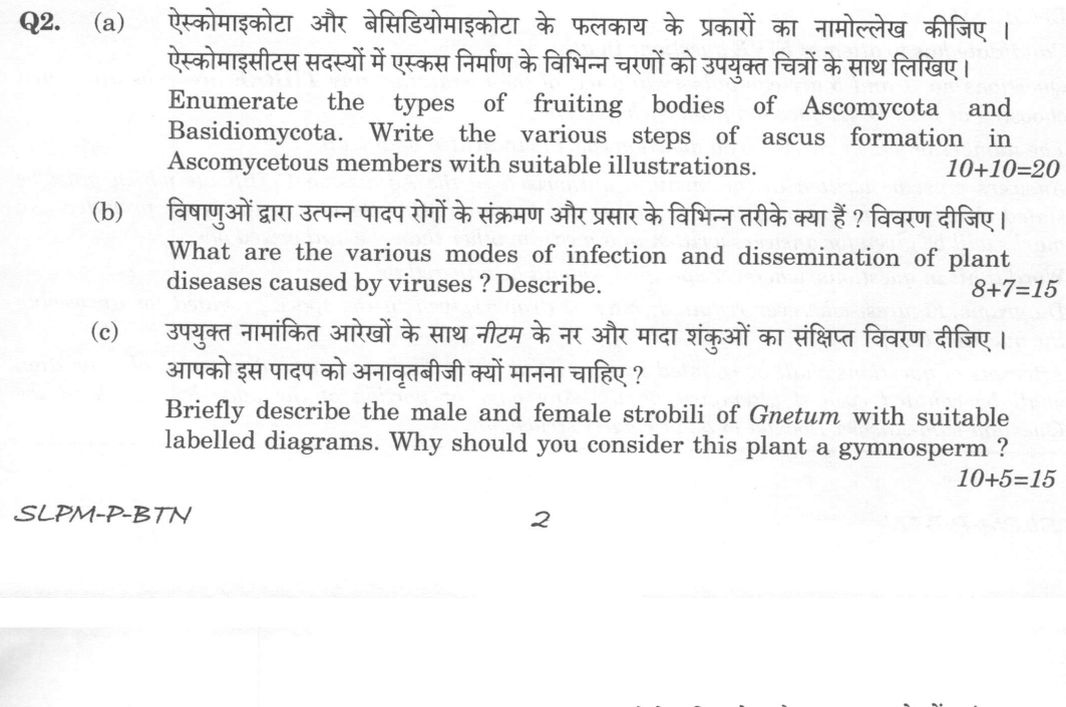
(a) Enumerate the types of fruiting bodies of Ascomycota and Basidiomycota. Write the various steps of ascus formation in…
Enumerate the types of fruiting bodies of Ascomycota and Basidiomycota. Write the various steps of ascus formation in Ascomycetous members with suitable illustrations. 10+10=20
What are the various modes of infection and dissemination of plant diseases caused by viruses ? Describe. 8+7=15
Briefly describe the male and female strobili of Gnetum with suitable labelled diagrams. Why should you consider this plant a gymnosperm ? 10+5=15
हिंदी में प्रश्न पढ़ें
ऐस्कोमाइकोटा और बेसिडियोमाइकोटा के फलकाय के प्रकारों का नामोल्लेख कीजिए । ऐस्कोमाइसीटीस सदस्यों में एक्स निर्माण के विभिन्न चरणों को उपयुक्त चित्रों के साथ लिखिए । 10+10=20
विषाणुओं द्वारा उत्पन्न पादप रोगों के संक्रमण और प्रसार के विभिन्न तरीके क्या हैं ? विवरण दीजिए । 8+7=15
उपयुक्त नामांकित आरेखों के साथ नीटम के नर और मादा शंकुओं का संक्षिप्त विवरण दीजिए । आपको इस पादप को अनावृतबीजी क्यों मानना चाहिए ? 10+5=15
Model answer
Written by UPSC Answer Check against this question's marking rubric, to the expected length. UPSC does not publish answers for Mains — this is one way to score well, not an official key.
Fruiting Bodies and Ascus Formation
Ascomycota produce sexual fruiting bodies known as ascocarps, which are categorized into three main types based on their morphology and spore release mechanism. The Apothecium is a cup-shaped, open structure where asci are exposed on the hymenium, facilitating passive spore dispersal; examples include Peziza and Neurospora. The Perithecium is a flask-shaped, closed structure with a narrow opening called an ostiole, protecting the asci; Penicillium and Aspergillus (in some sexual stages) exhibit this form. The Cleistothecium is a completely closed, spherical sac that ruptures to release spores, as seen in Erysiphe (powdery mildews).
Basidiomycota produce basidiocarps, primarily classified by their shape and spore-bearing surface. The Agaric (mushroom) features a pileus and stipe with gills, e.g., Agaricus bisporus. Polypores (bracket fungi) are woody, shelf-like structures with pores on the underside, e.g., Polyporus. Puffballs (Lycoperdon) are spherical and closed, releasing spores like dust. Clavarioid forms are club-shaped, e.g., Clavaria. Phalloid forms, such as stinkhorns (Phallus), have a distinctive stalk and cap, often with foul odors to attract vectors.
Ascus Formation Ascus development in Ascomycetes is a highly regulated process. It begins with the differentiation of ascogenous hyphae, where a hook or crozier forms at the tip. This hook bends back, and the nucleus divides mitotically. One nucleus migrates to the tip, while the other remains in the foot cell. The tip cell undergoes karyogamy (fusion of two haploid nuclei) to form a diploid nucleus. This is followed by meiosis I, producing two haploid nuclei, and meiosis II, resulting in four haploid nuclei. A subsequent mitotic division yields eight haploid nuclei. These nuclei become delimitated by cell walls to form eight ascospores within the ascus. The ascus wall may be vegetative (thin) or thick-walled, and in some species, the ascospores are forcibly discharged.
Viral Infection and Dissemination
Plant viruses infect hosts through specific entry points and disseminate via various vectors. Mechanical inoculation occurs when plant sap containing virions is transferred to wounds caused by pruning, harvesting, or natural abrasions. Grafting transmits viruses through vascular connections, particularly in perennial crops like citrus and grapes. Seed transmission is rare but significant in legumes (e.g., Bean Common Mosaic Virus) and cereals. Pollen transmission allows viruses to move from male to female flowers during pollination. Dodder (Cuscuta) acts as a parasitic vector, connecting to host plants and transmitting viruses through its haustoria.
Dissemination is heavily reliant on insect vectors. Aphids transmit viruses in non-persistent (short duration, e.g., Tobacco Mosaic Virus), semi-persistent, or persistent (long duration, e.g., Beet Yellows Virus) styles. Leafhoppers and whiteflies are key vectors for many rice and vegetable viruses. Nematodes (e.g., Xiphinema) transmit viruses like Beet Necrotic Yellow Vein Virus through soil. Fungal vectors such as Olpidium and Polymyxa transmit viruses in sedges and other monocots. Human agency also contributes to dissemination through the movement of infected planting material, seeds, and tools across regions. In India, the Tungro virus of rice is disseminated by the green rice leafhopper (Nephotettix spp.), causing significant yield losses in paddy fields.
Gnetum Strobili and Gymnosperm Status
Male Strobilus The male strobilus of Gnetum is a compact, strobiloid structure. It consists of a central axis bearing decussate bracts. Each bract bears a microsporangiophore on its inner surface. A single whorl of 3–6 microsporangiophores is present per collar. Each microsporangiophore bears 2–3 microsporangia on its inner surface. The microsporangia produce microspores that develop into male gametophytes with prothallial cells, which eventually produce two sperm cells.
Female Strobilus The female strobilus is larger and more complex. It is a compound structure with an outer envelope formed by bracts. Inside, there are nucelli (ovules) arranged in whorls. Each nucellus is surrounded by an integument and possesses a micropylar tube for pollen entry. The ovules are naked, lacking an ovary wall.
Gymnosperm Justification Gnetum is classified as a gymnosperm primarily because its ovules are naked, not enclosed within an ovary. Although it exhibits double fertilization (the second male gamete fuses with the ventral canal nucleus), it does not form triploid endosperm via triple fusion; instead, it produces a free-nuclear endosperm. The presence of archegonia (though reduced) and the retention of tracheids with bordered pits alongside vessels in its xylem further support its gymnosperm status, distinguishing it from angiosperms which lack archegonia and have true flowers and fruits.
What "Enumerate" is asking you to do
Produce the complete set of items asked for, countable and correctly named. The examiner marks against a checklist, so a missing item costs and an elaborated one gains nothing — where discussion is wanted the stem asks for it as a separate sub-part.
Structure that answers it
One line naming the basis on which the set is drawn → items numbered, each in a phrase or a single line → the discussion sub-part taken up separately, after the list is complete
Where marks are lost
Treating it as an essay. Six items named in six lines score better than three items explained at length.
How this answer will be evaluated
Approach
Framework: UPSC Botany Paper 1 (SLPM-P-BTN). (a) enumerate: list the items in order > one line each > no commentary | (b) describe: define > structure or process in order > labelled diagram > significance | (c) describe: define > structure or process in order > labelled diagram > significance Full marks: Comprehensive, accurate, well-illustrated, with specific examples and clear reasoning.
Key points expected
- List Ascomycota fruiting bodies (e.g., apothecium, perithecium, cleistothecium)
- List Basidiomycota fruiting bodies (e.g., basidiocarp, gasteromycete)
- Stepwise ascus formation: karyogamy, meiosis, mitosis, ascospore formation
- Suitable illustrations of ascus development stages
- Modes of infection: mechanical, vector-borne, seed-borne
- Dissemination: vectors (aphids, leafhoppers), grafting, pollen
- Mechanism of virus movement within plant (phloem)
- Examples of specific viral diseases (e.g., Mosaic virus)
Evaluation rubric
Each sub-part is marked on its own, against the marks and word limit printed on the paper.
- (a) List fruiting bodies of Ascomycota/Basidiomycota and describe ascus formation steps. 20 marks
enumerate— list the items in order → one line each → no commentary
Must cover
- List Ascomycota fruiting bodies (e.g., apothecium, perithecium, cleistothecium)
- List Basidiomycota fruiting bodies (e.g., basidiocarp, gasteromycete)
- Stepwise ascus formation: karyogamy, meiosis, mitosis, ascospore formation
- Suitable illustrations of ascus development stages
Loses marks
- Unlabelled diagrams of fruiting bodies
- Confusing ascus with basidium structure
Earns more
- Mention specific examples like *Neurospora* or *Aspergillus*
- Differentiate between open and closed fruiting bodies
Extra mark
- Mention specific biotech application of Ascomycetes
- Detailed diagram of karyogamy and meiosis
- (b) Explain modes of infection and dissemination of plant viral diseases. 15 marks
describe— define → structure or process in order → labelled diagram → significance
Must cover
- Modes of infection: mechanical, vector-borne, seed-borne
- Dissemination: vectors (aphids, leafhoppers), grafting, pollen
- Mechanism of virus movement within plant (phloem)
- Examples of specific viral diseases (e.g., Mosaic virus)
Loses marks
- Confusing bacterial with viral transmission
- Vague description of vector role
Earns more
- Mention specific vectors like *Myzus persicae*
- Describe latent period and systemic infection
Extra mark
- Mention recent biotech application in virus resistance
- Diagram of vector transmission cycle
- (c) Describe male/female strobili of *Gnetum* and justify its gymnosperm status. 15 marks
describe— define → structure or process in order → labelled diagram → significance
Must cover
- Structure of male strobili (microsporangia, pollen sacs)
- Structure of female strobili (ovules, integuments)
- Labelled diagrams of both strobili
- Reasons for gymnosperm classification (naked seeds, no fruit)
Loses marks
- Unlabelled diagrams of strobili
- Confusing gymnosperm with angiosperm features
Earns more
- Mention specific features like ovule structure
- Compare with angiosperm flowers
Extra mark
- Mention specific *Gnetum* species
- Detailed diagram of ovule development
Practice this exact question
Write your answer and it is marked point by point against the model answer above — what you covered, what you missed, what you got wrong.
Evaluate my answer →More from Botany 2025 Paper I
- Q1 Answer the following questions in about 150 words each: (a) How many types of gametophyte…
- Q2 (a) Enumerate the types of fruiting bodies of Ascomycota and Basidiomycota. Write the var…
- Q3 (a) Discuss how progressive sterilization of sporogenous tissue occurs in bryophytes, wit…
- Q4 (a) Describe the causal organisms, disease cycle and control measures of Early Blight of…
- Q5 Answer the following questions in about 150 words each: (a) Give an account of post-ferti…