Paper I — Q3
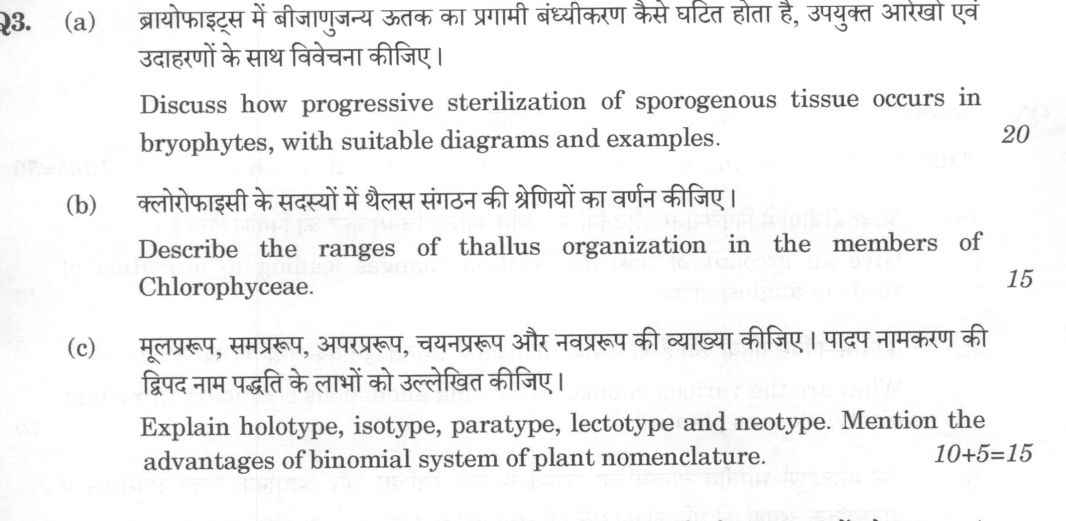
(a) Discuss how progressive sterilization of sporogenous tissue occurs in bryophytes, with suitable diagrams and examples…
Discuss how progressive sterilization of sporogenous tissue occurs in bryophytes, with suitable diagrams and examples. 20 marks
Describe the ranges of thallus organization in the members of Chlorophyceae. 15 marks
Explain holotype, isotype, paratype, lectotype and neotype. Mention the advantages of binomial system of plant nomenclature. 10+5=15
हिंदी में प्रश्न पढ़ें
ब्रायोफाइट्स में बीजाणुजन्य उत्तक का प्रगामी बंध्यीकरण कैसे घटित होता है, उपयुक्त आरेखों एवं उदाहरणों के साथ विवेचना कीजिए। 20
क्लोरोफाइसी के सदस्यों में थैलस संगठन की श्रेणियों का वर्णन कीजिए। 15
मूलप्ररूप, समप्ररूप, अपरप्ररूप, चयनप्ररूप और नवप्ररूप की व्याख्या कीजिए। पादप नामकरण की द्विपद नाम पद्धति के लाभों को उल्लेखित कीजिए। 10+5=15
Model answer
Written by UPSC Answer Check against this question's marking rubric, to the expected length. UPSC does not publish answers for Mains — this is one way to score well, not an official key.
Progressive Sterilization in Bryophytes
Bryophytes represent the critical evolutionary transition from aquatic algae to terrestrial vascular plants. A defining feature of this transition is the progressive sterilization of sporogenous tissue, where fertile cells become increasingly embedded within sterile jacket layers. This trend, observed from liverworts to mosses, enhances sporophyte independence and protects spores from desiccation.
In liverworts like Riccia and Marchantia, the sporophyte is highly dependent on the gametophyte. The capsule contains a central columella surrounded by sporogenous tissue. Here, sterilization is minimal; the sporogenous cells are largely exposed or protected only by a thin, non-differentiated wall. The sporophyte lacks true vascular tissue and relies entirely on the gametophyte for nutrition.
In hornworts (e.g., Notothylas), the sporophyte is a persistent, horn-like structure. While still dependent, the sporogenous tissue is more organized. The capsule wall begins to show differentiation, with an outer protective layer and an inner nutritive layer, though distinct amphithecium and endothecium are not yet fully developed.
In mosses, the trend culminates in advanced sterilization. In Funaria, the sporogenous tissue is completely surrounded by a thick, multi-layered wall. The outer layer, the amphithecium, is sterile and protective, while the inner layer, the endothecium, is nutritive. In Polytrichum, this is further refined; the sporogenous tissue is deeply embedded, and the capsule wall is highly differentiated with distinct epidermal, mesocarp, and endocarp layers. This extensive sterilization allows the sporophyte to retain moisture and protect spores during maturation, a crucial adaptation for terrestrial life.
Thallus Organization in Chlorophyceae
Chlorophyceae exhibit a wide spectrum of thallus organization, reflecting diverse ecological adaptations. The simplest form is unicellular, as seen in Chlamydomonas, where a single cell performs all functions. Colonial forms, such as Volvox and Pandorina, involve groups of cells enclosed in a gelatinous matrix, showing early cellular division of labor. Filamentous structures, like Spirogyra and Oedogonium, consist of unbranched chains of cells, facilitating efficient nutrient exchange in aquatic environments.
Beyond these, Chlorophyceae display palmelloid forms, such as Tetraspora, where cells aggregate into irregular, gelatinous masses, often aiding in survival during adverse conditions. Dendroid forms, characterized by branched, tree-like structures, are also present in certain genera, increasing surface area for photosynthesis. Finally, parenchymatous thalli, as in Ulva, consist of compact, sheet-like layers of cells, allowing for more complex structural integrity and adaptation to intertidal zones. This range from unicellular to parenchymatous demonstrates the morphological plasticity of green algae.
Type Specimens and Binomial Nomenclature
Under the International Code of Nomenclature for algae, fungi, and plants (ICN), type specimens serve as the nomenclatural reference for a name. A holotype is the single physical specimen designated by the author as the type. An isotype is a duplicate of the holotype, usually deposited in another herbarium. Paratypes are additional specimens cited in the original description but not designated as types. If no holotype was designated, a lectotype is selected from the original syntypes to serve as the single type. A neotype is designated when all original specimens are lost or destroyed, providing a new reference point.
The binomial system of nomenclature offers significant advantages. It ensures universal application, providing a single, standardized name for each species regardless of language. It promotes stability through the principle of priority, where the earliest validly published name takes precedence. This system avoids the confusion of long polynomial names and facilitates efficient information retrieval in biodiversity databases and taxonomic studies. By linking a name to a specific type specimen, it anchors taxonomic identity, ensuring that scientific communication remains precise and globally consistent.
In conclusion, the progressive sterilization in bryophytes illustrates the evolutionary pressure for sporophyte protection, while the diverse thallus forms in Chlorophyceae highlight morphological adaptation. Together with the rigorous framework of type specimens and binomial nomenclature, these concepts underpin the stability and clarity of plant taxonomy.
What "Discuss" is asking you to do
Lay the issue out from more than one side — how it arose, what is claimed for it, what is held against it, and where it now stands. UPSC attaches discuss to broad topics with several live dimensions, so coverage of the dimensions earns more than the strength of your opinion.
Structure that answers it
Set the issue up → the case as it is made → the case against → the dimension both sides leave out → where the balance now lies
Where marks are lost
Listing facts with no thread between them, or arguing one side throughout and calling it a discussion.
How this answer will be evaluated
Approach
Framework: UPSC Botany Paper 1. (a) discuss: intro > 3-4 dimensions > example > balanced close | (b) describe: define > structure or process in order > labelled diagram > significance | (c) explain: definition/context > points in order > small example > short close Full marks: Comprehensive, accurate, and well-structured answers with clear diagrams and specific examples.
Key points expected
- Define progressive sterilization of sporogenous tissue
- Describe the trend from *Marchantia* to *Polytrichum*
- Provide labelled diagrams of sporophyte development
- Explain the evolutionary significance of the trend
- Define thallus organization in Chlorophyceae
- Describe unicellular, colonial, and filamentous forms
- Provide examples for each type (e.g., *Chlamydomonas*, *Volvox*, *Spirogyra*)
- Include labelled diagrams of thallus types
Evaluation rubric
Each sub-part is marked on its own, against the marks and word limit printed on the paper.
- (a) Explain the progressive reduction of sporogenous tissue in bryophytes with diagrams. 20 marks
discuss— intro → 3-4 dimensions → example → balanced close
Must cover
- Define progressive sterilization of sporogenous tissue
- Describe the trend from *Marchantia* to *Polytrichum*
- Provide labelled diagrams of sporophyte development
- Explain the evolutionary significance of the trend
Loses marks
- Unlabelled or missing diagrams
- Confusing gametophyte and sporophyte structures
- Lack of specific examples
Earns more
- Mention specific examples like *Funaria* or *Sphagnum*
- Link to the evolution of vascular plants
- Discuss the role of the gametophyte in sporophyte nutrition
Extra mark
- Reference to recent molecular studies on bryophyte evolution
- Comparison with early vascular plant sporophytes
- (b) Describe the different types of thallus organization in Chlorophyceae. 15 marks
describe— define → structure or process in order → labelled diagram → significance
Must cover
- Define thallus organization in Chlorophyceae
- Describe unicellular, colonial, and filamentous forms
- Provide examples for each type (e.g., *Chlamydomonas*, *Volvox*, *Spirogyra*)
- Include labelled diagrams of thallus types
Loses marks
- Unlabelled or missing diagrams
- Confusing different thallus types
- Lack of specific examples
Earns more
- Mention specific features of each thallus type
- Discuss the ecological significance of different forms
- Link to the evolution of multicellularity
Extra mark
- Reference to recent biotech applications of Chlorophyceae
- Comparison with other algal groups
- (c) Explain nomenclature types and the advantages of the binomial system. 15 marks
explain— definition/context → points in order → small example → short close
Must cover
- Define holotype, isotype, paratype, lectotype, and neotype
- Explain the binomial system of plant nomenclature
- List at least three advantages of the binomial system
- Provide examples for each nomenclature type
Loses marks
- Confusing different nomenclature types
- Lack of specific examples
- Incomplete list of advantages
Earns more
- Mention the role of the International Code of Nomenclature
- Discuss the importance of type specimens in taxonomy
- Link to the history of plant nomenclature
Extra mark
- Reference to recent changes in the International Code of Nomenclature
- Comparison with animal nomenclature
Practice this exact question
Write your answer and it is marked point by point against the model answer above — what you covered, what you missed, what you got wrong.
Evaluate my answer →More from Botany 2025 Paper I
- Q1 Answer the following questions in about 150 words each: (a) How many types of gametophyte…
- Q2 (a) Enumerate the types of fruiting bodies of Ascomycota and Basidiomycota. Write the var…
- Q3 (a) Discuss how progressive sterilization of sporogenous tissue occurs in bryophytes, wit…
- Q4 (a) Describe the causal organisms, disease cycle and control measures of Early Blight of…
- Q5 Answer the following questions in about 150 words each: (a) Give an account of post-ferti…
- Q6 (a) What are the diagnostic characters of the families – Cucurbitaceae and Poaceae ? Writ…