Paper I — Q4
(a) Describe the causal organisms, disease cycle and control measures of Early Blight of Potato and Blast of Rice. 10+10=20 (b)…
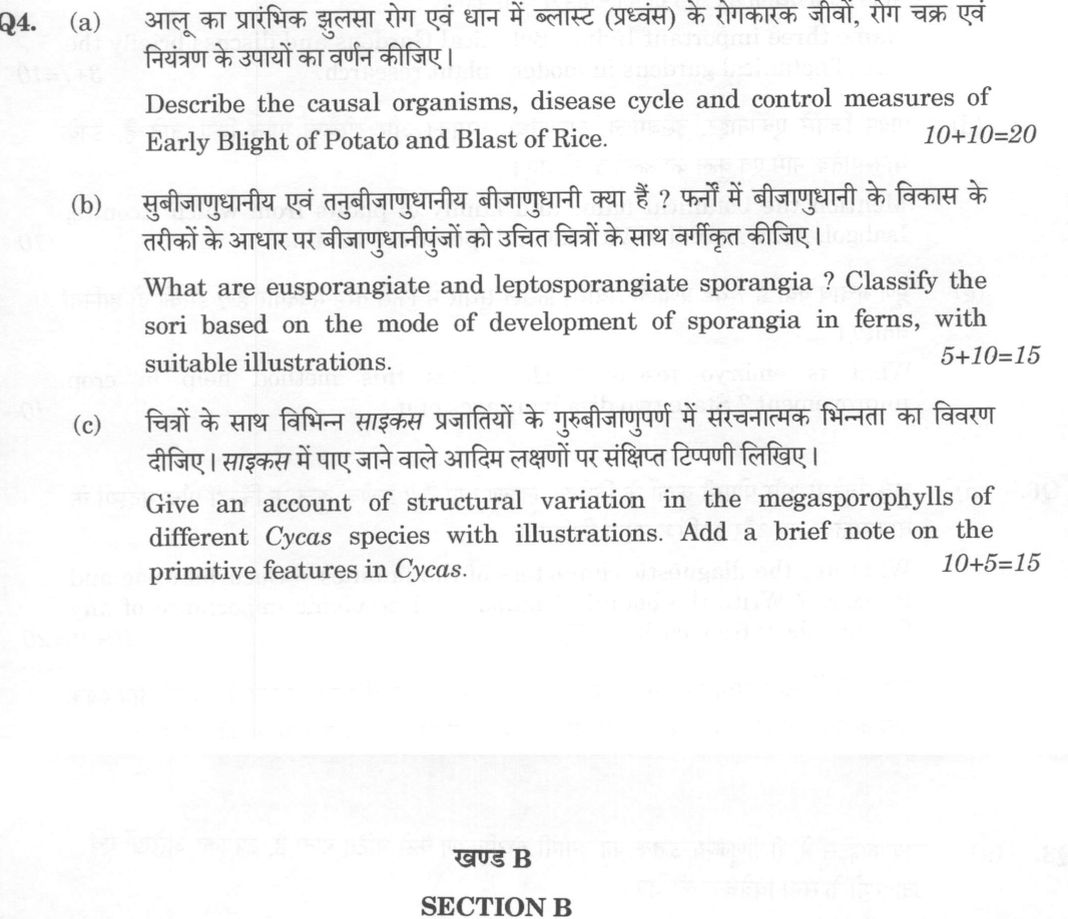
Describe the causal organisms, disease cycle and control measures of Early Blight of Potato and Blast of Rice. 10+10=20
What are eusporangiate and leptosporangiate sporangia ? Classify the sori based on the mode of development of sporangia in ferns, with suitable illustrations. 5+10=15
Give an account of structural variation in the megasporophylls of different Cycas species with illustrations. Add a brief note on the primitive features in Cycas. 10+5=15
हिंदी में प्रश्न पढ़ें
आलू का प्रारंभिक झुलसा रोग एवं धान में ब्लास्ट (प्रदंश) के रोगकारक जीवों, रोग चक्र एवं नियंत्रण के उपायों का वर्णन कीजिए। 10+10=20
सुबीजाणुधानीय एवं तनुबीजाणुधानीय बीजाणुधानी क्या है ? फर्नों में बीजाणुधानी के विकास के तरीकों के आधार पर बीजाणुधानीपुंजों को उचित चित्रों के साथ वर्गीकृत कीजिए। 5+10=15
चित्रों के साथ विभिन्न साइकस प्रजातियों के गुरुबीजाणुपर्ण में संरचनात्मक भिन्नता का विवरण दीजिए। साइकस में पाए जाने वाले आदिम लक्षणों पर संक्षिप्त टिप्पणी लिखिए। 10+5=15
Model answer
Written by UPSC Answer Check against this question's marking rubric, to the expected length. UPSC does not publish answers for Mains — this is one way to score well, not an official key.
Part (a): Early Blight of Potato and Blast of Rice
Early Blight of Potato is caused by the fungus Alternaria solani. The causal organism produces conidiophores that are branched, septate, and dark brown, bearing obpyriform conidia with transverse and longitudinal septa. The disease cycle begins with primary infection from infected seed tubers or crop debris overwintering in the soil. Under favorable conditions (15–25°C and high humidity), spores germinate and infect leaves via stomata or wounds. Secondary infection occurs rapidly through wind-borne conidia, leading to characteristic concentric ringed lesions ("target spots") on leaves and tubers. Control measures include planting certified disease-free seed tubers, crop rotation with non-hosts, and removal of infected debris. Chemical control involves the application of mancozeb or chlorothalonil at 7–10 day intervals. Resistant varieties such as Kufri Jyoti and Kufri Bahar are recommended for cultivation.
Blast of Rice is caused by the fungus Magnaporthe oryzae (syn. Pyricularia oryzae). The pathogen produces pyriform, two-celled conidia on conidiophores. Infection requires the formation of appressoria, which penetrate the rice cuticle. The disease cycle involves primary infection from overwintering mycelium in stubble or seed, followed by secondary spread via wind-dispersed conidia. High humidity, moderate temperatures (20–30°C), and excess nitrogen application favor disease development. Symptoms include diamond-shaped lesions on leaves, neck blast causing head drop, and node blast leading to lodging. Control strategies emphasize the use of resistant varieties like BRRI dhan47 or IR64 (depending on local pathogen races), avoiding excess nitrogen, and maintaining proper water management. Fungicides such as carbendazim or isoprothiolane are applied at the tillering and booting stages. Biological control using Trichoderma species can also be integrated into management.
Part (b): Eusporangiate and Leptosporangiate Sporangia
Eusporangiate sporangia develop from a group of superficial cells (initials) on the surface of the sporophyll. They are characterized by a thick, multi-layered wall and produce a large number of spores. The annulus, a row of specialized cells involved in sporangial dehiscence, is typically absent or rudimentary. Examples include the sporangia of Marattia and Danaea. In contrast, leptosporangiate sporangia arise from a single superficial cell (the sporogenous initial). They have a thin, single-layered wall and produce a limited number of spores. A distinct annulus is present, facilitating explosive spore release. This type is characteristic of most ferns, such as Dryopteris and Polypodium.
Based on the mode of sporangia development, sori in ferns are classified as follows:
- Eusporangiate Sori: These are typically coenosori (clusters of sporangia) or synangia (fused sporangia). In Marattia, the sori are large, coenosori-like structures located on the abaxial surface of the pinnae. In Danaea, the sporangia are arranged in synangia.
- Leptosporangiate Sori: These are further categorized based on the presence of an indusium.
- Indusiate Sori: Covered by a protective flap called an indusium. In Dryopteris, the indusium is a single, cup-shaped structure (unilateral). In Polypodium, the indusium is absent, making them nude sori.
- Nude Sori: Lacking an indusium. In Polypodiaceae, sori are often round and arranged in rows along the veins.
- Compound Sori: In some ferns like Asplenium, the sori are elongated and may appear compound due to the fusion of individual sporangia.
**Part (c): Structural Variation in Megasporophylls of *Cycas***
The megasporophylls of Cycas species exhibit significant structural variation. In C. circinalis, the megasporophylls are broad, pinnate, and bear distinct, large ovules on the abaxial surface. The ovules are subtended by a bract-like structure. In C. revoluta, the megasporophylls are narrower, with more numerous ovules arranged in a dense cluster. The ovules are smaller and more compact. C. beddomei features compact megasporophylls with overlapping scales, providing protection to the developing ovules. C. rumphii displays intermediate forms, with megasporophylls that are moderately broad and ovules that are less densely packed than in C. revoluta.
**Primitive Features in *Cycas*** Cycas retains several primitive features linking it to ferns and early seed plants. These include:
- Motile Sperms: The male gametes are flagellated and require water for fertilization, a characteristic of bryophytes and pteridophytes.
- Ovule Structure: The ovule is essentially a megasporangium surrounded by an integument, resembling the structure in ferns.
- Absence of Pollen Tube: Fertilization occurs via a pollen tube in some species, but in many Cycas species, the pollen grains release motile sperms directly, bypassing the need for a pollen tube.
- Leaf Morphology: The foliage leaves are large, pinnate, and resemble fern fronds, showing a fern-like morphology.
- Circinate Vernation: Young foliage leaves exhibit circinate vernation (coiled tip), a feature common in ferns. Note that megasporophylls do not show circinate vernation; this feature is restricted to the young foliage leaves.
In conclusion, Cycas serves as a crucial link in the evolutionary history of seed plants, retaining ancestral traits while exhibiting adaptations for terrestrial life.
What "Describe" is asking you to do
Give a full, ordered account of the thing named — its parts, stages or mechanism — in the sequence in which it actually exists or occurs. Most describe questions come from the science optionals, where the marks sit in correct technical detail and, where the stem says so, a labelled diagram.
Structure that answers it
One-line identification of the subject → the parts or stages in their real order, each with its defining detail → labelled diagram where the subject is structural → closing line on function or significance
Where marks are lost
Loose general prose where the examiner is ticking named parts, correct terminology and their sequence; and in the General Studies papers, turning to evaluation before the description is finished.
How this answer will be evaluated
Approach
Framework: Botany Paper 1: Define > Structure/Process > Labelled Diagram > Significance. (a) describe: define > structure or process in order > labelled diagram > significance | (b) describe: define > structure or process in order > labelled diagram > significance | (c) describe: define > structure or process in order > labelled diagram > significance Full marks: Precise binomials, clear labelled diagrams, stepwise cycles, specific control measures, and detailed structural comparisons.
Key points expected
- *Alternaria solani* and *Magnaporthe oryzae*
- Eusporangiate vs. leptosporangiate sporangia
- Sori classification in ferns
- *Cycas* megasporophyll structural variation
- Primitive features in *Cycas*
Evaluation rubric
Each sub-part is marked on its own, against the marks and word limit printed on the paper.
- (a) Causal agents, disease cycles, and control for Early Blight of Potato and Blast of Rice. 20 marks
describe— define → structure or process in order → labelled diagram → significance
Must cover
- Early Blight: *Alternaria solani*, cycle, control
- Blast: *Magnaporthe oryzae*, cycle, control
- Labelled diagram of disease cycle
- Specific control measures for both
Loses marks
- Unlabelled diagrams
- Loose common names instead of binomials
Earns more
- Mention of *Pyricularia oryzae* (anamorph)
- Specific fungicide names
- Cultural control details
Extra mark
- Recent biotech application (e.g., transgenic resistance)
- (b) Definitions of eusporangiate/leptosporangiate sporangia and classification of sori by development mode. 15 marks
describe— define → structure or process in order → labelled diagram → significance
Must cover
- Definition of eusporangiate sporangia
- Definition of leptosporangiate sporangia
- Classification of sori based on development
- Suitable illustrations of sori types
Loses marks
- Unlabelled diagrams
- Confusing sporangia types
Earns more
- Mention of *Pteridium* (eusporangiate)
- Mention of *Adiantum* (leptosporangiate)
- Details of indusium types
Extra mark
- Evolutionary significance of sporangia types
- (c) Structural variation in *Cycas* megasporophylls and primitive features. 15 marks
describe— define → structure or process in order → labelled diagram → significance
Must cover
- Structural variation in *Cycas* megasporophylls
- Illustrations of different *Cycas* species
- Primitive features in *Cycas*
- Comparison of megasporophyll structures
Loses marks
- Unlabelled diagrams
- Lack of specific species names
Earns more
- Mention of *Cycas revoluta*
- Mention of *Cycas circinatis*
- Details of ovule structure
Extra mark
- Conservation status of *Cycas* species
Practice this exact question
Write your answer and it is marked point by point against the model answer above — what you covered, what you missed, what you got wrong.
Evaluate my answer →More from Botany 2025 Paper I
- Q1 Answer the following questions in about 150 words each: (a) How many types of gametophyte…
- Q2 (a) Enumerate the types of fruiting bodies of Ascomycota and Basidiomycota. Write the var…
- Q3 (a) Discuss how progressive sterilization of sporogenous tissue occurs in bryophytes, wit…
- Q4 (a) Describe the causal organisms, disease cycle and control measures of Early Blight of…
- Q5 Answer the following questions in about 150 words each: (a) Give an account of post-ferti…
- Q6 (a) What are the diagnostic characters of the families – Cucurbitaceae and Poaceae ? Writ…
- Q7 (a) Write the botanical name, family, morphology of useful parts and uses of the followin…