Paper II — Q1
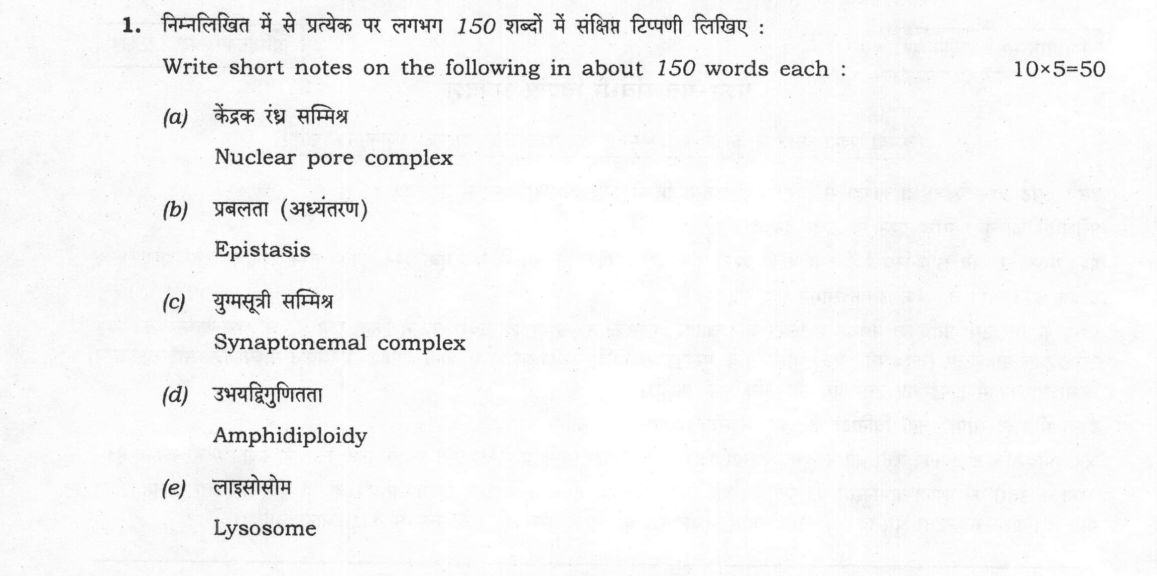
Write short notes on the following in about 150 words each: (a) Nuclear pore complex (10 marks) (b) Epistasis (10 marks) (c)…
Write short notes on the following in about 150 words each:
Nuclear pore complex 10 marks
Epistasis 10 marks
Synaptonemal complex 10 marks
Amphidiploidy 10 marks
Lysosome 10 marks
हिंदी में प्रश्न पढ़ें
निम्नलिखित में से प्रत्येक पर लगभग 150 शब्दों में संक्षिप्त टिप्पणी लिखिए :
केन्द्रक छिद्र सम्मिश्र (10 अंक)
प्रभलता (अर्थतरण) (10 अंक)
युग्मसूत्री सम्मिश्र (10 अंक)
उभयद्विगुणितता (10 अंक)
लाइसोसोम (10 अंक)
Model answer
Written by UPSC Answer Check against this question's marking rubric, to the 150-word length. UPSC does not publish answers for Mains — this is one way to score well, not an official key.
(a) Nuclear Pore Complex
The nuclear pore complex (NPC) is a massive macromolecular assembly (molecular mass of approximately 125 MDa in vertebrates) that perforates the double membrane of the nuclear envelope. It exhibits an eightfold rotational (octagonal) symmetry consisting of cytoplasmic filaments, outer rings, a central scaffold spanning both membranes, and a nucleoplasmic basket. The NPC is composed of roughly 30 distinct proteins termed nucleoporins (Nups), several of which line the central channel and display intrinsically disordered phenylalanine-glycine (FG) repeat motifs.
Functionally, the NPC regulates bidirectional nucleocytoplasmic transport. Ions and small metabolites (<40 kDa) undergo passive diffusion, whereas larger macromolecules (proteins, ribonucleoprotein complexes, mRNAs) are selectively transported via nuclear transport receptors (karyopherins: importins and exportins). Directionality and cargo release are governed by the asymmetric Ran-GTP/Ran-GDP gradient maintained across the nuclear envelope. NPC ensures nuclear compartmentalization and precise regulation of gene expression.
(b) Epistasis
Epistasis is a non-allelic gene interaction in which the phenotypic expression of an allele at one gene locus is masked, modified, or suppressed by the alleles of another independent gene locus. It leads to characteristic modifications of the classical Mendelian 9:3:3:1 dihybrid F2 ratio.
Major types include: Dominant epistasis (12:3:1), where a single dominant allele at the epistatic locus suppresses the hypostatic gene, seen in the fruit colour of Cucurbita pepo. Recessive epistasis or supplementary gene interaction (9:3:4), where homozygous recessive alleles mask both alleles of another locus, as observed in mammalian coat pigmentation. Duplicate recessive epistasis or complementary gene action (9:7), classically demonstrated by Bateson and Punnett in the flower colour of sweet pea (Lathyrus odoratus), where functional dominant alleles at two separate loci (C and P) are simultaneously required to produce purple anthocyanin pigment. Epistasis demonstrates that complex phenotypes arise from interactive biochemical pathways rather than strictly isolated single-gene actions.
(c) Synaptonemal Complex
The synaptonemal complex (SC) is a tripartite proteinaceous ultrastructure formed between homologous chromosomes during prophase I of meiosis to facilitate synapsis, crossing over, and chromosome segregation. Structurally, it consists of two parallel lateral elements (LE) flanking a central element (CE), bridged across a ~100 nm central space by transverse filaments (TF). The lateral elements assemble along chromosome axes via structural proteins SYCP2 and SYCP3, while transverse filaments are primarily composed of coiled-coil SYCP1 dimers that interact with the central element.
Assembly begins at the zygotene stage, reaches full maturation at pachytene when homologous chromosomes are tightly paired, and disassembles at diplotene. Along the central element, dense proteinaceous assemblies known as recombination nodules appear, coordinating the enzymatic machinery responsible for double-strand break repair and reciprocal crossing over. The SC prevents ectopic recombination, facilitates chiasma maturation, and prevents meiotic non-disjunction and aneuploidy.
(d) Amphidiploidy
Amphidiploidy is a specialized form of allopolyploidy wherein an interspecific or intergeneric F1 hybrid undergoes chromosome doubling, resulting in a synthetic, sexually fertile organism containing complete diploid chromosome sets from both parental species. In an ordinary F1 interspecific hybrid, sterility occurs due to the absence of homologous partners during meiotic prophase I, leading to univalents and abnormal segregation. Chromosome duplication (either spontaneously or induced via spindle inhibitors like colchicine) provides every chromosome with an exact homolog, restoring regular bivalent pairing, balanced gametogenesis, and fertility.
A classic synthetic example is Raphanobrassica (2n = 4x = 36), developed by G.D. Karpechenko through crossing radish (Raphanus sativus, 2n = 18, RR) and cabbage (Brassica oleracea, 2n = 18, BB). In nature, amphidiploidy plays a central evolutionary role in speciation; modern hexaploid bread wheat (Triticum aestivum, 2n = 6x = 42, AABBDD) evolved through successive natural hybridization and amphidiploidization events involving Triticum urartu, an *Aegilops speltoides*-related diploid, and Aegilops tauschii.
(e) Lysosome
The lysosome is a single-membrane-bound cytoplasmic organelle that functions as the principal acidic degradative compartment in eukaryotic cells. It contains over 50 soluble acid hydrolases—including proteases, nucleases, lipases, and glycosidases—that operate optimally at an acidic pH of 4.5 to 5.0. This low luminal pH is continuously maintained by a membrane-embedded vacuolar-type H⁺-ATPase (V-ATPase) proton pump. Newly synthesized lysosomal enzymes in the rough endoplasmic reticulum are post-translationally tagged in the cis-Golgi with a mannose-6-phosphate (M6P) recognition marker, directing them via M6P receptors to the endolysosomal system.
Physiologically, lysosomes mediate heterophagy (digesting extracellular cargo internalized by phagocytosis or endocytosis) and autophagy (clearing damaged organelles and cellular debris). Genetic mutations causing deficiencies in specific acid hydrolases result in lysosomal storage diseases (LSDs), characterized by the accumulation of undegraded substrates; notable examples include Tay-Sachs disease (hexosaminidase A deficiency) and Pompe disease (acid α-glucosidase deficiency).
What "Write short notes" is asking you to do
Five or six self-contained answers, marked separately, typically 10 marks and about 150 words each. Each note must carry its own definition, its two or three defining features and a line on why it matters; a common introduction or conclusion across the notes earns nothing.
Structure that answers it
Per note: one-line definition or identification → two or three features, mechanisms or named examples → one line of significance or Indian application
Where marks are lost
Writing the first two notes at essay length and rationing the rest. Each note is marked on its own, so marks surrendered on a compressed or unattempted note cannot be won back by the long ones.
How this answer will be evaluated
Approach
Framework: Botany Paper 2: Define > Structure/Process > Diagram > Significance. (a) write short notes: define > 3-4 key features > one example > one-line significance | (b) write short notes: define > 3-4 key features > one example > one-line significance | (c) write short notes: define > 3-4 key features > one example > one-line significance | (d) write short notes: define > 3-4 key features > one example > one-line significance | (e) write short notes: define > 3-4 key features > one example > one-line significance Full marks: Precise definitions, accurate structural details, relevant examples, and clear diagrams.
Key points expected
- Definition of Nuclear Pore Complex
- Mention of cytoplasmic and nuclear rings
- Description of central channel/transport
- Significance in nucleocytoplasmic exchange
- Definition of Epistasis
- Distinction from dominance
- Example of dominant/recessive epistasis
- Mention of modified Mendelian ratios
Evaluation rubric
Each sub-part is marked on its own, against the marks and word limit printed on the paper.
- (a) Define NPC, describe structure, and explain transport function. · 150 words
write short notes— define → 3-4 key features → one example → one-line significance
Must cover
- Definition of Nuclear Pore Complex
- Mention of cytoplasmic and nuclear rings
- Description of central channel/transport
- Significance in nucleocytoplasmic exchange
Loses marks
- Confusing NPC with nuclear envelope
- Omitting the transport function
Earns more
- Mention of FG-nucleoporins
- Reference to selective transport
- Labelled diagram of NPC
Extra mark
- Mention of specific transport receptors (karyopherins)
- (b) Define epistasis and explain gene interaction types. · 150 words
write short notes— define → 3-4 key features → one example → one-line significance
Must cover
- Definition of Epistasis
- Distinction from dominance
- Example of dominant/recessive epistasis
- Mention of modified Mendelian ratios
Loses marks
- Confusing epistasis with linkage
- Failing to mention modified ratios
Earns more
- Specific example (e.g., *Mendel's peas* or *Drosophila*)
- Mention of 9:3:4 or 12:3:1 ratios
- Diagram of gene interaction pathway
Extra mark
- Reference to specific crop trait (e.g., seed color)
- (c) Define synaptonemal complex and its role in meiosis. · 150 words
write short notes— define → 3-4 key features → one example → one-line significance
Must cover
- Definition of Synaptonemal Complex
- Mention of prophase I (pachytene)
- Description of lateral elements/central element
- Role in homologous chromosome pairing
Loses marks
- Confusing SC with spindle fibers
- Omitting the meiotic stage
Earns more
- Mention of recombination/crossing over
- Labelled diagram of SC
- Mention of synapsis process
Extra mark
- Reference to specific proteins (e.g., SYCP1)
- (d) Define amphidiploidy and explain its formation. · 150 words
write short notes— define → 3-4 key features → one example → one-line significance
Must cover
- Definition of Amphidiploidy (allopolyploidy)
- Mention of hybridization + chromosome doubling
- Explanation of fertility restoration
- Example of an amphidiploid species
Loses marks
- Confusing with autopolyploidy
- Failing to explain fertility mechanism
Earns more
- Mention of *Triticum aestivum* (bread wheat)
- Mention of *Gossypium hirsutum* (cotton)
- Diagram of formation process
Extra mark
- Reference to specific biotech application
- (e) Define lysosome and describe its functions. · 150 words
write short notes— define → 3-4 key features → one example → one-line significance
Must cover
- Definition of Lysosome
- Mention of hydrolytic enzymes
- Description of autophagy/heterophagy
- Significance in cellular digestion
Loses marks
- Confusing with peroxisome
- Omitting the enzyme content
Earns more
- Mention of acid hydrolases
- Labelled diagram of lysosome
- Mention of phagocytosis
Extra mark
- Reference to specific storage diseases (e.g., Tay-Sachs)
Practice this exact question
Write your answer and it is marked point by point against the model answer above — what you covered, what you missed, what you got wrong.
Evaluate my answer →More from Botany 2025 Paper II
- Q1 Write short notes on the following in about 150 words each: (a) Nuclear pore complex (10…
- Q2 (a) What are the different methods of DNA sequencing? Elaborate the shotgun sequencing me…
- Q3 (a) Elucidate the molecular basis of sex determination in plants. Explain the role of hom…
- Q4 (a) What is organic evolution? Discuss in detail the indirect evidences of organic evolut…