Paper II — Q4
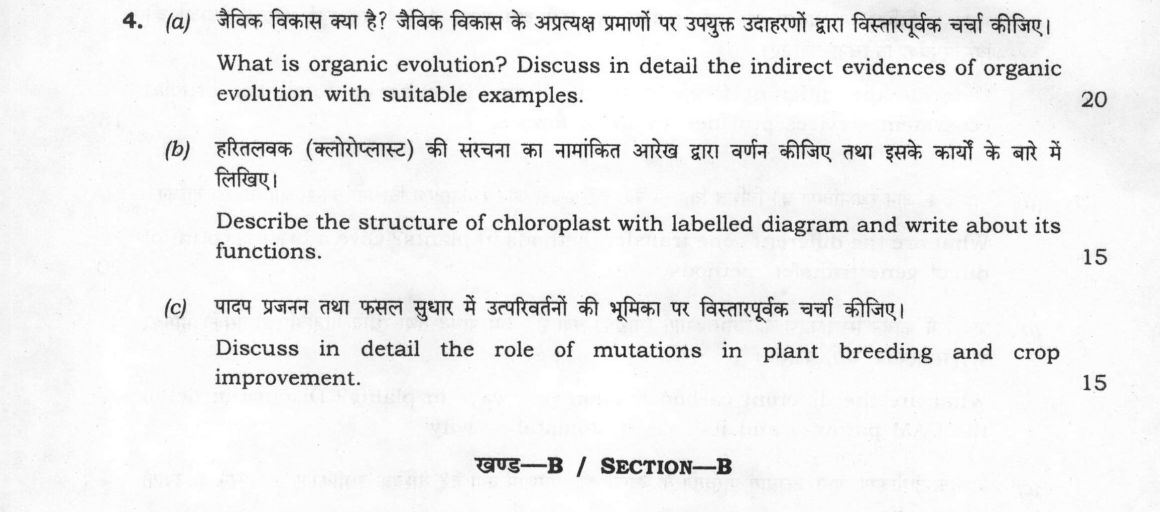
(a) What is organic evolution? Discuss in detail the indirect evidences of organic evolution with suitable examples. (20…
What is organic evolution? Discuss in detail the indirect evidences of organic evolution with suitable examples. 20 marks
Describe the structure of chloroplast with labelled diagram and write about its functions. 15 marks
Discuss in detail the role of mutations in plant breeding and crop improvement. 15 marks
हिंदी में प्रश्न पढ़ें
जैविक विकास क्या है? जैविक विकास के अप्रत्यक्ष प्रमाणों पर उपयुक्त उदाहरणों द्वारा विस्तारपूर्वक चर्चा कीजिए। (20 अंक)
हरितलवक (क्लोरोप्लास्ट) की संरचना का नामांकित आरेख द्वारा वर्णन कीजिए तथा इसके कार्यों के बारे में लिखिए। (15 अंक)
पादप प्रजनन तथा फसल सुधार में उत्परिवर्तनों की भूमिका पर विस्तारपूर्वक चर्चा कीजिए। (15 अंक)
Model answer
Written by UPSC Answer Check against this question's marking rubric, to the expected length. UPSC does not publish answers for Mains — this is one way to score well, not an official key.
Organic Evolution and Plant Improvement
Organic evolution is defined as descent with modification, where populations change over generations through natural selection acting on heritable variation. While direct observation of speciation is rare, indirect evidences provide a robust framework for understanding this process.
Indirect Evidences of Evolution Morphological evidence distinguishes between homologous and analogous structures. Homologous organs share a common origin but differ in function, such as the forelimbs of humans, bats, and whales. In contrast, analogous organs have different origins but similar functions, exemplified by the wings of birds and insects. A common error is citing Rhizophora stilt roots and Avicennia pneumatophores as analogous; they are both root modifications (homologous) serving different functions (support vs. aeration), not convergent structures from unrelated lineages. Embryological evidence relies on von Baer’s laws, which state that early embryos of related species resemble one another more than their adults. Haeckel’s biogenetic law (ontogeny recapitulates phylogeny) is discredited and should not be cited as valid modern evidence. Palaeontological records, such as the fossil horse sequence, illustrate branching radiation rather than a linear progression; Hyracotherium (formerly Eohippus) represents an early branch, not the sole ancestor of Equus. In India, Birbal Sahni’s work on Glossopteris flora provided critical evidence for Gondwana continental drift, linking South American and Indian floras.
Chloroplast Structure and Function The chloroplast is a double-membrane-bound organelle containing the stroma and the thylakoid system. The thylakoids are organized into stacks called grana and unstacked stroma lamellae. Key components include 70S ribosomes, circular DNA, and plastoglobuli for lipid storage.
[Labelled Diagram: Double envelope, stroma, grana stacks, stroma lamellae, thylakoid lumen, DNA, 70S ribosomes]
Functionally, the light reactions occur in the thylakoid membranes. The Z-scheme involves Photosystem II (PSII) and Photosystem I (PSI). Photophosphorylation yields ATP, while NADPH is produced by the light-driven reduction of NADP+ at PSI; it is inaccurate to state that photophosphorylation yields NADPH. The Calvin cycle operates in the stroma, fixing CO2 into sugars. Chloroplasts also engage in retrograde signaling, communicating stress signals to the nucleus.
Role of Mutations in Plant Breeding Mutations provide the raw material for crop improvement. Gene mutations include point mutations (transitions/transversions) and frameshifts. Chromosomal mutations involve deletions, duplications, inversions, and translocations, while genomic mutations include polyploidy. Mutations can be spontaneous or induced via physical agents (gamma rays, UV) or chemical agents (EMS, sodium azide).
In Indian crop improvement, mutation breeding has been highly successful for monogenic or oligogenic traits. For instance, EMS-induced mutants have led to TNAU rice varieties with improved yield and disease resistance. Gamma-ray irradiation produced the wheat variety Sharbati Sonora, and BARC has developed groundnut varieties with enhanced oil content. However, mutation breeding is less effective for polygenic abiotic stress tolerances (like drought or salinity), which are difficult to improve through mutation alone due to complex genetic architectures. Limitations include pleiotropy, chimeras, and linkage drag.
Conclusion Evolutionary mechanisms and cellular innovations are intrinsically linked. The endosymbiotic origin of chloroplasts provides an evolutionary basis for organelle genetics, while mutation provides the variability necessary for artificial selection. By understanding these processes, plant breeders can mimic natural selection to develop resilient crops, though a balanced approach combining mutation breeding with molecular tools is essential for addressing complex polygenic challenges.
What "Discuss" is asking you to do
Lay the issue out from more than one side — how it arose, what is claimed for it, what is held against it, and where it now stands. UPSC attaches discuss to broad topics with several live dimensions, so coverage of the dimensions earns more than the strength of your opinion.
Structure that answers it
Set the issue up → the case as it is made → the case against → the dimension both sides leave out → where the balance now lies
Where marks are lost
Listing facts with no thread between them, or arguing one side throughout and calling it a discussion.
How this answer will be evaluated
Approach
(a) discuss: intro > 3-4 dimensions > example > balanced close | (b) describe: define > structure or process in order > labelled diagram > significance | (c) discuss: intro > 3-4 dimensions > example > balanced close Full marks: Comprehensive coverage of all points with specific examples, clear diagrams, and accurate terminology.
Key points expected
- Definition of organic evolution (descent with modification)
- Fossil evidence with specific examples (e.g., *Horse*, *Whale*)
- Comparative anatomy (homologous/analogous organs)
- Molecular evidence (DNA/protein homology)
- Labelled diagram of chloroplast
- Description of outer/inner membranes and stroma
- Description of thylakoids, grana, and lamellae
- Functions: Photosynthesis (light/dark reactions)
Evaluation rubric
Each sub-part is marked on its own, against the marks and word limit printed on the paper.
- (a) Definition of organic evolution and detailed discussion of indirect evidences with examples. 20 marks
discuss— intro → 3-4 dimensions → example → balanced close
Must cover
- Definition of organic evolution (descent with modification)
- Fossil evidence with specific examples (e.g., *Horse*, *Whale*)
- Comparative anatomy (homologous/analogous organs)
- Molecular evidence (DNA/protein homology)
Loses marks
- Confusing direct (observation) with indirect evidence
- Lack of specific examples for evidence types
- Vague definition of evolution
Earns more
- Embryological evidence (Haeckel's recapitulation)
- Biogeographical evidence (Darwin's finches)
- Vestigial organs (e.g., coccyx, wisdom teeth)
Extra mark
- Mention of specific molecular clock data
- Reference to specific fossil sites (e.g., La Brea Tar Pits)
- (b) Structure of chloroplast with labelled diagram and its functions. 15 marks
describe— define → structure or process in order → labelled diagram → significance
Must cover
- Labelled diagram of chloroplast
- Description of outer/inner membranes and stroma
- Description of thylakoids, grana, and lamellae
- Functions: Photosynthesis (light/dark reactions)
Loses marks
- Unlabelled or missing diagram
- Confusing chloroplast with mitochondria structure
- Omitting the function of grana
Earns more
- Mention of chlorophyll pigments (a, b, carotenoids)
- Mention of DNA/Ribosomes in stroma
- Distinction between stroma and thylakoid lumen
Extra mark
- Mention of specific pigment absorption spectra
- Reference to specific plant species chloroplasts
- (c) Detailed discussion on the role of mutations in plant breeding and crop improvement. 15 marks
discuss— intro → 3-4 dimensions → example → balanced close
Must cover
- Definition of mutation in plant breeding context
- Induced mutation techniques (radiation, chemicals)
- Examples of improved crops (e.g., *Sorghum*, *Barley*)
- Advantages over traditional hybridization
Loses marks
- Confusing mutation with transgenic modification
- Lack of specific crop examples
- Ignoring the mechanism of induced mutations
Earns more
- Mention of specific mutagens (EMS, Gamma rays)
- Discussion of mutation breeding history (e.g., *Sorghum* in India)
- Comparison with genetic engineering
Extra mark
- Specific cultivar names (e.g., *S-28* sorghum)
- Reference to recent mutation breeding successes
Practice this exact question
Write your answer and it is marked point by point against the model answer above — what you covered, what you missed, what you got wrong.
Evaluate my answer →More from Botany 2025 Paper II
- Q1 Write short notes on the following in about 150 words each: (a) Nuclear pore complex (10…
- Q2 (a) What are the different methods of DNA sequencing? Elaborate the shotgun sequencing me…
- Q3 (a) Elucidate the molecular basis of sex determination in plants. Explain the role of hom…
- Q4 (a) What is organic evolution? Discuss in detail the indirect evidences of organic evolut…
- Q5 Write short notes on the following in about 150 words each: (a) Tests of significance (10…
- Q6 (a) What are transgenic crops? Discuss the prospects and risks involved in their cultivat…
- Q7 (a) What are the different gene transfer methods in plants? Give a brief account of direc…